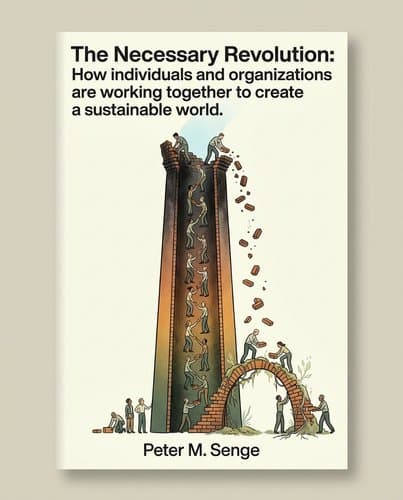
2809179_the-necessary-revolution
by Peter M. Senge
The Industrial Age is a bubble built on invisible assumptions—and escaping it requires not better technology, but three human capabilities: seeing whole…
In Brief
The Necessary Revolution: How individuals and organizations are working together to create a sustainable world. (2008) argues that the Industrial Age runs on flawed assumptions about energy, waste, and growth — and that fixing it requires three human capabilities: seeing whole systems, collaborating across unusual boundaries, and choosing to create rather than react.
Key Ideas
Connect Problems Before Designing Solutions
When you encounter any major sustainability problem, look for connections to others before designing a response — isolated solutions regularly create new problems downstream because the crises share root causes in Industrial Age assumptions about energy, waste, and growth.
Include Marginalized Voices in System Change
Before convening a sustainability initiative, ask whose voice is structurally missing — the supply chain workers, downstream communities, and NGO critics who bear costs but have no seat at the table. Genuine systems change requires 'the whole system in the room,' not just the stakeholders who already agree with you.
Replace Advocacy with Genuine Inquiry Questions
When the urge to advocate strikes, replace predictions and arguments with genuine inquiry: 'What are the implications for our organization if we're wrong about this?' Inquiry opens conversation; advocacy closes it. The distinction between advocate and animateur is the difference between pushing and asking.
Prototype Creates Vision Better Than Presentations
Build a prototype before building consensus — find the smallest thing you can make real that people can physically visit and say 'if they can do it, we can do it.' Vision travels through prototypes, not presentations, and the modesty of the prototype is part of its power.
Find Competitive Advantage in Future Quadrants
Map your organization's sustainability initiatives on a 2×2 grid (internal/external × today/future) and notice where the investments cluster. Most will sit in the lower-left (internal cost reduction). The upper-right quadrant — where disruptive technologies meet systemic global challenges — is where competitive advantage is being built.
Maintain Creative Tension, Never Lower Vision
When the gap between your vision and current reality becomes unbearable, resist the temptation to lower the vision. Name the fear or discouragement as one more dimension of current reality to be told the truth about — that is what keeps creative tension alive rather than collapsing into resignation.
Public Questions Unlock Collective Intelligence
Ask for help publicly before you know how to achieve your goal. John Browne committed BP to Kyoto targets in a 1997 speech, then wrote to 350 employees asking for their ideas. The result: hundreds of millions in savings the company hadn't imagined. Asking unlocks collective intelligence that advocacy and planning never reach.
Who Should Read This
Business operators, founders, and managers interested in Sustainability and Climate Change who want frameworks they can apply this week.
The Necessary Revolution: How individuals and organizations are working together to create a sustainable world.
By Peter M. Senge & Bryan Smith & Sara Schley & Joe Laur & Nina Kruschwitz & Ted Barker
8 min read
Why does it matter? Because every crisis you're trying to fix is a symptom of the same design failure.
Watch any news cycle long enough and you'll notice something strange: the climate summit, the water shortage report, the food price spike, and the financial contagion all arrive in separate windows, addressed by separate ministries, funded by separate budgets, narrated by separate experts who never quite talk to each other. The world feels like it's failing in six directions at once. What if that fragmentation isn't a communication problem — it's a symptom? The crises aren't separate. They share a common root: a set of assumptions about energy, waste, growth, and human purpose so old and so pervasive that we've stopped recognizing them as assumptions at all. This book names those assumptions. More usefully, it introduces the people already replacing them — not with better technology or louder advocacy, but with something they all seem to share: a recognizable way of seeing, a recognizable way of connecting, and a recognizable way of creating.
You're Not Facing Seven Crises — You're Inside One Failing System
Imagine seven hospitals treating seven outbreaks across a city: respiratory illness in one district, contaminated water in another, failing crops in a third. Each gets its own specialist, its own budget, its own task force. Nobody stops to ask whether all seven districts share the same water supply.
That's roughly what the authors of The Necessary Revolution describe. We've built separate policies and separate experts for water scarcity, climate change, food insecurity, and ecosystem collapse, as though they share no common origin. They do: the core assumptions of the Industrial Age itself.
A mill owner in Manchester in 1850 wasn't wrong to hold these assumptions. Coal had just multiplied what human muscle could do a hundredfold. Energy felt inexhaustible. Waste disappeared into rivers and sky without visible effect. Markets, in living memory, had doubled life expectancy and pushed literacy from 20% to over 90%. When a system generates that kind of abundance, you don't interrogate its long-run logic.
The corn ethanol story shows what happens when you treat a symptom without touching the system. Facing oil dependence, U.S. policymakers scaled up corn-based ethanol as a domestic alternative. By 2008, nearly 200 ethanol plants were operating or under construction, vast acreage shifted to corn, and food prices rose globally as grain redirected to fuel tanks. Then the accounting got complicated: greenhouse gas emissions from corn ethanol were roughly equivalent to gasoline, and when you factored in the forests and grasslands that farmers worldwide cleared to grow more corn in response to higher prices, the net effect may have worsened emissions. A fix for oil dependence that accelerated the problem it was meant to solve. The system that produced oil dependence kept generating the same pressures from a different angle.
The book's central argument is that this pattern isn't an accident of bad policy or corporate greed. It's structural. The Industrial Age was built with assumptions that made sense for a world of apparent abundance and limited interdependence. That world no longer exists. No number of single-issue fixes, however sincere, can reach a problem that lives in the design itself. The design persists because, from inside it, the assumptions feel locally rational — a company that unilaterally prices in environmental costs loses to competitors who don't. The structure rewards acting as though limits don't exist, which is what makes seeing the structure clearly the harder, more interesting problem.
It's Not Greed That Destroys Shared Resources — It's the Information Nobody Thinks to Share
At a corporate sustainability workshop for Harley-Davidson's management team, before the game even started, the Harley team laid down a condition: every fishing company at the table had to agree to share their total catch numbers each year. No one had asked for this. The game didn't require it. They just wouldn't start without it.
The game is Fish Banks, Ltd., a simulation running since the 1980s, played by thousands of groups worldwide — corporate executives, government agencies, environmental advocates. Teams run competing fishing companies with boats, budgets, and information about how quickly fish populations regenerate. The goal is simple: maximize profits. After more than two decades of play, the result is nearly universal: teams overfish, the fishery collapses, and everyone ends up poorer than if they'd held back. This holds even for environmental watchdog organizations who came in already knowing the point. Strip out corrupt governments and short-sighted investors, leave only ordinary people in a competitive structure, and the destruction happens anyway.
The Harley game went differently. Their precondition gave every team visibility into the one number that mattered: total catch across the entire fishery. They also chose, each year, to announce whether they planned to expand their fleet — disclosure nobody required. Others gradually followed. The fishery never collapsed. Every team made more money than the most profitable teams in games that ended in ruin. Fish stocks grew to full carrying capacity.
The difference was purely structural: who could see what, and when. Without shared totals, each team worked from its own numbers alone — and from those numbers, fishing harder before competitors did was always the rational move. That logic holds perfectly inside the bubble it creates. It just misses the larger system everyone is embedded in.
After students played classroom versions and collapsed their fisheries, Jaimie Cloud, a sustainability curriculum designer, asked them to explain their choices. Their answers were ordinary: there will always be fish; if others are doing it, I'd be stupid not to; the market will sort it out. Each of these beliefs made perfect sense inside the competitive information bubble the game creates. Each has felt true for generations.
That's the problem: a bubble of assumptions that has worked for two centuries is exactly the kind you can't see from inside.
The Harder You Push for Sustainability, the More You Entrench the Opposition
Monday morning, a major electric utility's management team meeting. Ted, the VP of Environment, demands the company reallocate 30% of next year's capital budget to renewables — now, before peak oil makes the current strategy untenable. Joanne from Operations counters: there's still plenty of coal, price spikes are cyclical, and companies that panic into large bets don't survive them. Stan from Public Affairs reinforces Ted's alarm: carbon taxes are coming, Chinese coal plants are already sparking riots. Robert, the CEO (thirty years with this company, one of the most successful tenures in its eighty-year history), cuts it off. He's seen issues like this come and go his whole career. Signals are mixed. He's late for his next meeting.
Almost everyone leaves frustrated. The sustainability advocates feel stonewalled by someone who just doesn't get the big picture. Robert privately concludes Ted and Stan have become single-issue advocates who've lost perspective on the actual business. The harder Ted pushes next time — and he will — the more firmly the opposition holds.
The book calls this the advocate-opposer trap, and argues it's one of the primary reasons sustainability never reaches the core of most business strategies. The people who care most about the problem generate the most entrenched resistance to solving it. Their instinct is to predict dire consequences and push for large financial commitments based on those predictions. That move activates the executives and operators whose job is precisely to guard against large bets on uncertain forecasts. Both sides stop inquiring and start competing to win.
The one productive moment in that meeting comes from Anthony, the strategy VP: what are the implications for the company if the CEO's assumptions about energy and climate turn out to be wrong? That question opens risk assessment rather than predicting outcomes, and even Robert has to engage with it, because assessing company risk is his actual job.
Anthony, without knowing it, was doing animateur work. Animateur is a French term for someone who breathes life into a conversation rather than dominating it. The move isn't to convert Robert. It's to understand why his thirty-year record was built on holding steady when others overreacted, and then ask the one question that record can't answer on its own: has the world changed enough that his steadiness is still the right bet?
Most People Can't Imagine a Different Future Until Someone Builds One They Can Touch
What does it take to spread a new idea across an entire country? The intuitive answer is persuasion: clearer data, more compelling presentations. Per Carstedt spent a decade learning that answer was wrong.
Carstedt is a Ford car dealer in northern Sweden who spent the 1990s building a biofuel economy through personal relationships and small consecutive bets. He imported the first flexi-fuel cars, persuaded gas stations one at a time, and often financed the pump installations himself. By August 2007, Sweden had 1,000 ethanol fueling stations, a quarter of the national network. "The first 100 stations took ten years," he says. "Nowadays we add 100 every three months."
None of that acceleration came from better arguments. It came from a structure you could walk through.
In 1997, Carstedt partnered with architect Anders Nyquist to design the most energy-efficient car dealership possible. The project grew into what they called the Green Zone: three ordinary businesses — Carstedt's dealership, a McDonald's, and a gas station — wired together so heat from the restaurant kitchens flowed directly into the dealership and filling station. Energy consumption fell more than 80 percent. The technologies weren't exotic; most were already available off the shelf.
Between 2000 and 2006, the Green Zone drew more than 500 official study visits. When a Japanese film crew arrived having traveled halfway around the world to film it, something clicked for Carstedt: "A lot of my talks about biofuels, climate change, and the whole-systems approach were too theoretical for most people." He'd been trying to spread ideas through words. What actually spread them was a place visitors could walk through, touch, and then go home and describe to their own communities with the phrase that does real work: if they can do it, we can do it.
The Partnership You've Been Avoiding Is Probably the Only One That Can Work
The bus from Xian had been moving through the Chinese countryside for four and a half hours when C.B. Chiu mentioned that he had never been this far outside a city. He was a 27-year Coca-Cola veteran, born in Hong Kong, living in Shanghai — a man who had spent his career inside one of the largest commercial distribution systems on earth. He was heading to a remote mountain nature preserve for a joint planning meeting between Coke's China team and WWF, both organizations still figuring out what working together actually meant. The facilities were basic: rustic cabins, outdoor plumbing. The food was grown by local farming families whose livelihoods depended on protecting the watershed.
Over three days, the group hiked ridges, visited families who had worked that land for four generations, and ate lunch in front yards. On the final evening, after local villagers organized karaoke, Chiu stood and offered a toast. He wanted the Yangtze to become WWF's flagship global river project. He wanted the group to visit the largest Coke bottling plant in China and work together on carbon footprints. The WWF coordinator who had arrived uncertain left convinced the partnership would hold.
Chiu's values were already in the right place; he needed to stand in the watershed and share a meal with someone whose great-grandparents had managed it.
Coke's engineers had spent years trimming in-plant water use from roughly three liters per liter of Coke to about two and a half — real progress, by any internal measure. Then WWF's food-systems expert Jason Clay measured the full supply chain. Growing the ingredients, mostly sugarcane, consumed more than 200 liters per liter of Coke. An 80-to-1 gap between what Coke could see and what was actually happening. Both organizations had the expertise to find this number; neither had thought to look for it.
You can't get that kind of data from a consultant's report. You have to be standing in a watershed, or sitting in a room with someone who is.
Your Sustainability Strategy Has the Wrong Energy Source
The energy powering most sustainability strategies is fear: fear of regulation, reputation damage, resource scarcity, stranded assets. Fear works, up to a point. It gets agendas onto meeting room walls and carbon targets into annual reports. What it reliably fails to produce is the kind of creative breakthrough that changes an industry.
The authors draw a sharp distinction between fighting against what you don't want and creating what you genuinely care about. These produce qualitatively different results — not incrementally, but categorically. And they have one scene that makes the gap tangible.
When a group visited Xerox's zero-waste facility after the DC 260 launched, they met a young lead designer who had just walked them through the specs of the new copier platform (200 parts, down from more than 2,000, designed to snap apart for reuse). A Ford executive in the room stopped her. He understood the intellectual excitement of the engineering challenge. What he wanted to know was different: what stand had she taken, and who was she, taking it?
She looked at him in silence. Then, in front of peers and bosses, she said: "I am a mom."
The authors call this inner alignment: when personal identity and professional work meet. Most workplaces quietly teach people to separate them. Be smarter, tougher, more customer-focused; leave the rest at the door. After long enough, people mistake the image for themselves. That split is expensive. The extraordinary energy behind the Xerox project — more than 200 patents, 1.9 billion pounds of waste diverted from landfills, $400 million in annual manufacturing savings — came partly from what happened when engineers stopped being required to pretend.
The Next Step Is Already Visible From Where You Stand
The most durable cage is one whose bars you can't see. Two centuries inside the Industrial Age — its logic of perpetual growth, its faith in limitless energy, its disappearing "away" — didn't just shape what we built; it shaped what we notice. You can't fight your way out by treating each crisis separately, and you won't think your way out by adopting better frameworks. What actually moves people is something they can walk through and carry home: if they can do it, we can do it. Per Carstedt's first hundred biofuel stations took ten years. The next hundred took three months. The threshold between those two speeds isn't funding or information. It's the moment a prototype becomes real enough to touch. The transformation this book describes doesn't require having every answer before you start. It requires knowing what you're actually for, and letting that show.
Notable Quotes
“America is addicted to oil.”
“Just as Socrates felt it was necessary to create a tension in the mind, so that individuals could rise from the bondage of myths and half-truths,”
“so must we … create the kind of tension in society that will help men rise from the dark depths of prejudice and racism.”
Frequently Asked Questions
- What is The Necessary Revolution about?
- The Necessary Revolution, published in 2008 by Peter M. Senge and others, argues that the Industrial Age runs on flawed assumptions about energy, waste, and growth. Fixing it requires three human capabilities: seeing whole systems, collaborating across unusual boundaries, and choosing to create rather than react. The book provides leaders and organizations a practical framework for driving sustainability initiatives that generate competitive advantage, not just cost savings. It examines how individuals and organizations work together to create a sustainable world.
- What does The Necessary Revolution teach about designing sustainability solutions?
- The Necessary Revolution teaches that when you encounter any major sustainability problem, you must look for connections to others before designing a response — isolated solutions regularly create new problems downstream because the crises share root causes in Industrial Age assumptions about energy, waste, and growth. Genuine systems change requires "the whole system in the room," not just the stakeholders who already agree with you. Before convening a sustainability initiative, ask whose voice is structurally missing—the supply chain workers, downstream communities, and NGO critics who bear costs but have no seat at the table.
- How does The Necessary Revolution recommend building consensus for change?
- The Necessary Revolution recommends building a prototype before building consensus. Find the smallest thing you can make real that people can physically visit and say "if they can do it, we can do it." Vision travels through prototypes, not presentations, and the modesty of the prototype is part of its power. Additionally, ask for help publicly before you know how to achieve your goal. When John Browne committed BP to Kyoto targets in a 1997 speech, then wrote to 350 employees asking for their ideas, the result was hundreds of millions in savings the company hadn't imagined.
- Why does The Necessary Revolution emphasize inquiry over advocacy?
- The Necessary Revolution emphasizes inquiry because when the urge to advocate strikes, you should replace predictions and arguments with genuine inquiry: "What are the implications for our organization if we're wrong about this?" Inquiry opens conversation; advocacy closes it. The distinction between advocate and animateur is the difference between pushing and asking. This approach unlocks collective intelligence that advocacy and planning never reach. By asking rather than pushing, organizations can engage stakeholders in genuine dialogue, enabling more productive conversations about sustainability challenges and systems change.
Related Book Summaries


Read the full summary of 2809179_the-necessary-revolution on InShort