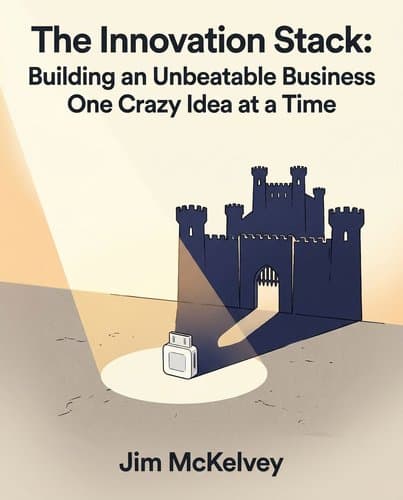
50748232_the-innovation-stack
by Jim McKelvey
Solving one impossible problem forces the next invention, then the next — until you've accidentally built an interlocking system that Amazon itself couldn't…
In Brief
Solving one impossible problem forces the next invention, then the next — until you've accidentally built an interlocking system that Amazon itself couldn't copy. Square's co-founder reveals why true innovation isn't a single breakthrough but a compounding stack your competitors can never fully replicate.
Key Ideas
Test for existing solutions first
Before committing to a problem, test whether any existing solution can be copied — if none exists anywhere in the world, you may have found a 'perfect problem' that only your specific circumstances and motivation can solve
Chained problems fuel innovation stacks
When solving one problem immediately creates new problems, don't treat it as a setback — that chain of forced invention is the Innovation Stack beginning to form; each link you add makes the whole harder to copy
Price to efficiency, not competition
Set your price as low as your stack's efficiency allows, not in response to what competitors charge — pricing to your own floor leaves no room for incremental copycats; pricing to beat competitors invites them to close the gap one innovation at a time
Partial copies self-destruct naturally
If a large attacker copies only some elements of your interlocking stack, the correct response is often to do nothing — partial copying of a dynamic system typically self-destructs before you need to respond
Avoid incumbent industry expertise hires
When entering a market that has never served your customers, be wary of hiring from the existing industry — experts in the current system bring solutions built for currently-served customers, not the excluded ones you're trying to reach
Who Should Read This
Business operators, founders, and managers interested in Startups and Innovation who want frameworks they can apply this week.
The Innovation Stack: Building an Unbeatable Business One Crazy Idea at a Time
By Jim McKelvey
10 min read
Why does it matter? Because the businesses that survived their biggest competitors never planned to build what protected them.
On Halloween 2015, Amazon didn't just stop attacking Square — it mailed its own customers a white Square card reader, packed in a smiling cardboard box. Not a concession. A tribute. Square co-founder Jim McKelvey spent three years reconstructing why, because nothing about it made sense. A startup with an 80% card reader, no phone support, and zero advertising budget had just outlasted the most dangerous company on the planet. The explanation has nothing to do with strategy, genius, or luck. It has everything to do with what happens when you commit to solving a problem nobody has ever solved before — each solution forces the next invention until you've built something so interlocked that copying it all at once is nearly impossible. Not a plan. A consequence. This book is about how that chain gets built, and why it protects you in ways no deliberate strategy ever could.
The Crime You Can't See Is Always Bigger Than the One You Can
On a rainy March night in 2007, Jim McKelvey's friend Bob drove seventeen miles across the Mississippi with his car's hood folded over the windshield. The latch had given out months earlier, replaced by a yellow bungee cord that finally snapped. When the hood flipped up, Bob leaned out the window into the rain — then pulled back inside when the drops started pelting his face — and kept driving, navigating by the four-inch gap between dashboard and crumpled hood. Later that night, he asked to borrow some pliers.
Bob is an excellent glassblower. McKelvey says he's the better artist. And periodically, Bob lived in the backseat of that 1992 Corsica.
The answer to that contradiction took McKelvey two years to find. Bob sells things people don't need: hand-blown glass, where the buyer's impulse is the whole transaction. And Bob couldn't accept credit cards. The 45:1 ratio McKelvey later found buried in a Federal Reserve report (small merchants paying forty-five times more per processed dollar than large corporations) was a real injustice. But it was the smaller crime.
The bigger crime was that Bob wasn't in the system at all. Not paying too much. Simply absent. Excluded by a forty-two-page contract, by hardware he couldn't afford, by a system whose complexity was the product, not a side effect. That invisibility was structural. No account meant no complaint. Bob couldn't threaten to leave a system that had never let him in.
Square's founding was a lost sale on an ugly glass faucet that hadn't moved in years, a buyer with the wrong card, and a skilled friend who couldn't sleep indoors. When McKelvey pitched venture capitalists, he had a photo of Bob's Corsica (hood folded, bungee dangling) on his laptop at every meeting. He never showed it once. Investors fund expansion into known markets; the unknown is someone else's problem. The pitch used the 45:1 ratio and the 5.2 million small businesses. The real mission never made a slide.
Every Winning Strategy Starts With Copying — Until You Hit a Problem No One Has Solved
Think about how you learned to speak. As a baby, you copied sounds until you had them right, then sentences, then tone and idiom, until the whole thing became invisible. No one called that cheating. Copying was exactly correct — because learning language by inventing it from scratch would be insane.
Business operates on the same logic. The formula for succeeding in any existing market is to copy what everyone else does — not as a shortcut, but as the right answer.
Howard Lerner built the first chain of upscale coffee shops in St. Louis before Starbucks arrived, sold the company for millions, then joined the faculty at Washington University to teach entrepreneurship. His course was called "So You Wanna Be an Entrepreneur."
Every time he showed his students an example of original thinking, they copied the example. He'd point at something unconventional; they'd stare at his finger. He stayed in touch with graduates for years, watching what a decade made of them. About one in ten had started a business — and almost all of them had opened coffee shops. His coffee shops. "I guess if I had used baby powder as a classroom example," he told McKelvey, "they would have joined Johnson & Johnson."
The students weren't failures. They were rational. Things that work are rare, and a model that has already survived the market doesn't need reinventing. Starting with something known isn't timid — it's how you avoid rebuilding a wheel that already rolls.
Innovation only begins where copying stops: the frontier where no one has solved the problem and no model exists to borrow. Until you reach that edge, replication isn't a compromise. It's the job. The decision to innovate isn't really a decision — it's what happens when you've learned all the language there is and the thing you need to say doesn't have a word yet.
The Innovation Stack Doesn't Get Designed — It Grows One Forced Problem at a Time
Jim McKelvey spent two all-nighters milling Square's first credit card reader from solid aluminum. The occasion was a meeting with Steve Jobs, and since Jobs was famous for loving brushed metal (the Apple Store made this obvious), McKelvey figured aluminum was the move. He finished it, tested it, it worked. Then he handed it to Jack Dorsey to try.
It didn't work.
McKelvey took it back, ran a card. Worked fine. Dorsey grabbed it. Nothing.
The back-and-forth continued until McKelvey spotted the difference: he held the card without touching the reader, while Dorsey pinched the reader with his fingers to stabilize it. Aluminum conducts electricity. When Dorsey's fingers touched the casing, his pulse — his actual heartbeat — interfered with the magnetic signal. McKelvey had not built a card reader. He had built a cardiac monitor.
This is the Innovation Stack in embryo. One forced solution (using the phone's microphone jack to avoid Apple's hardware licensing fees) created a problem: the reader needed a stable casing. Which prompted aluminum, because they were about to meet the most design-obsessed CEO in Silicon Valley. Which created cardiac interference. Which forced a switch to plastic and eventually the obsessive miniaturization that landed the reader at MoMA. Every step felt like a mistake. Every step was necessary.
None of it was planned. They copied whatever they could from established firms: corporate structure, HR policies, legal documents. Invention was the last resort. But their commitment to serve the merchants the existing system had rejected made copying impossible where it mattered most.
So the chain began. Flat pricing loses money on small transactions, which forces rapid scale, which forces free sign-up. Free sign-up forces cheap hardware (97 cents a unit when the market standard was $950), which makes long-term contracts pointless, which forces better software, which forces faster settlement (same-day deposits, while banks took two to three days). Merchants who get paid faster tell their friends. Square grew 10 percent weekly for two years without a dollar of advertising.
McKelvey called the engine behind all of it "so we have to." No contracts means customers can leave at any time, so we have to build software they actually like. Software they like means they tell their friends, so we have to build hardware worth talking about. Everywhere you look, the stack is a chain of necessity: not ambition, not vision, just reaction.
The Innovation Stack looks purposeful from the outside. From inside, it felt like surviving.
Giannini Did This With Horse Carts and a Bag of Gold in 1906
At 5:12 a.m. on April 18, 1906, A.P. Giannini was thrown out of bed. His house in San Mateo survived the earthquake; San Francisco would not. He rode into the city and arrived at noon to find his Bank of Italy intact, with thirty fires spreading toward it. The water lines broke in the same shaking that cracked the gas pipes, leaving nothing to fight the flames with. The police were overwhelmed, gangs were looting, and Giannini had no fire safe, just a lockbox of gold and one revolver.
He sent a clerk for two horse-drawn produce carts, buried the bank's gold under a layer of old vegetables, and waited for dark. At nightfall the carts rolled seventeen miles home, the gold ending up in his fireplace's ash trap. When they retrieved it days later, the coins still smelled of old produce.
Two days after the quake, San Francisco's bankers met and agreed to close for six months. Giannini went to the waterfront with a bag of gold and a ledger and started lending to anyone rebuilding the city.
What followed was a stack of innovations built on the same logic as Square's — each forced by the last. Charging 7 percent interest while competitors charged 12 required volume, which meant door-to-door salespeople at baptisms and church picnics. Nobody advertised banking then; Giannini ran ads promising that one dollar opened an account, because his customers were people who had been told they weren't worth the paperwork. Multilingual tellers. Evening and Sunday hours. A.P.'s own desk at the front of the bank, no iron bars anywhere in sight. Each solution made the next one necessary.
The Bank of Italy became Bank of America, the largest bank in the world. Everything we now consider standard came out of that stack: branches, small loans, home mortgages, installment credit.
The pattern is the same as Square's: commit to the people the system locked out, inherit their problems, invent your way through them. Square's headquarters sits a ten-minute walk from where Giannini founded his bank, give or take a century. McKelvey had been standing in the man's shadow without knowing it. Giannini built his stack for the same reason McKelvey built Square: the locked door is always there.
Even Amazon at 80% Per Element Had a 4% Shot at Copying the Full Stack
Picture a jump rope. Simple enough — you understand how it works. Now swap it for a yellow bungee cord. As you spin it, the cord stretches under tension, which changes its length, which changes how fast it moves, which changes the tension again. Add a few more properties — stiffness, humidity, the angle of the spin — and you've crossed a threshold. With eight variables all affecting each other, the number of possible interactions isn't eight. It's 251,548,592. You cannot model that. The system can only be understood by jumping it.
That's why an Innovation Stack can't be copied by throwing money at it. The protection is mathematical.
McKelvey ran the numbers on Square's fourteen-element stack. Give Amazon an 80 percent chance of successfully copying any single element. At two elements, the odds drop to 64 percent. At five, 33 percent. At fourteen: roughly 4 percent. Amazon had about the same chance of replicating Square's full stack as a coin landing heads four times in a row. And that's the optimistic version (the one that treats each element as independent). In reality, each piece shapes every other piece. The stack isn't a checklist. It's a jump rope made of bungee cord.
The proof is United Airlines. Before launching its discount brand Ted in 2004, United had spent thirty years studying Southwest. Thirty years. It knew the routes, the turnaround times, the pricing philosophy, the culture. It copied what it could: no meals, Airbus A320s for fuel efficiency, low fares, a deliberately quirky brand identity. By most measures, this was a serious attempt by a serious company.
But Ted kept two cabin classes, which required different reservation systems. It kept assigned seats. Its pilots flew under different contracts than Southwest's and needed additional training on unfamiliar planes. Ted didn't have enough aircraft to match Southwest's flight frequency on key routes. Herb Kelleher diagnosed the failure in one sentence: "They all took one thing out of twenty and said, 'This is what is going to make us the next Southwest,' but actually it was our holistic mixture."
United killed Ted in 2008. Every airline that performed surgery on Southwest's stack found the pieces wouldn't reassemble.
In a stable, known market, copying your competitor is exactly the right move. Coke watches Pepsi. Ford watches GM. Following the leader works when everyone is racing the same course.
But a company that builds an Innovation Stack isn't in a known race. It found a problem no one had solved and built its answer under pressure, one real-world iteration at a time. That answer isn't a strategy document. It's a living system — and you cannot copy a living system by reading its parts.
The Moment You Price Against Competitors Instead of Reflecting Your Own Costs, You Hand Them a Ladder
The moment you set your price by watching competitors, you've handed them a ladder.
Herb Kelleher never did that. During his tenure, twenty-two low-cost airlines tried to compete with Southwest — every one failed except JetBlue, which had its own stack. After Herb retired in 2008, Southwest's prices climbed more than 30 percent over five years while the industry average rose 8 percent. Five new competitors entered. All of them are still flying today. Southwest's routes, culture, and operating model were mostly intact — the stack hadn't disappeared. What changed was the price gap, and when it closed, the mathematical problem that had protected Southwest for decades became a business opportunity instead.
The mechanism is simple. Suppose your stack lets you operate at a cost where $5 is viable while competitors charge $10. To match you at $5, any rival has to replicate every element of your stack simultaneously — the near-impossibility described earlier. So they don't. They quit or find a different market.
Charge $9 instead — still the cheapest option, still "competitive" — and you've moved the finish line. A rival who copies two elements of your stack can reach $8. You drop to $7. They copy two more and hit $6. You're in a foot race with a competitor that started at $10 and has been closing the gap one piece at a time. The chasm that stopped them becomes a staircase you built for them.
Herb knew this. His own words: "If we try to maximize revenues we would be giving away our strongest, sharpest competitive weapon, which is the fact that our low costs enable us to charge low fares." Not a growth tactic to be abandoned once Southwest got big enough. The lock on the door. The low price wasn't the reward for building the stack — it was what made the stack impregnable.
Low price keeps the math working. Abandon it and the chasm that protected you becomes a staircase you built for the competition.
The Question You Can No Longer Dodge
The photo stayed on McKelvey's laptop at every pitch, folder never opened. A glassblower who couldn't sleep indoors because the credit card system hadn't bothered to make room for him — that was the real founding document of Square. Not the pitch deck, not the 45:1 ratio, not the five million underserved merchants. A bungee cord and a folded hood and a man genuinely good at making beautiful things who couldn't make enough money to sleep in a bed.
What McKelvey leaves you with isn't a framework. It's a position. You've seen that impossible problems look impossible only until someone builds the stack to solve them. Something else sticks: complexity is often exclusion wearing a disguise. You can no longer claim nothing can be done. There are only two honest sentences left: I won't. Or I will.
Notable Quotes
“wisdom to know the difference”
“What can I do out there?”
“No, this is live and you will see a dollar charge on your account.”
Frequently Asked Questions
- What is the Innovation Stack?
- The Innovation Stack is a business concept where solving an unsolved problem forces a chain of inventions that lock together into a system competitors can't copy. Jim McKelvey's framework demonstrates that "when solving one problem immediately creates new problems," that chain of forced invention forms the Innovation Stack's foundation rather than representing setback. Each link you add makes the entire system harder to replicate, creating a competitive moat. This interlocking system of solutions becomes nearly impossible for rivals to copy because they'd need to recreate the entire stack simultaneously, not individual innovations. McKelvey shows how this creates sustainable competitive advantages through cumulative problem-solving rather than single breakthroughs.
- What is a perfect problem according to the Innovation Stack?
- A perfect problem is one where no existing solution can be copied from anywhere in the world. According to McKelvey's framework, entrepreneurs should test whether any existing solution exists before committing resources. If "none exists anywhere in the world, you may have found a 'perfect problem' that only your specific circumstances and motivation can solve." These problems are valuable because they force genuine innovation with no competitor template to follow. By identifying and tackling a perfect problem, you create the foundation for an Innovation Stack that becomes uniquely difficult to replicate. This approach transforms problem selection from guesswork into strategic advantage.
- How should you price your product in the Innovation Stack framework?
- "Set your price as low as your stack's efficiency allows, not in response to what competitors charge" is McKelvey's core pricing principle. By following this approach, you create "no room for incremental copycats" because competitors cannot undercut you without destroying their margins. If you instead price to beat competitors, you invite them to "close the gap one innovation at a time," gradually narrowing your advantage. McKelvey argues this pricing strategy transforms the market dynamic from reactive competition into proactive defense. Pricing to your stack's efficiency floor becomes a structural barrier that makes incremental copying economically unsustainable and prevents competitors from slowly eroding your market share.
- What should you do when a large competitor copies part of your Innovation Stack?
- The correct response is often to do nothing. "If a large attacker copies only some elements of your interlocking stack, the correct response is often to do nothing — partial copying of a dynamic system typically self-destructs before you need to respond." This counterintuitive approach works because an Innovation Stack's strength lies in its integrated system—copying pieces without the whole foundation creates incompatibilities that the competitor must resolve. McKelvey argues that many entrepreneurs waste resources fighting competitors who will ultimately sabotage themselves through incomplete replication. Restraint becomes your best competitive defense.
Related Book Summaries

Read the full summary of 50748232_the-innovation-stack on InShort