21856367_the-innovators
by Walter Isaacson
The digital revolution wasn't built by lone geniuses—it was forged by collaborators who bridged science and the humanities. Isaacson's sweeping history reveals…
In Brief
The digital revolution wasn't built by lone geniuses—it was forged by collaborators who bridged science and the humanities. Isaacson's sweeping history reveals that the most transformative innovations came from teams, not solitary visionaries, offering a radical rethink of how we cultivate creativity and talent today.
Key Ideas
Proximity and equality spark unexpected discoveries
Design your environment for accidental collision: Bell Labs' long corridors, Noyce's identical cubicles, and Crocker's RFC culture all show that proximity and egalitarianism produce more breakthroughs than hierarchy and isolation.
Institutional support trumps timing of ideas
Simultaneous discovery is the rule, not the exception: when technology is ripe, multiple people hit the same idea independently. What separates a footnote from a revolution is not the idea but the team and institutional support behind it.
Interdisciplinary fusion defines lasting innovation
The innovators who lasted stood at the intersection of arts and engineering — Ada Lovelace seeing that any symbol (including musical notation) could be manipulated by a machine, Jobs pairing circuit boards with calligraphy, Engelbart augmenting human intelligence rather than replacing it.
Strategic choices reshape entire industry ecosystems
Open-source and proprietary models are not morally opposite — they are strategic choices with unintended consequences. Berners-Lee's generosity enabled the Web's growth and may have doomed journalism's economics. Gates's self-interest enabled Microsoft's dominance and drove hardware costs to near zero.
Collaboration with machines beats pure intelligence
The most valuable skill in an AI era may not be intelligence but collaboration: the two amateurs who beat grandmasters and supercomputers won because they knew how to coach their machines, not because they were smarter than either.
Who Should Read This
History readers interested in Technology History and Innovation who want a deeper understanding of how we got here.
The Innovators
By Walter Isaacson
11 min read
Why does it matter? Because the lone genius in the garage is a myth that actively misleads us about how innovation works.
Search
The Same Idea Struck Four People in the Same Year — and Only One of Them Changed the World
Picture John Vincent Atanasoff in the winter of 1937, so wound up over a computing problem he can't sit still. He gets in his car and drives — fast, without a destination — until he's crossed the Mississippi River and put 189 miles between himself and his lab at Iowa State. He stops at a roadhouse in Illinois, where he can actually buy a drink. He orders a bourbon and soda. The waitress ignores him. His thoughts go quiet.
On a paper napkin, he starts sketching. The core problem was memory: the capacitors he planned to use for storing data would lose their charge within a minute or two. Sitting alone at that bar, he figured out the fix — mount the capacitors on rotating drum cylinders, roughly the size of V8 juice cans, so that brush-like wires would touch each one in turn, refreshing the charge with every rotation. He called it 'jogging' the memory. After a few hours, the design was clear. He drove home at a slower pace.
Atanasoff was not alone in arriving at this destination. That same year, Turing published his theoretical framework for a universal computing machine. George Stibitz, working at Bell Labs, assembled a relay calculator on his kitchen table. Neither man knew the other existed. The technology was ripe, and multiple minds were reaching it at once.
So if the idea was in the air and Atanasoff caught it first, why isn't his name on the machine that changed the world? When his computer was shelved in the basement of a physics building, a graduate student dismantled it years later without knowing what it was and threw most of it away. The machine was never quite finished — a faulty card reader he couldn't fix left it permanently broken — because he was working alone, with only one young assistant.
Mauchly and Eckert, by contrast, built ENIAC at the University of Pennsylvania with Army funding, a full engineering team, and an institutional structure that could absorb setbacks and push through. A 1973 patent ruling confirmed that Atanasoff had the prior ideas. History still remembers ENIAC. What separated a footnote from a revolution wasn't the quality of the insight. It was everything that surrounded it.
Bell Labs Didn't Invent the Transistor — It Invented the Conditions That Made the Transistor Inevitable
The transistor wasn't Bell Labs' most important invention. The environment that produced it was.
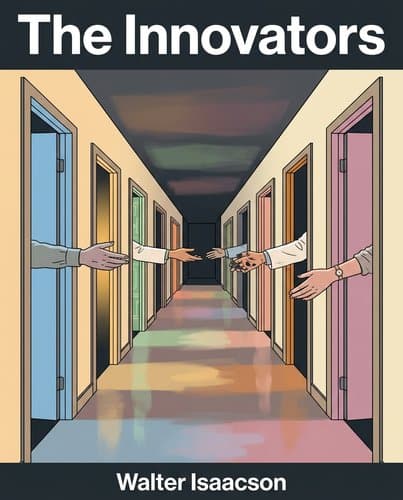
Mervin Kelly, the Labs' director, built the Murray Hill facility in New Jersey with a specific theory of creativity embedded in its architecture. Theorists and experimentalists were housed together, and the corridors connecting their wings were deliberately long, so that anyone walking between departments would pass through territory that wasn't theirs. A quantum physicist heading to lunch would brush shoulders with a materials engineer, then a chemist, then one of the technicians Bell called 'pole climbers' — the people who actually installed telephone equipment in the field and understood, viscerally, what the technology had to do in practice. You couldn't get from your desk to the cafeteria without accumulating collisions. The building was an innovation policy.
What Kelly assembled inside it was just as deliberate. John Bardeen was a physicist so quiet that colleagues sometimes forgot he was in the room — and then he'd walk to the blackboard and produce a breakthrough. Walter Brattain was the opposite: an improvisational experimentalist who once solved a condensation problem by filling a thermos with water because, as he freely admitted, he was 'essentially a lazy physicist.' William Shockley was the competitive visionary who held the team together through sheer intellectual intensity. None of them alone could have built what the three of them built together. The transistor, born in December 1947 when Brattain used gold foil, a plastic wedge, and a razor blade to create two contact points on germanium less than two-thousandths of an inch apart, was the product of that specific combination of minds — and the trust Kelly had engineered between them.
Then Shockley poisoned the well. When he moved to California to start his own semiconductor firm, he brought several of his best people with him, but he ran the place like a man who'd forgotten what had actually made Bell Labs work. The moment that finished him: a secretary cut her finger on a broken piece of glass. Shockley, convinced it was sabotage, ordered polygraph tests for the entire staff. Eight of his top engineers — including Robert Noyce and Gordon Moore — walked out together and founded Fairchild Semiconductor. Silicon Valley grew from that exodus.
The Women Who Programmed ENIAC Were Erased From the Story They Made Possible
The night before ENIAC's first public demonstration, Betty Snyder and Jean Jennings were still in the lab at midnight, staring at a program that wouldn't quit. It calculated missile trajectories beautifully — and then, after the shell would have hit the ground, kept going, modeling a shell burrowing through the earth at the same speed it had traveled through the air. Unless they fixed it before morning, the Army's showcase would be an embarrassment. They couldn't find it. At midnight, Snyder caught the last train home.
She woke up knowing the answer.
She took the early train back, found a loop setting one digit off in the code, flipped the switch. That evening, ENIAC performed flawlessly in front of military brass and press, spitting out in fifteen seconds what human calculators would need weeks to produce. The New York Times ran it on the front page.
That night, the men celebrated at a candlelit dinner in Penn's Houston Hall — engineers, officers, dignitaries. Snyder and Jennings walked home alone through a cold February night. They hadn't been invited.
The erasure wasn't incidental. The six women who programmed ENIAC — Jennings, Snyder, and four others — had worked without manuals, reverse-engineered wiring diagrams to understand a machine they'd never been formally trained on, and invented modular subroutines that became the foundational vocabulary of software engineering. Program notes listed them as 'operators,' a word that implied button-pushing. What they were actually doing was building, from scratch, the intellectual architecture that made the hardware useful.
That architecture had a longer history than anyone at Houston Hall seemed to remember. Ada Lovelace had understood a century earlier that the interesting problem wasn't building a calculating engine — it was telling one what to do. Grace Hopper had understood the same thing. At Harvard in the 1940s, when she joined Howard Aiken's Mark I team, she found an actual moth stuck in a relay and taped it into the logbook with the notation 'first actual case of bug being found' — giving a name to something programmers had always done and, later, writing the manual that formalized how to do it. She eventually built the first compiler, a program that translated human-readable instructions into machine language, on the theory that computers should do what humans found tedious. The hardware people built the instrument. Hopper and the women of ENIAC decided what it could play.
What the celebration at Houston Hall got wrong wasn't just the guest list. It was the model of invention it was celebrating — the lone engineer, the physical machine, the moment of ignition. Snyder's fix came to her in her sleep, which is its own kind of argument: the work had gone so deep it was still running after she left the building. That's not a support role. That's what invention looks like.
Silicon Valley Wasn't Born From Ambition — It Was Born From a Culture That Made Leaving Feel Like the Right Thing to Do
Why did startup culture — the one where talented people routinely quit stable jobs to found rivals — take root in one particular valley in California rather than somewhere else? The answer isn't venture capital or Stanford or the weather. It starts with a secretary cutting her finger on a piece of broken glass.
The eight engineers who walked out of Shockley Semiconductor in 1957 didn't just start a company. They started a counter-argument. In most of corporate America, you joined a firm young and retired from it old. Leaving was a kind of failure. The Fairchild eight made it a credential. As one observer later put it, in Silicon Valley it became understood that you were better off starting something and failing than staying put for thirty years.
Noyce encoded that logic into Intel's founding culture when he and Moore left Fairchild a decade later. When an employee asked for an org chart, Noyce drew an X in the center of a page and scattered other Xs around it connected by lines. The employee was at the center. Everyone else was just someone they'd work with. Noyce himself sat at a small dented aluminum desk in an open room, indistinguishable from anyone else's workspace, precisely so that no one could use furniture as a measure of rank. The culture wasn't an accident of personality. It was a direct rebuttal, built piece by piece, of everything Shockley had been.
The Internet Was Designed to Survive a Nuclear Attack and to Resist Central Authority — and Both Things Are True
Both versions of the origin story you've heard are correct. ARPA's director Stephen Lukasik, the man who actually signed the funding checks from 1967 onward, has said plainly that he authorized the network because packet switching would keep military command intact even if parts of the infrastructure were destroyed by a nuclear strike. He wasn't being abstract — this was the early 1970s, with Vietnam protests shutting down universities and Congress demanding that Defense Department money go only to projects with explicit military value. 'I would have been hard pressed to plow a lot of money into the network just to improve the productivity of the researchers,' he said. Nuclear survivability was the argument that worked. The money followed that argument.
The people Lukasik paid to build the thing had a completely different idea of what they were making. Bob Taylor, who ran ARPA's office responsible for the network's development, said his design philosophy was to keep authority distributed specifically because he didn't trust any single organization to control it — including the one funding him. The Pentagon, which reflexively prefers hierarchies and centralized command, had delegated the actual engineering to a collection of academics, several of whom were actively trying to avoid the draft, most of whom were constitutionally suspicious of centralized anything. What they built reflected who they were. Every node got its own router. No hub was indispensable. The architecture encoded the culture of the people who designed it, not the institution that paid for it.
What came out of that collision was Steve Crocker. A graduate student, Crocker drafted the first formal document describing how computers on the network should talk to each other while standing in a bathroom at midnight, naked, trying not to wake his hosts. He kept the tone deliberately humble, almost apologetic, framing it as a request rather than a standard. That document's accidental modesty established the open-source ethos that still governs the web's development today. A Pentagon project, funded for strategic military reasons, accidentally produced the most decentralized communication system in human history. The contradiction wasn't a bug. It was the design.
Gates Kept the Code; Berners-Lee Gave It Away — and Both Decisions Shaped the Internet We're Still Arguing About
Bill Gates understood exactly what he was building. When IBM came knocking in 1980 needing an operating system for its new personal computer, Gates didn't write one — he bought a rough one called QDOS from a programmer named Tim Paterson for fifty thousand dollars. The move that made it historic was what he did next: he licensed it to IBM without selling them the source code, which meant he could turn around and license the same software to every manufacturer building IBM-compatible machines. IBM thought it was getting an operating system. What it was actually doing was making Microsoft the toll booth on every road into computing. Hardware became a commodity. The code was the asset. Gates had understood, earlier than almost anyone, that in a world of interchangeable machines, the layer that mattered was the one you couldn't see inside.
Tim Berners-Lee made the opposite choice with the same clarity. When he designed the World Wide Web at a physics laboratory in Switzerland and convinced his employer to release all intellectual property rights — freely, permanently, to everyone — he wasn't being naive. He believed, correctly, that the Web's value depended on universal adoption, and universal adoption required that no one own the door. He was right. The Web spread at a speed that no licensed technology could have matched.
But neither man fully controlled what came next. Berners-Lee had imagined a two-way medium — a place where anyone could read and write, collaborate in real time, edit the shared record. What he got instead was shaped by Marc Andreessen's Mosaic browser, which made it easy to display images and nearly impossible to author content directly in the browser. Berners-Lee was explicit about what he didn't want: "He specifically didn't want magazines," Andreessen later recalled. "His view was that images are the first step on the road to hell." Andreessen, by his own description a Midwestern tinkerer who gave people what they asked for, added images anyway. The Web became a publishing platform. When it needed a business model, advertising filled the vacuum that micropayments might have occupied — and Berners-Lee spent the next two decades watching something he'd given away get turned into something he'd never intended. Gates's proprietary model, meanwhile, commoditized the very hardware that made personal computing accessible to millions of people who couldn't have afforded a vertically integrated machine.
The revolution kept arguing with itself — open versus closed, publishing versus collaboration, standard versus freedom — and the argument was the engine. Neither Gates nor Berners-Lee won. The tension between them produced the internet you're reading this on.
The Smartest Move in the 2005 Chess Tournament Wasn't Playing Better Chess
In 2005, a chess tournament invited its players to do something unusual: bring computers. Grandmasters entered. State-of-the-art machines entered. And then two American amateurs entered, carrying three ordinary laptops.
They won.
Not because they played better chess than the grandmasters. Not because their hardware was faster than the purpose-built machines. They won because they had figured out something the others hadn't: how to coach their computers. They knew when to trust the machine's calculation, when to override it with human judgment, and how to structure the collaboration so that each partner was doing what it actually did well. Garry Kasparov, watching from the sidelines, put it plainly: the combination of human strategic sense and machine tactical precision overwhelmed both the best humans and the best computers competing separately.
That result is a pretty good answer to the anxiety that AI will simply replace us. The machines that beat world champions at chess and trivia and Go are also, as Hans Moravec observed in his 1988 book Mind Children, completely helpless at things a toddler manages before lunch — navigating a cluttered room, recognizing a friend's face in bad lighting, understanding why a joke is funny. The hard problems are easy for them. The easy problems are hard. What that asymmetry suggests is not a rivalry but a partnership: let the machine search a million books a second while you decide what question is worth asking.
J.C.R. Licklider called this "man-computer symbiosis" in 1960, and it was always a more interesting goal than building a machine that thinks alone. He imagined humans and computers dividing the work the way a good team does — machines handling the computation and retrieval, humans supplying the judgment about what to compute and why. The two amateurs in that tournament were practicing it, sixty years later, with three laptops.
What Ada Knew That Babbage Missed
Ada Lovelace's mother prescribed mathematics as a cure for her father's reckless imagination. It didn't work — and the failure was the point. What Ada inherited from Byron wasn't a defect to be corrected but a second lens, and through both lenses together she saw something Babbage, who built the machine, never did: that symbols are symbols. Musical notation, logical propositions, algebraic variables — the engine didn't care. It would weave whatever pattern you handed it. That's not a footnote to the history of computing. It's the whole argument of this book in a single mind.
The question Isaacson leaves you with isn't historical. It's institutional. Look at how you hire, what you fund, how you sort children at school. Are you still treating the poem and the proof as opposite directions — or have you built the long corridor that lets them collide?
Notable Quotes
“The teams of human plus machine dominated even the strongest computers,”
“Human strategic guidance combined with the tactical acuity of a computer was overwhelming.”
“Their skill at manipulating and coaching their computers to look very deeply into positions effectively counteracted the superior chess understanding of their grandmaster opponents and the greater computational power of other participants,”
Frequently Asked Questions
- What is The Innovators about?
- The Innovators by Walter Isaacson traces the history of the digital revolution through profiles of the scientists, engineers, and visionaries who built the modern computing era. Isaacson argues that breakthrough innovation has always come from collaboration and the blending of humanities with technology — not lone geniuses — giving readers a new framework for understanding what truly drives creative progress. The book systematically challenges the popular narrative of the solitary genius by showing how institutional support, team dynamics, and cross-disciplinary thinking shaped every major innovation from Ada Lovelace to Steve Jobs.
- What are the key takeaways from The Innovators?
- The Innovators emphasizes that successful innovation requires collaboration and specific environmental conditions. Key insights include: designing spaces for accidental collision (proximity and egalitarianism produce more breakthroughs than hierarchy and isolation), recognizing that simultaneous discovery is the rule not the exception, and understanding that the most successful innovators stood at the intersection of arts and engineering. What separates a footnote from a revolution is not the idea but the team and institutional support behind it. In an AI era, collaboration may be more valuable than raw intelligence for achieving breakthrough results.
- What does The Innovators teach about the role of environment in innovation?
- The Innovators demonstrates that physical and organizational design dramatically shapes innovation outcomes. Bell Labs' long corridors, Noyce's identical cubicles, and RFC culture exemplify how proximity and egalitarianism produce more breakthroughs than hierarchy and isolation. Isaacson shows that designing for 'accidental collision' — unplanned encounters between diverse thinkers — fuels creative breakthroughs. The book argues that institutional structure matters as much as hiring talented people. Organizations removing barriers between disciplines and status levels generate more simultaneous discoveries than siloed hierarchies. This environmental perspective challenges the notion that innovation happens through individual genius working in isolation.
- Is The Innovators worth reading?
- The Innovators is worth reading if you seek to understand how breakthrough innovations actually develop. The book provides valuable insights that challenge common entrepreneurship myths, revealing that innovation requires collaboration, institutional support, and intersection of arts and engineering rather than lone genius. Isaacson's accessible writing makes complex technical history engaging for general audiences. The framework he develops applies beyond technology to any field seeking to foster creativity. Understanding that environmental design, team dynamics, and diversity of thought matter more than raw intelligence can reshape how organizations approach innovation and foster breakthrough ideas.
Related Book Summaries


Read the full summary of 21856367_the-innovators on InShort