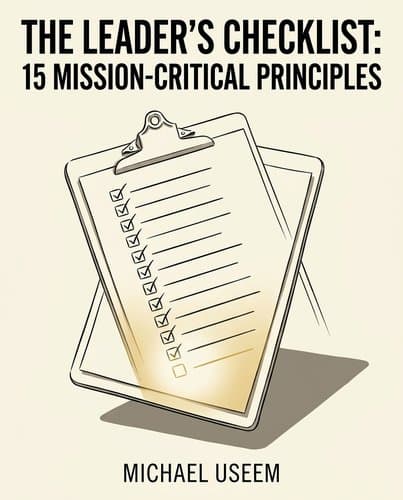
11791672_the-leader-s-checklist
by Michael Useem
Leadership isn't a gift—it's a checklist. Michael Useem distills 15 battle-tested principles from Chilé's mine rescue to 9/11's first responders, showing how…
In Brief
Leadership isn't a gift—it's a checklist. Michael Useem distills 15 battle-tested principles from Chilé's mine rescue to 9/11's first responders, showing how the right diagnostic questions, rehearsed before crisis hits, separate decisive leaders from those who improvise their way to disaster.
Key Ideas
Use Diagnosis to Surface Omissions
Before any high-stakes moment, run through the 15 principles as a diagnostic — not to find answers, but to surface omissions. The questions matter more than the answers: 'Have I prepared the organization for unlikely but extremely consequential events?' is a question AIG's leadership never asked.
Empirical Testing Over Intuitive Judgment
Test your checklist empirically, not intuitively. Identify the leadership behaviors you believe matter most, then check them against actual outcomes. In one major financial services firm, 30 of the 39 'vital' leadership traits had zero measurable impact on performance — only the 9 centered on frontline mentoring moved the needle.
Assemble Diverse Expertise Before Crisis
Build a diverse top team before you need one. Golborne had no mining expertise — his primary leadership act was assembling specialists (engineer, psychologist, political insider) and creating conditions for them to do their best work. The leader's job is often to ask the right questions, not supply the right answers.
Rehearse Checklists Until They Become Instinct
Internalize the checklist before the crisis arrives. Pfeifer had seconds when the North Tower lobby went black. Checklists only function under pressure if they have been rehearsed until they operate as instinct — through after-action reviews, stretch assignments, and deliberate study of others' leadership moments.
Hold Boldness and Caution in Tension
Distinguish boldness from recklessness by holding Principle 5 (Act Decisively, at the 70-percent threshold) alongside Principle 13 (Dampen Over-Optimism). Both are on the checklist. The tension between them is not a flaw — it's the point. A leader who only internalizes one of the two is halfway to a failure.
Common Interest as Strategic Filter
Place common interest first — not as a soft aspiration but as the filter through which every other decision runs. Chamberlain's salute wasn't symbolic; it was strategic in the deepest sense. The question 'Am I thinking like a president even if I'm not one?' reorients every choice on the list.
Who Should Read This
Business operators, founders, and managers interested in Leadership and Management who want frameworks they can apply this week.
The Leader's Checklist: 15 Mission-Critical Principles
By Michael Useem
11 min read
Why does it matter? Because leadership failures aren't caused by bad strategy — they're caused by omissions you could have named in advance.
AIG had the data. They had the analysts, the credit ratings, the risk models. What they didn't have was a short list of specific behaviors that someone, anyone, should have been performing—and wasn't. That absence cost $170 billion. Meanwhile, a retail executive with no mining background flew into the Atacama desert and outmaneuvered every credentialed specialist on site to pull 33 men out of the earth alive. Same pressure, opposite outcomes. The difference wasn't intelligence or experience or luck. It was a handful of nameable, learnable, testable behaviors—the kind you can put on a checklist.
Even Seasoned Executives Fail — Not From Ignorance, But From Omission
Golborne was already standing in the Atacama desert when this book's argument about leadership failure begins to come into focus.
Consider what was happening at American International Group at almost the same moment in history. AIG wasn't led by amateurs. Its leadership team had decades of financial industry experience, one of the most prestigious credit ratings in the world, and years of data on how their debt-insurance business performed. Their Financial Products division — fewer than 400 employees — had grown to backstop more than $1.5 trillion in credit obligations. Federal regulators warned AIG's board in 2005 about documentation weaknesses, inadequate stress testing, and murky lines of authority inside that division. They came back in 2007 with sharper warnings about subprime mortgage exposure. AIG's own outside auditors flagged problems with accounting practices in 2008. The information was there, delivered in writing, to the highest levels of the organization. Leadership ignored it. When Lehman Brothers fell in September 2008, a single credit downgrade triggered $18 billion in collateral calls within hours. By year's end, AIG had posted the largest annual corporate loss in history, and U.S. taxpayers had injected more than $170 billion to keep the company from collapsing entirely.
The unsettling point isn't that AIG's leaders made a wrong strategic bet. They had a knowable checklist of things to do — dampen overconfidence, stress-test for low-probability threats, scrutinize the division generating euphoric returns — and they simply didn't do them. Golborne, the outsider with no relevant expertise, executed almost every one of those behaviors instinctively. Experienced insiders, surrounded by warning signs, executed none. The most catastrophic failures don't come from bad strategy. They come from the omission of specific behaviors that were on the list the whole time.
The Same Dozen Principles Surface Whether You're in New York or Shanghai
The Marine Corps trains officers to act on a seventy-percent solution rather than waiting for certainty that never arrives. A mediocre decision executed immediately can be adjusted. Indecision just compounds the problem. Warren Bennis, studying effective leaders across sectors, identified the same cluster: determination, the ability to build trust, and a consistent bias toward action when the picture is still blurry. The checklist isn't a cultural artifact. It's closer to anatomy.
Useem tests this with a single recurring simulation built around a real and uncomfortable moment: Lou Gerstner, the day after IBM completed its $3.5 billion acquisition of Lotus Development Corporation, flying to Boston to face half the Lotus workforce. The employees in that room had concrete reasons to worry — Lotus had already announced plans to cut fifteen percent of its managers, IBM was in the middle of its own massive restructuring, and a hardware company with almost no software background had just bought their employer. Useem puts one program participant in Gerstner's shoes and asks the rest to play frightened Lotus employees. Then he asks: what would you need to hear, see, and feel from this person to stay and work hard?
Twelve principles surface every single time, regardless of whether the participants are in finance or healthcare, regardless of whether they're sitting in Mumbai or Chicago. The most consistent one surprises people: employees don't lead with job security. They lead with decision-making. Before they want reassurance, they want to see someone willing to make a call — any call — rather than stall while the uncertainty metastasizes. Investment bankers in New York name it. Technology managers in Shanghai name it. The Bennis research names it. Different rooms, different industries, different decades. Same answer.
Domain Expertise Is the Last Thing That Saves You in a Crisis
When Laurence Golborne arrived at the San José mine in the small hours of August 7th, a rescue crew told him the men were almost certainly dead. He was five months into his first government post — Chile's minister of mining — after spending his career running a retail chain. He had never overseen a mine rescue. He knew it. He briefed the waiting families on the bleak assessment, watched two daughters of a trapped miner begin to sob, and lost his own composure mid-sentence. A relative cut him off: 'Minister, you cannot break down. You have to give us strength.' That moment ended his ambivalence. Golborne decided the Chilean government would take full charge of a rescue at a privately owned mine — no legal precedent, serious political risk.
What followed was a masterclass in knowing exactly what you don't know. Golborne said plainly that the rescue lacked technical leadership and that he couldn't supply it. So he went looking for it. He recruited an experienced engineer from Chile's state-owned copper company and handed him authority in one sentence: 'You have to take charge.' He brought in a psychologist to manage the 300-odd relatives camped at the mine entrance, whose grief could easily have destabilized the whole effort, and a well-connected government insider to handle the risk-averse officials in Santiago who needed persuading, not managing from a distance. Then Golborne did something harder than delegating: he stayed engaged. Before a critical drilling decision, he gathered eight geologists, asked each for their reasoning, formed his own view, and made the call himself. 'Let the experts talk,' he said of his approach, while keeping the final decision where it belonged.
The result: three extraction methods running simultaneously as insurance, the eventual breakthrough, and 33 miners surfacing alive on October 13th before a global audience of a billion people. The engineers who solved the drilling problem were the heroes of the technical challenge. Golborne's contribution was making sure those engineers could actually do their work — shielded from media pressure, from family anguish, from political noise — while the larger operation held together. That is a distinct skill set, and it has almost nothing to do with mining.
Your Organization Is Probably Training Leaders in the Wrong 30 Skills
A 4,000-person division inside a major financial services firm set out to answer that question properly. Researchers interviewed virtually every senior executive and compiled roughly 200 distinct leadership capacities — things the bankers believed mattered for running the operation well. Leaders ranked them. Thirty-nine rose to the top: widely endorsed, clearly articulated, the obvious foundation for a development program.
Then the researchers did something most organizations skip entirely. They had peers, direct reports, and supervisors rate each leader on all 39 dimensions — and tracked actual financial results one year later. When the data came back, 30 of the 39 capacities had no statistically significant relationship to performance. Traits that look essential on a corporate values slide — demonstrating strong commitment to company success, building a team-based sales culture, streamlining the sales process — simply didn't move the needle. What actually drove results were nine specific behaviors, all clustered around one core activity: directly mentoring and motivating the frontline bankers who did the client-facing work.
The uncomfortable implication runs in both directions. Organizations waste significant time and money developing leaders in capacities that generate little return. And they systematically underinvest in the handful of behaviors that actually determine whether people follow, perform, and stay. The checklist isn't just a tool for individual leaders; it's a diagnostic for the programs meant to develop them — programs that, when built on intuition rather than evidence, are investing heavily in the wrong nine things.
When the Lobby Goes Black, You Have Seconds — and the Checklist Is Already in Your Head
Institutions can fail to train people for the worst moments — but individuals can prepare anyway. Joseph Pfeifer did.
At 8:46 on a clear September morning, Pfeifer was standing in a Lower Manhattan street watching a crew investigate a gas leak when he heard something wrong — a roar where there should have been silence. He looked up in time to see a commercial aircraft angle deliberately into the North Tower of the World Trade Center. In the seconds it took him to register what he'd witnessed, he made a decision that would define the next two hours: he told the dispatcher not just that a plane had hit a building, but that the plane had aimed. This was terrorism, not accident. He radioed a second alarm, then a third, before he had walked a single block toward the smoke.
Inside the North Tower lobby, the scene looked as though the impact had reached the ground floor — glass, debris, people with burns. Pfeifer assessed, ordered firefighters upward toward the 78th floor fire, and chose the 70th as their staging point. Eight floors of margin. Not a guess: a calculated buffer that kept options open while the situation developed.
Then at 9:59, the South Tower fell. The lobby went black and silent. No time to consult anything. Pfeifer grabbed his radio and transmitted: 'Command to all units in Tower One, evacuate the building.' The firefighters started coming down.
Here is the part worth sitting with: Pfeifer hadn't invented those decisions on the spot. The rapid alarm escalation, the safety margin, the instant evacuation order — these were patterns so deeply rehearsed they ran without deliberation. The checklist wasn't something he consulted in that darkened lobby. It was already operating, encoded through years of three-alarm fires, Mayday drills, and accountability protocols for tracking personnel in burning buildings, practiced until they became reflex. When the dust erased visibility and stress erased the luxury of reasoning, what remained was preparation.
One detail shows what that preparation actually means. After a large fire in the Bronx, a firefighter chased Pfeifer down the block to say: 'Chief, I'll follow you down any hallway.' Pfeifer accepted the compliment, got in his car — and then understood what had actually been said. The firefighter wasn't offering praise. He was placing his life in Pfeifer's hands and explaining why: because Pfeifer had already put his own on the line. Leadership in a crisis is the accumulated credibility of someone who has already been in the dark hallway. That credibility can't be improvised when the building starts shaking.
Boldness and Caution Are Both on the Checklist — and the Tension Is the Point
The checklist doesn't tell you when to be bold and when to hold back. It keeps both impulses live at the same time — and that tension is the point.
Consider the two principles that sit in sharpest conflict. The Owner's Manual endorses a 70-percent go point: move when you have most of the picture, because the rest rarely arrives before the moment passes. That's the Marine Corps logic — a committed mediocre decision beats a paralyzed excellent one. But Principle 13 tells you to dampen over-optimism, to actively hunt for the threats your confidence is obscuring. AIG's leadership ran a division that backed more than a trillion dollars in debt with fewer than 400 employees, brushed off three consecutive rounds of regulatory warnings, and watched executives publicly assure investors that they could not imagine losing a single dollar on their positions. They were decisive. They were confident. They destroyed the company. The 70-percent principle didn't fail them. Their failure was never invoking Principle 13 to ask whether the confidence itself had become the risk.
The checklist doesn't resolve this. It makes you aware of both pulls at once. That's more honest — and more useful — than any formula that promises to tell you which one wins.
The Moment That Makes Every Other Principle Hollow Without It
On the morning of April 12, 1865, Joshua Chamberlain stood in a Virginia field watching the Army of Northern Virginia march toward him. He was a college professor turned soldier who had been shot six times. Two weeks earlier, Confederate troops had put a bullet through his arm and chest. A year before that, one had torn through his hip and groin — a wound that would eventually kill him. The men now approaching to lay down their flags and rifles were the same men who had done these things to him.
Chamberlain ordered a bugle call: carry arms. Rifles raised to the shoulder, a soldier's gesture of respect. His fellow Union officers were furious. General John Gordon, riding at the head of the Confederate column with his head down, heard the shift in sound, looked up, understood the gesture immediately — both armies had trained out of the same traditions — and ordered his own men to return it. The 'salute returning a salute' is what historians have called it ever since.
The moment crystallizes everything Useem builds toward across 14 principles. Every other item on the checklist — build a clear vision, assemble a diverse team, dampen over-confidence, decide at the 70-percent mark — can be executed flawlessly in service of your own ambition, your own survival, your own need to be right. Chamberlain had more personal reason than almost anyone on that field to make the Confederate surrender feel like a defeat. He chose instead to make it feel like the beginning of something else, because the mission — national reconciliation, the thing Lincoln needed — required it. The anger of his colleagues, his own wounds, four years of killing: none of it outweighed the purpose the moment was actually serving.
This is what Useem names the 15th and most essential principle, and the Marine Corps encodes it in a single line: the officer eats last. Jim Collins, in his research on long-term corporate outperformers, found the same behavior running through every company that made the leap. The leaders who took struggling or merely adequate companies to sustained greatness consistently deflected credit to their teams and absorbed blame themselves — the inverse of most visible executive behavior. The principle doesn't add capability to the checklist. It determines what the rest of the checklist is for. Without it, every other skill is just leverage in service of the wrong goal.
What the Salute Was Really About
That's the thing about the 15th principle — it doesn't make the other fourteen more effective. It determines what they're actually for. Every skill on the checklist can be mastered and then quietly aimed inward: at your reputation, your survival, your version of the story. The question isn't whether you can execute the list. It's what you're executing it in service of.
So before the next high-stakes moment arrives — and it will, faster than you expect — ask yourself which principle you're most likely to leave off. Not because you've never heard it, but because pressure has a way of editing the list down to whatever flatters you most. What would it cost if that's the one that goes missing?
Notable Quotes
“Gordon, at the head of the marching column, riding with heavy spirit and downcast face, catches the sound of the shifting arms, looks up, and, taking the meaning,”
“his successive brigades to pass us with the same position.”
“his intellectual tradition, his y axis, is Anglo-American,”
Frequently Asked Questions
- What is The Leader's Checklist about?
- The Leader's Checklist presents leadership as a learnable discipline rather than an innate trait, built around 15 concrete principles for making better decisions in high-stakes situations. Michael Useem's 2011 book offers a systematic approach grounded in real crises and organizational research. Rather than inspirational platitudes, it presents leadership as a diagnostic tool—a checklist of 15 mission-critical principles leaders can internalize and apply before, during, and after critical moments. The framework emphasizes that the questions on the checklist matter more than the answers themselves, helping leaders surface omissions in their preparation and decision-making processes. It's designed for practitioners who must perform effectively under extreme pressure.
- What are the key principles for using the checklist before high-stakes moments?
- Leaders should run through the 15 principles as a diagnostic to surface omissions before any high-stakes moment—not to find answers, but to identify gaps. A crucial question to ask: "Have I prepared the organization for unlikely but extremely consequential events?" The checklist must be tested empirically, not intuitively. In one major financial services firm, 30 of the 39 'vital' leadership traits had zero measurable impact on performance—only the 9 centered on frontline mentoring moved the needle. This empirical approach ensures leaders focus their preparation on behaviors that actually drive outcomes. Testing reveals which principles matter most for your specific context.
- How important is building diverse leadership teams according to this book?
- Building a diverse top team before you need one is critical. Useem illustrates through Golborne, who had no mining expertise—his primary leadership act was "assembling specialists (engineer, psychologist, political insider) and creating conditions for them to do their best work." The leader's job is often to ask the right questions, not supply the right answers. Rather than positioning yourself as the source of all solutions, strong leadership means curating expertise and unlocking others' capabilities. Assembling such diverse teams in advance, before emergencies create urgency, allows leaders to function more effectively when crises strike. Diversity of knowledge and perspective becomes your organization's resilience advantage.
- How should leaders internalize the checklist before a crisis?
- Checklists only function under pressure if they have been rehearsed until they operate as instinct. Internalization happens through after-action reviews, stretch assignments, and deliberate study of others' leadership moments. The distinction between boldness and recklessness demonstrates this—Principle 5 (Act Decisively, at the 70-percent threshold) must be held alongside Principle 13 (Dampen Over-Optimism). A leader who only internalizes one is "halfway to a failure." The tension between competing principles isn't a flaw—it's the point. This integrated understanding develops only through consistent practice before the crisis arrives, ensuring automatic, correct responses when pressure eliminates decision-making time.
Related Book Summaries
Read the full summary of 11791672_the-leader-s-checklist on InShort