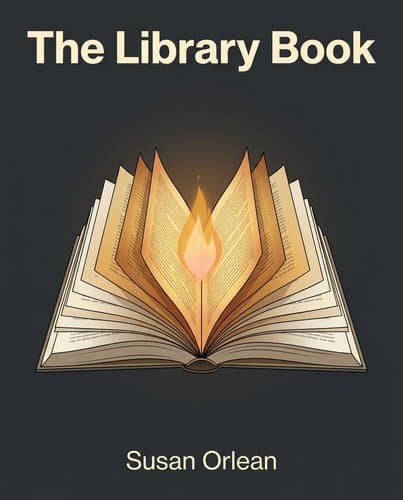
39507318_the-library-book
by Susan Orlean
When 400,000 books burned in the largest library arson in American history, the story vanished behind Chernobyl on page A14—Susan Orlean resurrects it to…
In Brief
When 400,000 books burned in the largest library arson in American history, the story vanished behind Chernobyl on page A14—Susan Orlean resurrects it to reveal why libraries are civilization's most radical act: the unconditional promise that every story, and every person, belongs.
Key Ideas
Catastrophes create double erasure of memory
The largest library fire in American history destroyed 400,000 books and was buried on page A14 of the New York Times — three days after it happened — because Chernobyl dominated every front page. The most significant cultural losses can vanish behind bigger catastrophes, leaving a double erasure: the thing itself, and the memory of losing it.
Pseudoscience convictions require nationwide forensic reform
The arson science used to name Harry Peak as suspect — burn patterns, origin points, fire temperature as evidence of intent — was based on assumptions a 1992 NFPA report would debunk as pseudoscience. Independent forensic investigator Paul Bieber, reviewing the case decades later, concluded: 'there isn't a guy to get.' Arson investigation has undergone a reckoning similar to bite-mark evidence, overturning convictions nationwide.
Librarians manage unresourced social service burden
Libraries are the only major public institution that accepts everyone unconditionally — which means they inherit by default every problem society refuses to address elsewhere: homelessness, mental illness, loneliness, digital exclusion. The librarians who manage this bear a social-services burden without the training, resources, or mandate for it.
Writing defies death through memory preservation
Writing a book — or preserving any story — is, in Orlean's formulation, 'an act of sheer defiance. It is a declaration that you believe in the persistence of memory.' The Senegalese expression captures the stakes: when someone dies, you say their library has burned. Writing extracts something from that private library before it disappears.
Physical libraries irreplaceable by digital platforms
A physical library isn't replaceable by digital access because what it provides isn't primarily information — it's an unconditional public space, a place that is 'home when you aren't at home.' The library's survival required an obscure real-estate instrument (air rights), one developer's aesthetic preference, and a tobacco company buyout the city wisely declined. Community sentiment alone nearly wasn't enough.
Who Should Read This
History readers interested in World History and Social Issues who want a deeper understanding of how we got here.
The Library Book
By Susan Orlean
10 min read
Why does it matter? Because the largest library fire in American history happened, and almost nobody knows.
The assumption going in is reasonable: a library fire sounds like a footnote, sad and local, the kind of thing that earns a paragraph in the regional paper. What actually happened on April 29, 1986 in Los Angeles was this: every firefighter in the city was called to the scene. The blaze burned for seven hours. Four hundred thousand books were destroyed. It was the largest library fire in American history, and the world, mostly, forgot. What Susan Orlean wants to know — and quietly forces you to ask — is what that forgetting cost us, and whether a library is really a building at all, or a civilization's stubborn insistence that nothing worth knowing should ever disappear.
The Fire That Changed Everything Was the Fire Nobody Remembered
Ken Brecher cracked open an old library book, brought it to his face, and inhaled. Then he told Susan Orlean that you could still smell the smoke in some of them. "The fire?" Orlean said. "What fire?"
That exchange is the seed of this book, a quiet diagnosis of how we lose things twice. On April 29, 1986, the worst library fire in American history burned for seven hours and thirty-eight minutes inside the Los Angeles Central Library. When firefighters finally declared it out, 400,000 books had been destroyed and another 700,000 damaged — the equivalent of fifteen branch libraries, gone. Among what vanished: all of Shakespeare, all biographies of subjects H through K, five and a half million patent filings dating back to 1799, a leaf from the first complete Bible translated into modern English, every ornithology book in the collection. The greatest loss to any public library in the history of the United States.
That week, Chernobyl was in nuclear meltdown. The New York Times ran the library story three days later, on page A14, and the news cycle swallowed even the memory of it.
Orlean's book is about both losses: what burned, and what happened to the memory of the burning. A catastrophe this size dissolved into a footnote while something larger consumed the front pages. You can still smell the smoke in some of the surviving books. Almost nobody knew to wonder why.
The Fire Achieved What Scientists Can Barely Create in a Lab — Then 2,000 Strangers Did Something Equally Rare
Picture fire as orange and familiar, something your eyes can track and your brain can parse. The fire that tore through the Los Angeles Central Library's stacks was none of those things.
Ron Hamel was a fire captain there that day, and he spent decades afterward trying to explain what he witnessed. What he saw was a fire so perfectly balanced between oxygen and fuel that it barely looked like fire at all — a condition so rare it almost never occurs outside a laboratory. Hamel had fought thousands of blazes over a long career. This was the only one that looked like this: colorless, nearly transparent, pale blue at the edges. You could see straight through it. Where every other fire he'd known burned red and orange, this one burned so intensely it appeared cold. Icy. Meeting Orlean decades later, still tapping his coffee mug, Hamel said his crew felt they were staring into the bowels of hell.
In the stacks, the destruction had its own strange logic. Book covers burst like popcorn. Pages tore free and spiraled upward in the updraft. Steel shelving brightened from gray to white, then glowed cherry red before twisting and dropping its contents into the flames. The compressed stacks formed their own ventilation system, feeding the fire from within.
Then the following morning, something equally improbable happened — in the opposite direction.
Seven hundred thousand water-damaged books needed to be removed within 48 hours, before mold could bloom and make salvage impossible. The logistics should have been paralyzing. Instead, nearly 2,000 people showed up at dawn, mostly strangers, without formal assignments. They formed a human chain and passed books hand to hand, out through the ruined building, into boxes, onto refrigerated trucks, and into industrial freezers where the volumes sat at seventy degrees below zero, shelved alongside frozen shrimp and broccoli.
Orlean observes that the chain of strangers had briefly become what the library itself is: a human system for protecting and passing shared knowledge from one person to the next. The fire achieved something combustion scientists can barely replicate in controlled conditions. The response that followed was its exact human mirror, something that operated at the same outer limit of what people can be.
No one had figured out yet who lit it.
Harry Peak Confessed to Burning the Library — and Unconfessed Even More Often
Fire investigators mapped how the blaze moved through the stacks within weeks. Who had set it was a different question. Thomas Makar, an ATF fire investigator, sat across from Harry Peak and listened as Harry explained that on the morning of April 29th, he'd been turned away at the library entrance by a security guard. A few hours after Makar left, Harry called him back: he'd misspoken — he'd actually never been to the library at all. Four days later, under oath, the story changed again.
Harry produced at least seven mutually incompatible accounts of where he'd spent that morning. He'd been turned away at the door; he'd never been near the place; he'd been on the freeway listening to fire coverage on the radio; he'd been at his parents' house in Santa Fe Springs — a claim disproved when phone records showed no calls from that address to his employer's law firm, as he'd insisted. He'd ended the morning at the French Market Café in West Hollywood with his chiropodist and a churchman from the American Orthodox Church. Each version landed with the same confidence and collapsed under the same weight. The roommate who'd evicted Harry over his compulsive fibbing told investigators: "He really couldn't control his lying" — then added, almost in the same breath: "He's a good person."
When investigators placed Harry under surveillance, he noticed the car outside his house and walked out with coffee and doughnuts for the team. He seemed, genuinely, unable to believe he was a real suspect in a real crime.
Harry Peak's lies are both the strongest case against him and the reason the case can never be closed. He lied to evade scrutiny, but also to strangers who had no power over him, and to friends who weren't asking, and apparently to himself. "He doesn't know the difference between fabrication and truth," another friend told investigators. If a man produces seven contradictory alibis, which version do you disbelieve?
One detail doesn't move. In multiple versions of his story, Harry mentioned bumping into an elderly woman inside the library and helping her to her feet. The detail never appeared in any news report. But it happened: both the woman and the guard on duty confirmed it. There is no way to know a fact that wasn't printed anywhere unless you were there when it occurred.
Investigators concluded he'd started the fire. The case remained entirely circumstantial — no physical evidence tied Harry to anything. But he knew about the woman. And Orlean, who spent years trying to understand him, ultimately refuses to hand the reader a verdict. Harry Peak may have burned one of the country's great libraries. No one will ever be able to prove it.
A Library Refuses Nobody — Which Makes It the Last Institution Society Sends Everyone It Has Given Up On
The library is the only major public institution that cannot refuse anyone. Courts reject filings. Hospitals redirect patients. Schools enroll by zip code. But the library must admit everyone — and that unconditional openness means every social problem society has left unsolved shows up at its doors and sits down at its tables.
The Computer Center at Central Library has fifty-five desktop computers, all full from the moment the doors open. The room smells of composting clothes. On the screens: Solitaire, celebrity gossip, résumé templates. A man yells "Oh God!" every day at the same volume; the librarians no longer look up. The head of security, David Aguirre, walks the building on the hour and has found three people dead on his rounds in six years, usually heart attacks or strokes. A transient died in the Religion section who appeared to have nothing; when staff patted him down, he had $20,000 in cash folded in a pocket.
Orlean watched all of this and arrived at a formulation that is almost disarmingly simple: whatever the city can't solve ends up at the library's tables. Homelessness, mental illness, loneliness, digital exclusion — all of it arrives because the library cannot turn anyone away. At an international librarians' conference, she found professionals from Germany, Zimbabwe, Colombia, and Thailand naming exactly the same problem: people without shelter taking up residence in their buildings, exasperating and without a clean answer. The problem isn't a local failure. That's just what a door that never closes costs you.
And then there is Stan Molden, the security guard who has spent thirty years standing inside this arrangement. He plans to retire to Sri Lanka — not because he has family there, but because a friend sent photographs and he did his research. When Orlean suggested the move seemed like quite a leap, Molden wasn't troubled. He'd seen the pictures, he said, and read the books. The same library that absorbs every problem society declines to solve also gave Molden the tools to imagine a life he hadn't been born into. It takes everything in, and it gives something back.
In Senegal, When Someone Dies, You Say Their Library Has Burned
Think of everything you've lived through as a collection — not shelved by Dewey Decimal, but organized by the peculiar logic of a single consciousness: the smell of a grandmother's kitchen cross-referenced with a particular summer, embarrassments filed alongside triumphs, the names of everyone you've loved. In Senegal, when someone dies, the polite way to say it is: their library has burned. Each of us carries something irreplaceable, and we know, if we face it directly, that it will vanish when we do.
Orlean came to this sideways. After years away from long-form projects, she had decided she was finished writing books. Then she heard about the fire, started researching, and found herself at her local library one afternoon with her young son. The visit cracked something open: not just nostalgia for her own childhood library trips, but a current that ran all the way back to her mother, who had taken her to libraries as a girl and given her the sense that books were where the serious, important things lived. When Orlean told her mother about the project, her mother said she was proud to have played a part in that love.
Then dementia came for her mother's library.
Dementia took things in patches at first: a name, a shared reference, a recognized story. Then it took more. When Orlean mentioned their afternoons together at the Bertram Woods branch in Shaker Heights, her mother would smile with what looked like encouragement but was actually blankness: no access, no recovered afternoon, just a gracious nothing behind the eyes. The circuit had broken. And Orlean found herself turning over one question: when a memory belongs to two people and one can no longer reach it, does it still exist? Is the surviving half enough to keep it alive?
She concluded it wasn't — not because the memory had died, but because she was now holding it alone, which meant it was on its way there.
The Arsonist Might Not Exist — Which Turns Out to Be Almost Beside the Point
Why did investigators never charge Harry Peak with arson? The easy assumption is that the case failed for procedural reasons: too circumstantial, too hard to prove to a jury. The investigators probably had the right man; they just couldn't get him. That assumption is reasonable. According to the best independent analysis of the evidence, it's also wrong.
In 1992, six years after the Central Library fire, the National Fire Protection Association published a report that dismantled most of what arson investigators treated as settled science. Fire temperature is unrelated to cause. Scorch patterns show where a fire lingered, not where it started. "Negative corpus" (the logic that says no obvious accident equals arson) is circular by definition. When the new standards were applied retroactively to old cases, two-thirds of fires previously ruled arson turned out to be inconclusive or accidental. People had gone to prison for fires that, under current standards, may have started on their own.
Orlean sent the Central Library case files to Paul Bieber, founder of the Arson Research Project. He reviewed everything — the fire department reports, the burn patterns, the investigation timeline — and replied with a long email. In a blaze that burned for nearly seven hours, soaked with thousands of gallons of water, with steel shelving collapsed into rubble and concrete walls broken apart by jackhammers, pinpointing where a fire started is, he wrote, "a fool's errand." Once investigators suspected Harry, he noted, they stopped examining accidental causes: faulty wiring, an overloaded outlet, a coffeepot left running. They had a theory and built toward it. His final lines: "In my opinion, it sounds like they got the wrong guy. It also sounds to me like there isn't a guy to get."
Harry Peak died of AIDS in April 1993, six months before the library reopened. The civil suit settled for $35,000. Not a verdict. An erasure. Orlean spent four years trying to decide what she believed about him and ultimately refused to. The mystery ends as a suspended chord: dissonant, unresolved, making you ache for a note that never comes.
Six months later, 50,000 people showed up for the reopening. The rotunda filled. There were Brazilian folk dancers and Japanese drummers and, in the checkout line, a man with three books under his arm doing a jiggling, hip-wagging dance while everyone stepped carefully around him. Public information director Robert Reagan watched it all and said simply: "the library was the hero." It doesn't matter who started the fire. This is what survived it.
The Conversation That Never Closes
Near closing time, a security guard called four minutes and Orlean kept walking the stacks. When she finally left, she was carrying more books than she'd planned on. This, she'd come to understand, is what a library actually is: not an archive but a whispering post, a conversation started centuries ago that continues whether you join it or not. You can walk in alone and find yourself already in the middle of it. The arsonist was never found. Seven years had passed since the fire. And yet here were the books, here were the doors opening again — not a triumph, just a Tuesday, which turns out to be enough.
Notable Quotes
“You can still smell the smoke in some of them,”
“They smell like smoke because the library used to let patrons smoke?”
“The big fire. The one that shut the library down.”
Frequently Asked Questions
- What is The Library Book about?
- The Library Book (2018) uses the 1986 Los Angeles Central Library fire—the largest library disaster in American history—to explore what libraries are and why they matter. Susan Orlean investigates the unsolved arson case, exposing how flawed forensic science was used to implicate a suspect. The book extends beyond this crime story to reveal that libraries function as America's only truly unconditional public institution. Orlean demonstrates why libraries endure as essential community spaces that welcome those no other institution will accept, making them irreplaceable despite the rise of digital alternatives.
- What role do libraries play in American society according to The Library Book?
- Libraries are the only major public institution that accepts everyone unconditionally, and this creates a paradox Orlean exposes: they inherit every problem society refuses to address elsewhere, including homelessness, mental illness, loneliness, and digital exclusion. Librarians manage this vast social-services burden without adequate training, resources, or mandate. Yet libraries remain irreplaceable by digital access because what they truly provide isn't primarily information—it's an unconditional public space, "home when you aren't at home." Orlean reveals that libraries are simultaneously society's greatest social resource and its most vulnerable institution, absorbing responsibilities it was never designed to bear.
- Why did the 1986 Los Angeles Library fire receive so little attention?
- The 1986 Los Angeles Central Library fire destroyed 400,000 books—the largest library disaster in American history—yet received minimal national coverage. The New York Times buried the story on page A14 three days after it occurred because Chernobyl dominated every front page. Orlean identifies how the most significant cultural losses can vanish behind bigger catastrophes, leaving both the event and the memory of losing it forgotten. The fire's destructive impact experienced a double loss: first overshadowed by Chernobyl, then forgotten by time. Orlean's book rescues this history from obscurity, examining why America failed to properly commemorate this massive cultural catastrophe.
- What is the significance of writing according to The Library Book?
- Orlean frames writing as "an act of sheer defiance. It is a declaration that you believe in the persistence of memory." She illustrates this through a Senegalese expression: "when someone dies, you say their library has burned." Writing extracts something from that private library before it disappears into death and forgetting. This framework extends to the Los Angeles Library fire itself: the destruction of 400,000 books represents a massive library burned, a cultural memory lost. By writing her book, Orlean practices this defiance, ensuring that both the fire and its implications for society's values regarding libraries are preserved.
Related Book Summaries
Read the full summary of 39507318_the-library-book on InShort