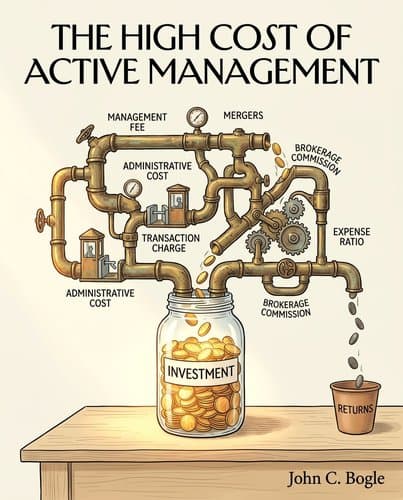
171127_the-little-book-of-common-sense-investing
by John C. Bogle
The financial industry is mathematically guaranteed to transfer your wealth to itself—unless you fight back with radical simplicity.
In Brief
The financial industry is mathematically guaranteed to transfer your wealth to itself—unless you fight back with radical simplicity. Bogle reveals why owning low-cost index funds and never trading is the only strategy that consistently beats professional money managers over time.
Key Ideas
Calculate all-in fund costs carefully
Calculate your all-in fund costs: expense ratio + estimated turnover cost (1% per 100% turnover) + any sales load amortized over your holding period. If the total exceeds 0.5%, you're paying for underperformance.
Automatic investing beats market timing
The gap between a fund's reported return and your actual return is almost always negative — driven by buying after good years and selling after bad ones. The cure is automatic investing on a fixed schedule, regardless of what the market just did.
Ask adviser about index funds
Before hiring any financial adviser, ask one question: 'Do you recommend low-cost index funds as the core of my portfolio?' If they don't have what William Bernstein calls 'asset-class religion,' don't hire them.
Survivorship bias hides fund failures
Survivorship bias makes active fund performance look far better than it is — the graveyard of failed and merged funds is excluded from every comparison you've ever seen. When someone shows you a fund's long-term record, ask how many funds from that era no longer exist.
Age-based bond allocation strategy works
A bond allocation roughly equal to your age (e.g., 60% bonds at age 60) in low-cost bond index funds is a practical starting point for balancing growth and stability — and even here, costs matter more than manager selection.
Cap stock picking at five percent
If you need a small account to satisfy the urge to pick stocks or chase active managers, cap it at 5% of your portfolio ('funny money'). Track it rigorously against your index fund core for five years. The comparison will be instructive.
High costs destroy lower returns
In a lower-return environment — which Bogle projected at roughly 7% nominal — a 2.5% cost burden consumes 40% of your return. The lower the expected market return, the more catastrophic any cost above the minimum.
Who Should Read This
Business operators, founders, and managers interested in Investing and Personal Finance who want frameworks they can apply this week.
The Little Book of Common Sense Investing: The Only Way to Guarantee Your Fair Share of Stock Market Returns
By John C. Bogle
9 min read
Why does it matter? Because the financial industry has engineered a system that guarantees it wins and you lose — and the math is embarrassingly simple.
Here is the number that should bother you: 69. Invest ten thousand dollars in the stock market over a fifty-year career, and — assuming a reasonable historical return — the financial system will keep roughly sixty-nine cents of every dollar your money earns, while you keep thirty-one. You assumed all the risk. You provided all the capital. They provided the invoice. This isn't a scandal that gets reported; it's arithmetic, which is quieter and more permanent than scandal. American capitalism genuinely does compound wealth — corporations have delivered nearly ten percent annually for over a century, and that number, left alone, turns modest savings into genuine fortunes. The question John Bogle spends this book answering is deceptively simple: what happens when that ten percent is not left alone?
Capitalism Builds Wealth. The Financial Industry's Job Is to Intercept It.
Think of the stock market like a racetrack: the house takes its cut before winners collect, so bettors in aggregate always walk out poorer. The financial industry operates on identical logic.
What makes this worth understanding: capitalism genuinely does create wealth. Over the past century, American corporations have earned roughly 9.5% annually on their capital. Compounded over four decades, a single dollar invested in the U.S. economy would grow to nearly $38. That is real. That is the prize on offer.
Now consider what happens to that prize in practice. Bogle tells the story of an imaginary family called the Gotrocks, who collectively own every share of every American company. Each year they receive all the dividends and all the earnings growth — 100% of whatever corporate America produces. Then, gradually, they make a series of decisions that seem reasonable in isolation. First, some cousins hire brokers to swap stocks around, hoping to get a bigger slice than their relatives. The brokers charge commissions. The family's total share of the pie shrinks. So the cousins hire professional stock pickers, figuring expertise will recover the lost ground. The managers charge fees, trade furiously to justify their salaries, and generate additional tax bills. The share shrinks further. Finally, the cousins hire consultants to help them choose better managers. More fees. More shrinkage. By the time the family sits down to assess the damage, their 100% share of corporate earnings has fallen to 60%.
Nothing about the underlying businesses changed. The corporations kept producing. What changed was how many hands the returns passed through before reaching the owners. The brokers, managers, and consultants — the "Helpers" — collected their fees regardless of outcome, because their pay was tied to activity, not results. The tab for all this help runs to something like $400 billion a year, extracted from returns that would otherwise belong to the people who actually own the companies.
The Number That Should Make You Furious: You Took All the Risk and Got 31% of the Profit
The financial industry has engineered a perfect swindle: you provide all the money, you absorb all the risk, and at the end of your investing lifetime you receive less than a third of the profit.
Here is the arithmetic, stated plainly. Assume the stock market returns 8% annually and you invest $10,000 for fifty years. Left alone to compound, that money grows to $469,000. That is what capitalism was prepared to hand you. Now introduce the costs of the average mutual fund — roughly 2.5% per year, a figure that sounds small because it is expressed as a percentage rather than a dollar amount. The net return drops to 5.5%. After fifty years, your $10,000 has grown to $145,400. The gap is $323,600.
You provided every dollar of capital. You bore every dollar of risk. If the market had collapsed, the fund manager still collected her fee. And after five decades, the financial system — which put up nothing and risked nothing — walked away with 69% of the wealth that compounding was building on your behalf. You got 31%.
The mechanism that produces this outcome is not fraud. It is arithmetic made invisible by the way costs are quoted. No fund prospectus shows you a line reading
The Gap Nobody Talks About: Your Fund's Returns Are Not Your Returns
Before you look at another fund's performance chart, consider one question: does the return printed on that chart have anything to do with the return you would actually earn?
Almost certainly not — and the gap between the two numbers is where the real damage happens.
The most damning illustration: five of the largest aggressive growth fund families, 1996 to 2005, reported a cumulative gain of 112 percent. Nearly a decade of perfectly acceptable results. On paper, the story looks fine. But investors did not spread their money evenly across those ten years. They watched these funds post 21% annual gains through the late 1990s, and then they poured in. More than $150 billion flooded in near the peak, mostly in 1999 and 2000, just before everything reversed. The investors who arrived late absorbed the full force of the decline. The average shareholder in those funds suffered a cumulative loss of 4.5%. A 117-percentage-point gap between what the fund reported and what a human being actually received. (Bogle calls this the difference between a time-weighted return — how a single share performs over time — and the dollar-weighted return an investor actually experiences, which depends on when money moved in and out.)
This is a story about a predictable emotional sequence: a rally builds, marketing amplifies it, money rushes in at the top, and the crash wipes out the people who arrived just in time to catch it. Across all equity funds over the 25 years ending in 2005, the average fund reported a 10% annual return. The average investor in those funds earned 7.3% — a 2.7-percentage-point annual penalty paid not to any manager, but to their own behavior.
The fees discussed earlier were a first layer of extraction. This is a second, often larger layer — and unlike fees, it is self-inflicted. The financial industry did not force anyone to chase the peak. But it did organize speculative funds precisely when demand was highest and advertise their recent returns in ways calculated to trigger the very behavior that would destroy the buyers. The money poured in because the marketing worked. The losses followed because the arithmetic was always going to work too.
Past Performance Doesn't Predict Future Returns. It Predicts Future Disappointment.
Imagine you are scanning a list of mutual funds from 1970, searching for the one that will carry your savings through the next four decades. You study the track records. You pick something that looks solid. What you cannot see — because the industry has no incentive to show you — is the graveyard.
Of the 355 equity funds that existed in 1970, 223 had disappeared entirely by 2006. Not restructured. Gone. Nearly two-thirds of the field, vanished. You can safely assume it wasn't the winners that closed: it was the laggards, quietly buried when their management companies decided they weren't exciting enough to market anymore. The graveyard is real. It just doesn't show up on the performance charts you're handed.
Of the 131 funds that survived, only 24 beat the S&P 500 by more than one percentage point annually. Fifteen of those 24 beat it by so little — under two percentage points — that luck and skill are statistically impossible to separate. Strip those away and nine genuine long-term winners remain. But six of those nine peaked decades ago, when they were small enough to be nimble, and have lagged ever since. Three funds, out of 355. Less than one percent.
Whether those three won through skill or fortune is not a rhetorical question. Statistician Ted Aronson calculated that, given the normal variability of market returns, you'd need up to 800 years of data to know whether a manager's edge was real or just luck. You do not have 800 years. Neither does the manager — the average fund portfolio manager lasts five years on the job before moving on or being replaced.
This is the compound trap the prior sections were building toward. Fees drain your returns whether the manager wins or loses. Your own behavior — rushing in after a hot streak — costs you further. And now a third layer: the performance history you use to select a fund is built from survivors, hiding the mass extinction of everything that failed. The odds against picking a sustained winner were never one in fourteen. They were always closer to one in a hundred, and no one was required to tell you that.
Every Escape Route Has a Toll Booth — Advisers, Star Ratings, and 'Smart' Indexes All Charge Entry
Every alternative to the plain index fund comes with a toll booth. Some are obvious. Most are disguised as help.
Start with financial advisers. The instinct to hire one is reasonable — the fund landscape is genuinely complex, and the mistakes a good adviser prevents (chasing last year's hot fund, panic-selling in a downturn) can be worth real money. But the evidence on the core promise — that advisers select funds that beat the market — is brutal. Broker-sold fund investors earned 2.9% annually against 6.6% for people who bought on their own, a gap that cost the advised group roughly $9 billion per year. The most vivid illustration of how this happens: in March 2000, at the precise peak of the internet bubble, Merrill Lynch launched two "new economy" funds and collected $2 billion from clients. The worse of the two lost 86% of its value before Merrill quietly merged it away to stop the embarrassment. The other shed 79% cumulatively. Two billion dollars in, most of it gone. The funds were not designed to fail — they were designed to sell, which is a different objective entirely, and it produces different outcomes.
If professional advice doesn't solve the problem, what about more sophisticated index strategies? The financial industry's answer is fundamental indexing — portfolios weighted by corporate revenues, dividends, or cash flows rather than market capitalization. The promoters are not shy about what they think they've accomplished: they compare themselves to Copernicus overturning ancient astronomy. What they don't announce is that their claims rest on back-tested data, selected specifically because it showed outperformance. No one builds a marketing campaign around a methodology that lagged. And the historical edge, even if real, is unlikely to last. Any undervaluation a strategy claims to exploit will attract capital until the undervaluation disappears. Value stocks were genuinely cheap in 1980; by 2000, everyone knew it, and the easy money was gone. The strategy that was right in the past becomes wrong in the future for the precise reason it was right — everyone piles in.
Every escape route circles back to the same arithmetic. The market's return is fixed. Every layer of management, advice, or complexity takes a cut before that return reaches you. The toll booths are real. The roads they guard don't go anywhere the index fund can't take you for free.
The Father of Stock-Picking Said: Stop Picking Stocks
In 1976, a journalist sat down with Benjamin Graham — the man who had invented the idea of analyzing stocks for a living — and asked him a simple question: could professional money managers, as a group, beat the market? Graham, then 82, had spent six decades teaching the world how to find undervalued securities. His textbooks defined the craft. His students ran Wall Street. And his answer was no. It was a logical contradiction, he explained — the professionals are the market, so collectively they cannot beat themselves. Asked whether ordinary investors should accept the market's return instead, he said yes. He went further: investors had no reason to settle for results inferior to an index fund, or to pay standard fees to get worse.
That interview happened at the precise moment John Bogle was launching the world's first publicly available index fund. The father of stock-picking, in his final years, had arrived at the same conclusion as the man he had never met.
It gets harder to dismiss. In 2006, Warren Buffett — Graham's most successful student, and the most celebrated investor alive — sent Bogle a personal note confirming that Graham had endorsed the index fund concept years before it existed in any formal way. Buffett's own position was unambiguous: for the great majority of investors, a low-cost index fund was the most sensible equity investment available. This was not a reluctant concession from someone who had given up on analysis. Buffett had spent his life proving that superior stock selection was possible. He simply concluded it wasn't possible for most people, most of the time — and that pretending otherwise cost them dearly.
Indexing feels like surrender only if you assume the alternative is winning. For nearly everyone, the alternative is paying heavily for the privilege of losing to the market. What Graham and Buffett actually concluded — after more combined decades of rigorous analysis than most institutions have existed — is that accepting the market's return isn't mediocrity. It's the only honest answer.
What that answer looks like in practice is simpler than most people expect.
The Simplest Portfolio Is Also the Most Powerful One
An 85-year-old man sat down and wrote a letter to John Bogle. He had never earned more than $25,000 in any single year of his working life. He had started investing in 1974 with $500. He bought index funds and bond funds, and when markets fell and every instinct said to flee, he remembered Bogle's advice and stayed put. When he tallied his holdings at the start of 2004, the total came to $1,391,407. No stock-picking. No manager selection. No timing the market. Just the arithmetic of owning American business at low cost, running for three decades without interference.
That letter is the whole argument, made flesh.
The strategy it illustrates is almost offensively simple. Put at least 95% of your investment assets into low-cost index funds tracking the total stock market — Bogle calls this the Serious Money account, the one that actually builds wealth. Whatever gambling impulse remains can go into a Funny Money account capped at 5% of your portfolio: a few individual stocks, maybe an active fund you genuinely believe in. The fun won't kill you at 5%. At 95%, it would.
For the Serious Money portion, one rule governs everything: costs are the enemy. Not market volatility, not the wrong sector bet, not bad luck — costs. A Vanguard S&P 500 index fund charges 0.09% annually. A Wells Fargo product tracking the identical index charges 0.80% plus a 5.5% sales load. On a $10,000 investment over two decades, that difference produced $23,600 less in profit for the Wells Fargo investor. The portfolios were identical. The only variable was how much each fund extracted before passing your returns back to you.
The math was always on your side. The industry just needed you not to notice.
The Arithmetic Doesn't Care About Your Story
An 85-year-old who put $6,500 into an index fund forty years ago and never touched it is sitting on roughly $1.4 million. The arithmetic for that outcome has always been available. The only thing standing between any investor and that number was an industry with a direct financial interest in making the math seem harder than it is. Graham spent sixty years mastering stock selection and concluded you shouldn't bother. Buffett spent his life proving genius was possible and told you not to count on it. Samuelson compared the index fund to the wheel. When the architects of the system you're opting out of all arrived at the same door, it wasn't surrender. It was honesty. The only move left is to stop moving, let time work, and don't let anyone take a cut of what the market is already building for you.
Notable Quotes
“Well, we failed to pick good stocks for ourselves, and when that didn’t work, we also failed to pick managers who could do so,”
“Just pay us a fee for our services,”
“and all will be well.”
Frequently Asked Questions
- What is The Little Book of Common Sense Investing about?
- The book presents a mathematical case that active fund management systematically transfers wealth from investors to the financial industry through costs and underperformance. Bogle shows that owning a low-cost total market index fund, trading as little as possible, and holding for the long term is the one reliable strategy for capturing your fair share of stock market returns. Published in 2007, it challenges conventional wisdom about active stock picking and mutual fund management.
- What investment strategy does Bogle recommend?
- Bogle recommends investing in low-cost total market index funds and holding for the long term. He emphasizes automatic investing on a fixed schedule, regardless of market conditions, because the gap between a fund's reported return and your actual return is almost always negative—driven by poor timing decisions. He suggests a bond allocation roughly equal to your age (e.g., 60% bonds at age 60) in low-cost bond index funds as a practical starting point for balancing growth and stability.
- What should you ask before hiring a financial adviser?
- Before hiring any financial adviser, ask one question: "Do you recommend low-cost index funds as the core of my portfolio?" If they don't have what William Bernstein calls "asset-class religion," don't hire them. This question reveals whether the adviser prioritizes your financial interests or higher-fee products. Any adviser without commitment to low-cost index funds likely prioritizes their compensation over your returns, making them unsuitable regardless of credentials, experience, or past performance records.
- How much do fund costs reduce your returns?
- Costs impact returns more significantly than most investors realize. Calculate your all-in fund costs: expense ratio plus estimated turnover cost (1% per 100% turnover) plus any sales load amortized over your holding period. If the total exceeds 0.5%, you're paying for underperformance. In a lower-return environment—which Bogle projected at roughly 7% nominal—a 2.5% cost burden consumes 40% of your return. The lower expected returns are, the more catastrophic costs become.
Related Book Summaries
Read the full summary of 171127_the-little-book-of-common-sense-investing on InShort