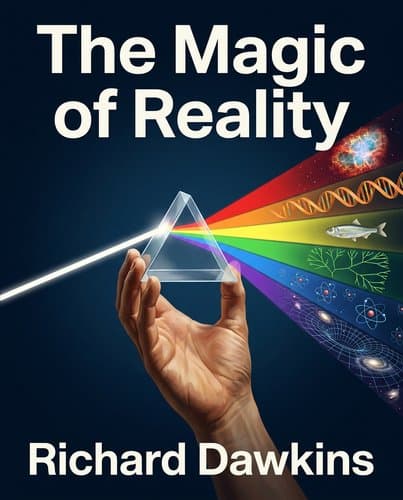
11256979_the-magic-of-reality
by Richard Dawkins, Dave McKean
Every myth reveals what humans wish were true; every scientific explanation reveals something stranger and more wondrous than the myth imagined.
In Brief
Every myth reveals what humans wish were true; every scientific explanation reveals something stranger and more wondrous than the myth imagined. Dawkins dismantles supernatural thinking chapter by chapter, replacing it with verified reality—from empty-space atoms to stardust origins—proving the universe needs no embellishment to inspire genuine awe.
Key Ideas
Supernatural claims close inquiry prematurely
When someone labels something 'supernatural,' they're not offering an explanation — they're declaring the question closed. Treat it as a red flag, not an answer.
Imperceptible change separates all species
The 40-mile bookshelf thought experiment is a portable cure for human exceptionalism: every pair of neighbors on that shelf is the same species, but you at one end and a fish at the other are separated by 185 million generations of imperceptible change.
Solidity emerges from electromagnetic forces
Solidity is not a property of matter — it's a property of electromagnetic forces. The rock under your feet is almost entirely empty space, which means 'solid' and 'empty' describe force relationships, not the presence of stuff.
False testimony more likely than miracles
Before accepting any miracle story, apply Hume's test: would it be more miraculous for this testimony to be false than for the miracle to be real? In virtually every documented case, the false-testimony option wins by an astronomical margin.
Supernovae scattered carbon in our bodies
'We are stardust' is not poetry — it's nuclear physics. Elements heavier than iron only form in supernovae, so the carbon in your body was scattered by a dying star. This is more awe-inspiring than any creation myth, and it's checkable.
Each observer sees unique rainbow geometry
The rainbow you see is private: its geometry is calculated from your specific eye position, and the person standing next to you is seeing light from entirely different raindrops. Reality is more intimate and stranger than any myth that treats it as a shared, fixed bridge.
Cultural fears shape sleep paralysis visions
Sleep paralysis — the body staying paralyzed while the mind wakes — produces hallucinations shaped by whatever the culture currently fears. Medieval Europeans saw demons; people today see aliens. The biology is identical. This is a one-sentence explanation for centuries of 'supernatural visitation' stories.
Who Should Read This
Science-curious readers interested in Evolution and Physics who want to go beyond the headlines.
The Magic of Reality
By Richard Dawkins & Dave McKean
12 min read
Why does it matter? Because the myths that comfort you are actually cutting you off from something far stranger and more wonderful.
Most people assume science is the thing that takes the color out. Strip away the gods, the myths, the fairy godmothers, and what's left feels colder, smaller, more ordinary. This book makes the opposite case — not by arguing it, but by demonstrating it, chapter by chapter, with the kind of detail that makes abstract claims suddenly, uncomfortably real. Your great-great-grandmother was a fish. The atoms in your bones are nearly all empty space. Every heavy element in your body was forged in a star that exploded before our sun existed. These aren't consolation prizes for giving up on magic. They're stranger than anything mythology ever produced. The myths, it turns out, were the timid version — human-scaled stories that underestimated the universe at every turn. Reality didn't need their help. The only question is whether you've actually seen it yet.
Calling Something 'Supernatural' Isn't an Explanation — It's a Surrender
Myths feel like explanations. A dying god stumbles across Tasmania and, in his haste, forgets to give humans bendable knees. Norse brothers find two tree trunks on a beach and breathe consciousness into them. The Hebrew god scoops dust into a man, pulls a rib to make a woman, and sets everything in motion with a single forbidden apple. These stories satisfy something in us — they answer the "why" with a who, a when, a scene you can picture. The problem is that they don't actually explain anything. They only push the mystery back a step and then quietly lock the door.
Dawkins makes this point with the sharpest analogy in the book. Imagine a detective who arrives at a murder scene, looks around, and writes "supernatural" in his notebook. Case closed. We wouldn't call that detective mysterious or humble — we'd call him lazy. The label doesn't name a cause; it names a refusal to look for one. And that's precisely what a supernatural explanation does. To say the sun crosses the sky because Helios drives a flaming chariot isn't just to say "we don't know how the sun moves" — it's to say "we will never know, so stop asking." Science treats every gap in knowledge as an open question rather than a locked room. The history of the last four centuries is largely a list of things once attributed to gods or spirits — disease, lightning, earthquakes — that are now understood well enough to treat, predict, and sometimes prevent.
The distinction matters because it changes what you do next. Not-knowing is a starting point. Supernatural is a full stop. One of them has produced antibiotics, telescopes, and the discovery that you share ancestors with every living thing on Earth. The other produced kangaroo tails on the first humans, according to one Aboriginal creation story.
Your Great-Times-185-Million-Grandfather Was a Fish
Imagine printing one photograph of each of your direct ancestors, going back and back without stopping, and arranging them on a shelf in a single long row. You at one end. Your father next to you, then his father, then his father's father. Keep going. After 185 million photographs, the shelf stretches roughly forty miles — and the face at the far end is a fish.
The staggering thing is that no photograph in that line looks different from its neighbors. Every parent resembles its child. You look like your father, who looks like his father, just as a man in his thirties looks like himself in his forties, and his fifties. There is no single morning when you can point to someone aging and say: here is where middle age became old age. The change is real, but it lives between the frames. The same logic runs the full forty miles. Any two adjacent photos show the same species. Walk from one end to the other and you move from a human to a fish, through creatures that look in turn like apes, like small primates, like shrews — each indistinguishable from its immediate neighbors, the whole sequence impossible to dismiss.
We find this hard to feel because we can only ever hold a few frames at once. We see ourselves, we see chimpanzees, and the gap looks like a wall. That wall is an illusion of proximity — we're standing too close to the shelf to see its length. The genetic evidence confirms it. Humans and chimps differ by just nine letters out of 2,076 in a single representative gene. Nine. We are not a separate category from other animals. We are a particular page in a very long book, and the fish at the far end of the shelf is writing in the same alphabet.
The Hardest Diamond Is Almost Entirely Empty Space
What is a rock actually made of? Not the chemical answer — the structural one. If you could shrink to the scale of atoms and walk into granite, what would you find?
Almost nothing. That's the answer, and it takes a moment to stop feeling absurd.
Here's the scale model that makes it real. Take the nucleus of a single carbon atom in a diamond — already the hardest material in everyday experience — and imagine scaling it up to the size of a football. On that same scale, the nearest neighboring nucleus would sit fifteen kilometers away. The electrons orbiting each nucleus would be specks smaller than gnats, circling several kilometers out from their football. Between the footballs: a vast, near-total emptiness, with a few gnats drifting through it.
This is the diamond. The legendarily hard diamond. The thing that cuts glass and survives geological time. Fifteen kilometers of nothing between footballs, and a handful of gnats for company.
The same is true of iron, of granite, of the chair you're sitting on, of your own hand. All of it is nearly empty space — nuclei and electrons separated by distances that make "packed" matter a kind of fiction.
So why can't you push your hand through the chair? Why does the diamond scratch the glass instead of both ghosting through each other? The answer is that solidity isn't a property of stuff — it's a property of forces. The electromagnetic fields surrounding atoms resist interpenetration with other atoms' fields. What you feel as hardness, as resistance, as the reassuring solidity of the floor beneath you, is not matter pressing against matter. It's force meeting force, fields repelling fields. The actual matter involved is, by volume, almost beside the point.
The rock isn't full. The floor isn't a barrier of packed substance. Reality is mostly emptiness held in shape by invisible interactions — and the remarkable thing is that it's all checkable: every number here has been measured.
You Are Made of Dead Stars — and That Is Literally True
Every carbon atom in your body was forged inside a dying star. That sentence reads like poetry. It is actually chemistry.
Here is what the physics requires. Stars like our sun fuse hydrogen into helium, releasing heat and light. Larger, hotter stars go further — their furnaces are violent enough to smash helium nuclei together into carbon, oxygen, nitrogen, iron. But iron is a ceiling. Nothing a living star does can produce anything heavier. The elements beyond iron — copper, gold, uranium — can only be forged in a supernova, the catastrophic self-destruction of a massive star, a detonation so vast it briefly outshines an entire galaxy. Then the explosion scatters everything outward: all the carbon, all the oxygen, all the iron the dying star spent its life accumulating, flung across space in an expanding cloud of dust.
Our sun condensed from one of those clouds. So did Earth. So did you. Every carbon atom knitting your proteins together, every oxygen atom moving through your blood — each one was scattered by a star that burned out long before our solar system existed. 'We are stardust' is not a metaphor reaching for grandeur. It is a literal description of where your atoms have been.
Now hold that against the Aztec priests who killed between twenty thousand and eighty thousand people at a single temple dedication in 1487, offering still-beating hearts because they feared that without this gift the sun would simply stop rising. They were asking the right question — what keeps the sun burning? — with none of the tools to find the real answer. The sun is a nuclear furnace held in shape by the balance between gravity pulling inward and the pressure of fusion pushing out, a self-regulating engine that will run for another five billion years regardless of what happens on Earth. No sacrifice ever touched that balance by a single degree.
What actually keeps it burning is stranger than anything the priests imagined. At the sun's core, fourteen million degrees of temperature and the crushing weight of a star press hydrogen nuclei close enough together to fuse — a process that has been running for four and a half billion years and will run for five billion more, untouched, automatic, indifferent. The light that fusion produces takes a hundred thousand years to fight its way from the core to the surface. Then eight minutes to reach your eyes. Every sunrise you have ever seen was already eight minutes old by the time it hit you.
No Two People Have Ever Seen the Same Rainbow
Two people standing side by side at a picnic both look up and say they can see a rainbow. They are wrong to think they're seeing the same one.
Here's the geometry. Red light exits a raindrop at roughly 42 degrees to the incoming sunlight; blue exits at about 40 degrees. Because those exit angles are fixed, your eye can only receive the red light from drops sitting at exactly the right angle relative to you — which means relative to your head, your height, your precise position on the grass. The person standing next to you is in a different position. Their red light is coming from a completely different set of raindrops. So is their blue, their green, their violet. You are not sharing a rainbow. You are each watching a private light show assembled specifically for your eyes, by a different collection of water drops, at this moment, from this spot. Shift a few feet to the left and your rainbow shifts with you. The arch doesn't sit in the sky like a bridge. It has no fixed location. It exists only in the relationship between a light source, a curtain of drops, and one particular observer.
Newton glimpsed the strangeness first when he pushed a beam of sunlight through a glass prism in 1666 and watched it fan into colors. His discovery wasn't the spectrum itself — people had seen that before — but what it meant. The prism wasn't adding color to the light. The colors were already there, packed invisibly inside the white beam, waiting to be pulled apart. White light is a rainbow in compression. Every sunrise, every lamp, every candle is already carrying all of this inside it.
The Universe Handed Us a Receipt for Its Own Birth
How do you prove, from where you're standing, that the universe has a birthday?
The honest answer is that you follow a chain of measurement. Not belief, not authority — measurement. And it starts with something you can do right now: hold a finger in front of your face and close one eye, then the other. The finger hops against the background. That hop is parallax — your two eyes sitting a few inches apart create slightly different angles to the same object. Earth's orbit gives astronomers the same trick at planetary scale. Observe a nearby star in January, then observe it again in July when Earth has moved 186 million miles to the opposite side of its orbit. Close stars hop against distant ones. From the size of the hop, you calculate the distance. Precisely. No guessing.
Parallax runs out for stars too far away to hop noticeably, so astronomers reach for a second tool: stars whose actual brightness is known, so distance can be read from how dim they appear. Farther still, and the spectroscope takes over — the same instrument that explains rainbows. Spread starlight across a spectrum and certain elements leave dark lines at fixed positions, a chemical barcode. Hydrogen always marks the same place. Sodium always marks the same place.
Edwin Hubble looked at these barcodes in distant galaxies and found them shifted — systematically pushed toward the red end of the spectrum. Not scrambled, not random: shifted, and shifted further in proportion to the galaxy's distance. This is the Doppler effect in light. A receding source stretches its own waves, the way a trumpeter running away from you plays in a lower key. Every distant galaxy is receding, and the further away it is, the faster it recedes. Run that film in reverse and everything in the universe converges toward a single point, roughly 13.8 billion years ago.
Dawkins admits he cannot properly imagine what it means to say that time itself began there. The question of what came before may simply be malformed — like asking for the address of a number, or the color of jealousy. Time began with the universe, so 'before' has no foothold. But notice what he's actually admitting: a limit of imagination, not a limit of evidence. The chain of measurement — finger-hop to standard candle to barcode to red shift — doesn't require you to picture the beginning. It requires only that you follow where the numbers lead. The Big Bang isn't a story told because we need one. It's a conclusion the universe left receipts for.
The World Is Not Out to Get You — Except When It Is
Imagine waking in the dark, completely aware — you can see your bedroom ceiling, hear the house settling — but you cannot move a single muscle. Something is in the room with you. You feel it with absolute certainty. In medieval Europe, the creature crouching on your chest was a demon or a hag. In seventeenth-century New England, a witch. Today, for someone raised on science fiction, it tends to be a grey-skinned figure with enormous eyes. Same biology, different costume. The experience is called sleep paralysis: the brain wakes before the mechanism that releases the body from its dreaming stillness, and hallucinations flood the gap. The imagery is borrowed wholesale from whatever the surrounding culture most fears. There is no demon, no witch, no alien — only a nervous system briefly out of sync with itself, reaching for the nearest story to explain the dread.
Myths do the same work: they fill sleep-paralysis-sized gaps with whatever frightening shapes the culture has on hand. The universe isn't punishing you. The earthquake doesn't single you out. The toast lands marmalade-side down roughly half the time, and we only remember the mess.
But the argument folds back on itself in a genuinely surprising way. For a rabbit, a fox actually is designed by natural selection to be its undoing. Not metaphorically. The fox's speed, its stealth, its entire architecture has been refined over millions of generations for the specific purpose of being catastrophic for rabbits. The universe is indifferent; biology is not. That distinction is worth sitting with. A storm and a virus can both destroy you, but they are different kinds of enemy. The storm has no strategy to outmaneuver, no weakness shaped by evolutionary pressure. The virus does — and so does your immune system's response to it. Knowing which kind of 'bad' you're facing tells you whether to seek shelter or a vaccine.
A Miracle Is Just a Lie We Haven't Tested Against the Math Yet
In October 1917, some seventy thousand people gathered in a field in Fatima, Portugal, many of them pilgrims who had traveled for days expecting a sign from heaven. What they reported seeing — the sun spinning, changing colors, plunging toward Earth — became one of the most cited miracles in modern religious history. Seventy thousand witnesses. How do you argue with that?
You reach for Hume's test, which is simpler than it sounds: don't try to disprove the miracle. Just compare two probabilities. How likely is it that seventy thousand people, primed for weeks by prophecy and expectation, standing in a crowd, looking directly at the sun, experienced a shared hallucination, a trick of overloaded retinas, a ripple of mass suggestion? And how likely is it that the sun — a nuclear furnace eight light-minutes away, the gravitational anchor of every planet in our solar system — actually lurched out of position? Because if it had moved at the speed witnesses described, Earth's orbit would have been shattered. The planet would have been flung into freezing darkness or dragged into incineration. The miracle, if real, would have killed everyone who witnessed it. So you are not choosing between 'miracle' and 'no miracle.' You are choosing between a crowd that saw what it expected to see, and a physical catastrophe that somehow left no other trace on Earth or in the astronomical record.
That comparison is Hume's razor: accept a miracle only when its falsehood would itself be more miraculous than the event. The philosopher's point wasn't that miracles are impossible — it was that you never need to prove them impossible. You only need to ask which story requires the universe to bend further. A crowd of pilgrims overwhelmed by expectation and solar glare, or the sun violently abandoning the orbit it has held for four billion years?
The math always favors the mundane — not because the mundane is comfortable, but because the universe demonstrably bends for it all the time. This is not lost certainty. It is a sharper tool than faith in any particular account: the recognition that testimony, however voluminous, is still softer evidence than physics. You don't walk away from Fatima having disproved anything. You walk away knowing how to weigh stories — which is something you can use every day, on claims far smaller than dancing suns.
What the Myths Were Actually Reaching For
The myth-makers were not wrong to feel the awe — they were wrong about where to aim it. Every story in every culture was reaching toward the same thing: an explanation worthy of how strange and improbable all of this feels. They just didn't have the instruments. You do. The supernova that forged your carbon, the fish that preceded you by 185 million generations, the rainbow assembled this instant from a specific curtain of drops for your eye alone — none of that requires a story on top of it. It already is the story. What science hands back is not a stripped-down version of wonder with the warmth removed. It is the actual object the myths were always groping toward in the dark. Right now, somewhere in your hand, there is a carbon atom that spent billions of years inside a dying star before it became part of you. That's not a metaphor. That's where you came from.
Frequently Asked Questions
- What is The Magic of Reality about?
- The Magic of Reality uses myth and science side by side to answer fundamental questions about nature, life, and the universe. Richard Dawkins demonstrates how scientific explanations—from evolution and atomic structure to rainbows and supernovae—are not only more accurate than myths but more astonishing. The book teaches readers to treat 'supernatural' as a red flag rather than an answer: when someone labels something supernatural, they're not offering an explanation—they're declaring the question closed. Dawkins provides a reliable framework for distinguishing evidence-based thinking from superstition.
- What does Dawkins mean by 'we are stardust' in The Magic of Reality?
- 'We are stardust' is not poetry — it's nuclear physics. Elements heavier than iron only form in supernovae, so the carbon in your body was scattered by a dying star. This scientific claim is more awe-inspiring than any creation myth, and it's checkable. Dawkins emphasizes that the elements comprising human bodies literally originated from stellar explosions billions of years ago. Rather than diminishing our significance, understanding this cosmic origin connects us directly to the universe's most violent and creative events, transforming how we view our place in nature.
- How does The Magic of Reality explain supernatural visitation claims?
- Dawkins explains centuries of 'supernatural visitation' stories through sleep paralysis—a physiological state where the body remains paralyzed while the mind wakes, producing hallucinations shaped by cultural fears. Medieval Europeans saw demons; people today see aliens. The biology is identical. Additionally, Dawkins applies Hume's test to miracle claims: before accepting any miracle story, ask whether it would be more miraculous for the testimony to be false than for the miracle to be real. In virtually every documented case, the false-testimony option wins by an astronomical margin, providing a rational framework for evaluating extraordinary claims.
- What is the 40-mile bookshelf thought experiment in The Magic of Reality?
- The 40-mile bookshelf is a thought experiment that addresses human exceptionalism and evolution. Imagine every pair of neighbors on a shelf represents the same species, but you at one end and a fish at the other are separated by 185 million generations of imperceptible change. This visualization demonstrates how evolution works through countless tiny, indiscernible steps rather than dramatic jumps. Dawkins uses this concept as a portable cure for human exceptionalism, showing that the vast gulf between humans and other species emerges gradually through incremental modifications, revealing evolution's power to create apparent discontinuity through continuous, subtle transformation.
Related Book Summaries

Read the full summary of 11256979_the-magic-of-reality on InShort