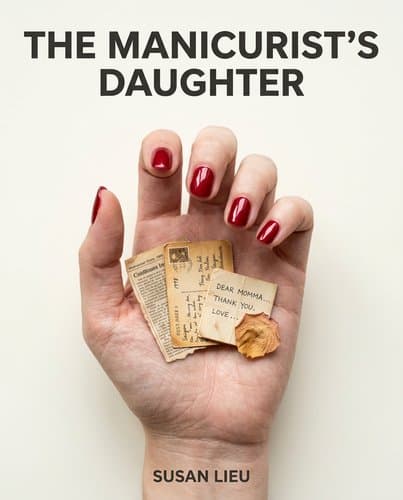
127305940_the-manicurist-s-daughter
by Susan Lieu
A Vietnamese-American daughter breaks twenty-four years of family silence to uncover the truth behind her mother's preventable death—and discovers that…
In Brief
A Vietnamese-American daughter breaks twenty-four years of family silence to uncover the truth behind her mother's preventable death—and discovers that grieving what you never had and building who you need to become are not separate journeys, but the same one.
Key Ideas
When Survival Strategies Become the Emergency
Silence inside immigrant families often functions as a survival strategy, not a character flaw — but survival strategies that outlast the emergency become the emergency. Recognizing this distinction is the first step toward addressing inherited trauma rather than just perpetuating it.
Documents Speak What Families Cannot
When you cannot get answers from the living, the documents tell a different story. Medical records, depositions, and legal filings contain the version of events that nobody in the family was willing to speak aloud — and reading them changes what you think you know about both the villains and the victims.
Learning to Read Unspoken Love
The way people who raised you express love may be completely illegible to you. Before concluding that you were unloved, consider whether the love was in a language you were never taught to read — acts of service, silent sacrifice, kept receipts — and what it would mean to learn that language now.
Confrontation Works Through Boundaries, Not Apologies
Confronting family members about harm they've caused is most effective when it is specific, tied to real consequences, and delivered without requiring them to apologize on your timeline. Susan's confrontation of Dì Ngân works not because it produces verbal contrition but because it draws a line that changes future behavior.
Vulnerability Creates Space for Mutual Recognition
Performing or sharing difficult personal truth publicly is not automatically exploitative. The test is whether it creates space for others to process their own version of the same experience — and whether the people in the story eventually recognize themselves in it with something other than shame.
Breaking Cycles Requires Naming the Grief
Intergenerational trauma does not break itself. It requires someone in the lineage to consciously interrupt it — to name what happened, to grieve it rather than bury it, and to make different choices when raising the next generation, even when those choices feel like betrayal of the old world.
Who Should Read This
Readers who connect with first-person stories about Memoir and Mental Health and want to see the world through someone else's eyes.
The Manicurist's Daughter
By Susan Lieu
13 min read
Why does it matter? Because the silence your family calls survival might be the very thing killing you.
Here is the story you think you know: refugee family escapes Vietnam on a boat, works seven days a week in a nail salon, buys the two-story house, sends the kids to Harvard. The American dream, delivered on schedule. What the story omits is the mother who died on an operating table in San Francisco getting a tummy tuck — elective, cosmetic, entirely preventable — while her eleven-year-old daughter's last words to her were I hate you. And then the part that might be worse: twenty-four years of total silence after, a family so fluent in survival they simply erased her, the way you throw out trash, which is, in fact, the literal meaning of the Vietnamese verb they used. Bỏ qua đi. Let it go. Susan Lieu refused. She hired lawyers, attended psychic sessions, and performed the whole excavation onstage for strangers. This is what she found.
The Six Tones of Ma: How One Word Contains an Entire Family's Buried History
Think of a family that has one word for everything it refuses to say. In Vietnamese, a single syllable — ma — shifts its entire meaning based on tone. Add one diacritical mark and you move from ghost to mother to tomb to the verb for letting go, which shares its root with throwing away trash. Susan Lieu, the youngest child of Vietnamese refugees who built a nail salon empire in California, spent over two decades watching her family weaponize that last meaning. Whenever she pressed for details about her mother's death, her father cut her off: bỏ qua đi. Let it go. Throw it away.
Then 1996. A tummy tuck in San Francisco performed by a surgeon who had already been sanctioned by the medical board twice and carried no malpractice insurance. Má lost oxygen to her brain for fourteen minutes before the surgeon called for help. Five days later, she was gone at thirty-eight.
What the success story omits is this: after Má died, the family didn't grieve together — they each went silent alone. No one gave Susan memories. No one named what happened. The woman who had built a two-story home within eight years of arriving penniless, who ran the salon from the head table nearest the door, who was so formidable that neighborhood children feared her more than their own parents — that woman became an absence with no edges. At least a myth, Susan writes, gives you details. What the family gave her was erasure — which is how her mother died a second time, not in a surgical suite but inside the people who survived her.
A Mother Who Ran Toward the Impossible — Even When It Killed Her
The fourth escape attempt looked like the one that would finally work. The signal came through, the boys were given sleeping medicine so they wouldn't cry in the dark, and the family slipped down to the docks without a Communist officer in sight. Then a man shouted the warning — police — and the shore exploded into chaos. Ba dropped the older boy at Má's feet and ran for the jungle alone; men who were caught went straight to prison. Má kicked off her waterlogged sandals and ran barefoot, carrying one child on each hip, into a thorny maze of jungle she couldn't see. She ran through it anyway. Night became day became night again. She and the boys licked dew off leaves to stay alive. When she finally stumbled out and found a jungle couple willing to guide her home, her feet were so full of thorns they looked completely black. Her sister spent the better part of that night pulling out spikes with a needle, Má howling and gripping the hammock frame.
Two weeks later, Má sent her sister back to stand watch at her house as a decoy. She was trying again.
Susan Lieu eventually has to reckon with a pattern: her mother didn't take catastrophic risks despite knowing the odds — she took them because of the odds. Someone who could run barefoot through thorns with two toddlers and then get back up and try again was someone whose entire operating logic was built on the idea that the worst outcome was staying still. That logic worked. It produced the underground gambling network that funded the escape, the boat journey to Malaysia, the refugee camp, the gardening company started by men who learned the trade by watching strangers through chain-link fences, the nail salon empire named after the first daughter born on American soil.
The same calculus that carried Má from a Mekong Delta village to a two-story house in Northern California also, eventually, carried her into the office of an uninsured San Francisco surgeon who had already been disciplined twice. She wanted a tummy tuck. She was thirty-eight. She believed, as she always had, that the reward was worth the risk — that the right amount of will could bend the outcome her way. For once, it couldn't.
'I Hate You' — The Last Words That Drive a Twenty-Four-Year Investigation
On the morning of volleyball tryouts, Susan's mother appears in the kitchen earlier than expected and Susan, caught off guard, confesses everything immediately. The argument is the same one they've been circling for weeks: twenty dollars for the jersey, grades to protect, a mother who will not bend. Susan pulls at her sleeve. Má refuses. And then the words arrive — 'I hate you' — blurted out in a kitchen in Northern California, and then Susan slams the door and stomps to school and makes the volleyball team, and none of that matters because three days later her brother Hang shows up in the driveway on a Friday he was never supposed to be home, his eyes rabid, repeating the same sentence: Má is in a coma in San Francisco.
At UCSF, Susan can barely recognize her own mother. The woman who ran that salon with the force of a small government is now a yellow, swollen figure threaded through with tubes, a machine doing her breathing in long exhausted sighs. The only thing Susan recognizes are the nails — Candy Apple Red, freshly polished. Her aunts drag her into the room and leave her alone with her mother's ice-cold hand, instructing her to make a wish and bring her back. What Susan actually does is bargain. She tells her mother she's sorry. She promises to quit volleyball. She reminds her that Má once said she'd come to college with her, and could she please do that, could she just come back. Her tears hit the hospital sheet faster than she can wipe them. No change registers on Má's face or on any of the monitors. The machines keep beeping, indifferent.
Má doesn't come back. And the funeral does something almost worse than the death: Susan, drowning in guilt over her last words, cannot cry. She stands in the funeral home watching the incense smoke rise, watching her aunts wail and collect themselves and wail again, and nothing comes. She waits at the open casket for her mother to open her eyes and say it was all a terrible joke. Instead she is escorted back to a pew where her sister has assembled their coping supplies — tissues, water, a sleeve of Oreos. No one hugs her. No one asks if she is all right. When the burial is finished, no one offers her the words for what just happened or permission to fall apart.
The grief finally breaks open at school, pried loose by a bully who delivers the cruelest guess as a taunt: 'What's wrong with you? Your mom die or something?' Susan runs to the yard duty lady — a stranger in a plaid dress — and hyperventilates into her sweater until there is nothing left. It is the first hug she receives in two weeks. A child who last told her mother she hated her, who could not cry at the funeral, who finally wept in the arms of someone who didn't even know her name.
Silence Is a Survival Skill That Outlasts Its Usefulness
Ba is in the front yard clipping the dead blooms off Má's eight rose trees, dropping them one by one into a soapy bucket. The aunts' room is already cleared. Bà Ngoại's cobra jar is gone. The shoe shelf that once held a hundred pairs is down to twelve. Susan has rattled his locked bedroom door, run back downstairs in his oversized sneakers, tried to stop the cars from pulling away — and found him here, doing this. He waves her off without a word.
This is not a man who doesn't feel the loss. His entire emotional vocabulary was built for endurance, not expression. When you've survived Communist Vietnam, a jungle escape, a refugee camp, and a wife's death by an unlicensed surgeon, you tend the roses. You keep the yard from going to ruin. You do not explain yourself to your thirteen-year-old, because in the world that made you, explaining yourself was never the point.
The same logic runs forward into Susan's adolescence. When she calls her father from school to tell him she got into Harvard, she is braced for the praise she has been chasing her entire life. He asks why she didn't get into Stanford. It lands like a slap — and it is meant to motivate, the way thorns were meant to slow Má down on her escape. They didn't, and neither does this. Ba is not indifferent to Susan's achievement. He simply has no template for celebrating what already exists. His daughter is about to leave, and the only thing he knows to do is point at the gap.
When Revenge Hits a Dead End, Art Becomes the Weapon
What do you do with twenty years of rage when the man you wanted to destroy is already dead? The answer, for most of Susan's life, was: keep it somewhere airtight and wait.
She graduates from Yale with a revenge blueprint — targeted Facebook ads designed to terrorize the surgeon, a billboard outside his clinic, a journalist exposé — and discovers two things in quick succession. First, the surgeon accumulated twenty-four malpractice lawsuits and was still on medical probation two decades after her mother's death. Second, he died of Parkinson's disease one month before she could act. Her lawyer friend delivers this news by phone. You can't sue a corpse. The legal window closed before she ever opened it, and the $250,000 that California law placed on her mother's life — a figure set in 1975 and never adjusted for inflation, divided five ways after legal fees, supposed to replace a woman — comes with no apology attached and never will. Ba's repeated instruction to bỏ qua đi, let it go, turns out to have been the only possible outcome all along, just not for the reasons he gave.
So Susan does what people do when they hit a wall: she signs up for a solo performance class in Seattle, intending to develop an absurdist mime involving a rainbow poncho and a hammer. A workshop facilitator named Ashlen — a woman who performs as a clown at children's birthday parties — keeps steering the conversation back to Má. Susan deflects: nobody wants to hear about a dead mother, the family would be furious, there's nothing interesting there. Ashlen doesn't argue. She just listens, and something about being listened to so carefully causes Susan to finally listen to herself. She cries into the facilitator's chest until the question she's been avoiding for two decades is the only question left. She rewrites the show in two weeks.
At a community theater in Greenwood, she places a copy of a San Francisco newspaper exposé — the original reporting on the surgeon's malpractice — on all fifty seats before anyone arrives. She wants the audience to know this isn't metaphor. When the lights go up she blanks on her opening line, sweat forming, and then the words come anyway.
The Medical Records That Turned a Villain Story Into Something Harder
After the performance in Section 5 cracked something open, Susan requested the legal files her family's old law firm had kept in a vault for two decades past their shredding date. Now she's alone in her apartment, a legal pad on the table and a marijuana gummy working its way through her system, when she opens them. She is looking for a villain. She finds one — and then something harder.
The villain is real enough. Dr. Leslie Moglen had no malpractice insurance, had been banned from operating at UCSF Mount Zion for five consecutive years, and faced nineteen prior lawsuits before Má ever sat in his consultation chair. He built his Vietnamese clientele deliberately, starting with an ad in a Vietnamese-language weekly that offered free reconstructive surgery to war casualties — a promise he later admitted he never honored because nobody requested it. The San Francisco Chronicle wrote him up as a humanitarian anyway, and the goodwill, as he called it, brought in paying customers. By 1996, Vietnamese patients made up nearly a third of his practice. His license to exploit them came courtesy of a medical board that put him on probation without limiting a single procedure he could perform, without requiring him to disclose anything to prospective patients, and without checking back in — he was still operating without consequence two years after Má's death.
All of this confirms the story Susan arrived with. Then she finds a single line buried in the medical board verdict: Má's actual weight at the time of surgery was 140 pounds. The intake form she filled out herself said 110. She wrote down the weight she wanted to be.
Susan is also 140 pounds when she reads this.
The consultation photos are in the same file — clinical shots of the chin Má wanted reduced, the nostrils she wanted narrowed, the abdomen she wanted flattened. A prior surgery notation reveals she'd already had breast implants two years earlier. The woman Susan had understood as fearless and larger-than-life was also a woman quietly chasing a number on a scale, saving money from three hundred acrylic fills to pay a predatory surgeon $5,500, doctoring her own medical forms. She was 'unusually nervous' before the procedure, anxious enough that Moglen gave her a sedative to calm her down.
Moglen was predatory; the system protected him; and Má was a woman with her own vanity and fear who walked in of her own will. Susan doesn't flinch from the discomfort — she props her laptop open in the kitchen so Má's last clinical photo, taken the day before the surgery, can watch her cook. It's an act that's equal parts grief and reckoning. She came looking for her mother, and she found her.
You Cannot Heal What You Cannot Name — But the Naming Might Cost You Your Family
The proof arrives during the postshow talkback after the Seattle world premiere. Kang, the eldest brother, sits onstage in front of 140 strangers and says that after a year of Susan's pestering, he went back and set up a home altar for Má — something he'd never done in his own house — and that it made him realize you have to stay connected to the past to move forward. He also admits that Susan's investigation had surfaced grief he thought he'd sealed off, that he'd felt as sad and empty as she had, he'd just never said so. Wendy, who once told Susan she was being rude for bringing up their mother at Christmas, says onstage that she'd been against the whole project initially, had closed that chapter and didn't want it reopened — but then she went to a show and watched it change people who had nothing to do with the Lieu family, and understood for the first time that the work wasn't about Susan getting attention. Neither sibling had said any of this directly to Susan before. They needed an audience, a moderator, a piece of theater to create the conditions for honesty.
This is the reversal the book builds toward: the family Susan experienced as cold and withholding was never indifferent to Má. Kang, at nineteen, made the decision to remove her from life support — a call their father deferred to him entirely — and had carried that weight alone for twenty years without anyone asking if he was all right. Hang, the brother who told Susan her emotions didn't matter, was a college freshman getting three phone calls a week from Má before she died, then nothing. Every person in that family was devastated. The performance didn't change them. It gave them a shared object to look at together, and looking at the same thing turned out to be close enough to talking.
The Villain Was Keeping Receipts the Whole Time
Ba is alone in his kitchen on the morning of Susan's last day in Texas, cutting open persimmons with a paring knife. He bought them that morning because she mentioned, once, the previous day, that she liked them. This is how he says things he cannot say.
The persimmons matter because of what came just before them — a striped photo album pulled from somewhere in the house, handed to Susan without explanation. Inside, she finds herself as a character in a story her father had been quietly assembling for decades. Every newspaper clipping about her performances: cut out, folded, without a single crease. Postcards she'd sent from a Zambian refugee camp, from Spain on her honeymoon, from the nail salon she'd addressed for Mother's Day cards year after year. And then something that stops her cold — a note she wrote at seventeen, thanking Ba for the airplane tickets to visit Harvard and Brown so she could make "the big decision." She had convinced herself she'd done everything alone, that he'd never supported her dreams. But there it was in her own handwriting, a thank-you to a man running a nail salon on $300 a month who had bought his daughter cross-country flights so she could choose between two Ivy League schools.
The story Susan had been telling herself — unloved, unsupported, fighting alone — wasn't false so much as it was the family's inherited way of misreading care. Ba never mentioned the newspaper clippings, so she assumed he'd thrown them away. He never praised the shows, so she read it as disapproval. But the album had been there the whole time, a private archive of a father who tracked his daughter's life with the same precision he used for everything that mattered to him: silently, without announcement, as though attention were too sacred to advertise.
He dismantles one more piece of her old story before she leaves. He was the last person to know about Má's surgery. Her mother had consulted friends, sisters, and a clinic translator before telling him. He never pushed her toward the operating table. He couldn't have stopped her. The man Susan had spent years holding partly responsible for the silence was simply another person the silence happened to.
Breaking the Cycle Requires You to Become the Thing You Were Searching For
On the drive to the hospital — March 29, 2020, Seattle roads emptied by pandemic, the whole country washing its groceries with dish soap — Marvin picks 'Appa,' the Korean word for father, without much trouble. Then he asks Susan what the baby will call her. She knows the answer. She has always known. But when she opens her mouth to say 'Má,' nothing comes out. Not a syllable. She tries again. Nothing. For twenty-four years, she had refused to say the word because she understood, at some cellular level, that it would go unanswered. Even in her solo show, the word was safe — she was playing a character, not making a real claim on a dead woman. This was different. She blows her nose on gas-station napkins from the glove box and keeps trying until something loosens, and the word scrapes out of her, small at first, then louder, Marvin squeezing her hand twice in the dark.
The moment carries the whole book's argument inside it. You cannot become a mother by achieving the right emotional state. You become one by doing the terrifying thing — by saying the name that will now be yours, even when your throat has spent two decades learning to refuse it. Susan had spent years excavating her mother's life: the jungle escape, the medical records, the 140-pound body described on the intake form as 110, the surgeon who destroyed her and went on to practice for years afterward. All of it was necessary. None of it was sufficient. What the investigation couldn't do, the labor ward could.
She names her son Art Lieu-Kim — no middle name, like both his parents. Her father renamed himself Tom after the reckless hero of a fighter-pilot movie; her mother became Jennifer on her final surgical consent form; Susan herself was handed an English name with 'USA' tucked inside it as a gift from a woman who had hustled to get here. Each name was survival in a different key. Art is something else: an act of making meaning rather than outrunning the past. The lineage continues. The trauma, Susan has decided, is the part that stops here.
What 'Má' Actually Costs to Say
The hardest part isn't the excavation — the depositions, the photographs, the weight written down wrong on a form. The hardest part is what you do after you find what you were looking for and it turns out to be more complicated than a villain. Susan Lieu spent twenty-four years learning to say one word, and when it finally came out, it came out broken, in a car, on the way to become the thing she'd been missing. That's not a resolution. That's an inheritance being consciously redirected. The question the book leaves you with isn't whether your family loved you — it's whether you've learned enough of their language to go back and read the evidence correctly. The postcards from Zambia were there. The persimmons were bought. The receipts were all there. Someone was paying attention the whole time. They just never told you, because no one ever told them that telling was allowed.
Notable Quotes
“Can we talk about something else?”
“140 pounds, though her reported weight in respondent’s consultation notes was only 110 pounds.”
“So, what has all of this been like? Being a part of Susan’s artistic process and watching your family tragedy performed onstage?”
Frequently Asked Questions
- What is The Manicurist's Daughter about?
- The Manicurist's Daughter traces one Vietnamese-American woman's investigation into her mother's preventable death and the twenty-four years of family silence that surrounded it. Susan Lieu uses medical records, legal documents, and direct confrontation to explore how inherited trauma can be named and interrupted. The memoir provides a framework for understanding immigrant family silence, grief, and intergenerational healing. It examines how survival strategies that outlast the emergency become the emergency themselves, and how documents can reveal truths that family members were unwilling to speak aloud.
- What does The Manicurist's Daughter teach about silence in immigrant families?
- The Manicurist's Daughter explains that silence inside immigrant families often functions as a survival strategy, not a character flaw. However, survival strategies that outlast the emergency become the emergency. Recognizing this distinction is the first step toward addressing inherited trauma rather than perpetuating it. Lieu demonstrates how the silence surrounding her mother's death was initially protective but eventually trapped the family in unprocessed grief and prevented accountability. The memoir shows that understanding silence as a survival mechanism allows families to distinguish between protective boundaries and harmful suppression, enabling them to interrupt cycles of inherited trauma.
- What role do documents play in The Manicurist's Daughter?
- When you cannot get answers from the living, documents tell a different story. Medical records, depositions, and legal filings contain the version of events that nobody in the family was willing to speak aloud. Reading these documents changes what Lieu thinks about both the villains and victims in her mother's story. The Manicurist's Daughter demonstrates that official records provide an alternative testimony when family narratives are marked by silence or denial. This approach offers a framework for others investigating family histories where oral storytelling has broken down or been silenced.
- What are the main lessons about intergenerational trauma in The Manicurist's Daughter?
- The Manicurist's Daughter shows that intergenerational trauma does not break itself. It requires someone in the lineage to consciously interrupt it—to name what happened, to grieve it rather than bury it, and to make different choices when raising the next generation, even when those choices feel like betrayal of the old world. Lieu's investigation and confrontation exemplify this work of interruption. By refusing silence and demanding accountability, she creates space for her family to process inherited pain. The memoir demonstrates that healing requires active, deliberate intervention across generations, not passive acceptance of inherited patterns.
Related Book Summaries

Read the full summary of 127305940_the-manicurist-s-daughter on InShort