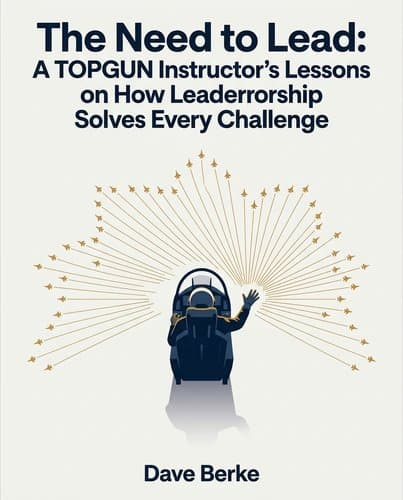
222376744_the-need-to-lead
by Dave Berke, Jocko Willink
The skills that made you indispensable as an individual performer will actively sabotage you as a leader. TOPGUN instructor Dave Berke reveals why real…
In Brief
The skills that made you indispensable as an individual performer will actively sabotage you as a leader. TOPGUN instructor Dave Berke reveals why real leadership is a second craft—built on multiplying others, not personal dominance—and gives you the exact mechanisms to master it.
Key Ideas
Visible Curiosity Reads as Confident Leadership
Ask questions instead of giving answers: the leaders who rose fastest were consistently the ones who made their curiosity visible — in meetings, with vendors, with people above them. It reads as confidence, not weakness.
Evaluate Hires as Team Glue or Solvent
Apply the Glue vs. Solvent calculation before your next hire: ask not just how skilled this person is, but whether they tighten or loosen the team around them. A high-competence solvent is often a net loss.
Compress Key Facts Into Persuasive Stories
Compress before you present: find the two or three facts that actually matter, connect them into a story, and cut the rest. Senior leaders experience anything beyond that as a signal that you haven't done the thinking.
Build Capability Through Unfamiliar Cross-Functional Moves
Make lateral moves deliberately: the leaders with the broadest capability built it by stepping into unfamiliar departments and failing industries — not by optimizing within their strength zone.
Formalize Feedback Structures to Prevent Degradation
Build a feedback structure, not a feedback intention: honest information degrades with rank. Specific mechanisms — skip-level conversations, rotating meeting leadership, formalized 360 reviews — are not optional extras; they are the only reliable antidote.
Specific Recognition Builds Outsized Loyalty Fast
Recognize immediately and specifically: the gap between what people contribute and what they hear about it is almost always larger than you think. The cost of closing it is low; the loyalty it builds is outsized.
Enable Others Instead of Personal Contribution
Shift from output to multiplication: the moment you move into a real leadership role, your personal contribution becomes almost irrelevant — what matters is the ceiling you set or remove for the people around you.
Who Should Read This
Business operators, founders, and managers interested in Leadership and Management who want frameworks they can apply this week.
The Need to Lead: A TOPGUN Instructor's Lessons on How Leadership Solves Every Challenge
By Dave Berke & Jocko Willink
11 min read
Why does it matter? Because the skills that got you here are exactly what will hold you back next.
Here's what nobody tells the high performer on the way up: the skills that made you exceptional are quietly building a ceiling above your head. Every habit that drove your results — the decisive certainty, the relentless personal output, the ability to outwork and out-think the room — starts working against you the moment your job becomes multiplying other people instead of outperforming them. TOPGUN doesn't just teach pilots to fly faster. It teaches them to recognize when the entire game has changed. Dave Berke and Jocko Willink spent careers inside one of the most unforgiving feedback environments ever designed — where every engagement gets reviewed on video and every mistake dissected in front of the room — and what they found is that leadership isn't a promotion from doing. It's a second craft, built on replacing dominance with trust, certainty with clarity, and personal excellence with the harder discipline of making everyone around you more capable than they'd be alone.
The Corner Office Is a Different Sport Entirely
Linda Hudson had just been named the first female president in General Dynamics history. She went to Nordstrom, bought sharp new suits, and let a sales associate teach her an unusual way to knot a scarf. She wore it to work. The next morning, she passed a dozen women in the building wearing their scarves tied exactly the same way.
She hadn't said a word to anyone. No memo, no meeting. She had simply walked the halls.
That moment cracked something open for Hudson. Every expression, every posture, every outfit choice was being decoded by the people she led. They weren't just watching her — they were using her as a weather instrument, reading the company's atmosphere through her body language. A thoughtful look could be misread as distress. A distracted response to "how are you?" could start a quiet rumor that something was wrong.
No one tells you this before you take the big job: it isn't a harder version of what you were doing before. Guy Kawasaki spent his education mastering finance and quantitative methods — the hard stuff, as he saw it. The interpersonal work seemed soft, learnable on the fly. Then he became a manager and discovered the inversion. A spreadsheet stays where you put it. People don't. Technical sharpness, individual output, clear answers — these are almost beside the point once you cross into genuine leadership.
What's waiting on the other side is something closer to stagecraft: your off-hand remark becomes a directive, your bad morning becomes the organization's bad morning, and your scarf becomes everyone's scarf.
Curiosity Is a Career Weapon, Not a Personality Trait
Ursula Burns walked into that 1989 meeting at Xerox expecting nothing more than a routine discussion about work-life issues. When a question surfaced implying that diversity programs lowered hiring standards, and a senior executive named Wayland Hicks politely batted it down, Burns did something almost no one at her level would do: she told him, in the room, that she was shocked he'd given the question any credibility at all. She was thirty years old, working in product development, sitting in a meeting led by someone who could end her career with a phone call. She expected that phone call to come. Instead, Hicks called her in to say she'd been right — just too blunt — and offered her a job traveling with him, sitting in on his most important conversations, learning leadership from the inside. A few years later, she challenged the company's president, Paul Allaire, in front of senior managers about why the company kept announcing hiring freezes and then immediately hiring thousands of people anyway. Same outcome: Allaire poached her from Hicks to be his own executive assistant. She eventually became Xerox's CEO.
What Burns noticed about that trajectory — what Hicks later told her he'd seen — wasn't polish. She wanted to understand why decisions were being made, and she showed up prepared enough to say so out loud when something didn't track. Standing in that room, she hadn't been performing confidence. She'd been genuinely bothered. That combination, real curiosity plus the work to back it up, is what got her into rooms that were otherwise closed.
The early career sets a trap here. The skills that earn the first promotions are certainty, depth, and the ability to deliver clean answers under pressure. Curiosity can even read as weakness — as not knowing enough. But the executives who end up running things describe their job differently: not as possessing the right answers, but as asking questions sharp enough that the right answers surface. Figuring out which question to ask is itself a creative act, and most people surrender that without realizing it, letting others define the problem while they compete to solve it.
The shift Burns made, from delivering answers to asking questions worth answering, wasn't a personality change. It was a deliberate practice. And it put her in front of people who could teach her things no job description would ever have delivered.
Confidence Isn't Something You're Born With — It's Something You Survive Into
At Babson College in 1991, William Green — then a recruiter for Accenture — was wrapping up a long day of interviews when he reached the last file in the stack. The résumé was thin: 3.2 GPA, no clubs, no sports, no semester abroad. Under work experience: Sam's Diner. When the candidate sat down, Green asked what else he'd been doing while his classmates were building their portfolios. The answer was simple. Every Friday after class, Sam drove home to work the family diner until close. All day Saturday. All day Sunday. Then back to Babson. Green wrote two words on the evaluation form: 'Hire him.' Sam spent his career at Accenture.
What Green saw wasn't credentials. It was a person who had faced a genuinely difficult situation and refused to let it become a story about what he couldn't have. Sam hadn't asked for a pass or treated the diner as an embarrassment to hide. He did the work and drove back. That posture — owning the hand you're dealt rather than auditing its unfairness — is what Green's firm calls an internal locus of control, and it's what Accenture filters for when it processes millions of applications a year.
This is the insight that catches high-achievers off guard. Early careers reward certainty and technical mastery. But the people who end up running things carry something different: a track record of hitting hard situations and not folding. That's confidence as scar tissue.
The people worth betting on aren't the ones who never struggled. They're the ones who struggled and declined to become the victim of the circumstance.
The Smartest Person in the Room Has Already Lost
Rosemary ran the coffee cart at Procter & Gamble. She had no seat in any strategy meeting, no access to performance reviews, no HR credentials whatsoever. She also predicted, with better accuracy than the company's human resources department, which young employees would make it and which wouldn't. Her method was simple: she watched how they treated her. Not because she was keeping score, but because she understood a piece of organizational physics that most career-builders miss. Everyone drops the ball eventually. What determines whether a stumble becomes a disaster is whether the people around you care enough to pick up the slack. Treat people like they're invisible, and when your moment of failure arrives, they'll let it sit. Treat them like they matter, and they'll cover for you before you even know you needed it.
What looks from the outside like being "likable" runs on a specific mechanic: relationship equity, built in small transactions, one interaction at a time. Greg Brenneman, a private equity chairman, carried a framework he'd picked up early in his career — every conversation either increases or decreases the account. You gain share or you lose it. The people who don't understand this spend years building impressive individual records while running a quiet deficit in the currency that actually matters when things get hard.
Will Wright, the designer behind The Sims, put a sharper edge on it. His hiring calculus: a high-competence person who generates conflict is a net loss — their output doesn't cover what they cost the people around them. A lower-competence person who pulls teams together and passes information freely can be a net gain. Most organizations never run this math. They optimize for the first number and ignore the multiplier, then wonder why brilliant hires leave wreckage behind them.
The Highest-Value Skill in Business Is Making a Complex Idea Disappear
Senior executives experience complexity as noise. Every extra slide, every extra layer of context, every detour through your methodology is a signal — and the signal it sends is that you haven't done the hardest work yet, which is thinking.
When Steve Ballmer ran Microsoft, meetings had a ritual: you arrived with a deck, walked the room through your reasoning from premise to conclusion, built the case brick by brick before revealing what you thought the company should do. He eventually recognized this as theater. So he killed it. He started reading materials in advance and showing up with four specific questions — skipping straight to the recommendation, treating the supporting data as something to pull up if needed, not something to perform. The change sounds procedural. It wasn't. It was a recalibration of what intelligence looks like at the top. Arriving at a conclusion through a thirty-slide journey reads, to a time-pressed executive, as an inability to separate what matters from what doesn't.
That inability is what derails otherwise capable people. The assumption going in is that thoroughness signals competence — that showing your work proves you earned the answer. But the executives making promotion decisions have already compressed their own world into the two or three levers that actually move things. They don't want to watch you discover what they already know. They want to see whether you can find the same core and get there fast.
The Career Ladder Is the Wrong Metaphor — And It's Costing You
What does a career path actually look like for someone who ends up running something? The honest answer is almost never what the person planned.
Joe Plumeri stumbled into his first Wall Street job in 1968 because he couldn't read a door correctly. He was a law student looking for afternoon work and knocked on the door of Cogan, Berlind, Weill & Levitt — four names, looked like lawyers. The receptionist sent him down the hall to see a man named Sandy Weill. Plumeri didn't know who Weill was. He pitched his idea anyway: law school in the mornings, learn the practical side in the afternoons. Weill pointed out that no one in the building practiced law. Plumeri tried to find a hole to climb into. Weill laughed and gave him a part-time job. That firm eventually became Citigroup. The whole thing was possible only because Plumeri was out knocking on doors he didn't fully understand.
Serendipity has a prerequisite. It requires you to be in motion, present, slightly outside your normal territory. The career-ladder model implies progress is vertical and scheduled. But the executives who reach the top almost universally describe careers shaped by lateral moves they took because something seemed interesting, by conversations with people outside their chain of command, by rooms they wandered into without a clear plan. Anne Mulcahy left a successful sales career at Xerox to run human resources — not because it was a calculated step upward, but because she found it genuinely interesting. Working HR meant she understood how people actually experienced the company from the inside: what burned them out, what kept them, where the org chart didn't match how decisions really got made. That knowledge, accumulated sideways, eventually put her in the CEO chair.
The tension worth sitting with: lateral moves require patience, and patience fights against the urgency that ambition generates. You have to be willing to stay in a role long enough to actually contribute — not just long enough to master the mechanics — before the next thing finds you.
Your Direct Reports Know Something About You That You Don't
Here is something rank does to you automatically, whether you are kind or arrogant or anywhere in between: it makes people funnier. Corporate Library co-founder Nell Minow received this warning the day she moved into a corner office, passed along from her partner Bob Monks — watch how funny your jokes become. The room laughs harder, the questions soften, and the memos arrive pre-polished. You didn't change. The information pipeline did.
The executives who understood this built structural workarounds rather than hoping goodwill would fix it. Kevin Sharer arrived as Amgen's incoming CEO having already spent six years as the company's president — known quantity, long track record — and still chose to sit down individually with the top 150 people in the organization before his start date, asking each of them the same questions: what should we protect, what should we change, what do you want me to do, and what are you afraid I'll do? He synthesized the answers and circulated them before taking the job. He also institutionalized a process where HR conducts a formal evaluation of him each year and presents the findings — including the uncomfortable parts — directly to the board. The mechanism is deliberately awkward. He does it because awkward is the only condition under which honest feedback actually survives contact with a CEO's title.
The Feedback You Give Reveals More About You Than About Them
Tachi Yamada, a young physician trying to impress his mentor Morton Grossman, once spent two evenings producing a six-page evisceration of a colleague's research paper. He handed it over confident he'd demonstrated serious analytical firepower. Grossman read it, set it down, and gave him a new assignment: go write a report explaining why the paper was fantastic, and how it could be made even better. Yamada did it. The paper, viewed from that angle, wasn't bad at all.
What Grossman caught — and what Yamada carried into his career running major health organizations — is that the instinct to tear something apart is rarely about the work. It's about the reviewer. About performing intelligence, establishing hierarchy, demonstrating that you can see what others missed. A six-page takedown teaches the author nothing useful. It mostly proves the writer is sharp enough to find flaws, which is easy. Finding what's worth saving, and figuring out how to push it further, is hard. That's the actual job.
Yamada brought this into his management philosophy directly. When he walked into new organizations and saw a mix of strong, average, and struggling people, he stopped asking who needed to be cut. He started asking what each person did well, and how he could move them up a notch. The math was simple: focus on the worst in everyone and you build a bad organization. Focus on the best and you build a good one.
The feedback you give exposes what you think your job is. If your notes are mostly about what went wrong, you've appointed yourself a critic. If they're mostly about what the person is trying to become and how to help them get there, you're doing something harder and more useful. The former feels like power. The latter is actually leadership.
People Don't Work for Companies. They Work for a Reason.
Think of every employee as a fish. You can own a twelve-hundred-acre ranch with a seventy-acre lake — plenty of water, plenty of fish — and still need bait. Gordon Bethune, who dragged Continental Airlines out of chronic near-bankruptcy in the 1990s, delivered that observation with the flat delivery of a man who had thought about it for a long time. The fish aren't obligated to bite. The obligation runs the other way.
Bethune's answer at Continental was brutally simple: define winning in terms everyone could see and feel. Planes depart on time. Luggage arrives. Customers come back. When those numbers beat the competition, fifteen percent of pretax profit went straight to the people who made it happen. No ambiguity about whether it mattered, no gap between what the CEO called success and what a baggage handler called success. The infighting over budget resources — which is mostly people competing for proof that their work counts — went quiet, because everyone was reading the same scoreboard.
David Novak, who built Yum Brands into a global operation, traced his entire philosophy about recognition back to a single morning in St. Louis. He was running a six a.m. roundtable with route salesmen, asking about merchandising, and the room kept circling back to a veteran named Bob — forty-two years with the company, retiring the following week. Bob was sitting right there. When the praise kept coming, he started to cry. He hadn't known. Not once in four decades had anyone said it to his face. Novak decided that if he ever ran something big, no one who worked for him would reach retirement in that condition. The floppy rubber chicken he later handed out as KFC's version of a performance award — accompanied by a hundred dollars and a photo taken with the president — sounds like a gag. A Yum Award that a restaurant manager in China carried home and locked in his father's safe doesn't sound like a gag at all.
The Craft You Didn't Know You Were Learning
Here is what all of these stories add up to, if you squint at them the right way: not one of these leaders arrived polished. They arrived confused, or too blunt, or reading the wrong door entirely. What they learned, slowly and at some cost, was to stop measuring themselves by their own certainty and start measuring themselves by what they could see happening in the people around them.
That's the diagnostic. Not whether you feel confident in the role — confidence, as every chapter here shows, is something you earn through the embarrassing moments, not something you feel in advance. The real question is whether the people near you are getting sharper, speaking more honestly, taking on more than they thought they could. Picture the pilot who finally stops narrating the cockpit and starts listening to it — the co-pilot volunteers something uncomfortable, the crew chief flags a problem before it compounds, and the silence that used to mean compliance has turned into something more useful. That's the signal. If the people around you are doing that, you're probably doing it. If they aren't, no amount of personal clarity changes the math.
Notable Quotes
“I was surprised that you gave this assertion any credence.”
“I own a twelve-hundred-acre ranch, and it’s got a seventy-acre lake,”
“At Zappos, we view culture as our number-one priority,”
Frequently Asked Questions
- What is "The Need to Lead" about?
- The book argues that "the skills driving individual success actively work against effective leadership — and that leading is a second craft requiring deliberate relearning." Drawing on TOPGUN and business experience, the authors provide frameworks for multiplying team performance, building honest feedback structures, and shifting from personal output to organizational impact. The core premise is that excellence as an individual contributor does not automatically translate to leadership ability, requiring instead that leaders deliberately develop new capabilities and mindsets distinct from those that made them successful individually.
- What are the most important leadership principles in "The Need to Lead"?
- Key principles include asking questions instead of giving answers, which demonstrates confidence rather than weakness. Leaders should apply the "Glue vs. Solvent calculation" when evaluating new hires, assessing whether candidates will strengthen or weaken team dynamics. Compress complex information before presenting to senior leaders by identifying the two or three facts that actually matter and connecting them into a coherent story. Make deliberate lateral moves across unfamiliar departments to build broad capability. Establish concrete feedback mechanisms like skip-level conversations and formalized 360 reviews. Recognize contributions immediately and specifically. Finally, transition from measuring personal output to multiplying team performance and impact.
- What does "The Need to Lead" teach about asking questions and communication?
- The book emphasizes that leaders who rose fastest consistently made their curiosity visible in meetings, with vendors, and with people above them. This approach demonstrates confidence, not weakness, and represents a core leadership skill. Beyond asking questions, the book stresses compression before presentations: identify the two or three facts that actually matter, connect them into a story, and cut the rest. Senior leaders experience anything beyond that as a signal that you haven't done the thinking. This dual approach — visible curiosity plus clarity — builds stronger leadership credibility and enables more effective decision-making across organizations.
- How should organizations structure feedback according to "The Need to Lead"?
- The book argues that honest information degrades with rank, making feedback structures essential rather than optional. Specific mechanisms — skip-level conversations, rotating meeting leadership, and formalized 360 reviews — are the only reliable antidote to information loss across hierarchies. Beyond structural fixes, the book emphasizes that "the gap between what people contribute and what they hear about it is almost always larger than you think." Closing this recognition gap costs little but builds outsized loyalty and directly impacts retention. Together, structured feedback and specific recognition prevent valuable information from disappearing through organizational levels.
Related Book Summaries
Read the full summary of 222376744_the-need-to-lead on InShort