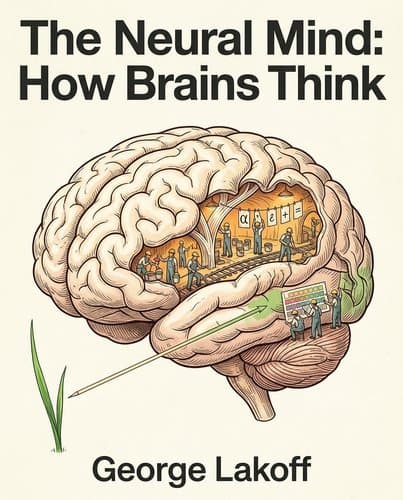
217215454_the-neural-mind
by George Lakoff, Srinivas Narayanan
Your brain doesn't receive reality—it constructs it through neural circuits that shape perception, language, and politics before conscious thought begins.
In Brief
Your brain doesn't receive reality—it constructs it through neural circuits that shape perception, language, and politics before conscious thought begins. Lakoff and Narayanan reveal why negating a frame strengthens it, why repetition builds belief before evaluation, and how motor control secretly governs abstract reasoning.
Key Ideas
Narrative activation bypasses conscious rejection
When you encounter political framing or emotionally vivid stories, treat them as attempts to physically strengthen neural circuits — not just as arguments to evaluate logically. Conscious rejection doesn't prevent the activation.
Prototypes embed moral reasoning in categories
Your categories are radial, not logical. When a concept feels obvious or natural — 'a mother,' 'a threat,' 'a crime' — ask which frames are active and which have been inhibited. The prototype hiding inside the category is doing most of your moral work.
Negation activates rather than eliminates frames
Negating a frame activates it. 'Don't think of X' is not a rhetorical trick — it's a neural fact. If you want to displace a frame, you need a competing positive frame, not a denial.
Goal representation restructures stuck reasoning loops
Abstract reasoning inherits the structure of motor control: precondition, start, goal test, iterate, finish. When you're 'stuck' on a problem, your reasoning X-Net is literally looping on a failed goal test — changing the goal representation, not just adding more effort, is what breaks the loop.
Neural recruitment precedes conscious belief formation
Language learning and idea adoption are forms of neural recruitment — the more a circuit is activated, the more permanent it becomes. This means repetition is the mechanism of belief, not just reinforcement of existing belief. Exposure shapes circuitry before evaluation can occur.
Who Should Read This
Science-curious readers interested in Neuroscience and Cognitive Psychology who want to go beyond the headlines.
The Neural Mind: How Brains Think
By George Lakoff & Srinivas Narayanan
11 min read
Why does it matter? Because the brain you think with isn't showing you the world — it's building one.
You think you see grass because grass is green. That assumption is wrong in a way that changes everything. The color isn't out there in the world — it's manufactured inside your skull, assembled from wavelengths by neural machinery you'll never consciously access. And once you accept that, a much larger claim becomes unavoidable: if your brain constructs color from scratch, what else is it building? Turns out: logic. Grammar. The felt sense that your political beliefs are simply correct. None of these are received signals from a neutral reality. They're physical events — circuits firing, connections strengthening, simulations running — in a body that evolved for survival, not for truth. Tracing exactly how that construction happens reveals something that will make familiar things — language, reason, metaphor — feel suddenly strange, and why that strangeness has consequences that reach from grammar to propaganda to the survival of democracy.
Grass Isn't Green — Your Brain Just Decided It Was
Your brain is not a camera. It is a confabulation engine, and it has been busy rewriting your experience of reality every waking second of your life without asking permission.
Start with color, because the revelation is so clean it's almost cruel. The grass outside your window is not green. The blood in your veins is not red. Those colors don't exist as properties of the physical world — objects emit wavelengths of light, and wavelengths have frequency and intensity but no hue whatsoever. What converts those wavelengths into the crimson of a rose or the gold of an afternoon sky is a collaboration between three types of cone cells in your retina and the neural circuitry running from those cones deep into your brain. The world hands your eyes numbers; your brain decides what color to paint them.
The machinery doing the painting varies from person to person in a specific, measurable way. Color cone chemistry is tied to the X chromosome, and since women typically carry two X chromosomes and men one, their cone configurations frequently differ. The same red pepper, held under the same light, can genuinely register as different colors to different people. Those arguments about whether a fabric is navy or black aren't misunderstandings. They're two nervous systems constructing different realities from identical physical input.
Once you absorb this about color, a stranger implication follows. If the brain quietly manufactures hue from raw wavelength data, what else is it manufacturing? Quite a lot, it turns out, and the experiments that reveal this are difficult to shake. In one study, a device taps a spot on a subject's forearm, taps it again, then taps a different spot a short distance away — each tap separated by less than two hundred milliseconds. The subject doesn't feel three taps at three locations. They feel the second tap as having occurred in the space between the first and third, on a straight line, as if something small had hopped across their arm. The second tap migrates to a location it never touched, and does so backward in time — the brain has to wait for the third tap to arrive before it can decide where to place the second one in conscious experience.
That is the system doing exactly what it evolved to do: assembling coherent perceptual stories out of fragmentary inputs, smoothing discontinuity into pattern, filling gaps with plausible inference. You don't perceive the world and then interpret it. The interpretation arrives first, unconsciously, and what surfaces into your awareness is the finished version — edited, gap-filled, occasionally invented. Seeing is not believing. It's constructing.
The Same Circuit That Picks Up a Glass Also Runs Your Logic
Imagine trying to explain what it means to pick up a glass of water. Not the mechanics — the concept. You would describe something like: you reach, you grasp, you raise, you drink, and if you are still thirsty you drink some more, and when you are satisfied you put the glass down. That sequence has a shape. A beginning condition, a central action with a built-in test, an exit when the goal is met. Researchers at the Berkeley Neural Theory of Language project discovered, by accident, that this shape is not incidental to thought. It is thought.
They were building a digital human body — a model called Jack, with simulated bones and joints — and trying to teach it to perform hand actions by learning verbs from different languages. The vocabulary of hand motion is enormous and bewilderingly varied: in Spanish, pushing a button gets its own dedicated verb, separate from all other pushing. The researchers expected the underlying neural structures to vary just as wildly. They did not. Despite every surface difference, the top-level computational structure for every action in every language was identical. They called these structures Executing Networks — X-Nets.
When they presented this finding at the weekly lab meeting, the linguists in the room immediately recognized what they were looking at. The X-Net structure matched what linguists call aspect — the universal grammar of events found in every known human language. English marks it with words like 'about to,' 'starting to,' and the progressive '-ing'; with iteratives like 'sipped and sipped' when a purpose keeps going unmet; with 'has sipped' to signal a relevant consequence after the fact. These are not arbitrary grammatical decorations. They are the linguistic surface of the same loop that lifts a glass to your mouth: precondition, start, ongoing action, goal test, iterate or finish, consequent state.
X-Nets do not stay in the body. When you say you are 'getting nowhere on this problem' or that you are 'stuck,' you are not reaching for a colorful metaphor about travel. Your brain is running the same motor-control loop — the one built for purposeful movement through space — and applying it to the act of reasoning. The goal-test stage is asking whether the intellectual destination has been reached. The iterate branch fires when it has not. Abstract reasoning is motor control with the body swapped out.
Evolution did not engineer a separate system for logic. It repurposed the circuitry that coordinates limbs. The same neural architecture that checks whether your hand has reached the glass checks whether your argument has reached its conclusion. Grammar, inference, and the structure of events in every human language are all running on biological machinery that originally evolved to move a body through the world.
Categories Aren't Containers — They're Stories the Brain Tells Itself
What makes a woman, the sun, a stonefish, and a caterpillar whose sting burns for a month belong to the same grammatical category? In the Australian Aboriginal language Dyirbal, they all do. The classifier balan groups them together — and once you understand why, the classical picture of categories as neat containers with clear membership rules collapses entirely.
The Aristotelian model says categories work by necessary and sufficient conditions: a thing belongs if it has the required properties, and doesn't if it lacks them. That model predicts sharp edges. Dyirbal has none. The balan category starts with women as its center, then extends outward through a chain of cultural reasoning. A Dyirbal myth holds that the sun is the wife of the moon, so the sun enters the women's category. The sun is hot, so fire follows. Fire is dangerous, so fighting spears follow, then the sharp-toothed stonefish, then the Hairy Mary caterpillar. There is no shared property linking these things. The category is held together by mythology and metonymy — each link logical given the previous one, but the endpoints sharing nothing except the chain that connects them.
This is what a radial category looks like: a prototypical center with extensions that radiate outward through cultural frames and associations rather than logical features. The wheel shape matters. You can't look at the caterpillar and deduce it belongs with women by examining the caterpillar. You have to trace the spokes back to the hub.
The same architecture governs concepts far closer to home. 'Mother' is not a single unified concept — it is a cluster of four distinct frames: birth, genetics, nurturance, and marriage. In the standard case all four coincide, so you never notice the seams. But the moment they diverge, new terms appear: 'birth mother' (the birth frame without the others), 'stepmother' (the marriage frame without birth or genetics), 'genetic mother' (the egg donor, nothing more). Each is a radial variation on the central case, one or more frames switched off. The concept was always a story the brain assembled from parts. You just didn't see the assembly until the parts came apart. Membership is not a yes-or-no question. It is a story with a center.
A Vivid Story Rewires Your Brain's Probability Estimates
In the fall of 1979, a DC-10 lost an engine on takeoff from O'Hare International Airport and rolled inverted into a field outside Chicago, killing all 273 people aboard. The crash was filmed. Television networks played the footage on loop for days — the plane banking, the fireball, the smoke. And then something measurable happened: people stopped flying DC-10s. Demand cratered. Airlines pulled them from routes.
Here's what makes this interesting rather than merely tragic. The DC-10 had an excellent safety record. The statistical case for avoiding it over any other aircraft was nonexistent. The fear was not a response to data. It was a response to a circuit.
Every time that footage ran, the neural pattern associated with DC-10s and catastrophe fired again in millions of viewers' brains. Kahneman observed the mechanism: each activation of a neural circuit strengthens it. Not metaphorically — physically, through the same synaptic reinforcement that encodes any memory or skill. Repetition doesn't remind the brain of a danger; it installs the danger more deeply each time. When that circuit becomes the most readily activated thing associated with DC-10s, it starts doing something it was never designed to do: stand in for statistical frequency. The brain reads circuit strength as probability. A vivid story, replayed enough times, becomes the brain's best answer to the question 'how likely is this?'
Donald Trump's 2016 strategy was, from a neural standpoint, the same operation run deliberately. He returned again and again to two specific crimes committed by undocumented immigrants — a rape, a murder — and offered them as proof that Mexican immigrants as a class were rapists and murderers. The factual counter-argument, that immigrants commit crimes at lower rates than native-born citizens, addresses the wrong level entirely. Logic runs on propositions. This ran on circuitry. Each retelling strengthened the associative link between 'Mexican immigrant' and 'violent crime' in every brain that heard it, regardless of what the listener consciously believed. The story wasn't persuading anyone. It was doing construction work.
The implication is uncomfortable: political manipulation doesn't primarily succeed by feeding people false facts. It succeeds by building infrastructure — installing circuits through repetition until a single vivid image becomes the metonymic representative of an entire statistical class, displacing actual frequency with felt vividness.
You don't argue your way out of a structure someone has built inside you. You need a different story, told more often.
Grammar Is What Your Motor System Does When It Talks
Grammar, the authors argue, is not a rule system imposed on top of meaning. It is meaning — implemented in the same neural hardware your brain uses to reach for a glass of water.
The evidence sits inside a single English sentence: 'Harry ran in.' 'Ran' carries the manner of motion — the gait, the speed, the quality of movement. 'In' carries the spatial change — crossing a boundary from outside to inside. English distributes the event across two words because it runs on two separate neural systems: X-Nets, which encode how actions unfold through time, and image schemas, which encode spatial structure. Spanish doesn't carve the event the same way. 'Sale un búho' — 'exits an owl' — buries the spatial change directly into the verb and lets manner fall away entirely. Same physical event, same owl, same hole in the tree: two languages encoding it through different neural circuits, each grammar reflecting which machinery the language leans on.
If grammar were a dedicated biological module, you'd expect it to organize events the same way everywhere — and it doesn't. Grammar adapts to available circuitry, to whichever combination of motor-control networks and spatial-processing networks a language has recruited over generations of use. Some languages split manner from path. Some fuse them. The variation maps directly onto the two primary forms of neural embodiment the authors have traced through every other domain of cognition.
And once grammar is physical, something else falls out: triggering a grammatical construction activates its meaning whether you want it to or not. George Lakoff developed this into a general principle about framing — tell an audience 'Don't think of an elephant' and the elephant circuit fires anyway, because the frame activates on contact with language regardless of the negation wrapped around it. This is why political framing works even when audiences consciously reject the message: the construction runs before the rejection arrives. Grammatical constructions are neural circuits linking form to meaning, and those links are not optional. Hearing the form runs the meaning. That's not a quirk of language. That's what it means for grammar to be physical.
Ideas Don't Spread Through Minds — They Get Installed in Bodies
Think of a rumor spreading through a town. You probably imagine it as information — someone hears it, encodes it, passes it along, and the message travels from mind to mind like a file being copied. That model is wrong, and getting it wrong has consequences that reach from political campaigns all the way to what democracy actually is.
An idea spreading is not a transfer of information. It is a physical event inside individual bodies. Here is the mechanism: a thought is a specific pattern of neural activation. If that pattern fires once, weakly, with no significant consequences, the synapses along the circuit don't strengthen and the idea evaporates. But if the idea matters to you — if it surfaces in language, if you act on it — the circuit gets reinforced. Now suppose you express that idea. Language activates frames and associations in other people's brains, and those frames are neural circuits. Hearing the idea runs those circuits in the listener. Repeated exposure strengthens them. Repeat this across a population and the circuit becomes structurally permanent in many people simultaneously. The idea hasn't traveled between minds. It has been installed, separately, in each body that encountered it.
Lakoff and Narayanan call this a self-reinforcing loop: the more widely an idea circulates, the stronger it becomes in each brain that holds it, and the stronger it becomes, the more likely those people are to express it in turn. The loop is especially potent when the idea operates unconsciously, below the threshold where people might think to question it.
The Bill of Rights is not a sequence of letters. It is not a set of arguments. When you read it with genuine comprehension, it activates specific neural circuits in your body — circuits constituting rights, dignity, government accountability — and strengthens them each time. The document works because it does real biological work in real bodies. Meaning and democracy are not separable from the flesh that generates them.
This is also why large language models don't understand anything. Chomsky's language module proposed that grammar was innate and self-contained — independent of the body, of action, of what words actually refer to. Embodied cognition kills that picture: concepts are grounded in motor systems and sensorimotor experience, not in a free-standing syntactic engine. A system that predicts the next token from statistical patterns in text has no motor system to exapt, no body to ground what 'thirst' or 'pain' or 'injustice' actually refers to. It generates plausible sequences. It installs nothing. Human understanding is the physical reinforcement of embodied circuits through repeated activation — which is exactly what no current AI architecture does, and why the gap between fluent text generation and genuine comprehension is not a matter of scale but of kind.
What the Bill of Rights Actually Is
Everything this book has shown you about color, grammar, motor control, and the machinery of categories points toward the same uncomfortable conclusion: you don't choose which ideas you understand. You choose which ideas you let fire, repeatedly, until they become structural. Which circuits are you strengthening? Which are you letting someone else install?
Frequently Asked Questions
- What is The Neural Mind: How Brains Think about?
- The Neural Mind: How Brains Think explains how the brain actively constructs reality through neural circuits that shape perception, language, and political belief. Published in 2025, the book draws on cognitive science and neuroscience to show how framing, categorization, and repetition physically rewire thought patterns. George Lakoff and Srinivas Narayanan provide readers with practical insights into why rational argument often fails and how to influence minds more effectively. The work demonstrates that understanding neural mechanisms underlying thought and belief formation is crucial to comprehending human cognition.
- What does The Neural Mind say about negating frames?
- According to Lakoff and Narayanan, negating a frame activates it. As the authors explain, 'Don't think of X' is not a rhetorical trick — it's a neural fact. If you want to displace a frame, you need a competing positive frame, not a denial.' This principle has significant implications for communication and persuasion. Rather than telling people what not to believe, effective persuasion requires providing an alternative positive framework that activates competing neural circuits. This understanding challenges traditional counter-argument approaches and suggests new strategies for influence based on how the brain actually processes language and frames.
- What are the key takeaways about categories from The Neural Mind?
- Lakoff and Narayanan argue that your categories are radial, not logical. When a concept feels obvious or natural — 'a mother,' 'a threat,' 'a crime' — ask which frames are active and which have been inhibited. The prototype hiding inside the category is doing most of your moral work. This insight reveals that seemingly natural, objective categories are actually shaped by underlying neural frames and prototypes. Understanding this mechanism explains why people with different frames perceive identical information differently, and why changing minds requires addressing the underlying categorical structure rather than simply presenting new information.
- What does The Neural Mind explain about repetition and belief?
- According to the book, language learning and idea adoption are forms of neural recruitment — the more a circuit is activated, the more permanent it becomes. Lakoff and Narayanan argue that repetition is the mechanism of belief, not just reinforcement of existing belief. Exposure shapes circuitry before evaluation can occur. This challenges the assumption that people rationally evaluate ideas before adopting them. Instead, neural circuits activated by exposure to ideas strengthen through repetition, making belief formation a physical neural process. This explains why awareness or criticism alone may not prevent adoption of frequently encountered ideas.
Related Book Summaries

Read the full summary of 217215454_the-neural-mind on InShort