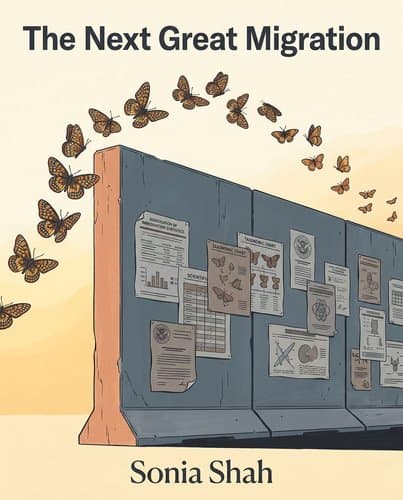
51079278_the-next-great-migration
by Sonia Shah
The idea that people belong in fixed places was fabricated in 1758 from bad science—and it's still killing thousands by driving immigration policy.
In Brief
The idea that people belong in fixed places was fabricated in 1758 from bad science—and it's still killing thousands by driving immigration policy. Sonia Shah exposes how restricting migration doesn't stop movement; it just multiplies the body count while defying every lesson biology has to offer.
Key Ideas
Border violations artificially inflate migrant crime statistics
When a statistic about migrant crime circulates, check whether the underlying 'crime' counts the act of crossing a border — Germany's 402,000 migrant crimes consisted entirely of border-crossing violations; once extracted, German crime reached a thirty-year low in 2018.
Geographic human suitability is colonial pseudo-science
The scientific premise that human groups are biologically suited to specific geographic locations — still embedded in immigration policy debates — was constructed in 1758 from anatomical evidence that turned out to be ordinary human biology, used to give scientific cover to colonial practices already underway.
Border restrictions increase deaths without reducing migration
Restricting border crossings doesn't reduce migration; it raises the death rate. The EU's Mediterranean crackdown cut official crossings by 85% while multiplying the death rate sevenfold — the people crossing were going to cross regardless.
Migration reverses genetic decline in isolated populations
Isolated populations without new arrivals inbreed toward collapse: the Isle Royale wolves reached 58% congenital deformity rates before one migrant male reversed decades of genetic deterioration within a single generation. The mechanism is not unique to wolves.
Immigration restrictions rooted in population-bomb propaganda
The modern immigration restriction network — FAIR, CIS, NumbersUSA, and the organizations that staffed the Trump administration — grew directly from the 1960s population-bomb movement, a misapplication of animal ecology to human societies that its own architects eventually admitted was 'a propaganda piece, not science.'
Who Should Read This
Science-curious readers interested in Social Issues and Policy who want to go beyond the headlines.
The Next Great Migration
By Sonia Shah
10 min read
Why does it matter? Because the 'migration crisis' is built on science that was already disproven before it became law.
The migration crisis is real. The deaths at sea, the overwhelmed border posts, the political upheaval — all of it is happening. What doesn't hold up is the story built around it: that human movement is an emergency, an anomaly, something requiring containment. Check the source documents behind the crime statistics, the rape epidemics, the invasion-biology warnings, and they collapse one by one. The fear underneath traces back to an 18th-century naturalist who classified humans by continent and invented biological differences between them on anatomical evidence that turned out to be perfectly ordinary human anatomy. We built walls, laws, and mass death on a stack of scientific frauds — and the thing being walled out is the defining behavior of every living thing on Earth.
Germany's '402,000 Migrant Crimes' Were All the Same Crime: Crossing a Border
The 402,000 crimes Germany attributed to its incoming migrants were real. They were also all the same crime: crossing a border without permission — a violation that, by definition, could only be committed by migrants. Strip those out of the Interior Ministry's data and German crime rates were unchanged from the year before the arrivals. By 2018, Germany recorded its lowest crime figures in thirty years.
Sweden's designation as the "rape capital of Europe" came from a Fox News documentary whose central Swedish security expert had not, it turned out, lived in Sweden for a very long time — no one in the country's security community recognized him. The two police officers who appeared in the film said their answers had been edited; they had been responding to entirely different questions. Sweden's actual rape rate was 0.06 percent of the population. England and Wales reported nearly three times that figure.
The U.S. Border Patrol's assault surge traced to a 2015 change in counting method. Instead of tallying agents assaulted, officials now multiplied agents by attackers by objects used — six people throwing rocks at seven agents became 126 separate assaults. Corrected to the old standard, Border Patrol officers had the lowest assault rate of any federal law enforcement group.
The migration crisis had government reports, expert testimony, and prime-time coverage behind it. Read any of them carefully and they said something different from what they'd been cited to prove. The panic didn't live in the statistics. It lived in the gap between what those numbers measured and what everyone agreed they meant.
The Taxonomy That Made Foreigners Seem Biologically Alien Was Built on a Body Part No One Had Ever Seen
In 1815, a woman named Saartje Baartman died in Paris at twenty-six, after five years on exhibit across European capitals as the "Hottentot Venus." Paying audiences could, for an extra fee, poke and prod her. Francis Galton, who would later coin the word "eugenics," had visited with a sextant to measure her from every angle. A commission of zoologists subjected her to a three-day scientific examination; she clutched a handkerchief over herself and only, as one historian put it, "with great sorrow" let it briefly drop — the scientists saw nothing unusual but decided she hadn't given them long enough to look. When she died, the anatomist Cuvier dissected her, finally certain he would confirm what science had long insisted was there: an unusual genital formation in African women that one early illustrator had depicted as two tails reaching the knees.
He found ordinary labia. "Two wrinkled fleshy petals" was his description. He devoted nine of sixteen memoir pages to her anatomy anyway, removed her genitals, and preserved them in a jar at the Musée de l'homme. Stephen Jay Gould found the jar on a basement shelf in 1987.
The body part Cuvier had been searching for — the "sinus pudoris," or genital flap — was the load-bearing evidence for the most influential human taxonomy in history. Carl Linnaeus had in 1758 classified humanity into four continental subspecies. Homo sapiens europaeus: "white, serious, strong... Ruled by laws." Homo sapiens afer, the peoples of Africa: "Black, impassive, lazy... Women with genital flap." Louis XV officially adopted the system in 1774. Rousseau called Linnaeus "no greater man on earth."
Linnaeus had never seen one. He'd tried: begging the East India Company to procure him a "troglodyte" for personal examination, dispatching a student to London to examine a Jamaican girl with albinism on exhibit there — the girl's keeper refused. The feature's original written account had been deleted from its English translation; only the image circulated.
There had been a naturalist who got it roughly right. Buffon argued that all humans shared ancestry — mixed-race children weren't sterile like mules, and African parents with dark skin could produce pale-skinned babies, proving skin color was a mutable surface feature. He theorized a migratory dispersal from a common origin, with different environments shaping bodies accordingly. He was largely correct.
He lost. Linnaeus's fixed, continent-coded taxonomy served a purpose Buffon's dynamic one didn't. If all humans shared biology, they could plausibly claim equal rights — a serious obstacle to colonialism. If the people whose lands you were occupying were biologically alien, fixed to a different place, then dispossession became natural order. Dutch settlers in southern Africa had already been treating local people as animals before Linnaeus published a word. He gave the practice a Latin binomial and called it science.
The Eugenics Science That Barred Jewish Refugees from America Had Already Collapsed in Its Own Labs
Imagine a prosecution whose star witness recants on the stand — after the guilty verdict has already been read. That is roughly what happened with the law that closed America's borders.
The scientific case for restricting immigration turned on a single empirical question: what happened biologically when people from different races produced children together? The theory — pushed by Madison Grant and Henry Fairfield Osborn from the American Museum of Natural History through federal hearing rooms — held that such mixing produced degenerate hybrids, sapping the "germplasm," the inherited material we'd now call DNA, of superior races. Policy demanded proof. Museum anthropologist Harry Shapiro was sent to find it.
When Shapiro reached Pitcairn Island in 1934, he expected the clearest possible case: descendants of nine British mutineers who had settled the island in 1789 with Polynesian women, chosen as subjects precisely because their two parent populations were as unlike each other as possible, with five generations of mixing to evaluate. He took dozens of measurements — skulls, lips, nasal passages, height, fertility rates. What he found were people who resembled ordinary English dockworkers. Physically robust. Healthy. Fertile. Taller than either parent population. The only thing wrong with them was their teeth.
Charles Davenport, the eugenicist who ran Cold Spring Harbor's research program, reached the same wall with his own Jamaican study: "Physically there is little to choose between the three groups." The science wasn't there. It had never been there.
The Johnson-Reed Act had passed in 1924, drafted by Grant's eugenics committee, reserving eighty percent of immigration slots for western and northern Europeans and dropping annual arrivals from eight hundred thousand to fewer than a hundred thousand. When Hitler read Grant's book in a Bavarian jail and wrote to him that it was "my bible," he was inheriting a tradition America's own scientists were quietly dismantling. And when the MS St. Louis arrived off Miami in 1939 carrying over nine hundred Jewish refugees — circling for days while passengers wept on the balconies, before being turned back to Europe — more than 250 died in the Holocaust. Congress that same year killed a bill to admit twenty thousand Jewish children. The evidence had already collapsed. The doors stayed shut.
A Butterfly Biologist Who'd Never Studied Humans Helped Build the Modern Anti-Immigration Network
Paul Ehrlich had spent his career studying checkerspot butterflies — creatures he'd documented almost never leaving their patch of hillside, regardless of conditions. When he landed in New Delhi in June 1966, he saw a city of 2.8 million and called it "hellish."
What he didn't note: Paris held 8 million. Delhi's chaos had a more immediate explanation than population pressure — government programs were funneling rural workers into a city whose infrastructure couldn't absorb them. The environmental damage Ehrlich saw in Kashmir had come from an India-Pakistan war fought across those valleys the year before, with troops and artillery cratering the same meadows he'd hoped to study butterflies in.
None of that made it into The Population Bomb. What did: a recommendation that the United States send helicopters and surgeons to India to forcibly sterilize men with three or more children. Ehrlich treated high birth rates as a fixed biological feature of certain peoples, not a response to economic conditions. Years later, he admitted the book had been "a propaganda piece." He'd been, he said, "trying to get something done."
What it got done was John Tanton. An ophthalmologist from Petoskey, Michigan, Tanton bought The Population Bomb by the case to hand to neighbors. By 1975 he was president of Ehrlich's Zero Population Growth organization. In 1979 he spun off its immigration committee into the Federation for American Immigration Reform, then built out the Center for Immigration Studies, NumbersUSA, and the publishing house that circulated Grant's The Passing of the Great Race, which Hitler had called his bible. The network that grew from Ehrlich's butterfly-biologist misreading of a Delhi traffic jam wrote Arizona's show-me-your-papers law, killed the 2007 immigration reform bill, and shaped the Trump administration's immigration policy through Kellyanne Conway, Kris Kobach, and Stephen Miller, who had worked at NumbersUSA.
Migration Doesn't Destroy Ecosystems — Removing It Does
What actually happens to an ecosystem when migration stops? Invasion biology, the field that came to dominate conservation science from the 1980s onward, never quite asked. It was too busy cataloging damage from species arriving in new places to examine what happened to populations cut off from outside arrivals. Look at the isolated cases and the picture inverts.
The ecological case against migration was built, in part, on a staged Disney film. White Wilderness, released in 1958, won the Academy Award for best documentary and ran in American classrooms for years. Its defining scene depicted lemmings marching off a cliff into the Arctic sea — migration as biological self-destruction. The science behind it traced to a 1924 paper by Oxford zoologist Charles Elton, who had based his theory on a Norwegian book he couldn't read in the original, whose lemming accounts a historian of ecology later called myths and sailors' tall tales. Elton never witnessed a lemming migration; neither did his colleagues. What lemmings actually do is breed in snow-insulated burrows, then scatter when spring melt floods their tunnels — not suicide, just dispersal. Disney's crew paid Canadian teenagers twenty-five cents per captured lemming, shipped the animals a thousand miles to a Calgary set with a painted Arctic sky, herded them onto a turntable to create the impression of a running horde, then tipped them off a riverbank with cameras rolling. The Academy Award went to a murder scene.
The fraud stayed embedded in public consciousness long enough to help launch invasion biology, a scientific program that treated migrant species as ecological criminals. But when ecologists checked the actual record, only about one percent of introduced species establish themselves in ways that harm existing residents. When the Suez Canal joined two seas separated for millions of years, 250 species crossed and, among the hundreds already present, researchers documented a single extinction. Four centuries of open borders for wild migrants increased American biodiversity by 18 percent.
More telling is what happened on Isle Royale, a Lake Superior island whose wolf population descended from a single breeding pair that crossed on ice in 1949. Cut off from newcomers, they grew steadily more inbred. By 2012, 58 percent had congenital spine deformities (against 1 percent in connected populations). A female died in her den surrounded by seven dead pups. Then in 1997, a single male migrated in. Within one generation, his genes appeared in 56 percent of the island's wolves. The population rebounded. Moose numbers fell. Forests, no longer trampled by unchecked moose, recovered. One migrant cascaded through the entire system.
The ecological argument against migration turns out to describe what happens when migration is withheld.
Border Walls Don't Reduce Migration — They Just Multiply the Death Rate
A young man in an American Eagle polo shirt set out from somewhere south of the United States and made it across the Rio Grande. The desert on the other side killed him. His body was found before it dissolved entirely (the Texas desert can make a human corpse unrecognizable within a day), and a local official ferried him to a morgue, then to his family's cotton farm, where he was buried in an unmarked grave alongside homeless people and unidentified hospital patients, because no public cemetery in the area would take them. A paper tag reading "John Doe" sat on top. Landscapers mowed it over. Ten years later, a forensic anthropologist's team spent a week digging up nearly two dozen such bodies from the farm, many coming out half-liquid. The man was identified only by a biohazard bag of clothes, the polo shirt and a single white tube sock, tucked in the crook of his skeleton's neck.
He had made it thirty miles past the border.
The logic behind border enforcement is that if you make crossing dangerous enough, people stop coming. The evidence runs the other way. When European officials cracked down on Mediterranean crossings between 2015 and 2018, the number of people attempting them fell from over a million to fewer than 150,000. The death rate went from one in 269 to one in 51. A European border official described the pattern plainly: the flow doesn't disappear, it finds the next gap. The somewhere else is always worse. When the Niger-Libya land route closed in 2016, migrants shifted into Chad, where smugglers abandoned over a thousand people in 110-degree Sahara heat in eight months alone.
Between 1993 and 2017, more than 33,000 people died trying to enter Europe. That figure doesn't measure the failure of migration policy. It is migration policy — the death toll that accumulates when you build barriers against movement that was going to happen either way.
The Wall Is Sixteen Feet High. The Butterfly Doesn't Notice.
Trump's wall prototypes stood near Tijuana in a row — sixteen concrete slabs like some demented Stonehenge. Checkerspot butterflies, the same species whose range shifts first proved climate change was already moving life around the planet, drifted toward them. They drift at mid-height through open air. The wall stands twice that.
When the moment came, they rose.
By the time you reach this page, every specific claim that justified the wall has collapsed. The crime statistics measured border crossing, not violence. The racial science was built on a body part no one had ever seen. The ecological argument against migration described exactly what happened when migration stopped. What remained was the infrastructure — and the bodies in South Texas cotton fields.
The migration was always going to happen. The only question we ever controlled was the body count we'd accept before admitting it was always going to happen.
Notable Quotes
“The path was very narrow,”
“You can't even get a horse through. People broke their legs on the trail and had to be left behind, probably to die.”
“It was very cruel, my friend,”
Frequently Asked Questions
- What is The Next Great Migration about?
- The Next Great Migration traces how the belief that living things belong in fixed geographic places was invented for ideological purposes and built on fabricated science. Drawing on ecology, genetics, history, and policy data, Shah demonstrates that migration is life's fundamental adaptive strategy. The book challenges the scientific premise that supports geographic fixity, revealing it was constructed from ordinary human biology rather than genuine anatomical differences. Shah argues that border restrictions don't reduce movement—they only raise the death toll, fundamentally reframing migration as natural, necessary, and biologically essential across species.
- What does The Next Great Migration say about border restrictions and migration?
- Border restrictions fail to reduce migration; they only raise death rates, according to Shah's research. The EU's Mediterranean crackdown cut official crossings by 85% while multiplying the death rate sevenfold. Shah argues that "the people crossing were going to cross regardless," making border enforcement a deadly policy rather than an effective control measure. She also demonstrates through Isle Royale wolves that isolated populations without new arrivals face genetic deterioration—reaching 58% congenital deformity rates before one migrant reversed decades of decline. This phenomenon is not unique to wolves, revealing migration's critical biological function.
- What scientific claims does The Next Great Migration challenge?
- Shah challenges the scientific premise embedded in immigration policy debates that human groups are biologically suited to specific geographic locations. She traces this premise to 1758, when it "was constructed...from anatomical evidence that turned out to be ordinary human biology, used to give scientific cover to colonial practices already underway." This debunking is central to her argument that geographic fixity is ideological invention, not biological reality. The book demonstrates how pseudoscience was weaponized to justify policies that had already begun on ideological grounds, establishing the foundation for modern border restrictions.
- What are the historical roots of modern immigration restriction organizations?
- The modern immigration restriction network—FAIR, CIS, NumbersUSA, and organizations that staffed the Trump administration—grew directly from the 1960s population-bomb movement, which misapplied animal ecology to human societies. Shah notes that the architects of this movement "eventually admitted [it] was 'a propaganda piece, not science.'" Understanding this genealogy reveals how discredited ecological theories transformed into institutional power that determines migration policy. These organizations maintain influence despite pseudoscientific foundations, demonstrating how false scientific claims become embedded in policy infrastructure.
Related Book Summaries


Read the full summary of 51079278_the-next-great-migration on InShort