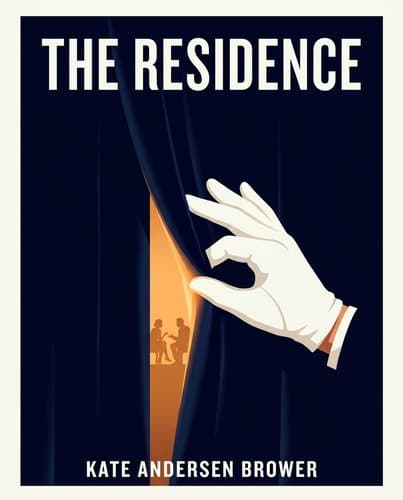
22693222_the-residence
by Kate Andersen Brower
Behind every president's polished public image stand roughly 100 invisible workers whose institutional memory, quiet sacrifices, and unfiltered observations…
In Brief
The Residence (Apri) reveals the hidden workforce of roughly 100 domestic staff who have kept the White House running across generations of presidents. Drawing on firsthand accounts, it examines how these workers maintained institutional continuity, absorbed the unguarded behavior of the most powerful families in America, and paid a real human cost for their lifelong discretion.
Key Ideas
Daily staff labor manufactures presidential dignity
The presidency's dignity is not inherent — it's manufactured daily by roughly 100 domestic workers whose institutional memory spans decades and whose names appear in no political histories
Silence simultaneously protected and suppressed
The staff's 'code of silence' served multiple functions simultaneously: it protected the first family's privacy, it protected the staff's jobs, and it suppressed legitimate grievances about wages, racial discrimination, and working conditions — discretion and suppression shared the same silence
Presidential temperament revealed through staff treatment
Presidential temperament, stripped of press management, is most accurately read in how a leader treated the people paid to be invisible: LBJ's bullying, the Reagans' nonchalance, the Bushes' genuine warmth, and the Clintons' paranoia were all witnessed firsthand by people with no incentive to flatter
Service exacted devastating human and emotional cost
The human cost of institutional loyalty is rarely romantic up close — Freddie Mayfield's death, Roland Mesnier's Sunday in the kitchen contemplating suicide, and the jar of medical bills in the Butler's Pantry are more accurate measures of what this devotion cost than any tribute paid at a funeral
Residence staff provide institutional continuity
Every incoming administration loses the institutional knowledge accumulated by departing political staff — but the residence workers carry continuity across administrations, making them the only true 'permanent government' in the building
Who Should Read This
History readers interested in World History and Political Figures who want a deeper understanding of how we got here.
The Residence
By Kate Andersen Brower
11 min read
Why does it matter? Because the people who actually knew the presidents never gave interviews.
You think you know the presidency. You've read the memoirs, watched the documentaries, followed the aides who sprinted out the side door to sell their stories before the West Wing chairs were cold. But every single one of them was watched — closely, quietly — by people who never said a word. The butlers who stood still enough to become furniture. The maids who stripped bloodstained sheets and said nothing. The plumber who suffered a nervous breakdown over a shower nozzle and somehow kept showing up. These workers spent thirty, forty years inside the world's most scrutinized home, and they saw everything the press conferences were designed to hide. The Residence is their account — and it will permanently change the shape of every president you thought you already understood.
The People Who Saw Everything Chose to Say Nothing
At four in the morning on November 23, 1963, Preston Bruce — White House doorman, son of a South Carolina sharecropper, descendant of slaves — was standing at his post when Jackie Kennedy walked through the door still wearing the pink wool suit caked in her husband's blood. She had been awake for nearly twenty hours. She looked at Bruce and said, softly, 'You waited.' He told her he always would.
He guided her and Robert Kennedy to the elevator. In that small, rising box, something broke open. Bruce wept first. Then Jackie. Then Robert. The three of them held each other until the doors opened on the second floor. Days later, Jackie gave Bruce the tie JFK had been wearing on the flight to Dallas — he'd switched it before the motorcade and the old one was in his pocket when he was shot. Robert Kennedy pulled off the gloves he'd worn to the funeral and pressed them into Bruce's hands. 'Remember always,' he said, 'that I wore them to my brother's funeral.'
Bruce never gave a press conference about this. He went home — four days later — and said almost nothing.
That silence is the pattern that reframes everything you think you know about American presidents. The people who gave televised interviews, wrote the memoirs, and became household names were the political aides: press secretaries, chiefs of staff, campaign strategists. The people actually present for the grief, the rage, the private humiliations were the roughly one hundred maids, butlers, ushers, florists, and doormen who kept the house running. They engineered their own disappearance as a matter of professional honor. One staffer described his colleagues as sharing 'a passion for anonymity.'
Total discretion in exchange for a closeness no political appointee ever achieved. Jackie Kennedy gave her husband's tie to his doorman, not his cabinet.
Six Hours to Swap the Most Powerful Family on Earth
The transfer of power at the White House is the most logistically insane six hours in American civic life, and the only people who know how to pull it off are the butlers and housekeepers who've done it before.
While the outgoing and incoming presidents are at the Capitol — from roughly eleven in the morning until five in the afternoon — around one hundred residence workers must move one family completely out and another completely in. No professional movers are permitted anywhere near the building; the security clearance process alone would make that impossible. So the executive chef hauls boxes. The carpenters hang pictures. The florists fold clothes and place them in drawers. Someone puts toothbrushes on bathroom counters. No detail goes unaddressed, because the new president will walk through the door expecting a home, not a construction site.
The pressure is punishing enough under normal circumstances. The 1993 Clinton move-in was so physically brutal that one staffer threw out his back lifting a sofa and couldn't return to work for months. But consider what the same staff faced thirty years earlier, in November 1963: the Kennedy-to-Johnson transition was forced into motion while a flag-draped coffin still sat in the East Room. The staff who had wept with Jackie Kennedy in the elevator at four in the morning were expected, within days, to remake the residence for a new family — while the country was still in shock and the building still smelled like grief.
None of this institutional knowledge belongs to anyone in elected office. It lives with Operations Supervisor Tony Savoy, who on inauguration mornings has personally directed furniture placement, supervised the labeling of every box coming off the truck, and called out room assignments to movers who'd never set foot in the building before. He knows which hallways bottleneck, which service elevator runs slow, and exactly how long it takes to dress the Lincoln Bedroom from scratch. He's also the one who will tell you, with a perfectly straight face, that the best inauguration is when the incumbent wins and nobody has to move at all. That joke contains the whole truth. For the residence workers, continuity isn't a political ideal. It's a six-hour physical ordeal they've quietly mastered so that democracy can look effortless — and the daily work that fills every other morning of the year is no less demanding.
The President's Comfort Is a Matter of National Security — or So They Acted
Lyndon Johnson's shower is the purest case. He wanted water pressure equivalent to a fire hose, two nozzles positioned with anatomical specificity, and an instant toggle between scalding and cold — nothing in between. The White House plumbing foreman, a man the staff called Reds Arrington, spent more than five years of his working life trying to deliver this. The project consumed tens of thousands of dollars drawn from classified security funds. Engineers installed four separate pumps and had to widen the water lines because the pressure Johnson demanded was literally starving the rest of the building. Arrington was summoned by phone while sitting underground in the Plumber's Shop, Johnson's voice ricocheting off the walls: if he could move ten thousand troops in a day, the bathroom should be manageable. Eventually the pressure — the institutional kind — sent Arrington to the hospital for a nervous breakdown. Johnson, meanwhile, packed his personal shower nozzle when he traveled, tucked in alongside dozens of cases of Cutty Sark whiskey, because the alternative was having to endure whatever fixtures the rest of the world used.
No one filed a complaint. No one suggested that perhaps the leader of the free world could tolerate a normal shower. The institutional response was to keep trying.
The same dynamic played out more quietly but no less brutally under Nancy Reagan. Pastry Chef Roland Mesnier presented her with three separate dessert proposals for a 1982 state dinner honoring Dutch royalty. She rejected each one. After the third, she tilted her head, gave her signature small smile, and sent him back to the kitchen. He stood there on a Sunday afternoon — by his own account, to an interviewer years later — and genuinely considered whether he could continue. The word he used was despair. Total despair. She then called him back upstairs and assigned him fifteen hand-pulled sugar baskets, each containing sculpted tulips, to be completed in two days. When he pointed out the timeline, she corrected him: two days and two nights. He thanked her, clicked his heels, and went to work.
He later said she made him better. And maybe she did. But that's a generous read of what was actually happening: the staff were expected to absorb, without complaint, whatever the first family needed in order to stay functional. The presidency required a certain equanimity from the person holding it. The residence staff were the ones who manufactured that equanimity, at cost to themselves, and called it an honor.
Devotion Looks Different When You Examine the Price Tag
What does it mean to love your work so much you die for it? Not metaphorically — literally postpone the surgery your doctor said was urgent, wait for one more presidential trip to end, and then have a heart attack on your way to the White House at fifty-eight years old?
That's what happened to Freddie Mayfield, the doorman who spent his shifts in a silver-haired, white-tied, black-tailcoated vigil by the elevator, waiting to bring the president upstairs at the end of each day. When his doctor said he needed bypass surgery immediately, Mayfield negotiated with his own mortality: just let this next trip wrap up first. The trip came and went. He found another reason to wait. His colleagues understood the logic, because they shared it. Usher Skip Allen said it wasn't that Mayfield thought no one else could do the job — it was simpler than that. Pride in station. The need to give his best to the president while he still could. Nancy Reagan came to the funeral and told people it just didn't seem right without his smile at the elevator. She was correct. It wasn't right. It also wasn't surprising, which is the harder thing to sit with.
Mayfield's story is the sharpest version of a cost that ran through the entire staff. Several butlers were divorced, at least partly because of the hours. Operations Supervisor Tony Savoy logged roughly a thousand hours of overtime in a single year. The informal safety net for all of this was a jar in the Butler's Pantry where colleagues pooled cash for whoever was drowning in medical bills. It was an improvised insurance system, born of people who gave so much to an institution that they had to take care of each other when the institution couldn't quite manage it.
The book never resolves the tension between the genuine love these workers felt for their jobs and what that love extracted from their lives. It just holds both things up to the light.
The White House Was Built by Black Hands and Staffed by Black Workers Who Weren't Allowed to Be Seen
The White House was built by enslaved laborers and maintained for generations by Black workers paid, quite literally, poverty wages. By the time the civil rights movement was rewriting the legal and moral architecture of the country one march at a time, maids and housemen were still earning $2,900 a year — less than the cost of a new car, at a moment when white household staff earned nearly twice that. The 'passion for anonymity' described earlier as a chosen professional ethic was, for the African American staff, also a condition of employment.
Storeroom manager Bill Hamilton looked at that number and decided something had to happen. So before a state dinner — precisely the moment when the residence could least afford chaos — he gathered a group of housemen and told them they weren't working that night. There was immediate panic. These were men with families, mortgages, nothing resembling a financial cushion. Lose this job and then what? Hamilton's argument was simple and unassailable: the White House couldn't bring in replacements off the street, because no one without security clearance could get through the gate. They had leverage they'd never used. Tonight was the night.
Chief Usher J. B. West came out visibly furious, his face so red that Hamilton, retelling the story decades later, still laughed at the image. West asked if Hamilton was the spokesman. Hamilton allowed that you could say that. West sputtered — he was being asked to put on a bow tie and pick up dropped silverware himself — and Hamilton told him, with a calm that must have been extraordinary to witness, that he didn't much care what West decided to do. The salaries went up.
These men had spent decades at the symbolic center of American democracy earning wages that left them poor. The devotion was real. The pride was real. But it operated inside a system that counted on those things to prevent exactly what Hamilton finally organized. The jar of pooled cash in the Butler's Pantry was a mutual aid network. So was the strike. Both were ways of surviving a place that couldn't quite decide whether to honor the people holding it together.
When History Broke, the Staff Was Already in the Room
On the morning of November 22, 1963, upholsterer Lawrence Arata got a phone call that changed his job description permanently. The president had been shot in Dallas. Jackie Kennedy wanted the East Room draped in black to replicate Lincoln's lying in state — and she wanted it done before the casket arrived. Arata had, by coincidence, just taken delivery of a fresh hundred-yard roll of black cambric, a flimsy material normally used to cover the undersides of chairs. He and his wife went to work that night, stretching it over chandeliers, doorways, and windows, following an old engraving of Lincoln's funeral as their blueprint. Nobody on the residence staff had trained for this. Nobody had a manual. The usher who received official confirmation of Kennedy's death from a Secret Service agent calling from a Dallas hospital then spent the next several hours ordering engineers to lower the flag, notifying embassies and ships at sea, and arranging for the president's casket to rest on the same wooden platform that had held Lincoln's body nearly a century earlier — all while the ushers themselves slept on folding cots in the basement, because there was no time to go home. When Nelson Pierce finally saw Jackie Kennedy in the early hours of November 23, the Lincoln catafalque was in place, the chandeliers were draped, the house was ready. He said nothing. They just looked at each other, and somehow that was enough.
The same instinct held on September 11, 2001. When the second plane hit the South Tower and the Secret Service began screaming for everyone to abandon the building, Chief Usher Gary Walters and a small crew stayed behind on the South Lawn to clear 190 picnic tables set up for a congressional barbecue. The president's helicopter needed space to land, and someone had to move the tables — each one heavy, none of this in any evacuation protocol — with smoke from the Pentagon visible across the river and rumors of another inbound aircraft crackling over the radio. Walters's daughter, watching the news from Boston, had been told a plane hit the White House. His wife wouldn't hear from him until eight that night.
What these two moments share is the thing this book keeps asking you to notice: the dignity of the American presidency — its capacity to absorb catastrophe and still look like a functioning institution — is not an accident of character or a product of political will. It is manufactured, on extremely short notice, by domestic workers who held no titles anyone would recognize and earned salaries no one would envy. History remembers the grief of presidents and first ladies. The people who draped the chandeliers, cleared the lawn, and slept on cots so they could be there when the first lady came home — history barely learned their names.
The Jokes They Told in the Bomb Shelter Were Never in Any History Book
Not everything inside that building was grief and sacrifice.
Sometime in 1966, Bess Abell — Lyndon Johnson's social secretary — stood in a White House corridor holding a dessert plate and trying not to scream. Lady Bird had spent months collaborating with Tiffany designers on a new state china service, each dessert plate meant to showcase a different state flower. The finished plates arrived looking, in Abell's description, like puppies had relieved themselves on them. The flowers were misshapen and ugly. Replacements had to be ordered. The originals, per protocol, had to be destroyed.
So Abell and Chief Usher J. B. West — legendary among the staff for mixing the best frozen daiquiris in Washington — carried the plates down to the White House bomb shelter. They brought a full pitcher. They taped bull's-eyes to the wall, labeled with the names and hand-drawn caricatures of their least favorite West Wing staffers. Then they threw the plates at them until nothing was left.
The Butler Standing Just Off-Camera
Here is what you are left with: somewhere in the White House right now, before the press briefings and the motorcades and the carefully lit photographs, someone is pressing a crease into a tablecloth or testing a faucet or making sure the flowers face the right direction. You will never know their name. They will not tell you. Every moment of national grief you've watched through a screen, someone just outside the frame had already cleared the room, set the table, and decided, without being asked, that they would stay. The historians write about power. These are the people who made it look possible.
Notable Quotes
“We lost a friend, a very close friend,”
“Hundreds of people were walking around those corridors silently, numbly,”
“They used to be such happy, bustling, noisy corridors. Now people moved slowly, bowed, and when they spoke, they whispered, as if afraid their emotions would burst forth.”
Frequently Asked Questions
- What is The Residence about?
- The Residence by Kate Andersen Brower reveals the hidden workforce of roughly 100 domestic staff who have kept the White House running across generations of presidents. Drawing on firsthand accounts from those who worked behind the scenes, the book examines how these invisible workers maintained institutional continuity while absorbing the unguarded behavior of the most powerful families in America. The narrative centers on the real human cost these workers paid for their lifelong discretion, shedding light on people whose institutional memory spans decades but whose names rarely appear in political histories.
- What are the key takeaways from The Residence?
- The Residence demonstrates that presidential dignity is manufactured daily by roughly 100 workers whose institutional memory spans decades, yet whose contributions go unrecognized in political histories. The book reveals how the staff's 'code of silence' simultaneously protected first family privacy, preserved jobs, and suppressed grievances about wages, discrimination, and conditions. Presidential temperament is most accurately assessed through how leaders treated invisible staff: 'the Reagans' nonchalance, the Bushes' genuine warmth, and the Clintons' paranoia were all witnessed firsthand by people with no incentive to flatter.' Residence workers represent the true 'permanent government' carrying institutional continuity across administrations.
- What does The Residence reveal about presidential character?
- The Residence suggests that presidential character is most accurately revealed through how leaders treated their domestic staff rather than through public perception management. The book notes that 'LBJ's bullying, the Reagans' nonchalance, the Bushes' genuine warmth, and the Clintons' paranoia were all witnessed firsthand by people with no incentive to flatter.' These workers, uniquely positioned as permanent observers, provide unfiltered insight into presidential temperament. The book argues this perspective—from those paid to be invisible—offers the most authentic measure of character because it lacks the distortion of political theater and press management.
- What was the human cost of service in The Residence?
- The Residence documents the profound personal costs paid by White House staff for their loyalty and discretion. The book highlights specific cases—Freddie Mayfield's death, Roland Mesnier's Sunday in the kitchen contemplating suicide, and 'the jar of medical bills in the Butler's Pantry'—to illustrate what institutional devotion demanded. Rather than celebrating noble sacrifice, Andersen Brower emphasizes how discretion suppressed legitimate grievances about wages, racial discrimination, and working conditions. The human toll of this 'code of silence' was rarely romantic in reality, revealing the genuine human costs of White House service.
Related Book Summaries



Read the full summary of 22693222_the-residence on InShort