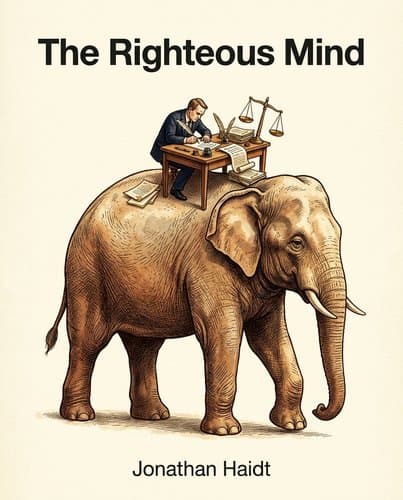
11324722_the-righteous-mind
by Jonathan Haidt
Moral convictions aren't reasoned conclusions—they're tribal intuitions wearing logic as a disguise. Haidt reveals the six psychological foundations that…
In Brief
Moral convictions aren't reasoned conclusions—they're tribal intuitions wearing logic as a disguise. Haidt reveals the six psychological foundations that secretly drive political disagreement, explaining why smart people become more entrenched, not less, and how to actually reach across the divide.
Key Ideas
Intuition Fires Before Reasoning Begins
When someone states a strong moral position, their intuition fired before their reasoning began — which means challenging their logic head-on will just produce better rationalizations, not reconsideration
Physical Sensations Shift Moral Verdicts
Bodily state shapes moral judgment more than we realize: foul smells, bitter tastes, and even proximity to hand sanitizer measurably shift moral verdicts — which means the feeling of certainty about a moral position is not evidence of its correctness
Moral Foundations Calibrate Across Cultural Tribes
The six moral foundations (Care, Fairness, Loyalty, Authority, Sanctity, Liberty) are like taste receptors: everyone has them, but cultures and political tribes calibrate them differently — understanding which channels your opponent is tuned to is more useful than arguing they're wrong to tune there
Intelligence Polishes Rationalizations, Not Objectivity
High intelligence doesn't reduce confirmation bias — it increases the sophistication of the rationalizations, which is why better-educated partisans tend to be more entrenched, not less
Curiosity Precedes Successful Mind Change
Before attempting to change anyone's mind on a contested issue, establish genuine curiosity about their perspective first — the elephant evaluates the person before the rider evaluates the argument, and a perceived threat shuts down all downstream persuasion
Shared Norms Load-Bear Moral Communities
Moral communities are fragile infrastructure, not just collections of opinions — reforms that ignore the load-bearing function of shared norms, rituals, and identity can destroy social cohesion even when their stated goals are good
Group Loss Creates Genuine Wellbeing
The capacity to 'lose yourself' in a group — at a concert, in a religious community, on a sports team — is not weakness or manipulation; it is a genuine feature of human psychology, and suppressing it entirely has real costs for wellbeing and community
Who Should Read This
Curious readers interested in Behavioral Psychology and Social Psychology and the science of how the mind actually works.
The Righteous Mind
By Jonathan Haidt
14 min read
Why does it matter? Because the moral convictions you're most certain about are the ones most likely to be confabulated after the fact.
You believe you arrived at your political views through careful thought. You weighed the evidence, considered the arguments, and reached reasonable conclusions. So did the person across from you — the one whose positions seem not just wrong but baffling, maybe even morally offensive. Jonathan Haidt spent his career inside that puzzle, and what he found is genuinely unsettling: the reasoning comes after. The verdict arrives in a flash, wordless and certain. Then your brain — brilliant, articulate, self-congratulatory — spends the next thirty seconds building a case for what your gut already decided. This isn't a flaw in certain people. It's the standard equipment. The question is what happens once you actually see it — not just in your opponents, but in yourself.
You Didn't Reason Your Way to That Moral Verdict — You Arrived There Before You Started Thinking
Scott, a psychology undergraduate at the University of Virginia, sits across from a student volunteer and reads aloud: Julie and Mark, college-age siblings vacationing in France, use two forms of birth control and have sex once, tell no one, and feel closer afterward. Was that wrong?
Eighty percent of people said yes, immediately. What happened next is the interesting part.
Scott's job was to play devil's advocate — trained to dismantle every objection the subject raised. Worried about birth defects? They used a condom and the pill. Worried about psychological damage? The story says they felt closer. Worried someone would find out? The story says they kept it secret. Every escape hatch was sealed. Almost no one changed their verdict. Instead, they cycled through fresh objections. When those were knocked down, they reached for more. One subject burned through half a dozen reasons before landing, exhausted, on this: "I just can't change my mind but I don't know how to show what I'm feeling."
That sentence is a small window into how moral judgment actually works. The verdict — wrong — arrived in the first second. Everything after was a search party sent out to justify it. When the search party came back empty-handed, the verdict stood anyway.
Jonathan Haidt, who designed the study, calls this moral dumbfounding: being certain something is wrong while being unable to say why. He found the same pattern with a different scenario — a family that ate their dog after it was killed by a car. No harm, their property, already dead. Subjects still condemned it. Asked who was hurt, they invented victims on the spot. When an interviewer pointed out that those explanations contradicted the story, subjects didn't update their verdict. They went looking for a different victim.
Moral reasoning, most of the time, runs backward. You don't weigh the evidence and reach a conclusion. You reach a conclusion — instantly, automatically, below conscious awareness — and then your reasoning faculty gets to work building a case for it. The case feels like the cause. It isn't. The verdict was already in before the trial began.
Your Brain Is a Press Secretary, Not a Judge — and It's Very Good at Its Job
The confirmation bias feels like a correctable mistake — something a careful thinker can train themselves out of. The research says otherwise. It is a structural feature of a mind built not to find truth, but to win arguments. And here is the part that makes it worse: intelligence doesn't fix it. It accelerates it.
David Perkins, a researcher who spent years studying everyday reasoning, recruited people across education levels and asked them to think through policy questions — would giving schools more money improve outcomes? He had them write down every reason they could think of, pro and con. More educated people did produce more reasons. But when Perkins separated the arguments into my-side and other-side columns, the additional reasons fell almost entirely on one side. Higher IQ predicted how many supporting arguments a person could generate. It said almost nothing about their willingness to engage the opposing case. Smart people, it turns out, make better press secretaries. They are faster at finding evidence for the conclusion that what Haidt calls the Elephant — the intuitive, automatic system that actually drives decisions — already reached, more agile at deflecting counterarguments, more persuasive to themselves and everyone else. The reasoning is real. The conclusions were never really in doubt.
Drew Westen's fMRI work makes this visible at the level of the brain. He brought committed partisans into a scanner and showed them footage of their preferred presidential candidate caught in an apparent contradiction. The brain regions associated with deliberate reasoning — the ones that activate when you work through a math problem — stayed quiet. What fired instead were circuits tied to emotional threat. Then, when subjects found a way to explain away the contradiction, the brain's reward center released a small pulse of dopamine. Resolving the dissonance felt good in a measurable, chemical way. The mind wasn't investigating. It was celebrating an acquittal. For committed partisans, Westen concluded, this cycle of threat and release may become self-reinforcing: the motivated-reasoning brain gets rewarded so consistently that it gets better and faster at the job, which is exactly the wrong direction.
The upshot is that you should be very suspicious of any individual's reasoning, including your own — because the more skilled the reasoner, the more convincing the brief they can build for whatever the Elephant already believes.
WEIRD Morality Is Not Universal Morality — It's a Local Dialect Mistaken for the Mother Tongue
What would it mean to discover that the moral philosophy you grew up treating as universal — rights, individual harm, personal autonomy — is actually a regional dialect, intelligible mainly to people who share your particular cognitive style?
Haidt spent three months in Bhubaneswar, a city in eastern India, and that question stopped being hypothetical. He arrived expecting to study violations of purity and sanctity, and he did. But the bigger discovery was personal. The society he landed in was hierarchical, sex-segregated, and saturated with religious ritual. Men dined while their wives stayed in the kitchen. Servants were expected to serve without being thanked. Sacred water that was visibly polluted was used for cooking and bathing. Every instinct Haidt carried from his education told him this was oppression in need of a diagnosis.
But something shifted. He liked his hosts. They were generous, warm, and happy to teach him. Gratitude, it turns out, is a powerful solvent for ideological certainty. As his emotional connection to the people around him deepened, his interpretation of their social world began to change. He stopped seeing a collection of individuals being denied their rights and started seeing something else: a moral system organized around duties, roles, and the obligations that flow between generations and between people of different status. In this framework, asking "who was harmed?" was roughly as useful as asking "which team won?" at a piano recital. It was the wrong question for the domain.
Richard Shweder, an anthropologist whose work Haidt had been reading, had already mapped this territory. He identified three broad ethical systems. Autonomy organizes morality around individual rights and harm — the one WEIRD philosophy covers. Community grounds it in duty, hierarchy, and group welfare: an eldest son expected to abandon his career to care for aging parents isn't being oppressed; he's fulfilling an obligation that gives his life meaning. Divinity links behavior to purity and sacred order: the belief that eating beef is wrong not because it hurts anyone but because the cow is sacred. WEIRD moral philosophy covers exactly one of those three. That means most of the moral reasoning happening on Earth looks to a Western liberal eye like confusion, superstition, or plain wrongness. Not because it is, but because the observer has one receptor and is encountering a cuisine built for five.
When Haidt boarded his flight home, he overheard an American passenger arguing loudly with a flight attendant about storage-bin rights. He cringed. That reflexive entitlement — the immediate appeal to personal right — was the same cognitive reflex he'd been trained to call moral clarity. India had given him a place to stand outside that reflex, and from there it looked considerably smaller than it had before.
Morality Has Six Taste Receptors, and Most Political Disagreements Are Arguments Between People Eating Different Menus
Imagine a restaurant that serves only sweeteners. Every dish, every beverage — nothing but sugar, honey, and syrup, because the owner has determined that sweetness triggers the strongest dopamine response and is therefore the only taste worth optimizing. You'd eat one meal and never return. Not because the food was bad, exactly, but because you're built for more than one flavor.
Haidt uses this thought experiment to describe what happened to Western moral philosophy. Utilitarianism is the sweetener restaurant: everything reduces to welfare, pleasure, pain, the hedonic calculus. Kantian deontology serves only salt — duties and rights, the logical structure of obligation. Both are one-receptor moralities built by extraordinary systematizers who were, by most accounts, not especially gifted at reading other people's inner lives. The result was a tradition that could deduce moral rules from first principles but struggled to explain why a nurse who absentmindedly strokes an unconscious child's hair during surgery strikes almost everyone as more virtuous than the technically identical nurse who doesn't. Neither framework has a category for that kind of moral texture — the small unrequested gesture, the warmth that costs nothing and means everything — because neither framework was built to notice it.
The actual human moral palette, Haidt argues, has six receptors, each an evolutionary solution to a recurring social problem. Care responds to vulnerability and suffering — it evolved to protect helpless offspring and now fires when you see a hungry child in a news photograph. Fairness tracks reciprocity and cheating: the deep satisfaction of tit-for-tat and the specific fury of being taken advantage of. Loyalty monitors coalition membership, the difference between team player and traitor. Authority registers legitimate hierarchy — not raw domination, but the kind of structured relationship that, as primatologist Frans de Waal observed, even chimpanzees rely on to suppress constant low-level conflict. Sanctity is the behavioral immune system: the visceral recoil from contamination and degradation. In 2001, a German man named Armin Meiwes killed and ate a willing victim who had answered his online advertisement. No coercion, no deception, no surviving party with a grievance — and yet virtually everyone who hears the story feels that something went wrong. Sanctity is what's firing. Harm-based ethics has no name for the feeling.
What makes this more than taxonomy is what Haidt found when he built the Moral Foundations Questionnaire and collected data from over 130,000 people through YourMorals.org. The graph is stark. Liberals score high on Care and Fairness and then drop sharply — Loyalty, Authority, and Sanctity register close to zero. Conservatives distribute weight across all six, roughly equally. This isn't a story about one side caring and the other not caring. It's a story about people genuinely responding to different signals, tasting different things in the same meal. Telling a conservative that Loyalty doesn't belong in morality lands roughly the way telling someone their experience of bitterness is a cognitive error would. The receptor is real. The taste is real. The menu just doesn't list it.
Liberals Aren't More Rational — They're Running Fewer Channels and Calling the Missing Ones Irrelevant
Haidt's data from YourMorals.org, across more than 130,000 subjects, showed something more unsettling than a distribution gap. When he asked participants to fill out the Moral Foundations Questionnaire as a typical conservative would answer it, liberals made the largest errors of anyone in the study. They assumed conservatives would score low on Care — would essentially not register whether someone was hurt — because from inside a three-channel framework, that's the only available explanation for why someone would also weight Loyalty and Sanctity. The logic fails because it assumes the foundations compete for the same space, like pie slices. They don't. Conservatives aren't trading Care away for Loyalty. They're running both simultaneously, and liberals, it turns out, couldn't see that from where they were standing.
Haidt traces the political consequence through his own failed instinct to help John Kerry's 2004 campaign — spending evening dog walks mentally rewriting Kerry's speeches, convinced the candidate was pitching everything at the rider, at deliberate cost-benefit reasoning, while Republican ads went straight for the gut. The deeper problem, though, wasn't tactical. Consider two ways of thinking about what a society is for. One says society is a contract among individuals to prevent harm — you leave me alone, I leave you alone, and the state referees the edges. The other says society is something that evolved to suppress selfishness and bind people into groups that outlast any individual — where the rules, rituals, and hierarchies aren't arbitrary but are the machinery that makes cooperation possible at all. These aren't competing answers to the same question. They're different questions entirely. Argue policy between people operating from these two starting points and you don't get debate — you get mutual incomprehension that looks, from either side, like stupidity or bad faith.
What looks like irrational deference to tradition from the first position often turns out to be load-bearing infrastructure. Haidt calls this moral capital: the accumulated norms, institutions, identities, and practices that keep selfishness in check and allow a community to function. Robert Putnam's research on ethnic diversity shows why this matters. Putnam found that high diversity was associated with reduced civic participation — and the surprising part was that trust didn't just fall between groups. It fell within them too. People didn't become hostile to outsiders; they withdrew from everyone, including their neighbors. He called it turtling. Before registering an impulse to fix this — diversify the leadership, launch an inclusion initiative, adjust the policy settings — notice the reflex itself. The shared moral matrix that makes cooperation possible isn't a parameter you can dial up. It's the substrate the whole structure sits on. Reform that treats it as an obstacle rather than a resource doesn't liberate the bees. It damages the hive, often irreversibly, and most of all for the people the reform was meant to help.
We Are Built to Lose Ourselves in Groups — and That's Both Our Best Feature and Our Worst
In the 1980s, a geneticist named William Muir was trying to solve a practical problem in the egg industry. If you want more eggs, the obvious move is to select only the most productive hens for breeding. Muir tried this. The results were catastrophic. The highest-producing hens turned out to be the most aggressive ones — dominant birds who got more food, more space, and more eggs by brutalizing their cage-mates. Breed only winners, and you breed a population of bullies. By the sixth generation, the death rate in his cages hit 67 percent. The survivors were battered, partially defeathered, and producing fewer eggs than when he started. Individual selection had optimized for a trait that destroyed the system it depended on.
Then Muir ran the experiment differently. Instead of selecting the most productive individual hens, he selected the most productive cages — and bred all the hens in those cages together, regardless of individual output. Within three generations, aggression collapsed. By the sixth, the death rate fell to 8 percent and egg output nearly tripled. The birds looked, for the first time, like the chickens in children's books: plump, calm, well-feathered. He hadn't selected for docility directly. He'd just changed the unit of competition from the individual to the group, and the group's internal logic did the rest.
Haidt's point is that humans aren't individual optimizers with altruism bolted on as an afterthought. We carry a second mode — a genuine capacity to dissolve the self into something larger and subordinate personal advantage to group success. That capacity wasn't an accident. It was built by exactly the same evolutionary pressure Muir replicated in his cages: groups that suppressed internal competition outcompeted groups that didn't.
But here is where it gets uncomfortable. The hive switch is tribal by design. Oxytocin — the hormone that floods the brain during moments of group bonding — does not increase generalized love for humanity. In controlled studies, it increased in-group favoritism and willingness to harm outsiders to protect the team, simultaneously. The same chemical that produces the feeling of dissolving into something larger — the feeling anyone who has stood in a crowd singing the same song has felt — also draws a sharp line around who counts as us. The warmth is real. So is the boundary.
This is why the same psychology that produces soldiers running toward gunfire to save their unit also produces the unit burning a village. The hive switch doesn't expand the circle of moral concern; it intensifies everything inside the circle while making the outside feel more distant, sometimes more threatening. Understanding this doesn't resolve the tension — it just means you can no longer treat human tribalism as a malfunction. It is the feature, running exactly as designed. Which is precisely why the question shifts from whether we have this machinery to how we aim it — and that's where the next section picks up.
Once You See the Machinery, You Can Work With It — But You Have to Stop Arguing With the Elephant
What do you do once you understand that the person across from you isn't irrational — they're running different moral receptors, tracking real social goods that your framework simply doesn't register? The answer isn't to find better arguments. Arguments address the rider. The rider doesn't decide.
Haidt pictures the moral mind as a Rider — the reasoning self — sitting atop an Elephant — the intuitive, emotional self — that goes where it wants. His most practical insight follows from this: the elephant evaluates the person before the rider evaluates the argument. If someone feels judged, dismissed, or threatened, the elephant turns away, and no argument, however airtight, can reach a rider whose elephant has already left the room. Sequence matters enormously. Start with genuine commonality or real curiosity about the other person's experience — not performed openness, actual interest. Only after some basic trust has formed do you approach the contested territory. The rider gets a fair hearing only because the elephant has already decided you're safe.
None of this requires pretending all value systems are equivalent. Berlin's distinction is useful here: pluralism is not relativism. A relativist says every preference is equally valid — coffee with milk, or concentration camps, just different tastes. A pluralist says there is a finite number of genuine human values — perhaps twenty-seven, perhaps seventy-four — and that if you understand the circumstances that led someone to prioritize one you don't, you can understand why they pursue it without having to agree. The difference matters because it preserves the possibility of disagreement while keeping the other person fully human.
Haidt sketches a three-part framework for public life that runs on the same logic. Liberal wisdom tracks victims of power and can see when corporate interests corrupt markets — the leaded gasoline phaseout saved more lives per dollar than almost any public health intervention in American history, and only government pressure made it happen. Libertarian wisdom tracks the generative miracle of voluntary exchange, and is right that destroying price signals produces systems where no one has any incentive to care about cost. Social conservative wisdom insists you cannot help a subset of bees by weakening the hive — and the data on anomie, civic withdrawal, and moral capital shows this isn't nostalgia. Each position sees something the others genuinely cannot. Not because any side is stupid, but because they're running different receptors, and the signal is real.
Which real thing are they tracking that I don't yet have the receptor for?
The Rip in the Fabric, and the Only Thread That Fixes It
Here is the uncomfortable gift the book leaves you with: understanding the wiring diagram doesn't exempt you from it. Haidt spent years mapping the machinery before noticing he'd been running it on three channels and calling the other three noise. The knowledge doesn't inoculate you — it just changes what you notice when the reflex fires. And that's enough to change something important. You can't reason someone into a verdict their elephant hasn't already approved. But you can talk to the elephant first — with actual curiosity, not tactical patience — and when you do, you're no longer asking how can they possibly believe that? You're asking which real thing are they tracking that I don't yet have the receptor for? That question, asked honestly, is what the machinery was always capable of. It just needed somewhere to point.
Notable Quotes
“Well, I don’t know, maybe the woman will feel guilty afterward about throwing out her flag?”
“It’s wrong to cut up the flag because a neighbor might see her do it, and he might be offended,”
“Well, it says here in the story that nobody saw her do it. So would you still say it was wrong for her to cut up her flag?”
Frequently Asked Questions
- What is The Righteous Mind about?
- The Righteous Mind argues that moral judgments are driven by intuition first and reason second — making most political disagreement a clash of tribal instincts, not competing logic. Drawing on psychology and evolutionary theory, Haidt maps the six moral foundations (Care, Fairness, Loyalty, Authority, Sanctity, Liberty) that underlie human values. The book provides a framework for understanding why people across the political spectrum hold the convictions they do. Rather than treating moral disagreement as a failure of reason, Haidt shows how moral foundations function differently across cultures and political groups. The core insight is that the elephant (intuition) is more powerful than the rider (reason) in shaping moral convictions.
- What are the six moral foundations?
- The six moral foundations are Care, Fairness, Loyalty, Authority, Sanctity, and Liberty. According to Haidt, these are like taste receptors: everyone has them, but cultures and political tribes calibrate them differently. Care emphasizes harm prevention and compassion; Fairness focuses on justice and equality; Loyalty strengthens group bonds; Authority values hierarchy and tradition; Sanctity addresses purity and sacred values; and Liberty opposes domination. Understanding which moral foundations your opponent prioritizes is more useful than arguing they're wrong to tune there. This framework explains why people with identical values sometimes reach opposite moral conclusions—they're simply emphasizing different foundations.
- Why is it hard to change someone's mind on moral issues?
- When someone states a strong moral position, their intuition fired before their reasoning began — which means challenging their logic head-on will just produce better rationalizations, not reconsideration. High intelligence doesn't reduce confirmation bias; it increases the sophistication of the rationalizations, which is why better-educated partisans tend to be more entrenched, not less. The rider (reason) serves the elephant (intuition), not the other way around. So directly attacking someone's moral logic activates defensive reasoning. Before attempting to change anyone's mind on a contested issue, establish genuine curiosity about their perspective first — the elephant evaluates the person before the rider evaluates the argument.
- How do physical sensations affect moral judgment?
- Bodily state shapes moral judgment more than we realize: foul smells, bitter tastes, and even proximity to hand sanitizer measurably shift moral verdicts — which means the feeling of certainty about a moral position is not evidence of its correctness. When you're feeling physically disgusted, you're more likely to make harsh moral judgments. When you're calm and content, you're more forgiving. Haidt uses this insight to explain why moral debates often feel intractable—we're not just disagreeing on facts, we're in different bodily states that activate different moral intuitions. Recognizing this embodied nature of morality suggests that changing minds sometimes requires changing the atmosphere before changing the argument.
Related Book Summaries
Read the full summary of 11324722_the-righteous-mind on InShort