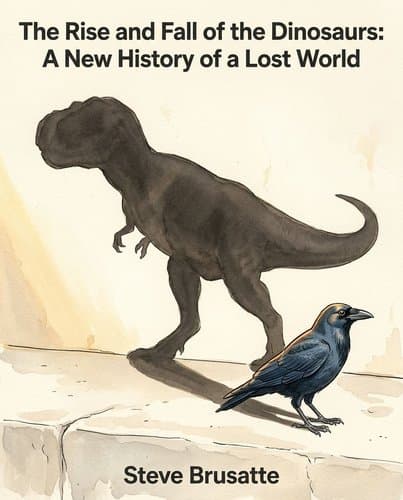
35820369_the-rise-and-fall-of-the-dinosaurs
by Steve Brusatte
Dinosaurs didn't fail—they conquered every catastrophe Earth threw at them for 165 million years, and 10,000 of their descendants are singing outside your…
In Brief
Dinosaurs didn't fail—they conquered every catastrophe Earth threw at them for 165 million years, and 10,000 of their descendants are singing outside your window right now. Uncover how mass extinctions, not superiority, determine who rules the planet, and why a six-mile rock is the only reason mammals—including you—got a turn.
Key Ideas
Birds are dinosaurs by taxonomy
When a scientist says birds 'are' dinosaurs, they're not being poetic — birds sit taxonomically inside Dinosauria by the same logic that makes bats mammals. The dinosaur empire didn't end; roughly 10,000 species of it are overhead right now.
Winners shaped by luck not fitness
Dinosaurs spent their entire first 30 million years consistently outpaced by crocodile-line archosaurs (pseudosuchians), which were more anatomically diverse throughout the Triassic. 'Superior organism' explanations for evolutionary winners are almost always myths built backward from the outcome.
Mass extinction created dinosaur dominance
Two mass extinctions, not fitness, explain dinosaur dominance: the end-Permian event (252 million years ago, ~90% of species dead) created the ecological opening; the end-Triassic event (201 million years ago) eliminated the pseudosuchians that had kept dinosaurs marginal. Catastrophe is the real engine of who rules the Earth.
T. rex: feathered, intelligent, engineered
T. rex bit at approximately 13,400 newtons per tooth — roughly the weight of a pickup truck — and its skull was architecturally engineered (fused nasal bones as a stress vault, circular jaw cross-section) to survive its own bite force. It also almost certainly had feathers, grew at roughly 5 pounds per day during adolescence, and had an EQ comparable to a chimpanzee.
Asteroid instantly killed thriving dinosaurs
The K-Pg extinction was not a slow decline: most dinosaur groups were thriving right up to the boundary. The killing was geologically instantaneous — a few thousand years at most — triggered by a six-mile asteroid at 67,000 mph. The creatures who inherited the Earth, including our ancestors, survived only because they were small, burrowing, and omnivorous when the sky caught fire.
Who Should Read This
Science-curious readers interested in Evolution and Biology who want to go beyond the headlines.
The Rise and Fall of the Dinosaurs: A New History of a Lost World
By Steve Brusatte
12 min read
Why does it matter? Because every assumption you hold about dinosaurs is backwards — including whether they're extinct.
Picture the dinosaur from grade school: a ponderous, gray-skinned brute, too stupid to survive, preserved behind museum glass as a cautionary tale about evolutionary failure. Consider that right now, scientists are describing a new dinosaur species — and that this happens, on average, once a week. That most of them had feathers. That one is probably visible outside your window right now. The closed chapter of natural history you think you know turns out to be neither closed nor, technically, a chapter about anything extinct. What Steve Brusatte reconstructs here isn't the story you absorbed from Jurassic Park or childhood dioramas — it's one about contingency: a lineage that didn't win through superiority, didn't die through failure, and hasn't actually ended. More unsettlingly, it's the story of why you exist at all.
Scientists Are Finding a New Dinosaur Species Every Week — and Most of Them Look Like Birds, Not Reptiles
Before dawn on a November morning in 2014, Steve Brusatte was sprinting through Beijing's central railway station with a suitcase full of camera gear, barely able to read a single Chinese character, knocking into commuters and ignoring their shouted complaints. He had a train to catch to Jinzhou, a city in old Manchuria near the North Korean border, where a farmer had turned up something extraordinary in a cornfield. Junchang Lü, one of China's most prominent dinosaur hunters, had sent Brusatte grainy photos. Both men suspected it could be one of the great finds: a new species preserved so completely you could almost sense what it was like alive.
The fossil was waiting in a local museum, balanced on a small table that seemed to sag under the slab's weight. What Brusatte found there stopped him: a mule-sized skeleton with the clear markings of a Velociraptor cousin — serrated teeth, curved claws, a long whiplike tail — but also hollow bones, heron-thin legs built for speed, and something else entirely. Feathers. Full quill-pen wing feathers layered across both arms in the arrangement of a wing, with bushy plumage on the head and branching feathers fanning from the tail. The creature, later named Zhenyuanlong suni, looked exactly like a bird.
That discovery captures the argument Brusatte has spent a career making: everything you were taught about dinosaurs (the slow, scaly, dim-witted giants lumbering toward inevitable extinction) is wrong. The evidence is arriving fast enough to make that undeniable. Somewhere on Earth, a new dinosaur species is being named each week, roughly 50 a year. And the tools are as surprising as the fossils: high-powered microscopes can read preserved pigment structures in fossilized feathers and tell you the actual color of an animal dead for over a hundred million years.
The picture that emerges is of animals supremely suited to their world for over 150 million years. Whether the 10,000 species of birds alive today count as a continuation of that empire is a stranger argument than it sounds.
Dinosaurs Spent Their First 30 Million Years Consistently Losing to Their Crocodile Cousins
For their first 30 million years on Earth, dinosaurs were consistently losing to their competitors — and the most damning evidence came from Brusatte's own data.
The old story was almost theological. Paleontologists like the paleo-celebrity Robert Bakker argued that dinosaurs were simply better: faster, smarter, metabolically superior creatures who inevitably outcompeted everything else in Triassic Pangea. Brusatte read those arguments and found them inspiring — and then found the fossils that contradicted them.
The creature that cracked it open is called Effigia okeeffeae. In 1947, Edwin Colbert's field team at Ghost Ranch, New Mexico, excavated hundreds of Coelophysis skeletons, early theropod dinosaurs the size of dogs, and tucked the bones into plaster blocks that sat in American Museum of Natural History storage for the next half century. In 2004, Sterling Nesbitt, starting his PhD, opened one of those blocks. The skeleton inside had no teeth. It had a beak. Its arms were tiny stubs. Its ankle matched a crocodile's, not a dinosaur's. What Colbert's crew had filed away as just another Coelophysis was actually a pseudosuchian, a distant ancestor of modern crocodiles, that had independently evolved a body plan nearly identical to its dinosaur neighbors. It had been sitting in a museum drawer for 57 years.
Convergence, where two unrelated lineages arrive at the same solution, usually implies similar environmental pressures. But if pseudosuchians kept evolving into shapes indistinguishable from dinosaurs, what exactly made dinosaurs the chosen ones?
Brusatte ran the numbers. He built a database of 76 Triassic species, dinosaurs and pseudosuchians together, encoding 470 features of their skeletons: how many toes, which legs they walked on, the shape of their teeth. He plotted every species in a morphospace — a map where creatures that look alike cluster together and creatures that look different spread apart. Going in, he was testing an assumption he'd absorbed from the field: that dinosaurs would cover more of that map, that their diversity would show up as a wider spread. It didn't. Pseudosuchians filled more of the map at every time slice across the entire Triassic, experimenting with more body plans, more diets, more ecological strategies. Both groups diversified as the period wore on, but the crocodile line always outpaced the dinosaurs. The creatures Bakker celebrated as superior warriors were, in the data, also-rans.
Dinosaur dominance wasn't earned through competition; it was gifted by catastrophe. Something would have to happen to the pseudosuchians before dinosaurs got their chance. At the end of the Triassic, something did.
Dinosaurs Didn't Earn Their Crown — Two Apocalypses Handed It to Them
Two catastrophes, spaced 50 million years apart, eliminated the competition on dinosaurs' behalf.
The first struck 252 million years ago — the single deadliest event in Earth's history. Across Siberia, miles-long cracks in the earth oozed lava continuously for hundreds of thousands of years, not the explosive eruptions of modern imagination but a relentless bleeding of the continent. Atmospheric dust blocked photosynthesis, carbon dioxide triggered runaway warming, the oceans turned acidic. Ninety percent of all species died. The old world was gone.
Then, 50 million years later, Pangea began to tear apart and bled again. Four volcanic pulses over roughly 600,000 years buried three million square miles under basalt stacked thousands of feet thick. Columbia paleontologist Paul Olsen spent his career reading this transition in the rock record of New Jersey's Newark Basin, where dinosaur and pseudosuchian footprints lay preserved in layered stone spanning tens of millions of years. Before the eruptions, dinosaur tracks made up about 20% of what's preserved. Immediately after: 50%, with entirely new oversized prints, the three-toed Eubrontes, 35 centimeters, replacing the small Grallator tracks left by earlier theropods. The pseudosuchians that had outpaced dinosaurs at every ecological measure were gone. Why dinosaurs survived while morphologically similar rivals didn't remains unresolved. Brusatte suspects fortune played as large a role as biology.
On Scotland's Isle of Skye, Brusatte and a colleague spent a full day on hands and knees hunting fish teeth before packing up as the tide came in. Walking back in low afternoon light, they noticed large, oval depressions in the rock, then more, arranged in a zigzag pattern stretching in every direction: a 170-million-year-old sauropod trackway in an ancient lagoon.
The creatures that left those prints had assembled five adaptations that, together, no rival lineage had combined. It started with the neck — elongated far beyond any competitor's, it worked like a cherry-picker, sweeping enormous quantities of food while the animal barely moved. Getting to that size required extraordinary speed: from hatchlings you could cup in two hands to 50-foot adults in 30 to 40 years. But a body that large needs oxygen a standard reptile lung can't deliver, so sauropods had unidirectional lungs, like modern birds, that extracted oxygen on both inhale and exhale. Those lungs came with internal air sacs that solved two additional problems at once: they hollowed the bones into honeycombs light enough to support a neck that long without toppling, and they dissipated body heat that would otherwise cook an animal at that mass. Remove any one and sauropods reaching 50 tons become biologically impossible.
Catastrophe opened the door. A very specific biology walked through it.
T. rex Bit With the Force of a Pickup Truck — and Its Brain Was More Chimp Than Lizard
Greg Erickson had a Triceratops pelvis with a half-inch puncture, a T. rex bite mark tens of millions of years old. In a Florida State lab in the mid-1990s, he built a machine to find out exactly how hard that bite had been. He cast a T. rex tooth in bronze and aluminum, loaded it into a hydraulic press, and drove it into a cow pelvis until it made a matching hole. The instruments read 13,400 newtons: roughly 3,000 pounds from a single tooth, the weight of a pickup truck balanced on one point. African lions bite at 940 pounds. Humans manage 175. The only modern animals in the same range are alligators — and T. rex had fifty of these teeth.
That number created an immediate engineering puzzle. Emily Rayfield at Bristol answered it with finite element analysis (the same software engineers use to stress-test bridges before they're built). What she found was a skull built to survive its own power: nasal bones fused into a long vaulted tube that redirected stress; thick bony bars framing each eye socket; a lower jaw nearly circular in cross-section to absorb force from any direction. No other theropod had this architecture. Allosaurus and the great carcharodontosaurs, predators even larger than T. rex but built for slicing rather than crushing, had more delicate skulls. T. rex alone evolved the complete package: the teeth, the jaw muscles, and the reinforced chassis to survive using them.
The animal behind that skull was stranger still. CAT scans placed its encephalization quotient (a brain-to-body ratio that roughly tracks intelligence) in the same range as a chimpanzee, well above dogs or cats. Its olfactory bulbs were proportionally enormous; its eyes angled forward for depth perception. Erickson's bone-ring studies showed it grew at nearly five pounds a day during its teenage years, reaching seven tons in under three decades. Early tyrannosaurs from China, dog-sized and thirty-foot alike, were preserved coated in dense six-inch filamentous feathers. The common ancestor of all tyrannosaurs was feathered — and T. rex almost certainly was too. The bite is just the most measurable thing about it.
Birds Aren't Dinosaur Descendants — Taxonomically, They Are Dinosaurs
Yale paleontologist John Ostrom spent the 1970s arguing something the field resisted: birds weren't distant relatives of dinosaurs, they were dinosaurs. His case rested on Deinonychus, a lithe, long-armed Montana raptor that moved nothing like the lumbering monsters in old museum dioramas, and whose anatomy mapped almost precisely onto the earliest birds. The relationship is the same as bats inside mammals — not descent from a shared ancestor but membership in the same group, by the same logic that makes a bat a mammal rather than a mammal's cousin. Birds aren't descended from dinosaurs the way whales descended from land mammals. They're a subgroup within Dinosauria, on the same family tree as T. rex and Brontosaurus.
The argument was contested, then gradually accepted, but physical proof — a dinosaur preserved in stone with actual feathers — remained elusive. By 1996, late in his career, Ostrom was at a paleontologists' gathering in New York when Phil Currie, a Canadian colleague who'd spent years tracking fossil sites across China, pulled a photograph from his pocket. It showed a small dinosaur from China's Liaoning region, its outline blurred by dense, downy filaments, preserved so precisely it might have died the week before. Ostrom looked at it and began to cry. His knees buckled. He had spent twenty years betting on an idea, and somebody had finally found his feathered dinosaur.
What the Liaoning excavations revealed was stranger than the connection itself. Almost nothing in the bird body plan evolved for flight. Wishbones appear in the earliest theropods, functioning there as shock absorbers for catching prey. Flow-through lungs, hollow bones, fast growth rates, brooding behavior over eggs: all of it turns up in ground-dwelling dinosaurs tens of millions of years before any of them got airborne. Wings most likely started as display structures — elaborate, colorful surfaces for signaling mates, co-opted for aerodynamics only once body sizes shrank enough for the physics to work. The bird didn't descend from the dinosaur; the bird is a dinosaur that got small enough to fly.
That reframe carries a strange consequence. The dinosaur empire never fully fell. Over ten thousand species of living dinosaurs occupy the planet right now — in forests, on coastlines, outside chip shops. The seagull at a Scottish harbor, sharp-eyed and casually menacing, is a more direct line to Velociraptor than anything mounted on a museum wall. The age of dinosaurs didn't end. It just got wings.
The Dinosaur Empire Didn't Decline — It Ended on a Single Morning
On the morning of the last day of the Cretaceous, a pack of T. rex was readying for a hunt on the floodplains of what is now Montana. The forest looked exactly as it had for millions of years. Then a point of light appeared to the southeast.
What followed took fifteen minutes. Two flashes: the first as the incoming rock compressed the atmosphere so violently that the air ignited, the second when the asteroid hit bedrock in what is now Mexico's Yucatán Peninsula. The ground turned liquid with shock waves, rising and falling in pulses that launched forty-foot tyrannosaurs several feet into the air. Then came rain, but not water: scalding glass beads, condensed from vaporized rock, transferring heat to the atmosphere until forests across North America ignited spontaneously. The sonic boom arrived two and a half hours after the light. Most of the Hell Creek ecosystem was already dead.
The old narrative — that dinosaurs were already in decline when the rock arrived — collapses against Brusatte's own data. He and Richard Butler analyzed anatomical diversity across every dinosaur group in the final millions of years before the boundary. Theropods, sauropods, pachycephalosaurs: all stable right to the end. Triceratops bones appear just centimeters below the iridium layer fingerprinting the asteroid. Paleoecologist Jonathan Mitchell's food-web model adds one wrinkle: the large herbivore guild had thinned in the final stretch, making ecosystems more fragile. The rock hit when they were already brittle, though whether anything survives an impact that size is a different question.
What survived were the small and lucky and underground. Mammals that could burrow. Crocodiles and turtles that could wait underwater while the surface became an oven. And a few bird lineages that could fly toward cover. Somewhere in that group of burrowing mammals were your ancestors and mine.
Three million years after the impact, Tom Williamson found a skeleton in the New Mexico badlands: a puppy-sized creature called Torrejonia, gangly-limbed, with long grasping toes built for branches. One of the oldest known primates. Its ancestors had been in the ground when the glass rain fell.
Without the asteroid, Brusatte writes, dinosaurs would still rule and we would not exist. That's either a comforting thought about contingency or a troubling one about permanence, depending on where you let it land. Dinosaurs spent 150 million years at the top of the world and lost their empire in an afternoon. We've had ours for considerably less.
The Crown We Inherited From a Rock
The dinosaurs didn't lose. For 150 million years — twice as long as the entire span since the rock that ended them — they ran this planet without serious competition. They were still thriving on the morning the rock arrived. What ended them wasn't weakness or slow decline or any flaw a natural selector could have caught. It was a six-mile asteroid, arriving on an ordinary morning, cracking the sky in fifteen minutes. Your ancestors survived because they were small enough to burrow and lucky enough to be underground when the glass rain fell. Not better. Just smaller, and already there.
We have held this world for 66 million years. The dinosaurs held it for 150 million, and lost it in fifteen minutes. Your ancestors were underground when it happened, small enough to survive what killed everything else.
Notable Quotes
“How would you like to describe a new species of dinosaur?”
Frequently Asked Questions
- What are the key takeaways from The Rise and Fall of the Dinosaurs?
- The Rise and Fall of the Dinosaurs fundamentally challenges how we understand evolution and planetary history. Mass extinctions—not biological superiority—drove dominance on Earth, with two key events reshaping life: the end-Permian extinction created ecological space, and the end-Triassic extinction eliminated competitors that had kept dinosaurs marginal for 30 million years. Dinosaurs didn't truly disappear; birds are their living descendants, with roughly 10,000 species still alive today. The K-Pg extinction was catastrophically sudden, triggered by a six-mile asteroid at 67,000 mph, killing most surviving dinosaur groups in just thousands of years. Catastrophe, not fitness, is evolution's real driver.
- Are birds actually dinosaurs?
- When a scientist says birds 'are' dinosaurs, they're not being poetic — birds sit taxonomically inside Dinosauria by the same logic that makes bats mammals. The dinosaur empire didn't end; roughly 10,000 species of it are overhead right now as modern birds. This represents precise evolutionary biology, not metaphor: birds are true dinosaurs descended from theropod lineages. Understanding this taxonomic relationship fundamentally reshapes how we view extinction; what we call the 'end' of the dinosaurs was actually their transformation into the most diverse and successful vertebrate group alive today.
- Why did dinosaurs dominate the Earth?
- Dinosaurs dominated Earth not through superior evolution but through catastrophic timing. During their first 30 million years, dinosaurs were consistently outpaced by crocodile-line archosaurs (pseudosuchians), which were more anatomically diverse throughout the Triassic. 'Superior organism' explanations for evolutionary winners are almost always myths built backward from the outcome. Two mass extinctions drove dinosaur dominance: the end-Permian extinction (~252 million years ago) killed ~90% of species and created ecological opportunity, while the end-Triassic extinction (201 million years ago) eliminated the pseudosuchian competitors that had kept dinosaurs marginal. Catastrophe is the real engine of who rules the Earth.
- What special features did T. rex have?
- T. rex possessed extraordinary predatory features that reveal sophistication far beyond typical depictions. Its bite force reached approximately 13,400 newtons per tooth—roughly the weight of a pickup truck—and its skull was architecturally engineered with fused nasal bones as a stress vault and circular jaw cross-section to survive this immense force. T. rex almost certainly had feathers and grew at roughly 5 pounds per day during adolescence. The creature had an EQ comparable to a chimpanzee, demonstrating cognitive abilities far exceeding common assumptions about dinosaur intelligence, especially for a predator whose reign ended 66 million years ago.
Related Book Summaries
Read the full summary of 35820369_the-rise-and-fall-of-the-dinosaurs on InShort