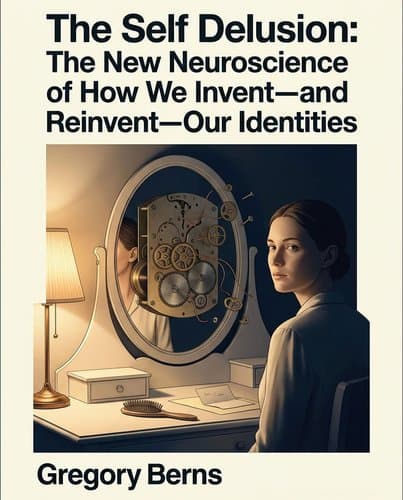
60383036_the-self-delusion
by Gregory Berns
Your brain fabricates a "you" from lossy memories and borrowed cultural scripts — and that invented self updates with every experience.
In Brief
Your brain fabricates a "you" from lossy memories and borrowed cultural scripts — and that invented self updates with every experience. Neuroscientist Gregory Berns maps the construction machinery so you can stop being written by default narratives and start deliberately authoring the identity you want.
Key Ideas
Treat Emotions as Observable Data
When you feel a strong emotion, try the shift from 'I am angry' to 'I feel angry' — it recasts an identity claim as a perceptual report and immediately creates psychological distance from the state, because you are treating the sensation as data rather than as you.
Vivid Memory Confidence Signals Unreliability
Your most confident memories of significant events (9/11, major life moments) are among the least reliable — confidence and accuracy diverge after one year, and inaccurate memories get reinforced through repetition; treat vivid memories as hypotheses, not recordings.
Hero Narrative Reveals False Causation
Before accepting a narrative that explains a frightening or confusing event, check whether it follows the hero's journey structure and assigns blame to a hidden external actor — this is the signature of the Bayesian back door, not evidence of truth.
Omission Regrets Outpace Commission Regrets
When facing a significant decision, project yourself five years forward and ask which choice that future self will regret more — omission regrets (things you didn't do) grow over time, while commission regrets (things you did) tend to fade; the asymmetry matters.
Present Tense Activates Predictive Narrative
Write quality-of-life statements in the present tense — 'I have a community I can rely on,' not 'I want community' — because present-tense writing activates the same predictive machinery that encodes new events as deviations from existing narrative, nudging the brain to interpret incoming experience against the new story rather than the old one.
Groups Disable Independent Perceptual Analysis
When you notice yourself conforming to a group's view, check whether you actually ran the mental rotation task yourself — the fMRI data shows the brain literally stops doing the perceptual work when the group has already weighed in, often below conscious awareness.
Who Should Read This
Curious readers interested in Neuroscience and Cognitive Psychology and the science of how the mind actually works.
The Self Delusion: The New Neuroscience of How We Invent―and Reinvent―Our Identities
By Gregory Berns
12 min read
Why does it matter? Because the continuous, coherent self you trust completely is something your brain manufactures in real time — and understanding the machinery is how you start choosing what gets built.
Most of us treat self-knowledge as an excavation project. Dig deeper, be more honest, strip away the defenses — and eventually you reach something solid, the real you. What nobody mentions is that the tool you're using to dig is the same tool that built the thing you're digging toward. Your brain cannot perceive itself. It constructs a simulation of everything else — your body, your memories, your sense of continuous identity — using shortcuts it assembled before you were old enough to question their materials. The self you think you're honestly examining is a narrative the brain manufactures in real time, assembled from the same machinery that produces optical illusions and superstitions. The question isn't whether you have an authentic self waiting to be discovered. The question is whether you understand how the one you're already living in got assembled — because that understanding is the only purchase you have on building a different one.
The Self You Experience Right Now Is Already Half a Second Out of Date
A student slides into the fMRI scanner, headphones on, pulse quickening. Minutes later, face to face with the contorted gray mass behind every decision they've ever made, the reaction is almost universal in Gregory Berns' neuroimaging class: a moment of excitement, then a strange letdown. After all that, it's just tissue. The brain cannot feel itself. It has no inward-pointing sensation. What you call "you" is something the brain builds from signals coming from everywhere except its own tissue: a running simulation of a body, minus the simulator.
That simulation runs on a delay.
Take off your shoe and look at your big toe. Now run hot water over it. The thin nerve fibers that carry heat and pain conduct signals at roughly one meter per second, barely walking pace. From toe to brain: nearly two seconds. Your eyes, fed by light, report the water hitting your skin almost instantaneously. Two signals, same event, arriving two seconds apart. The brain can't synchronize them. So it predicts. Over a lifetime it has learned that signals from your feet run late, and it computes a forecast: where your toe will be, what it will feel, two seconds from now. Match that to current visual input, and the gap disappears. Until you stub your toe. You watch your foot catch the chair leg, you wince, and the pain arrives afterward, like a delivery the tracking notification already warned you about. The present-self feels immediate and unified. It isn't. It's a predictive model running two seconds behind, stitching delayed signals into something that feels like now.
If the present is already constructed, the past is worse.
September 11 seemed like the perfect test for flashbulb memory theory, the idea that trauma burns itself into the brain with unusual accuracy. Tracking what people remembered, year after year, said otherwise. Accuracy dropped significantly within the first year and kept declining over the following decade. Confidence held steady. People remained certain of details they'd already gotten wrong, and the mistaken version, once told aloud, tended to get retold, cementing the errors with each repetition. The brain doesn't mark its own revisions. It replaces the old file with the new one and presents the result as memory.
The self you feel continuous with — grounded in what you actually experienced, coherent from past to present — is a construction that fills its own gaps. And if the present is manufactured from prediction, the past is assembled from something even less reliable.
Your Memory Isn't a Recording — It's a JPEG Compressed Against Templates from Childhood
Take any photo you've saved on your phone and look at its file format. If it's a JPEG, most of the original pixel data was discarded the moment you hit save. What remains is a set of mathematical waves, a compression trick: any pattern, however complex, can be reconstructed from combinations of simple waves. Your eye can't spot the loss. The brain fills in what the file no longer contains.
Your brain does the same thing to experience.
There is not enough storage to record episodic memory in its original form. So the brain compresses it into schemas, abstract templates that hold the essential pattern of an experience, then reconstruct the scene during recall. A brain region called the ventromedial prefrontal cortex, the region that maps incoming experience against prior patterns, actively uses these templates to bias what you perceive and what gets encoded. New experiences aren't stored as fresh recordings; they're stored as deviations from whatever template already exists.
This is why you remember your first kiss but not your second. The first one created a schema. The second was encoded only as a difference from it, and without the original template plus the deviation, there's nothing to retrieve. But here's the part that reaches further back: your first kiss wasn't entering a blank template either. It arrived into a brain already loaded with cultural scripts about the power of a kiss: fairy tales, films, family stories absorbed years before the experience itself. The encounter was filtered through narratives that were already in place.
Where did those templates come from? Psychologist Susan Engel tracked how children develop as storytellers. The critical window runs roughly from age five to nine. During this period, children cycle through stories, refining them against feedback from parents and peers, keeping what works and dropping what doesn't. When puberty approaches, the repertoire narrows and stabilizes. The unquestioning openness of childhood — the part that believed in Santa Claus without asking for evidence — collapses. New events stop being absorbed openly and get slotted into narrative forms already in place. The templates were locked in before the critical faculties to evaluate them were fully online.
Every memory you form as an adult is compressed against a schema you built before you were ten. The brain presents the reconstruction as faithful recall. It isn't. But reconstruction isn't neutral. The templates that shape what you remember also shape what you feel about it.
You Don't Know What You're Feeling Until Your Brain Decides
When you feel your heart flutter before a presentation, are you nervous? Finnish researchers asked 1,026 people to map a hundred different feelings onto body outlines, and the result was inconvenient: nearly half of all emotional states concentrated in the chest. Gratitude. Anxiety. Excitement. Love. The flutter doesn't tell you which one you're having. Your brain decides.
The study produced a probability map. Given a chest sensation, what are the odds it's gratitude versus anxiety versus excitement? The boundaries blur. Which interpretation wins depends not on the sensation itself but on what you've most often felt in that situation before. Someone who rarely notices gratitude will read the same flutter as anxiety. The body delivers raw data. Prior experience assigns the label.
The same mechanism the brain uses to predict visual input — picking the most probable interpretation based on prior experience — runs inward on physical sensation. And like vision, the selection happens outside awareness. Your brain chooses an interpretation and presents it as fact. You don't think "my brain has classified this as anxiety." You think: I am anxious.
That verb is the trap. In English, "I am angry" fuses identity and state completely — you don't merely have an experience, you become it. Berns argues the grammatical shift to "I feel angry" does real work, not just semantic work. It recasts the emotion as a perceptual report rather than an identity claim: something the nervous system produced, which the brain classified, which you might classify differently if you shifted your attention. Try it when you're next furious. Note the slight loosening. The sensation doesn't vanish. But the automatic grip of the interpretation does.
The self you present to the world as emotional truth is the output of a classification system. The input (that bare flutter, that tightening) was never labeled to begin with. The system doesn't stop at the body's edge. The same classification machinery runs on social input with the same automatic confidence: a crowd, a room, the way someone looked at you.
Your Brain Quietly Offloads Independent Thought to the Group
The brain doesn't weigh your judgment against the group's and pick a side. It hands the job over.
In Berns's fMRI version of Solomon Asch's classic conformity experiment, participants matched shapes on a screen. Alone, they got 86% right. Then planted actors gave the wrong answer. Accuracy collapsed to 59%, barely above chance. But the finding that mattered wasn't behavioral. When Berns looked inside the scanner at the moment subjects saw the group's response, activity in the parietal lobes, the region doing the actual mental rotation work, decreased. The brain wasn't running the comparison and losing. It stopped comparing entirely. It offloaded the perceptual task to whoever was in the room.
The cost of resisting showed up elsewhere. When subjects went against the group, the amygdala activated — the brain's threat signal. Most subjects never consciously noticed. They'd recall going with the group sometimes, without knowing quite when or why. The stress was real, neurologically measurable, and almost entirely invisible to you. Nonconformity felt like nothing in particular. It was neurologically expensive anyway.
Berns ran a second experiment that pushes the question further.
In 2006, Berns's team scraped 120 songs from unsigned artists on MySpace, logging each song's play count. Thirty-two teenagers listened to fifteen-second clips in an MRI scanner, rated how much they liked each song, then saw the songs' popularity numbers and had the chance to revise their ratings. Three years later, Berns pulled sales data and ran the correlations.
Likability ratings didn't predict commercial success. Self-reported taste, the thing everyone treats as the clearest expression of personal preference, had no predictive power at all. But activity in the nucleus accumbens, the brain's reward hub, did. At a sales threshold of around 30,000 copies, the teenagers' neural responses predicted which songs would cross that line with 95% accuracy, and which wouldn't with 80%. Among the confirmed hits: "Apologize" by OneRepublic, an unknown act at the time of scanning, a chart-topper three years later.
Thirty-two teenagers. Their stated preferences couldn't see what was coming. Their brains already knew.
The implication Berns draws is uncomfortable: your brain isn't producing thoughts entirely your own. When you feel certain about a preference, a judgment, a position, the certainty is real. The content arrived largely from the people around you. The stress of holding a different view is neurological, not merely social. The reward of belonging is wired in, not chosen. The individual isn't exactly a fiction. But it isn't quite what it feels like either.
The same back door operates on narrative templates too — slower to install, harder to trace, and in place long before you walked into any room.
Any Story That Fits a Template Can Colonize Your Identity — Without Your Permission
In the fall of 1959, a nun named Sister Boniface Dyrda lay in a St. Louis hospital bed, too weak to lift her arms. Surgeons had removed her spleen trying to halt what looked like lupus, and she'd dropped from 140 pounds to 86. A priest came, administered last rites, then suggested she redirect her prayers, not to established saints but to a California missionary named Junipero Serra who hadn't been beatified yet and still needed a verified miracle to qualify.
A week later, Boniface told her nurse she wanted to walk. Within a month she was hungry. By spring she was teaching again.
What followed was a 30-year Vatican investigation — thousands of pages of medical records, panels of expert witnesses — that produced no scientific explanation. In 1988, Pope John Paul II beatified Serra. Sister Boniface attended the ceremony.
Three groups looked at the same events and reached three different conclusions. Surgeons pointed to the splenectomy: she'd been declining before the operation and improved afterward. Cause and effect. The Church pointed to prayer: timing unmistakable, recovery inexplicable. Skeptics noted that lupus is naturally a relapsing-and-remitting disease; spontaneous recovery without intervention is expected.
Every party agreed on the temporal sequence. No fact was in dispute. They disagreed only on causal structure. That structure, Berns argues, isn't extracted from events. It's imposed on them by a template already in place.
That template was installed early. Vladimir Propp, a Russian folklorist, found in the 1920s that a hundred fairy tales all followed the same 31 plot functions in invariant sequence. Joseph Campbell, the scholar who mapped the hero's journey across world mythology, later compressed these into a three-act monomyth: departure, initiation, return. George Lucas built Star Wars from those bones deliberately. The brain, wired on that arc since childhood, applies it automatically to any sequence that fits.
Conspiracy theories spread so efficiently for the same reason. They don't require unusual credulity. They use the hero's journey template already embedded. The believer becomes the hero, one of the few who know the truth; whoever holds institutional power becomes the villain. The Plandemic video cost $2,000 to produce and was banned by every major platform within 48 hours; the bans appeared to accelerate its spread by confirming the conspiracy's central premise.
You don't choose which template captures you. The capture happens at the level of pattern recognition, below deliberate thought — before any conscious evaluation can intervene.
Regret Is an Evolutionary Optimization Algorithm — Run It Forward Before You Have to Run It Back
Before a computer at the Annual Computer Poker Competition makes a move, it runs thousands of simulated games against itself — not searching for the perfect play, but for the one that minimizes regret. The algorithm, called counterfactual regret minimization, doesn't need complete information. It stores compressed averages, samples possible outcomes, and selects whatever leaves it least exposed to the thought I should have done otherwise. Running since 2006, it has dominated the tournament and eventually solved Texas Hold'em.
This is exactly what your brain evolved to do. You're just running it backward by default.
The evidence comes from a circular maze built for rats. David Redish, a neuroscientist at the University of Minnesota, created a track with four spokes, each offering a different flavored food. A rat that left one spoke early and found worse options on the next would then do something striking: look back. During those backward glances, neurons in the orbitofrontal cortex and caudate nucleus (structures implicated in human regret) fired in identical patterns. Rats simulate what might have been. Every animal in the evolutionary tree that couldn't, died. Regret is a feature encoded across millions of years of decision-making, built to let you absorb the lesson of a path not taken without having to travel it.
The default direction is backward. The same machinery runs forward.
When you're at a decision point (stay in this job, this city, this relationship), the instruction Berns arrives at is almost aggressively simple: project yourself four years ahead and look back. Don't ask which choice produces the best outcome. Ask which choice, if things go badly, you'll regret less. That's the algorithm. It doesn't guarantee the best result; it minimizes the chance you'll lie awake wondering why you didn't choose differently.
The whole arc of this book has argued that the self is a narrative assembled by machinery below awareness. What the final chapters add is this: once you understand the machinery, you can run it deliberately. Your brain has been writing your story all along. Running regret forward is how you take the pen.
You Were Never Uncovering Yourself. You Were Always Writing the Story.
The self you've been protecting all these years was never found; it was built. The machinery ran early, mostly before you had the tools to question its materials, and it produced something that feels inalterably yours. Your memories, your emotions, your preferences: constructions. But it never stopped running. It's still compressing new experience against existing templates, still classifying sensation against prior expectation. Which means: load different templates, get a different self. Write the present-tense statement, project five years forward to ask which choice leaves you less exposed to regret, and notice when the group has already done the rotation task for you. The brain assembled you once without your consent. It will reassemble you, if you're willing to choose what goes in. The teenager in the scanner, hearing the song for the first time, went completely still — the machinery already logging what it was being given.
Notable Quotes
“What was the last book you read for fun?”
“On a scale from 1 to 4, overall how excited were you by this reading?”
“on the meanings to be fulfilled in the future.”
Frequently Asked Questions
- What is The Self Delusion about?
- The book uses neuroscience to challenge the idea that identity is fixed. It shows how "the self is not a fixed core you discover but a predictive narrative the brain constructs from memory, culture, and social input." Published in 2022, Gregory Berns examines how the brain continuously invents and reinvents your sense of self based on external inputs and internal predictions. Rather than discovering an inherent identity, you're actually constructing one through ongoing neural processes. The book provides practical tools to recognize how this identity machinery works and deliberately reshape your identity.
- What are the most practical strategies from The Self Delusion?
- The book offers actionable techniques for managing emotions, memory, and decisions. Key strategies include shifting from "I am angry" to "I feel angry" to create psychological distance from emotions. Treat vivid memories as hypotheses rather than accurate recordings, since confidence and accuracy diverge after one year. Use present-tense quality-of-life statements—"I have a community I can rely on" rather than "I want community"—to activate predictive brain machinery. When facing significant decisions, project five years forward: omission regrets (things you didn't do) grow over time while commission regrets (things you did) tend to fade, making the asymmetry crucial for choice-making.
- How reliable are confident memories according to The Self Delusion?
- Your most confident memories are often unreliable, especially for significant events. "Your most confident memories of significant events (9/11, major life moments) are among the least reliable — confidence and accuracy diverge after one year, and inaccurate memories get reinforced through repetition." Rather than trusting vivid memories as accurate recordings, treat them as hypotheses requiring verification. This shift prevents you from being overly certain about the past and resistant to new information contradicting memory. Recognizing memory unreliability is foundational to rebuilding identity deliberately and avoiding the trap of false certainty.
- Does The Self Delusion explain why people conform to group opinions?
- Yes—the book reveals how groups influence cognition at a neural level. According to Berns, "when you notice yourself conforming to a group's view, check whether you actually ran the mental rotation task yourself — the fMRI data shows the brain literally stops doing the perceptual work when the group has already weighed in, often below conscious awareness." This demonstrates you may outsource thinking to groups unconsciously. Being aware of this tendency helps maintain independent judgment and make more authentic decisions aligned with your actual beliefs rather than external group pressure.
Related Book Summaries


Read the full summary of 60383036_the-self-delusion on InShort