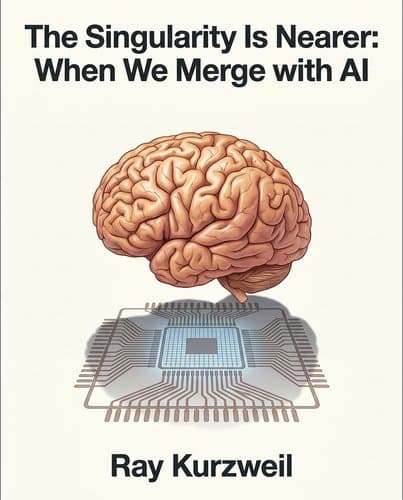
45024007_the-singularity-is-nearer
by Ray Kurzweil
Computing power has improved two-trillion-fold since 1965, and that same relentless curve is about to merge human and machine intelligence in your lifetime—the…
In Brief
Computing power has improved two-trillion-fold since 1965, and that same relentless curve is about to merge human and machine intelligence in your lifetime—the decisions shaping whether that's transcendence or catastrophe are being made right now, by people who mostly don't realize how close the deadline is.
Key Ideas
Computing Performance Predicts AI Timelines Better
Track computing price-performance as a leading indicator — it has improved two-trillion-fold since 1965, doubles every 16 months, and predates every technological paradigm it has ever run on. Expert intuitions about AI timelines have consistently lagged this metric by years.
Pessimism Bias Masks Accelerating Progress
Test your empirical intuitions against the data: if you believe world poverty is rising, or that crime is increasing, you're likely wrong — and that same availability-heuristic bias is making you systematically underestimate AI's near-term trajectory.
Information Patterns Create Durable Identity
Identity is continuity of information pattern, not continuity of material substrate — your brain already replaces itself completely within months. The philosophical case for brain-computer interfaces in the 2030s rests on the same continuity logic already operating in cochlear implants and hippocampal prosthetics today.
Exponential Medicine Inflection Point Imminent
The COVID mRNA vaccine (63 days from genetic sequence to first human dose, against a 5–10 year baseline) is the clearest signal that medicine has crossed into exponential territory. AlphaFold-class protein-structure tools are the next inflection to watch.
Political Asymmetry in Automation Distribution
AI job displacement is a distribution problem, not an aggregate one. History shows automation raises overall living standards; the political danger is that diffuse benefits to hundreds of millions don't organize into a constituency the way concentrated, identifiable harm to several million workers does.
Existential Defenses Require Matching Acceleration
The existential risks from engineered biotech, nanotech self-replication, and AI misalignment are governed by the same exponential arithmetic as the book's optimistic projections — which means the defenses require the same acceleration as the threats, and the next 20 years are when the foundational choices get made.
Who Should Read This
Science-curious readers interested in Artificial Intelligence and Futurism who want to go beyond the headlines.
The Singularity Is Nearer: When We Merge with AI
By Ray Kurzweil
10 min read
Why does it matter? Because 2045 is closer than your brain is wired to believe — and the gap between those two facts is the most important thing you'll read today.
The Singularity sounds like a concept that belongs to someone else's future — younger people, maybe, or people not yet born. Then you do the arithmetic. Ray Kurzweil was born in 1948 and expects to be there. Babies born this year will be finishing college when it arrives in 2045. The trend driving it — computing power that doubles in price-performance roughly every sixteen months — predates transistors and has never once paused. The reason this doesn't feel urgent isn't the pace of change. It's that human perception is catastrophically miscalibrated for exponential curves. We evolved to read a linear world. The result is a measurable gap between that pace and your brain's ability to perceive it, and closing that gap is what this summary is actually about.
The Cognitive Bug That Makes the Singularity Invisible
How well do you actually track the pace of technological change? Not in the abstract. Concretely, right now, compared to twenty years ago?
Nearly 32,000 people across 26 countries were asked a simple factual question: over the past two decades, had world poverty risen or fallen? Most said it had risen. The true answer: poverty rates had been cut in half. Only 2% got it right. This wasn't a trick question or an edge case — it was one of the most dramatic improvements in human welfare in recorded history, unfolding across their own lifetimes, and nearly everyone got it exactly backwards.
Kurzweil treats this as a calibration failure, not a philosophical quirk. Human brains evolved to track threats: rare, vivid, urgent events that spike emotional engagement. The result is a systematic filter: disasters get covered, gradual improvements don't. Progress in poverty, disease, and violence accumulates invisibly in the background while crises cycle through the foreground. Your intuition about the state of the world is built from a skewed sample, and you have no way to feel this happening.
The same bug warps our perception of technology specifically. No human intuition handles exponential compounding — we can state the numbers, but we can't feel them. And that failure isn't neutral: it determines how seriously we take predictions about the next decade. If you believe computing power improves the way highway traffic gets worse (linearly, gradually, with reversals), a claim that AI will pass a valid Turing test by 2029 sounds like wishful thinking. If you understand that the underlying trend has been doubling in price-performance roughly every sixteen months for over eighty years, predating transistors and surviving every shift in underlying technology, that same prediction reads like a project deadline.
The Machine That Learned to Win Chess Without Being Told the Rules
In 2017, a program called AlphaZero was handed the rules of chess — just the rules, nothing else — and set loose to play against itself. No recordings of grandmaster games, no centuries of accumulated opening theory, no endgame databases. After four hours, it had defeated every other chess-playing program in the world.
AlphaZero wasn't the first. A few years earlier, DeepMind's AlphaGo had become the first program to beat a world-class human Go player, but that version learned from millions of recorded human games. Then came AlphaGo Zero: given only the rules of Go and no human knowledge at all, it played against itself for three days and beat its human-trained predecessor 100 games to zero. AlphaZero did the same for chess in four hours. Then MuZero went further: it mastered multiple games without being given the rules at all, inferring them from play.
Each generation removes something we'd assumed was foundational. First human expertise, then human knowledge, then even the explicit rules of the domain. The machines aren't getting incrementally better at the same kind of task. Each time, they need less from us.
The same dynamic shows up in language. Earlier AI systems lost track of object states across a sequence of actions, treating each step in isolation rather than maintaining any model of what was happening. By 2023, GPT-4 could: when a coffee cup holding a diamond is flipped upside down and then righted, the diamond ends up on the bed, not back in the cup. Three years earlier, that kind of continuous world modeling was considered a fundamental barrier to AI cognition. The underlying driver is the same: computing price-performance roughly doubling every sixteen months, a pattern that predates transistors and has held for over eighty years.
The math compounds into numbers that resist intuition. That curve, the same one that produced the IBM-to-iPhone leap, is what powered everything in this section. It's why Kurzweil predicted in 1999, twenty years before it seemed plausible to most observers, that an AI would pass a legitimate Turing test by 2029: a test where a panel of expert judges, talking to both humans and the AI without knowing which is which, can't reliably tell them apart. By 2023, Metaculus, aggregating predictions from thousands of analysts, had converged on the same year.
What looks like a sequence of surprising breakthroughs is a single curve, and you're reading it near the part where it goes vertical.
You Are Not Your Neurons — You're the Pattern They Run
But the more capable these systems become, the harder it gets to avoid a question most people prefer not to ask: if machines can do what minds do, what exactly is a mind?
In 2019, Ray Kurzweil's daughter Amy sat down to interview her grandfather. Fredric Kurzweil had been dead for decades, but Ray had fed everything the man ever wrote into an AI he calls the Dad Bot: love letters to his wife, lecture notes, a half-finished book on music, personal reflections. The system answered from nothing but that archive.
She asked what he loved most about music. She asked about his favorite composer. Then she asked what the meaning of life was.
"Love," the system answered.
Kurzweil says the answers were coherent enough that if told it was a live conversation, you wouldn't have noticed. And yet the obvious objection surfaces immediately: this isn't Fredric. It's a pattern extracted from his words. There's no one home.
But here's where the philosophy gets uncomfortable. What exactly is home in your brain right now?
The molecular gatekeepers in your synapses, NMDA receptors, cycle through in hours. The protein scaffolding inside your dendrites lasts roughly forty seconds. The proteins fueling those connections are swapped out every two to five days. Within a few months, your brain has replaced nearly all of its molecular components. You are, in a literal sense, a different collection of atoms than you were last year — yet no one argues you've died and been replaced by a stranger.
Identity isn't in the matter. It's in the pattern the matter instantiates.
Kurzweil runs two thought experiments. In the first, someone creates an exact copy of your brain — a perfect replica, down to every synapse. The copy wakes up remembering your whole life. Is it you? Almost certainly not, because the moment it exists, it starts diverging from you, and there are now two separate centers of experience. You haven't become the copy; you've been duplicated.
In the second scenario, your neurons are replaced one at a time with functionally equivalent artificial ones, as cochlear implants already begin to do, as hippocampal prosthetics are doing for patients with memory damage. At no point does a second you branch off. The pattern that constitutes your identity stays continuous throughout.
That replica is the first scenario: a copy made from artifacts, no continuity of experience from Fredric's side. The Singularity, as Kurzweil envisions it, is the second: augmentation so gradual you would never feel the seam. By the time you're partly silicon, the "you" that arrived there is the same "you" that started walking.
What we're afraid of losing in the merge is ourselves. Gradual augmentation, by definition, cannot take that.
Medicine Just Crossed Into Exponential Territory — The 63-Day Vaccine Is the Proof
Think of drug discovery like searching for a specific grain of sand on all the world's beaches while blindfolded. The chemical space of possible drug-like molecules contains an estimated 10^60 candidates (a number that dwarfs atoms in the observable universe). Traditional pharmaceutical research picked compounds by hand, tested them in cells, failed, backed up, tried again. The timeline wasn't a regulatory artifact or a bureaucratic inefficiency you could reform away. It was math.
Then the blindfold came off.
On January 11, 2020, Chinese scientists released the genetic sequence of a novel coronavirus. Researchers at Moderna fed that sequence into machine-learning tools trained on millions of viral protein patterns, and two days later had designed the mRNA vaccine candidate. The company produced its first clinical batch on February 7. The first dose entered a human arm on March 16. Sixty-three days from sequence release to human trial. The previous record for vaccine development was four years.
That wasn't an exception. It was the first clear sign of a trend. Around the same time, DeepMind's AlphaFold 2 grew the library of mapped protein structures from 180,000 (the product of decades of experimental lab work) to hundreds of millions in a single release. The foundational data problem of structural biology, the one that had blocked rational drug design for fifty years, dissolved in months.
The roadmap ahead extends the same exponential logic. Through the 2020s, AI-accelerated drug discovery collapses timelines across a broad front. Through the 2030s, nanotechnology matures: molecular machines capable of operating inside the body, repairing cellular damage directly rather than blocking symptoms downstream. Think of a repair crew working at the cellular level, patching oxidative damage before it compounds into disease. By the 2040s, Kurzweil argues, the convergence of these tools produces what aging researcher Aubrey de Grey calls longevity escape velocity: the moment when anti-aging research advances fast enough that each year of calendar time buys more than a year of additional life expectancy. Cross that threshold, and nanotechnology closes the remaining gap. The first person to live to a thousand, on this math, has likely already been born.
The 63-day vaccine looked like a miracle — the kind of thing you read about and file under "exception." What it actually was: the first clear data point confirming that biology, too, is now inside the exponential.
The Jobs Math Works Out in Aggregate — Which Is Cold Comfort to the People Inside the Numbers
Has any previous wave of automation actually caused lasting economic damage? The historical record says no — and that's exactly what makes the next one so hard to think clearly about.
Agriculture employed more than 80 percent of Americans in the early 1800s; today it's under 2 percent. Manufacturing peaked at roughly a quarter of the workforce in 1920 and has since fallen to about 8 percent. Each time, the jobs vanished and the economy grew anyway. Total employment expanded from 29 million workers in 1900 to 166 million in 2023. Real wages roughly tripled. The pattern is so consistent that dismissing AI displacement concerns as Luddite anxiety seems like the rational position.
But Kurzweil identifies a structural feature of AI displacement that previous waves didn't share, and it has nothing to do with the aggregate numbers. The difference is the geometry of who benefits and who pays.
Consider autonomous vehicles. The expected benefits (lives saved, time freed, pollution reduced, transportation costs cut) are projected at somewhere between $642 billion and $7 trillion annually, distributed across nearly 400 million Americans. Every person who climbs into a self-driving car wins a little. The lives statistically saved by removing human error from the roads are real. But they're anonymous. No one will know which specific person doesn't die in 2035 because a machine drove more carefully than a drunk or distracted human would have.
The costs are different in kind. Roughly 4.6 million Americans drive for a living. When automation takes those jobs, each one is a specific person losing a specific livelihood: identifiable, countable, angry with reason. The mismatch isn't incidental. It's structural: diffuse, invisible benefits on one side; concentrated, named harms on the other.
Daniel Kahneman, psychologist and Nobel laureate who spent a career studying how humans misread risk, thinks this geometry makes the transition politically explosive in a way previous automation waves weren't. He told Kurzweil he expects genuine conflict and possibly violence as the disruption accelerates. Kurzweil is more optimistic about the overall arc. But they agree on the diagnosis: the aggregate math works out fine, and that's not the problem. The problem is that the person who lost their driving job cannot feed their family on a statistical improvement in national GDP, and they know exactly who they are. The question is whether the infrastructure to soften the transition arrives before the disruption does.
The Same Exponential That Cures Cancer Can Destroy the Biosphere in 90 Minutes
The exponential curve Kurzweil uses to predict medicine's golden age is the same curve that makes certain extinction scenarios arithmetically plausible within a human lifespan.
Start with the math. Earth's biomass contains roughly 10^40 carbon atoms. A self-replicating nanobot requires around 10^7 atoms. Converting the entire biosphere takes approximately 10^33 copies — about 110 generations of doubling. Nanotechnology researcher Robert Freitas estimates replication time at roughly 100 seconds per generation. Under ideal conditions: about three hours.
A two-phase attack collapses that window to 90 minutes. Phase one: over time, convert one out of every thousand trillion carbon atoms worldwide into dormant nanobots, sparse enough to be undetectable. Phase two: trigger them simultaneously via radio signal. Each sleeping nanobot needs only about fifty replications to convert all surrounding biomass. Ninety minutes from signal to biosphere consumed.
The doubling logic is identical to what drives the AI breakthroughs in every previous chapter. It just runs in a different direction.
Defense follows the same arithmetic. Freitas calculates that 88,000 metric tons of what nanotech researchers call "blue goo" (defensive nanobots dispersed optimally worldwide) could sweep the entire atmosphere in 24 hours. Less mass than the water displaced by a large aircraft carrier. Offense and defense are functions of the same exponential. The question is which arrives deployed first.
That's the structure of every threat Kurzweil catalogs: biological and AI misalignment, each powered by the same accelerating capability that drives the medicine and cognition advances. What he won't let you do is treat the upside as inevitable and the downside as abstract. They're governed by identical math, unfolding on the same timeline. The next twenty years aren't a passive wait — they're a window in which decisions about deployment, governance, and defensive infrastructure determine which curve gets ahead. The exponential doesn't care which side it's on.
The Deadline Nobody Circled on the Calendar
The same doubling that halves cancer diagnosis time also halves the cost of engineering a pandemic. Kurzweil doesn't resolve that tension because it isn't resolvable from where we stand — only navigable. What he's really arguing, underneath all the price-performance curves and decade-by-decade forecasts, is that the people who understand the trajectory are the only ones positioned to influence it. You are almost certainly part of the last generation for whom the question of how humans and AI merge remains genuinely open. The choices made in the next twenty years — about defensive infrastructure, governance, who controls the most powerful tools — will harden into the architecture everyone afterward inherits. That's not a reason to panic. It's a reason to stop treating 2045 as someone else's deadline.
Notable Quotes
“When you turned the coffee cup upside down on your bed, the diamond inside the thimble would have likely fallen out onto the bed. The diamond is now on your bed.”
“It gave this perfect exposition:”
“Even more importantly, PaLM could explain how it reached conclusions via”
Frequently Asked Questions
- What is The Singularity Is Nearer about?
- The Singularity Is Nearer argues that "human and machine intelligence will merge within decades — not centuries." Kurzweil maps the exponential trajectory of computing, biotechnology, and artificial intelligence to demonstrate why this convergence is inevitable. The book equips readers to overcome availability-heuristic biases that make them underestimate AI's near-term impact and to understand what the merger means for jobs, identity, and existential risk. By analyzing historical data and trend analysis, foundational decisions about this transformation are being made right now, making this understanding critical for navigating the future.
- What does computing price-performance reveal about AI progress?
- Computing price-performance has improved two-trillion-fold since 1965 and "doubles every 16 months," and it "predates every technological paradigm it has ever run on." This metric serves as a leading indicator, yet "Expert intuitions about AI timelines have consistently lagged this metric by years." Kurzweil emphasizes tracking price-performance improvement to overcome biases shaped by linear thinking. Understanding this gap between data-driven predictions and expert intuition is crucial for accurately assessing when transformative AI breakthroughs will occur. The historical record shows those relying on intuition rather than computing trends have repeatedly underestimated technological pace.
- How does Kurzweil define identity in The Singularity Is Nearer?
- "Identity is continuity of information pattern, not continuity of material substrate." Your "brain already replaces itself completely within months," yet you remain yourself. This philosophical understanding supports brain-computer interfaces in the 2030s, using "the same continuity logic already operating in cochlear implants and hippocampal prosthetics today." By recognizing that personal identity persists through material replacement, Kurzweil argues that gradually integrating artificial components doesn't threaten the self. Instead, it's a continuation of natural processes your body already performs. This reframing addresses philosophical objections to human-machine integration.
- What does Kurzweil say about AI and job displacement?
- "AI job displacement is a distribution problem, not an aggregate one." "History shows automation raises overall living standards"; however, "the political danger is that diffuse benefits to hundreds of millions don't organize into a constituency the way concentrated, identifiable harm to several million workers does." Kurzweil recognizes this mismatch creates real political challenges, even if the overall economic trajectory remains positive. Understanding this distinction is crucial for designing policy responses that harness automation's benefits while addressing transition effects on specific communities most directly affected by technological change.
Related Book Summaries
Read the full summary of 45024007_the-singularity-is-nearer on InShort