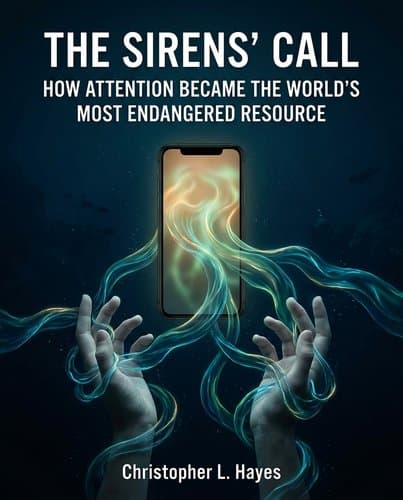
217869789_the-sirens-call
by Christopher L. Hayes
Attention isn't just being stolen—it's being systematically dismantled by platforms that spent billions engineering your brain's involuntary reflexes against…
In Brief
Attention isn't just being stolen—it's being systematically dismantled by platforms that spent billions engineering your brain's involuntary reflexes against you. Hayes reveals why distraction is a structural problem, not a personal failure, and how reclaiming your focus means reclaiming your selfhood.
Key Ideas
Distraction is structural, not personal failure
Distraction is not a character flaw — it is the intended output of systems that have spent billions engineering your biology against you. Understanding it as structural rather than personal is the first step to addressing it effectively.
Platforms exploit all three attention modes
Your attention has three distinct modes — voluntary (focused), involuntary (startled), and social (name-triggered) — and the most profitable platforms have learned to exploit all three simultaneously, which is why the 'slot machine' feed is so much harder to resist than any single piece of content.
Boredom is civilizational, not inevitable
The craving for stimulation predates smartphones by centuries (Pascal diagnosed it in 1670), but it is not universal — the Cofán people of Ecuador have no word for boredom — meaning it is a civilizational arrangement that can, in principle, be rearranged.
Fame intensifies rather than satisfies hunger
Social attention from strangers is structurally different from genuine recognition: it activates the same hunger without being able to satisfy it, which is why fame and follower counts reliably make the craving worse rather than better.
Intentionality matters more than the medium
Intentionality is the key variable, not the medium itself. The video store wasn't a nonprofit, but it forced a proactive choice. Seek out formats — vinyl, print, Signal, scheduled viewing — that require you to decide in advance what deserves your attention.
Collective action needed for attention reform
The labor movement won the eight-hour day through collective action, not individual willpower. Meaningful reform of the attention economy — age minimums, regulatory caps, non-commercial digital spaces — will require the same.
Who Should Read This
Curious readers interested in Behavioral Psychology and Neuroscience and the science of how the mind actually works.
The Sirens' Call: How Attention Became the World's Most Endangered Resource
By Christopher L. Hayes
12 min read
Why does it matter? Because the thing being stolen from you is not your time — it is your self.
You already know something is wrong. Not in a vague, self-help way — in the specific, humiliating way of checking your phone before you've finished a thought, of losing an hour to a feed you can't quite remember, of that weekly Screen Time notification arriving like a little indictment. The standard diagnosis says this is your fault: weak will, bad habits, insufficient discipline. That diagnosis is flattering to the people who built the machine. What Chris Hayes argues — drawing on Marx, Pascal, neuroscience, and his own years of compulsively searching his own name on Twitter — is that the real story is stranger and higher-stakes than a personal failing. Attention isn't just something being stolen from you. It is you. And the systems mining it for profit aren't just wasting your time. They're dissolving the very faculty by which you exist as a self. The fix, it turns out, isn't a screen-time limit. It's a confrontation with what you actually want your life to be made of.
You're Not Distracted Because You're Weak — You're Distracted Because You're Hunted
Pick up your phone right now. Check the time. Now try to remember exactly what you did with the last twenty minutes. Hayes, a cable news anchor who thinks about attention professionally, ran this experiment on himself and came up empty. His Screen Time report told him he was averaging five hours and sixteen minutes of daily phone use — but when he tried to reconstruct where those hours went, all he could find were fragments: a ten-second scroll here, a quick check there, tiny sips of distraction he could barely remember taking. The whole thing had evaporated, parceled out in moments too small to hold.
If that lands with uncomfortable familiarity, here's what Hayes wants you to sit with: your inability to account for those hours is not a character flaw. It's evidence that something is working exactly as designed.
The economic story of our era is really a story about attention replacing physical resources as the thing worth fighting over — six of the ten most valuable American companies once pulled their wealth from the ground; today's list is Microsoft, Apple, Google, Meta, Amazon, all competing for the same finite, non-renewable commodity: the fact that your conscious awareness can only be in one place at once.
What makes Hayes's argument more than an economics lesson is the biological layer underneath it. The ten-second increments that vanish from your memory aren't being taken through your rational mind. They're extracted through older, faster, preconscious machinery — the same circuitry that snaps your head toward a loud noise before you've decided to look. The most sophisticated commercial apparatus in human history has spent billions reverse-engineering your evolutionary wiring, and it runs experiments on you every time you open an app. The reason you can't simply decide to stop isn't weakness. It's that the machinery hunting your attention was built specifically to reach you before your willpower even wakes up.
The Slot Machine in Your Pocket Is Not Trying to Entertain You
The entertainment industry spent a century trying to solve a hard problem: what will hold someone's attention? Every Hollywood studio, network executive, and Broadway producer has wrestled with it. Silicon Valley looked at that problem and quietly solved a different one instead.
Hayes builds his argument on a three-part map of how attention actually works. There's voluntary attention — the spotlight you consciously aim at something. There's involuntary attention — the snap reflex that yanks your head toward a sudden noise before you've decided anything. And there's social attention — the eerily specific phenomenon Neville Moray documented in 1959 in a landmark set of listening experiments: your own name, spoken across a noisy room, cuts through all other sound and lands. Nothing else does this as reliably. Only you.
The slot machine model, as Hayes calls it, runs almost entirely on the first two. Intermittent reinforcement — the same mechanism that keeps a gambler feeding quarters — keeps users in what researcher Natasha Dow Schüll calls the machine zone: a suspended, trance-like state where the act of scrolling replaces the need for anything interesting to actually appear. The feed moves vertically and endlessly, and that's not a metaphor — it's a design choice. You don't need to hold someone's attention if you can grab it thousands of times instead. Every app on your phone has been refined, through genuine market competition and machine learning, to find exactly what catches you in a given moment and serve you nothing but that.
Then the platforms add what Hayes calls the Uncle Sam move — his term for the way a notification hails you by name. Someone mentioned you, replied to you, tagged you. This isn't just an alert. It triggers the same endorphin circuit as hearing yourself called across a crowded party. Social attention, wired into us as infants desperate for a caregiver's gaze, weaponized at industrial scale.
The result is that the five hours and sixteen minutes Hayes finds on his Screen Time report didn't require the platforms to entertain him for five continuous hours. They just needed to grab ten seconds, release, grab again. The question of what holds attention is irrelevant when you've engineered a system that never has to hold it at all — only interrupt it, endlessly, using biology you didn't choose and can't override by simply deciding to do better.
The Real Reason You'd Rather Get an Electric Shock Than Sit Alone With Your Thoughts
Picture a windowless room somewhere on the University of Virginia campus. You sit alone. No phone, no book, nothing to do but think. A researcher has wired you to a small device and given you one option if the silence becomes unbearable: press a button and give yourself a mild electric shock. Then the door closes.
Most of us imagine we'd simply sit there and wait it out. It's fifteen minutes. How bad could it be? But when researchers ran this experiment in 2014, something startling happened: 67 percent of men chose the shock over the silence. One participant hit the button 190 times in a single sitting — not because the shock was pleasant, but because the alternative, being alone inside his own head, was somehow worse.
Blaise Pascal diagnosed this exact condition in 1670, which means we can't blame the smartphone. In his philosophical notebooks, the French mathematician wrote that nearly all human suffering traces to a single source: people cannot stay quietly in their own rooms. His explanation cuts deeper than restlessness. When we're left alone with nothing to do, he argued, our minds drift inevitably toward the one thing we cannot solve — our own mortality. Distraction isn't laziness. It's a shield against that unbearable contemplation. The noise, the bustle, the endless scroll: all of it keeps the thought at bay.
What makes this ancient vulnerability feel newly dangerous is the evidence that it isn't universal. The Cofán people of Ecuador have no word for boredom. Anthropologists report that individuals there can spend hours in a hammock doing nothing, without apparent distress. It's simply the absence of a condition that industrial modernity manufactured and then handed, generation by generation, down to us. The desperate hunger for stimulation isn't human nature. It's a specific inheritance — a civilizational arrangement that left us exquisitely vulnerable by the time anyone thought to exploit it.
Fame Is Empty Calories: Why Being Seen by Millions Leaves You Starving
At the 2009 Golden Globes, Tina Fey stood onstage holding an award for one of the most beloved shows on television and used her acceptance speech to read out the usernames of people who had been mean to her on the internet. 'BabsonLacrosse, you can suck it,' she said. The audience laughed — it was clearly a bit — but when reporters googled the names, they were real commenters on an LA Times blog who had actually criticized her. Here was one of the most celebrated comedians in America, at the peak of her powers, still being gnawed at by strangers who didn't like her.
Hayes recognizes this from the inside. In his early days as a cable news host, he would compulsively search Twitter not just for mentions but for his own name — hunting for what people were saying about him without tagging him. He knew it was self-destructive. He did it anyway. And what he found confirmed a brutal asymmetry: a thousand kind words from viewers would register for roughly as long as it took to read them, while a single insult from someone he would never meet could hollow out an entire day.
That asymmetry is the first clue that something structural is wrong with the bargain. Hayes pushes deeper, borrowing a distinction from Hegel to name what's actually missing. There is a difference between attention — being noticed — and recognition, which means being seen as a full human subject by another person who is genuinely present to you. Real recognition is mutual. It requires the other person to actually perceive you as someone specific, irreplaceable, not interchangeable with the next follower. What social media delivers at scale is the first thing while being architecturally incapable of the second. The fan who sends a kind word has no access to who you actually are. The troll attacking you is responding to a projection. Either way, nobody in that exchange is really seeing you — and some part of us, conditioned by a lifetime of genuine human relationships, knows it immediately.
The result is being stuffed and starved simultaneously. Flooded with attention while the thing that actually nourishes — reciprocal recognition from people who know you — quietly goes unmet. The platforms exploit the craving without ever satisfying it, which means the craving only grows. More followers, more likes, more mentions, and still that same hollowness underneath: the one that sent a celebrated comedian to the podium to settle scores with anonymous strangers on a blog.
When Attention Becomes a Commodity, Your Consciousness Gets Sold at Auction
Think of a craftsman in 1850 — a cobbler who selects the leather, cuts the pattern, shapes each shoe by hand, and feels genuine pride when a customer walks out wearing something he made. Now drop that same man into a factory in 1880, where his entire contribution is a single motion repeated ten thousand times a day on a piece of someone else's shoe. The object is the same. The labor is technically similar. But something essential has been severed — his skill, his judgment, his sense of making something — and what remains is interchangeable with any other pair of hands on the line. That's what Marx called alienation: not just tedium, but a structural estrangement from the very thing you're doing.
This is exactly what the attention economy has done to your inner life.
Human attention has always existed. But 'clicks,' 'engagement,' and 'eyeballs' are inventions of attention capitalism — the conversion of conscious focus into a fungible commodity, sliced into milliseconds and sold at automated auction to the highest bidder. Just as the factory turned the craftsman's irreplaceable skill into a unit of interchangeable labor, the platforms have turned your awareness — the thing that makes your experience yours — into inventory. The economic historian Karl Polanyi, whose 1944 book The Great Transformation argued that market economies devour the human materials they depend on, warned that you can't treat labor as a pure commodity without damaging the person attached to it — you can't separate the worker from the work. The problem is even more acute when the commodity is consciousness itself. Attention isn't something you have; it's something you are. Auctioning it off doesn't just waste your time. It estranges you from your own mind.
The strangeness of how far this has spread is captured in a detail Hayes finds genuinely arresting. After the Taliban seized Kabul in 2021, insurgents who had spent two decades in violent combat suddenly became office workers — sitting at desks, processing paperwork, eight to four. A 25-year-old fighter named Abdul Nafi described the drudgery as crushing. His solution was the same one available to everyone navigating modern alienation: he became, in his own words, addicted to the internet, especially Twitter. A man whose entire prior existence was defined by extreme purpose and physical presence found himself sitting in a fluorescent-lit room, surrendering his attention to the same platform as everyone else.
If the attention economy can reach him — in Kabul, fresh from two decades of guerrilla warfare — the machinery isn't targeting a type of person. It's targeting a structural condition: the gap between the life we're living and the life that would feel fully our own. The platforms don't just fill that gap. They widen it, by converting the very act of seeking meaning into another transaction, another piece of inventory moving through the auction house. What gets sold isn't your time. It's the substance of who you are when no one is asking anything of you.
How a Broken Attention Commons Turns Politics Into a War for Eyeballs
Imagine two Senate candidates agreeing to seven joint appearances, each one lasting three hours, across the flatlands of 1858 Illinois. The format had rules: an opening address of sixty minutes, a ninety-minute rebuttal, a thirty-minute response. The topic, more or less, was one thing — slavery. Crowds of fifteen thousand people stood in open fields for the full duration. This wasn't endurance performance art. It was normal. The format assumed that collective attention could be gathered, held, and directed — that there was a working regime governing how public discourse happened and what it owed its participants.
That regime is gone, and Hayes's argument is that its collapse explains more about modern politics than any particular villain or bad idea does. When there are no rules governing whose turn it is to speak, how long they may speak, or what they are expected to speak about, the competition shifts. It stops being about persuasion and becomes a fight for salience — for being the thing people are looking at right now. The quality of your ideas is almost irrelevant. What matters is the shamelessness to interrupt.
Donald Trump is Hayes's clearest exhibit. Traditional politicians treat negative attention as a cost — the equivalent of running naked through the neighborhood, memorable but ruinous. Trump understood something different: in a collapsed attentional commons, getting on the news is the win. By saying extreme things about immigration in 2015, he didn't need voters to approve of his specific proposals. He just needed the subject to dominate. Republicans already held a polling advantage on immigration; forcing the entire conversation there was itself the strategy. Negative attention is still attention, and attention is still the only currency that buys the next news cycle. Hayes calls this attentional warlordism — not an ideological victory but a capture of the infrastructure of public attention itself.
The same structural logic produces two other mutations Hayes reads as symptoms rather than causes. Whataboutism — responding to any accusation by pointing at a different scandal — isn't an argument; it's a battle over what to focus on, fought entirely in the attentional register. Conspiracism spreads for the same reason: outlandish falsehoods are more attention-grabbing than the slow, undramatic grind of actual events. Hayes cites a Shia militia commander in Iraq who believed a fabricated video showing Obama promising to rebuild Iraqi homes — not because the lie was credible, but because it was more compelling than the reality of being ignored. The lie was attentionally stickier.
So the infrastructure once holding public discourse together has dissolved, and what grows in the ruins rewards whoever can seize the most eyeballs by any means available. Bad actors didn't cause this. They just noticed it first.
Resistance Is Not a Digital Detox — It Looks More Like a Labor Movement
So if the problem is structural — built into the platforms, the incentives, the infrastructure of attention capitalism — what are you supposed to do about it? Delete Instagram? Meditate more? Put the phone in a drawer?
Hayes takes those impulses seriously without mistaking them for solutions. He points to something interesting in the data: vinyl sales hit 41 million in 2023, and print newspaper subscribers still punch far above their subscriber share in revenue, generating roughly a third of the New York Times's income from about 8 percent of its base. These aren't nostalgia purchases. They're what Hayes calls commitment mechanisms — formats that force a deliberate choice before any consumption happens. You have to go to the store, pick the record, put it on. The friction is the point. It's the video store logic: binding yourself to the mast before the sirens start singing, rather than discovering mid-scroll that you've already lost an hour. That kind of intentional friction matters.
But here's what it can't do: change the conditions facing everyone who doesn't have the money, the leisure, or the willpower to opt out. That's where Hayes reaches for the only historical precedent that actually fits. When industrial-era factory owners claimed the right to work people twelve or fourteen hours a day, nobody solved that by encouraging individual workers to practice better self-discipline. They organized. They demanded, collectively, that the law recognize something that felt radical at the time: there is a portion of human life that does not belong to capital. The labor movement's slogan made it concrete — eight hours for work, eight hours for sleep, eight hours for what we will. That last category, time belonging fully to you, was a political achievement, not a personal one. Nobody got it by journaling.
Hayes argues we need the same fight now. Our 'what we will' time is being fracked for profit, and the only instrument ever strong enough to stop that kind of extraction is collective action that makes certain forms of exploitation illegal. That's not despair. It's the most hopeful thing in the book — because it's been done before. And if it happened once, there's a version of your life on the other side of it: evenings that don't belong to an algorithm, attention that accumulates into something instead of dispersing into nothing. That's not a fantasy. It's a precedent.
The Thing You Cannot Outsource
Here is what makes this different from every previous worry about television or comic books or rock and roll: those things competed for your attention. They wanted you to look at them instead of something else. What Hayes is describing wants something more intimate — to occupy the space where your own priorities would otherwise live, ten seconds at a time, until the act of deciding what matters to you has been quietly outsourced. The moment your consciousness becomes someone else's inventory, the question isn't what you're missing out on. It's who is doing the experiencing. The good news — the genuinely hopeful part — is that the labor movement didn't win the eight-hour day by asking workers to want less. It won by insisting that some portion of a human life is simply not for sale. That argument worked once. It can work again.
Notable Quotes
“You have averaged 5 hours and 16 minutes of daily screen time last week,”
“opportunity to experience negative stimulation (an electric shock) if they so desired.”
“Many participants elected to receive negative stimulation over no stimulation—especially men: 67% of men (12 of 18) gave themselves at least one shock during the thinking period.”
Frequently Asked Questions
- What is 'The Sirens' Call: How Attention Became the World's Most Endangered Resource' about?
- "The Sirens' Call" argues that "distraction is not a personal failing but the engineered output of systems designed to exploit human biology for profit." Drawing on history, neuroscience, and political economy, Christopher L. Hayes' 2025 work explains how digital platforms capture attention at a structural level through deliberate design. The book examines both the mechanisms behind attention capture—including how platforms exploit three distinct modes of human attention—and potential solutions ranging from individual habits to collective policy reforms. Hayes demonstrates that reclaiming our attention requires understanding it as a systems problem rather than a character flaw.
- Why does 'The Sirens' Call' argue that individual willpower isn't the solution?
- Hayes argues that meaningful change requires collective action, not just personal discipline. The book emphasizes that "the labor movement won the eight-hour day through collective action, not individual willpower," and applies this lesson to the attention economy. While Hayes recommends individual strategies—formats like vinyl, print, and scheduled viewing that require intentional choices—he argues these alone are insufficient. Meaningful reform addressing "age minimums, regulatory caps, non-commercial digital spaces" requires collective mobilization. Hayes frames attention as a structural issue demanding structural solutions, not merely personal virtue.
- How do digital platforms exploit human attention according to 'The Sirens' Call'?
- Hayes identifies three distinct modes of attention that platforms exploit simultaneously: voluntary (focused), involuntary (startled), and social (name-triggered). "The most profitable platforms have learned to exploit all three simultaneously, which is why the 'slot machine' feed is so much harder to resist than any single piece of content." By triggering startle responses, capturing focused attention, and providing social validation through engagement metrics, platforms create compound effects that individual willpower struggles against. Understanding this three-pronged exploitation reveals why quitting feels so difficult—it's not weakness, but rational response to sophisticated system design.
- Does 'The Sirens' Call' argue that boredom is natural or culturally constructed?
- Hayes traces the human desire for stimulation to Pascal's 17th-century observations, but argues that susceptibility to boredom is culturally constructed rather than universal. "The craving for stimulation predates smartphones by centuries (Pascal diagnosed it in 1670), but it is not universal — the Cofán people of Ecuador have no word for boredom — meaning it is a civilizational arrangement that can, in principle, be rearranged." This historical and anthropological evidence suggests that our current vulnerability to distraction isn't inevitable. By understanding boredom as a product of specific civilizations rather than human nature, Hayes opens the possibility of cultural transformation.
Related Book Summaries
Read the full summary of 217869789_the-sirens-call on InShort