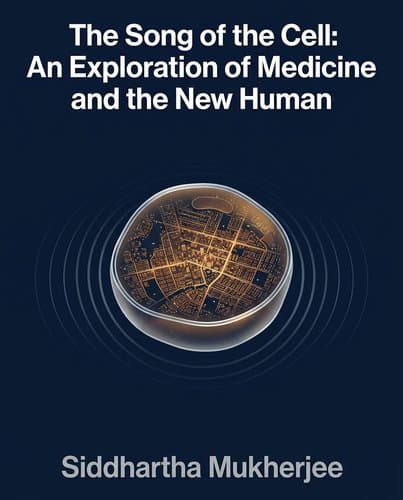
60321392_the-song-of-the-cell
by Siddhartha Mukherjee
Medicine's next revolution isn't treating organs or editing genes—it's engineering the cells themselves. Mukherjee reveals how mastering the cell's molecular…
In Brief
Medicine's next revolution isn't treating organs or editing genes—it's engineering the cells themselves. Mukherjee reveals how mastering the cell's molecular address unlocks cures for cancer, autoimmune disease, and aging, while forcing a profound question: what are we when our biological building blocks become rewritable?
Key Ideas
Cellular dysfunction is disease's fundamental basis
Every disease ultimately traces to a specific cellular dysfunction — Virchow's 19th-century claim is still medicine's master framework, which means the first question in any diagnosis is: which cell is failing, and why?
Precision medicine targets molecular cellular addresses
The most spectacular cures of the past 30 years — CAR-T, rituximab, bone marrow transplantation — worked not by attacking disease broadly but by reading the molecular address of one specific cell type and intervening there precisely.
Immune tolerance prevents destructive autoimmunity
The immune system's job is not just to detect and destroy — it must also tolerate everything it is made of. Dedicated regulatory cells maintain this balance; their loss (as in IPEX syndrome) produces multi-system autoimmune catastrophe, not stronger immunity.
Cancer therapy and autoimmunity share mechanisms
Checkpoint inhibitors (drugs that block CTLA4 or PD-1 to unleash T cells against cancer) and autoimmune diseases share identical molecular machinery — releasing the T cell's trigger lock does not come with a targeting guarantee.
Organ function emerges from cellular coordination
Organ function is emergent, not additive: the heartbeat arises from cells coordinating through gap junctions, not from any single cardiac cell's properties. Understanding the cell is necessary but not sufficient to understand the organ.
Relationships matter more than isolated mutations
Naming every cell type and mapping every mutation is atomism — and atomism cannot explain why cancer colonizes the liver but almost never the spleen, or why Parkinson's appears to lower cancer risk. The next medicine will be written in the language of cellular relationships.
Therapy versus redesign is ethical, not technical
The molecular tools that cure sickle cell anemia and leukemia are the same tools He Jiankui used to edit human embryos. The line between therapy and redesign is ethical and definitional, not technical — and medicine has not formally drawn it.
Who Should Read This
Science-curious readers interested in Biology and Futurism who want to go beyond the headlines.
The Song of the Cell: An Exploration of Medicine and the New Human
By Siddhartha Mukherjee
10 min read
Why does it matter? Because the body isn't a machine you fix — it's a civilization you govern.
We assume medicine advances by finding better targets — sharper drugs, cleaner cuts, more precise molecular locks. And it does. But every target lives inside a cell. Every cell lives inside a community of cells with its own politics: tolerance thresholds, belonging signals, defection protocols. When those politics fail, no molecule fixes it alone.
That's the gap this book opens. Siddhartha Mukherjee argues we're in the early days of a civilizational shift — not from organ medicine to gene medicine, but from both of those toward something stranger: engineering the cells themselves. Not repairing the machine. Rewriting the citizens. A leukemia patient gets her own T cells returned as weapons. A diabetic receives insulin-producing cells grown in a dish.
Where therapy ends and transformation begins is no longer a philosophical question. It's a clinical one.
Every Disease You Have Ever Had Happened Inside a Cell
In a Boston hospital room in the winter of 2002, a 23-year-old named M.K. lay shivering through a fever that cycled without pattern. His skin had grown so papery that inserting an IV felt like piercing parchment. For years he had been battered by infections that wouldn't clear. His chart read severe combined immunodeficiency. Antibodies low, B cells low, treatments failing. No one could explain why.
The problem: everyone was diagnosing at the wrong level of the body.
M.K. needed what the German physician Rudolf Virchow had proposed in 1858: not a diagnosis by organ or system, but a cell-by-cell dissection of what had actually broken down. When Mukherjee — the book's author, then a resident at Massachusetts General — persuaded the pathologists to go through M.K.'s blood one cell type at a time, the answer appeared. His B cells were depleted, but that was a consequence, not a cause. His T cells, the immune system's coordinators, were nearly absent, developmentally stunted, and nonfunctional. That single cellular failure had cascaded through the entire immune network, dragging everything else down with it.
A bone marrow transplant repopulated his bloodstream with functional T cells. His infections cleared. He gained weight. At a five-year follow-up, he was free of disease. Cellular repair had restored the organism.
M.K.'s recovery was Virchow's claim made flesh, 144 years after he articulated it. Since 1858, medicine has run on a single insight: every disease you have ever had — every fever, every tumor, every immune collapse — began as a malfunction in a specific type of cell. Not an organ. Not a system. A cell. The whole revolution of modern medicine starts the moment doctors stopped asking "which organ?" and started asking "which cell?" The Song of the Cell traces how that question was first posed, how it was answered, and where it is taking medicine now.
Knowing Exactly Which Cell to Target Made the Impossible Routine
A six-year-old named Emily Whitehead, the seventh patient to receive engineered T cells for leukemia, was in multi-organ failure in the ICU. She had received three days of infusions, then spiked a fever so severe her kidneys shut down. Nothing in the protocol explained what was happening.
What saved her was not luck, though it was lucky. It was the accumulation of precise cellular knowledge — knowledge so specific that when the crisis came, the right question was askable and the right answer already existed.
Here is what that knowledge looked like in practice. Emily's cancer was acute lymphoblastic leukemia, a malignancy that had packed nearly every one of her organs with cells and had resisted every available drug. Researchers at Penn and the Sloan Kettering Institute had established that these leukemia cells carried a specific protein on their surface that normal mature cells don't express. A team led by Carl June had spent years engineering Emily's own T cells to recognize that exact molecular marker, culturing them in enormous numbers outside the body before returning them to her bloodstream. The resulting cells were programmed with a single address. They would find anything bearing that marker and destroy it.
They worked. But the dying of the leukemia triggered something the protocol hadn't fully anticipated: a flood of inflammatory signals. Blood tests showed that a molecule called interleukin-6 was running at roughly a thousand times its normal level — the immune system's alarm shrieking as the T cells tore through the tumor. Emily's organs were failing not from the cancer but from the killing of the cancer.
June had already drafted an email to Penn's provost calling off the trial. But he had a daughter with juvenile arthritis. Through her treatment, he had come across a drug called tocilizumab, approved by the FDA just four months earlier, that blocked IL-6 directly. Stephan Grupp, Emily's oncologist, filed an emergency request to use it off-label. The pharmacy approved it that evening.
Two days later, on her seventh birthday, Emily woke up. A bone marrow biopsy three weeks after that showed no detectable leukemia. She remains in remission today, considered cured. June never sent the email.
Each intervention depended on a precise biological address. The unique surface marker on the leukemia cells. The specific cytokine flooding the blood. The receptor tocilizumab could block. None of those interventions was possible until researchers had mapped the cellular identities involved at the molecular level — precisely enough to say: this protein, on this cell type, is where we act. What looks like a miracle, reconstructed step by step, turns out to be cell biology made sufficiently exact.
Your Immune System Runs a Two-Question Test — and One Wrong Answer Can Kill You
In a London taxi at dusk, moving through streets lined with lit windows and locked doors, Oxford immunologist Alain Townsend described to his graduate student a problem that had paralyzed his lab for years.
Killer T cells were finding and destroying cells infected with the influenza virus. That was established. What nobody could explain was how. The viral protein these cells were targeting, called nucleoprotein, never reached the cell's surface. Townsend had run every test available, week after week, looking for even a trace of it at the membrane. Nothing. "It isn't even there," he said, "and yet it's perfectly visible to the T cell."
The solution he worked out through the late 1980s was stranger than the puzzle. Every cell in your body runs a constant internal waste-disposal process: proteins are fed into a molecular grinder called the proteasome, chopped into fragments, and ejected. The cell treats viral proteins the same way it treats its own. Those fragments are loaded onto carrier molecules called MHC class I proteins, which ferry them to the cell surface. The inside is turned outside. Each cell broadcasts a continuous sample of its interior.
When crystallographer Pam Bjorkman solved the structure of an MHC molecule, it matched its function precisely: two protein helices forming a groove, a short viral fragment sitting in the channel between them, exposed. The T cell receptor that docks onto this structure looks like two outstretched fingers — parts touching the MHC (the self), parts touching the foreign peptide in the groove. Both contacts must happen simultaneously. This is the two-question test: confirm the presenting cell belongs to this body, and confirm it is harboring something foreign. Confirm one without the other, and nothing happens.
The Drug That Cures Your Cancer May Also Destroy Your Liver
The hospital room was dim when Mukherjee arrived, Sam P. still sweating off the nausea. A nurse had helped him back to bed. He turned on the lamp and asked to speak alone. "It's over, isn't it?" Sam said, looking directly at him. "Be honest."
The answer was genuinely uncertain. Some of Sam's melanoma tumors were responding to checkpoint inhibitors, the drugs Jim Allison had developed at Berkeley a decade earlier. Allison had discovered that T cells carry a protein called CTLA4 that acts as a safety switch: when it binds to a matching protein on nearby immune cells, the T cell goes dark, unable to attack anything. Normal body, normal cell — the trigger holds. He blocked CTLA4 with antibodies in mice bearing immune-resistant tumors. Over Christmas, those stubborn tumors dissolved; the T cells, no longer held in check, had finally turned on them. That discovery eventually won the Nobel Prize.
The switch couldn't distinguish. Sam's T cells went after the melanoma deposits and went after his liver with equal conviction. Every time Mukherjee's team raised the dose trying to push the cancer back, autoimmune hepatitis pushed them back just as hard. The same immune machinery dissolving tumors in his skin was running an identical program in his liver cells. He died that week — his tumor cells had outlasted him, evading the drugs that were consuming his liver.
COVID ran the same logic. When the infection became undeniable, the cell yanked a crude alarm, flooding the bloodstream with inflammatory signals called cytokines. Confused immune cells surged in and launched what Yale immunologist Akiko Iwasaki called "immunological misfiring," an indiscriminate assault on lung tissue trying to contain a viral invasion that had already been running undetected for days. The lungs filled with fluid. The war against the virus became as lethal as the virus itself.
Both failures trace to the same underlying fact: the immune system has no category for helpful collateral damage. It has switches that are on or off, alarms that fire or don't. Allison's checkpoint inhibitors freed T cells from restraint without giving them a target list. COVID's cytokine storm arrived too late and hit too hard.
The Heart Reveals What Every Organ Really Is: A Civilization, Not a Machine
Think of a mechanical pump: valve, chamber, piston, power source, blueprint. Now remove every one of those things and ask how two billion contractions still happen on schedule.
In 1912, Alexis Carrel cut a fragment from an 18-day-old chick embryo heart and placed it in liquid culture. He had severed every nerve connection. There was no pacemaker, no external signal. The fragment pulsated anyway, regular and rhythmic, for three months, generating roughly nine million heartbeats before finally falling silent. The pulsation didn't come from the nervous system. It was intrinsic to the cells.
Inside each of those cells, two interlocking protein networks, actin and myosin, slide against each other in a continuous cycle: myosin grasps actin, pulls, releases, and grasps again. Each cell contains thousands of these pairs, all aligned, all pulling in the same direction. The contraction shrinks the cell. The energy is consumed not by the contraction but by the release. When an organism dies and energy drains away, every muscle fiber locks in a permanent grip. The fibers can no longer let go. The body stiffens into what we call rigor mortis — a cellular phenomenon, not a mysterious collapse.
But a single cell contracting is still not a pump. For the heart to work, all its cells must contract together — atria first, then ventricles, in coordinated sequence. Gap junctions, tiny molecular channels connecting adjacent cells, make that possible. When calcium floods into one cell and triggers a contraction, the signal travels automatically to the next, and the next. The calcium is self-amplifying: its entry triggers the release of more calcium. What begins as one cell firing becomes, in milliseconds, the entire organ contracting in unison.
The heart, then, is a civilization of coordinated cells. The pump function arises from the citizenship. Carrel's fragment pulsated because the cells were talking to each other, their connections as essential as any individual contractile mechanism. Examine any single heart cell in isolation and you will find a unit capable of firing. What you won't find is a heartbeat.
We've Named Every Cell in the Body. We Still Can't Explain Why Cancer Avoids the Spleen.
In 2018, a Chinese biophysicist named He Jiankui announced the birth of two gene-edited girls at a scientific summit in Hong Kong, and the room gasped. Knowing which gene to edit is not the same as understanding what happens when you edit it. He had spent years mastering the first problem and almost no time on the second, announcing the birth as though those two problems were the same.
He had used CRISPR, a tool that cuts DNA at a precise location, to target CCR5 — a gene involved in HIV infection — in human embryos before implantation. He said he felt proud. What he could not answer, then or since, were three questions about what he had actually done: Did every cell in the twins' bodies carry the edit? Were any other genes inadvertently cut? Did the novel CCR5 variant he had introduced, a sequence never before seen in any human being, confer any protection at all? Nobody knew. The gene had been named. The cellular context had not been: how this edit would propagate through a developing organism, how it would interact with every other gene and tissue across a human lifetime.
A clinical trial two years earlier had demonstrated the same gap without the catastrophe: 122 patients across lung, colon, and thyroid cancers, all carrying the same BRAF mutation, all treated with the same drug. Lung cancer responded at 42 percent. Colon cancer: zero percent. Identical mutation, radically different cellular environments, completely different diseases. A trial organized around shared genetics had enrolled patients whose cancers had almost nothing clinically in common. MIT cancer biologist Michael Yaffe called it "looking under the sequencing lamppost," cataloguing what was measurable while the clinically decisive information stayed in the dark.
The liver and the spleen are anatomical neighbors, nearly identical in size and blood supply. Cancer metastasizes readily to one; it almost never colonizes the other. We have no explanation. We have named the cells. We have not yet learned their songs.
The Line Between Healing and Redesigning Humanity Is Already Behind Us
What separates a cure from a transgression when both use the same molecular scissors?
William K. was admitted to the hospital once a month, every month, for years. Each visit required continuous IV morphine, the only thing that could dull the pain sickle cell anemia drove into his bones and chest. He lived between crises haunted by two fears that couldn't be separated: the next episode, and addiction to the drug that made it survivable. His disease is among the best-understood in medicine at the molecular level: a single amino acid substitution in one protein causes hemoglobin to clump in low-oxygen conditions, deforming red cells into crescents that clog capillaries in the marrow, the fingers, the intestines — a heart attack repeated everywhere, monthly.
Between 2019 and 2021, researchers developed a treatment that edited patients' own blood stem cells, reactivating a dormant fetal gene that produces a form of hemoglobin with no mutation, one that cannot sickle. A 33-year-old woman who had experienced seven to nine severe crises per year went eighteen months after treatment with none. She had been rebuilt at the cellular level from her own materials. A new human, constructed out of reengineered cells.
Place He Jiankui beside her. He edited embryos — not patients with a disease, but potential people facing a risk that was already zero. Sperm washing had made HIV transmission impossible. No disease was waiting. No monthly crisis was the alternative. The tool was identical. The moral situation was not.
Medicine has established in practice, though never formally argued in principle, that the same technology becomes therapy or transgression depending on what it addresses. Editing living cells to relieve documented suffering is treatment. Editing embryonic cells to alter the biology of a person who doesn't yet exist, against a threat that doesn't exist, is something else. The distinction feels clear at the extremes. Between them, medicine goes quiet. At what point does restoring the body become redesigning it?
We Know Everyone's Name. We Haven't Learned the Songs.
Virchow died on September 5, 1902, in exactly the sequence his own theory would predict: bone cells unable to knit a fractured femur, immune cells too depleted to hold off infection, cardiac cells finally going quiet. His framework, applied to his own body, held perfectly. And yet it cannot tell you why cancer colonizes the liver but almost never touches the spleen, or why Parkinson's disease appears to lower cancer risk. Mukherjee borrows Ghosh's image of the botanist who has catalogued every plant in the forest but cannot name a single birdsong. You finish this book exactly there — not at the limit of medicine's power, but at the edge of what it comprehends. That is the most honest place any science can end.
Notable Quotes
“every animal presents itself as a sum of vital unities… a so-called individual always represents a social arrangement of parts.”
“has its own special action, even though it derive[s] its stimulus from other parts.”
“A social arrangement of parts.”
Frequently Asked Questions
- What is The Song of the Cell about?
- The Song of the Cell traces how modern medicine shifted from treating organs to engineering the cells within them. Mukherjee shows how the most spectacular medical breakthroughs of the past three decades—from CAR-T immunotherapy to bone marrow transplantation—succeeded not by attacking disease broadly but by reading the molecular address of specific cell types and intervening there precisely. Drawing on decades of discovery and research, the book explores what this precise cellular medicine means for the future of human identity and how understanding cellular dysfunction has become medicine's foundational framework.
- What are the key concepts in cellular medicine according to this book?
- Every disease ultimately traces to a specific cellular dysfunction—Virchow's 19th-century claim remains medicine's master framework. This means the foundational clinical question becomes: which cell is failing, and why? The book shows how modern medicine succeeds by reading the molecular address of one specific cell type and intervening with precision there. Understanding that organ function is emergent rather than additive—the heartbeat arises from cells coordinating through gap junctions—means that while cellular understanding is necessary, it is not sufficient to explain organ behavior. The next medicine will be written in the language of cellular relationships.
- What does the book say about cancer immunotherapy and autoimmune disease?
- Checkpoint inhibitors and autoimmune diseases share identical molecular machinery. These drugs—which block CTLA4 or PD-1 to unleash T cells against cancer—work by releasing the T cell's trigger lock, but this release does not come with a targeting guarantee. The immune system's primary role is not just detecting and destroying threats but also tolerating everything it is made of. Specialized regulatory cells maintain this delicate balance; when they fail (as in IPEX syndrome), multi-system autoimmune catastrophe results. The book illustrates how the same cellular mechanisms that create precise cancer cures can paradoxically unleash self-destructive immune responses.
- What ethical questions does the book raise about cell engineering?
- The molecular tools that cure sickle cell anemia and leukemia are the same tools He Jiankui used to edit human embryos—a parallel that raises profound ethical questions. According to the book, the line between therapy and redesign is ethical and definitional, not technical. Medicine has not formally drawn this line, leaving critical questions about when cellular engineering becomes human enhancement. The book argues this ambiguity is urgent as cellular medicine's precision increases. Society must develop explicit frameworks distinguishing therapeutic intervention from human redesign, grounding distinctions in ethics rather than science.
Related Book Summaries

Read the full summary of 60321392_the-song-of-the-cell on InShort