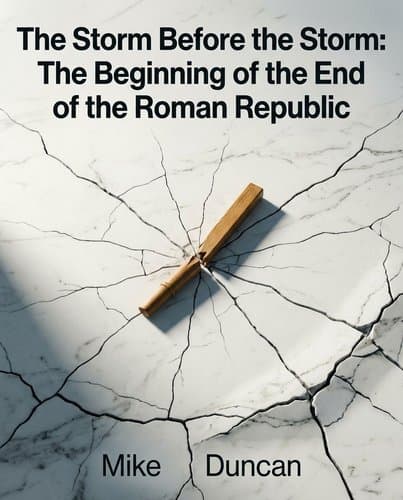
34184069_the-storm-before-the-storm
by Mike Duncan
Rome's republic wasn't killed by Caesar—it was already dying decades earlier, as well-meaning politicians shattered unwritten norms "just this once," each…
In Brief
Rome's republic wasn't killed by Caesar—it was already dying decades earlier, as well-meaning politicians shattered unwritten norms "just this once," each violation licensing a worse one until armies marched on the city and violence became routine. The real lesson of Rome is how democracies devour themselves from within.
Key Ideas
Norms sustain republics more than laws
Political norms — not constitutions, not laws, not formal institutions — are the actual load-bearing structure of a republic. Written rules derive their force from the shared expectations surrounding them; once those expectations erode, the laws cannot compensate.
Successful violence creates repeatable precedent
The first successful act of political violence doesn't just end a conflict — it proves a method. Every subsequent actor in the Roman crisis justified their escalation by pointing to what someone else had already done. The permission slip compounds.
Unaddressed grievances invite radical solutions
Economic grievances left unaddressed don't disappear; they find their own resolution through whoever is willing to exploit them. The Senate's repeated refusal to engage with real inequality (displaced farmers, Italian citizenship, publicani corruption) didn't prevent reform — it guaranteed that reform would arrive in its most destructive form.
Personal loyalty replaces institutional authority
When soldiers' loyalty shifts from an institution to an individual general, that general's ambitions become the institution's structural problem. Marius's property-qualification waiver was the hinge on which citizen-soldier became professional mercenary — a change that made every subsequent civil war possible.
Precedent outlasts the reformer's changes
The most dangerous legacy a successful norm-breaker leaves is not their ideology or their reforms — it's their biography, which teaches ambitious successors what is possible, not what is wise. Sulla's constitution was gone in a decade; the lesson that armies could take Rome lasted forever.
Internal erosion compounds with each defense
Republics are not brought down by tyrants arriving from outside — they are brought down by the accumulated decisions of people who genuinely believed they were defending the republic, each transgression handing the next faction a slightly larger permission slip.
Who Should Read This
History readers interested in World History and Political Figures who want a deeper understanding of how we got here.
The Storm Before the Storm: The Beginning of the End of the Roman Republic
By Mike Duncan
11 min read
Why does it matter? Because you've been watching the third act of a collapse without knowing the first two.
Everyone thinks they know how Rome fell. Caesar crossed the Rubicon — dramatic, decisive, one man, one choice. Except by the time Caesar waded into that river, the Republic had already been dying for a generation, killed not by a tyrant but by people who genuinely believed they were saving it. Mike Duncan's argument is that the real story starts a hundred years earlier, in 133 BC, when senators armed with chair legs beat a tribune to death on the Capitoline Hill — not because they were monsters, but because they convinced themselves they had no other choice. That was the first permission slip. What this book tracks is how it traveled, hand to hand, each transgression licensing the next, until political violence stopped being a crisis and became just grammar. The fall of Rome won't feel like ancient history. It'll feel like a warning everyone agreed not to read.
The Real Constitution Was Never Written Down
The Roman Republic had a sophisticated written framework that political theorists celebrated — and it protected almost nothing on its own. What actually held the republic together was something no document could contain: a shared, unwritten understanding of how far you were allowed to go.
The Romans had a name for it: mos maiorum, "the way of the elders." Not a law code. Not a constitution. A collective agreement about the rules of the game, maintained purely because everyone with power accepted it.
The tribunate offers the cleanest proof of how this worked. When the republic's lower classes, the plebs, refused military service in a fifth-century standoff, the Senate agreed to create magistrates specifically to shield ordinary citizens from aristocratic abuse. Those magistrates, the tribunes, were declared sacrosanct: inviolable within Rome's city limits, immune even from the consuls themselves. For three centuries, that line held — not because a court would punish any transgressor, there was no mechanism for that, but because Romans agreed it was unthinkable.
The Table Legs That Proved Politics Could Be Settled With Violence
The morning after the vote failed, Rome's chief priest put on his ceremonial robes and went to kill someone.
Publius Scipio Nasica was pontifex maximus, the highest religious office in the Republic, and one of the most powerful senators alive. When the consul refused to act against Tiberius Gracchus, Nasica stood up in the Senate and declared that those who wanted to save the country should follow him. Then he led a mob of senators and their clients up the Capitoline Hill. Weapons were prohibited inside Rome's sacred boundary, so they grabbed what they could find: table legs, bench fragments. Tiberius's supporters were packed around the Temple of Jupiter, waiting for a vote. When the mob arrived, the crowd began to give way. Then the beating started.
Tiberius Gracchus — tribune of the people, a magistrate whose body the Republic had declared inviolable for three centuries — was beaten to death near the temple entrance, set upon while trying to get up from a fall. His body and those of the men who died with him were denied funeral rites and thrown into the Tiber.
Then something almost more important happened: nothing. The Senate opened no investigation. Nasica faced no charges. Instead, the official story hardened: Tiberius had been trying to make himself king. The murder was reframed as a republican defense of republican values, which meant that anyone who wanted to do the same in the future had a ready-made justification waiting. The cover story was itself a template.
Velleius Paterculus, writing more than a century later, put his finger on what Rome had just done to itself: "Precedents do not stop where they begin, but, however narrow the path upon which they enter, they create for themselves a highway whereon they may wander with the utmost latitude." What he adds next is the part that should make you uneasy: no one considers a method beneath him once it has proved profitable for others.
Nasica had proven something. Political violence, carried out boldly enough, against a target labeled dangerous enough, with enough senators behind you — it worked. It went unpunished. It was celebrated. The three hundred dead on the Capitoline were not a tragedy the Republic was forced to reckon with. They were a data point that future strongmen would study.
The murder of Tiberius Gracchus was not the end of Roman politics. It was a proof of concept — and the experiment had come back positive.
The Senate Refused to Fix the Problem That Was Destroying the Republic
The murder came first. To understand it, you need the economics.
Rome's wars in Spain, Greece, and North Africa stretched for years and pulled citizen-farmers thousands of miles from their plots. When they finally came home, their land was in ruins. Wealthy senators had been waiting. They bought up the neglected farms — sometimes through market forces, often through coercion — and stocked the new estates with the slaves their own victories had generated. The same wars that ruined small farmers produced the slaves who replaced them; Rome's victories were consuming itself. The pool of citizens who could meet the property requirement for military service shrank with each generation, taking Rome's capacity to field armies with it.
The Gracchi proposed breaking this by recovering state land that wealthy families had been illegally squatting on for generations and redistributing it to the landless poor. When the Senate refused to engage, and then murdered Tiberius, and then chased Gaius down and killed him, they weren't defending the Republic. They were defending the specific arrangement that benefited them.
The consequence arrived on schedule. In 91 BC, a tribune named Drusus assembled a final omnibus reform package: grain subsidies, land redistribution, and — the proposal that kept exploding every decade — citizenship for Rome's Italian Allies, who had been supplying half the legions for generations while holding no political rights. The Senate annulled the entire package. Drusus was stabbed in the hip while saying goodbye to visitors at his front door, and died asking whether Rome would ever have a citizen like him again. Three months later, the Italians launched the Social War. Roughly 300,000 people died before it ended. Rome granted the citizenship anyway, then packed the new Italian voters into tribes that voted last, after every real decision was already made.
The Senate had spent fifty years refusing to manage a problem that was entirely manageable. Then it spent years managing the catastrophe that followed.
Marius's Most Dangerous Reform Had Nothing to Do With Tactics
Think about the difference between a homeowner defending his property and a hired guard defending someone else's. The homeowner fights with everything he has because the outcome is personal — his farm, his family, his future. The guard fights for whoever holds the contract. Change the contractor, and loyalty follows.
For four centuries, Rome's legions were built on homeowners. The property qualification for military service was an alignment mechanism, not bureaucratic gatekeeping. The citizen-soldier had land to return to. His stake in the Republic was literal. He fought to protect a world he owned a piece of.
By 107 BC, Gaius Marius had a problem. The structural crisis the Gracchi had tried and failed to fix — wars draining farms, senators buying up the abandoned land, the pool of property-owning citizens shrinking each generation — had left him unable to fill his legions through traditional means. The Cimbri, a Germanic people who'd already destroyed three Roman armies, were pressing from the north. Jugurtha, a Numidian king who'd been evading Roman forces for years, was still loose in North Africa. The property rolls were too thin.
So Marius waived the requirement. Any man, regardless of acreage, could now serve. Destitute men from across Italy signed up immediately.
The Roman historian Sallust, writing roughly a century after these events, gave the coldest summary of what Marius had actually done: "to one who aspires to power the poorest man is the most helpful, since he has no regard for his property, having none, and considers anything honorable for which he receives pay." Marius wasn't thinking in those terms. He needed soldiers and there they were. But the logic Sallust identified was now permanently in play. A man with nothing to lose follows the general who promises him everything, not the Senate, not the Republic. Just the general.
The change that made every subsequent catastrophe possible was quieter than the histories suggest. What Marius altered was the soldier himself: a man with no property and therefore no institutional stake, whose loyalty ran to whoever promised land and pay. Caesar would use this logic to cross the Rubicon. Augustus would use it to end the Republic. The fuel Marius loaded in 107 BC powered everything that followed.
A Personal Vanity Dispute That Nearly Brought Rome to Ruin
Lucius Cornelius Sulla commissioned a wax seal sometime after the capture of Jugurtha. The image he chose wasn't a family emblem or a god. It was a scene: himself, accepting the Numidian king in chains from the Mauretanian king Bocchus. That capture had ended the Jugurthine War, the moment Gaius Marius had been waiting years to celebrate. Sulla had executed the triple-cross diplomacy personally, riding past Jugurtha's own camp at night on the strength of a prince's promise, but under Roman military tradition, the commanding general, Marius, received all glory for whatever happened in his province.
Sulla chose to disagree. He didn't dispute Marius's triumph. He just had a seal made.
Plutarch's assessment was crisp: "This was the first seed of that bitter and incurable hatred between Marius and Sulla, which nearly brought Rome to ruin."
A wax impression brought Rome to ruin.
What followed was seventeen years of escalation, and at every step the move that seemed outrageous was simply the logical response to the last outrageous thing. Sulla built a reputation through the Social War (the very war in which Marius was repeatedly shunted aside) that left him elected consul and assigned the eastern command Marius had spent years maneuvering to get. When a tribune named Sulpicius, who admired Saturninus (the radical who'd organized street violence a decade earlier and paid for it with his life) and faulted him only for timidity, organized Rome's first professional political street gang and transferred the command from Sulla to Marius, Sulla did something no Roman general had ever done: he gave his soldiers a political speech about what had been done to him, then marched his six legions down the Via Appia toward Rome. When Senate envoys rode out to ask why he was marching against his own country, he said: "To deliver her from tyrants."
Every link in that chain was locally defensible. Sulla was robbed of a lawfully won command. The tribune had organized violence first. The Senate had failed to act. Each violation of mos maiorum created the pretext for the next one, and each actor could point to someone else's transgression as justification. The pattern is familiar because it is not unique to Rome.
The outcome was Marius — six-time consul, savior of the Republic — dragged out of a swamp naked and covered with mud, led into a coastal town by a rope around his neck. He ended up sitting among the ruins of Carthage: two fallen powers, each destroyed by forces they had set in motion themselves. He sustained himself with one thought: he had only held the consulship six times, and was destined for seven. He would get it. He would die seventeen days into it.
The civil war that followed killed hundreds of thousands. It began because a man who helped win a war thought he deserved credit for winning it — and another man thought differently. Neither could have imagined where a seal would lead. That's usually how it goes.
The Dictator Who Saved Rome Taught the Next Generation How to Destroy It
A nineteen-year-old with the wrong wife was hiding in the hills outside Rome when a pardon arrived. Sulla had ordered Gaius Julius Caesar to divorce Cinna's daughter; Caesar refused; his name went on the list.
The list had started at eighty names and stopped having a meaningful upper limit. The mechanism was self-funding: bounties for heads, murderers receiving shares of victims' property. Marcus Crassus traveled Italy with a young officer he kept close, executing merchants and bankers; Crassus himself had one man killed in Bruttium simply to seize an attractive estate. An apolitical landowner named Quintus Aurelius found his name posted in the Forum and understood his situation immediately: "done for because of my Alban Farm." When proscription gangs couldn't identify real targets, they grabbed strangers off the street and delivered the heads to Sulla, who paid every bounty without asking who was really on the list.
Caesar's name was on the list. The friends he had inside Sulla's circle went to work, and when they finally pressured the dictator into a pardon, Sulla granted it with a warning: in this Caesar, he told them, there is more than one Marius.
He meant it as an argument for killing the boy. It became the most accurate prediction any Roman made about his own legacy.
Duncan's cold analysis: Sulla believed Rome's crises had been caused by popular power running amok, so he stripped the tribunate of authority, restored senatorial supremacy, and retired, convinced he had repaired the machine. He had diagnosed it backwards. Senatorial oligarchy was the root condition the Gracchi had died trying to treat. Sulla's constitution was swept aside within a decade.
His biography was not. What Caesar absorbed from Sulla's example — and Pompey, and Crassus, and every ambitious man who came after — was not any lesson about institutional balance. It was the demonstration that one general with loyal legions could take Rome, and nobody would stop him if he moved fast enough. Every permission slip written on the Capitoline Hill, every norm bent, every transgression the Senate declined to prosecute had accumulated into exactly this: a proof of concept, refined over a century, available to whoever was determined enough to use it.
The great figures of the Republic's final collapse weren't aberrations. They were men who had watched Sulla, watched him win, watched him retire unmolested, and decided the only mistake he'd made was giving it back.
The Permission Slip You Don't Know You're Signing
Duncan closed his Author's Note in October 2017 by cataloging what he'd found in the century before Caesar — the wealth gaps, the displaced workers, the armies that answered to their generals before they answered to the Senate, the slow erosion of the rules everyone had agreed to treat as binding. He called them echoes, not conclusions. The point isn't that America is Rome — it's that the machine runs on human nature, not Latin. Caesar and Augustus weren't aberrations who hijacked a healthy system. They were the predictable output of a century of exactly this: each broken norm made the next one cheaper, each generation watched the rules bend for the bold and drew the obvious lesson. Sulla's first proscription list had eighty names. He never announced an upper limit. The Romans had reasons for every step. The reasons are gone; the steps are still with us.
Notable Quotes
“done for because of my Alban Farm.”
“Have your way and take him; only bear in mind that the man you are so eager to save will one day deal the death blow to the cause of the aristocracy, which you have joined with me in upholding; for in this Caesar there is more than one Marius.”
“he would resort to no violence and would put no citizen to death without a trial; if, however, the people, under persuasion or compulsion from Tiberius, should vote anything that was unlawful, he would not regard this vote as binding.”
Frequently Asked Questions
- What is 'The Storm Before the Storm' about?
- The Storm Before the Storm examines the generation of Roman politicians before Julius Caesar whose escalating transgressions dismantled the republic's unwritten rules. Through detailed narratives of figures like Marius, Sulla, and the Gracchi, it shows how political violence, ignored inequality, and eroded norms compound into structural collapse. The book demonstrates what the arc of Roman decline reveals about how republics actually fall and the specific conditions that make such collapse inevitable. Duncan traces the incremental breakdown of the shared expectations that had held the republic together for centuries.
- What are the key takeaways about political norms in 'The Storm Before the Storm'?
- Political norms — not constitutions, not laws, not formal institutions — are the actual load-bearing structure of a republic, according to the book's central argument. Written rules derive their force from the shared expectations surrounding them; once those expectations erode, the laws cannot compensate. This insight challenges conventional thinking about constitutional preservation, which typically focuses on formal institutional design. Duncan's analysis suggests that maintaining the cultural consensus surrounding shared expectations is more fundamental to republic survival than any legal document, however well-crafted.
- How does 'The Storm Before the Storm' explain political violence escalation in Rome?
- The first successful act of political violence doesn't just end a conflict — it proves a method. Every subsequent actor in the Roman crisis justified their escalation by pointing to what someone else had already done. This creates a compounding permission slip where each transgression becomes precedent for the next, teaching ambitious successors what is possible. Once Marius and Sulla demonstrated that military force could override political process, their success showed that the same tactics were viable, making escalation structurally inevitable and defense of the previous norm increasingly difficult.
- What does 'The Storm Before the Storm' reveal about how republics fall?
- Republics are not brought down by tyrants arriving from outside — they are brought down by the accumulated decisions of people who genuinely believed they were defending the republic. Duncan demonstrates this pattern through Rome's collapse, which resulted from internal erosion through successive norm violations rather than external conquest. No single actor intended to destroy the republic; instead, each believed they were protecting it. This insight suggests republics fail through accumulated compromises of their own members rather than invasion by enemies, making internal vigilance essential.
Related Book Summaries

Read the full summary of 34184069_the-storm-before-the-storm on InShort