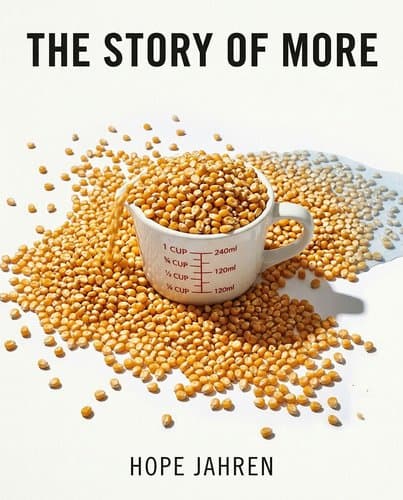
49960370_the-story-of-more
by Hope Jahren
The systems that saved billions from hunger, disease, and poverty worked so well they're now consuming the future they were meant to protect — and Jahren…
In Brief
The systems that saved billions from hunger, disease, and poverty worked so well they're now consuming the future they were meant to protect — and Jahren shows, with uncomfortable precision, exactly which everyday choices (your water heater, your diet, your index fund) actually move the needle.
Key Ideas
Water heaters dominate home energy consumption impact
Your water heater accounts for roughly half your home's electricity use — it's the single highest-leverage appliance to upgrade or dial back, dwarfing the impact of switching lightbulbs or unplugging chargers
Renewable energy growth masks coal dependence reality
When you hear that renewable energy is 'the fastest-growing sector,' check the total alongside the percentage: wind and solar together still supply less than 5% of global electricity; a declining share can coexist with a rising absolute — and it does
One meatless day unlocks fifteen percent grain
One meatless day per week across OECD nations would free roughly 120 million extra tons of grain — approximately 15% of the global food-grain supply — without any new technology or infrastructure
Grid composition determines electric vehicle climate benefit
Electric vehicles reduce local emissions but don't eliminate fossil fuel use if your regional grid runs primarily on coal; the climate benefit is real but roughly half of what the marketing implies for coal-heavy grids
Index funds bind you to conflicting values
Audit what your investments actually own: index funds frequently hold stakes in the industries whose practices conflict with your stated values, making you a financial participant in what you publicly oppose
Climate burden shifts from rich polluters to poor
The countries most exposed to sea level rise, crop failure, and extreme heat contributed less than 1% of cumulative CO2 emissions; climate change is not a burden distributed among those who caused it — it is a transfer of costs from rich to poor across generations
Efficiency gains become consumption rather than savings
The efficiency argument cuts both ways: the 1973 oil crisis produced cars 50% more efficient by 1980, then Americans used those savings to drive twice as far and buy larger vehicles; efficiency gains are only net reductions if you don't consume the savings
Who Should Read This
Science-curious readers interested in Climate Change and Sustainability who want to go beyond the headlines.
The Story of More
By Hope Jahren
10 min read
Why does it matter? Because the climate crisis isn't a failure of civilization — it's what its success looks like after fifty years of compounding.
On September 27, 1969, a Minnesota physics teacher named his youngest daughter Hope. That same year: a river burned in Ohio, an offshore oil platform smothered thirty-five miles of California coastline, and Sesame Street premiered. Her parents believed science and love would outrun every old problem. They were both right and wrong — and that phrase carries the weight of this entire book.
Jahren spent years after a reluctant classroom assignment doing something unusual: not warning, just counting. Grain production tripled. Meat output quadrupled. Three billion people moved into cities. Every system humanity built to escape hunger, disease, and early death succeeded — completely, at a scale no previous generation imagined. The weight of all that success is now aimed at our grandchildren. This book is the arithmetic of how we got here, and one quiet, uncomfortable question: is this where we want to be?
In Fifty Years, Humanity Achieved What Ten Thousand Years Could Not
The year Jahren's father was born — 1923 — someone had already worked out when he was likely to die. Not by prophecy but by actuarial table: the average American newborn of that year was expected to live fifty-eight years. A ceiling had been placed above every bassinet, and it sat low.
He blew past it, making it to ninety-two. But the number is the point, not the man. When Jahren herself arrived in 1969, the figure had risen to seventy-one. By the time her son was born in 2004, it stood at seventy-eight. Three generations, roughly eighty years, and buried in there are twenty additional years of expected life that simply hadn't existed for her father. They were conjured from cleaner water, better sewage, vaccines, and the slow reach of trained medical care into communities that had never had it.
In 1819, two of every five children born alive died before their fifth birthday — a grief so routine that most mothers of that era knew it firsthand. When Jahren was born in 1969, that ratio had already been cut to one in five. Today it is one in twenty-five. The same compression was running in parallel across food: since 1897, global population doubled, but grain, fish, and meat production all tripled or better. The collapse of childhood death from near-universal grief to relative rarity happened mostly inside a single lifetime, the one Jahren has been living.
She spent the years after 2009 pulling these numbers from public databases, searching for patterns across the decades of her own life, then teaching them week after week to university students. Not as warnings, not as prescriptions — just as the record of what had actually happened. The baseline, she called it. And the baseline begins with a miracle.
We Tripled the Food Supply — and Most of It Never Reached a Human Mouth
Humanity did triple its food supply in fifty years, and the numbers are real. The planet now produces three billion tons of cereal annually, up from one billion in 1969, on only ten percent more land. That's not spin — it's what happened, measured in bushels and hectares. But what happened to all that grain is harder to celebrate.
Take corn, which Jahren watched from car windows on drives across Minnesota and Iowa every season of her childhood. The United States now produces fifteen billion bushels per year, a 300 percent increase in fifty years. Of that harvest, ten percent reaches a human mouth. The rest goes to ethanol, industrial starches, and animal feed. More than a billion bushels flow into livestock and emerge as manure. That's enough grain to sustain one hundred million people for a year.
The numbers from there get worse. The planet feeds roughly one billion tons of grain to people and another billion to animals. The animal share yields about one hundred million tons of meat and three hundred million tons of waste. Six pounds of grain go in for every pound of harvestable flesh that comes out. The math runs the wrong way at planetary scale.
Jahren grew up in Austin, Minnesota, where 6 percent of all American hogs were slaughtered, nineteen thousand animals a day, between Fourth and Eighth Streets Northeast. She could smell the plant from the car, a particular heaviness that clung to that part of town, a scent she'd stopped noticing by grade school. She used to defend it at dinner parties: Temple Grandin, the animal-welfare researcher who redesigned how livestock move through slaughterhouses to reduce their stress, had helped design it; the workers got decent wages and a clinic; the pigs met their end quickly and without knowing it was coming. She told these stories in between bites of pork. What she couldn't argue her way around was the calculation happening upstream — those corn fields flowing not into pantries but into feedlots, compressed through an animal, and coming out as a fraction of what went in.
The arithmetic has a lever. If every OECD nation (the wealthy bloc stretching from North America to Europe to Japan) skipped meat one day a week, 120 million extra tons of grain would be available immediately. Not after new fields were cleared or new seeds engineered. Immediately, by subtraction. Against a backdrop of eight hundred million people currently undernourished, that's not a small number. The grain is already there. The question is what we route it through before it reaches anyone's plate.
Every Time We Made Something More Efficient, We Used the Savings to Consume More
Think of a friend who spent twenty years gradually cutting the share of his paycheck that went to cigarettes, while smoking seven times as many cigarettes. Both facts are true. Neither one is the story.
The global energy picture runs the same math. Over the past fifty years, the fraction of the world's energy coming from fossil fuels has declined — from 94 percent to 85 percent. That's real. But over that same period, the total amount of fossil fuel burned each year has more than doubled. The percentage went down; the quantity went up. Pick either number alone and you get the wrong story.
The car story is the same logic, run in slow motion over a century. After the 1973 OPEC embargo quadrupled gasoline prices overnight, American engineers redesigned the passenger car. By 1980, the average engine was fifty percent more efficient, the vehicles themselves twenty percent lighter, fuel economy reaching twenty miles per gallon. A genuine triumph — and a choice point almost no one noticed at the time: stay with one efficient car per family, drive roughly the same distances, and energy use would have kept falling for decades as the technology improved further.
Instead, Americans took the efficiency gains and spent them on more car. Horsepower climbed from roughly twenty in the original Model T to an average of 230 today. Minivans and SUVs crowded out the lighter vehicles. By 2000, average fuel economy had slipped below where it stood in 1980, and Americans were driving twice as far per year as they had in 1970. The efficiency gains were real. They just didn't stick, because nobody asked whether driving twice as far was a good idea.
The pattern shows up everywhere: efficiency improvements get absorbed by expanded use, and the floor keeps rising. The electric car offers one last version of the trick — it moves combustion to the other side of town, where a coal plant burns quietly so you can imagine your commute as clean. The question she keeps returning to, without pressing it, is whether we've ever once decided that the cake was large enough before reaching for more.
The Physics Was Settled in 1856 — and the Penalty Falls on Those Who Burned Almost Nothing
The greenhouse effect is not a hypothesis. It was experimentally confirmed before the American Civil War.
In 1999, Jahren's team built growth chambers from RadioShack and Home Depot parts — Plexiglas boxes filled with elevated carbon dioxide and bathed in artificial light. Within an hour, the temperature inside shot past 90 degrees Fahrenheit. The building held at 65. She spent six months trying to figure out what was wrong with her equipment before finding, buried in the chemistry literature, that nothing was wrong at all. In 1856, an American experimenter named Eunice Foote had filled glass jars with extra carbon dioxide, set them in the sun, and watched them heat up faster and take far longer to cool than ordinary air. John Tyndall reproduced the result a few years later and received the recognition Foote never did. By 1896, the Swedish chemist Svante Arrhenius had worked out that burning fossil fuels would warm the entire planet. All of this predates the automobile. It predates the airplane. The science Jahren found herself rediscovering had been sitting in chemistry textbooks for over a century.
The science didn't move the policy. Since Arrhenius's warning, atmospheric carbon dioxide has risen by more than a third. Average global surface temperatures have climbed more than a degree and a half Fahrenheit. We are already roughly halfway through the two-degree Celsius warming budget that international agreements have repeatedly described as the threshold of catastrophe — and our current trajectory points well past it. The Kyoto Protocol got signed and ignored. The Paris Agreement got 175 signatures and was followed by the hottest year on record. What neither agreement managed was to bend the emissions curve.
The part that doesn't resolve is this: the people absorbing the worst consequences are almost entirely different from the people who generated the problem. Bangladesh is a river delta barely above sea level, home to half the population of the United States packed into a country the size of Alabama. It is likely to lose a fifth of its land within thirty years to rising water. Its people have produced less than one percent of the carbon dioxide that has accumulated in the atmosphere since industrialization began. They didn't build the feedlots or the refineries or the interstates. They didn't triple the food supply and then spend the efficiency gains on bigger engines. The nations that did those things are now the ones debating whether the inconvenience of change is worth the effort.
Jahren doesn't frame this as accusation. She keeps returning to the arithmetic: the benefits and the costs have not landed on the same people.
Scientists Are Racing to Look a Species in the Face at Least Once Before It's Gone
Climate disruption doesn't stop at human borders. The smell hits before anything else — grain alcohol so thick it's hard to focus on whoever's talking to you. This is the fish collections lab at PUCRS university in Porto Alegre, Brazil, 2005, and when Jahren's eyes adjust, she sees the walls: shoulder-high white plastic barrels lining every hallway and balcony, each holding forty-plus fish on fishing lines in ethanol, waiting their turn.
The lab is working through every freshwater fish in South America. Teams set nets across Brazilian rivers, haul the catch back, preserve it in alcohol, and wait for someone to examine each specimen and decide if it's new to science. For most biologists, discovering a new species is the defining event of a career. These researchers were doing it, on average, once every four days.
Jahren asks her guide whether they'll ever get through all those barrels. Eventually, yes, comes the answer. Then, almost as an aside, he adds something she can't unhear: much of the work is really just about seeing each species once — just once — before it's gone.
That line reframes the whole enterprise. These scientists aren't racing to save anything. They're racing to document, to get a record of what exists before it disappears. Freshwater habitats cover less than one percent of Earth's surface but hold roughly six percent of all species; anything that disrupts the water flow (a dam, a dropped water table, a warming season) hits this concentrated pocket of life hard and fast.
The current extinction rate runs about a thousand times faster than the background rate in the fossil record. Projected to 2050, roughly one in four of all species alive today will be gone. Not mass extinction by the geological definition (that threshold is seventy percent), but heading there. The last mass extinction killed the dinosaurs sixty-six million years ago. This one is arriving quietly enough that most of us won't notice until it's already irreversible.
The Only Surefire Solution Creates No New Wealth, Produces No New Jobs, and Therefore Cannot Be Sold
Is there a cleaner version of this problem being solved in a lab somewhere? Jahren works through every candidate honestly. Carbon capture uses more energy to run than it traps. Tree planting won't pay off within your lifetime or your children's. Aerosol spraying to block sunlight could slow warming but would likely disrupt the monsoon patterns that billions of people depend on for crop water. None of the proposed fixes close the gap we've already opened.
Only one intervention does: using less. If all the electricity generated today were divided equally among every person alive, each share would match what the average Swiss person consumed in the 1960s — people in wool coats waiting at train stations, small cups of coffee, workdays that ended before dark. That standard of living came with a life expectancy comparable to today's America. The problem, as Jahren sees it, isn't that the planet can't produce enough. It's that we haven't built a system that shares what it already makes.
Conservation can't be patented or sold. It generates no revenue and employs no engineers. It has met systematic resistance from every industry built on rising consumption, which is most of them. This is precisely why we keep waiting for the technological fix.
The trap is concluding that individuals are therefore powerless. Jahren checked her own ledger. In 2008, her lab published a study exposing the industrial uniformity of fast-food meat — isotope signatures (chemical markers that reveal what an animal ate and where it lived) identical from Boston to Los Angeles, as though one enormous captive animal in Nebraska was supplying every chain in the country. She felt righteous. Then her husband reminded her that their index funds probably owned those chains. He was right: one fund held Restaurant Brands International, the corporate parent of Burger King and Popeyes. She had been financing what she was exposing.
The point isn't guilt. The levers are real, and they're everywhere. Where your savings flow is a choice. What you eat on a Tuesday is a choice. Jahren's message to students overwhelmed by the data: no single solution saves us, which is exactly why every choice matters. The new century is unwritten. You have power over more than you've been using.
Both Right and Wrong — and What That Means for the Next Page
Jahren was named Hope by parents who were, she admits, both right and wrong at the same time. The name implies something earned, waiting to be justified. After years of running the numbers, she found the math unresolved and herself inside it — still commuting in a car, still holding a retirement account she'd never thought to audit. She offers this not as confession but as a portrait of where most of us live: inside a system we didn't design but keep funding with every dollar and every meal. Here's what she keeps implying without quite saying: lazy nihilism gets the arithmetic exactly wrong. It is precisely because no single choice saves us that every choice you make still counts. The next century is a blank page. Who fills it is not yet decided.
Notable Quotes
“in the sun but were”
“well below 2 degrees Celsius”
“People Need to Be Scared About Climate Change”
Frequently Asked Questions
- What household appliance has the biggest impact on home electricity use?
- Your water heater is your home's single highest-leverage appliance for energy reduction. According to Jahren, it accounts for roughly half your home's electricity use, far outweighing the impact of switching lightbulbs or unplugging chargers. Upgrading to a more efficient model or simply dialing back temperature settings delivers substantially greater carbon and cost savings than commonly recommended efficiency measures. This data-driven finding challenges popular energy-saving advice focused on minor appliances and phantom loads. Understanding where your home's energy actually goes helps prioritize investments with real climate impact, rather than pursuing incremental conservation efforts that offer minimal environmental benefit relative to effort and cost.
- What percentage of global electricity comes from wind and solar?
- Wind and solar together still supply less than 5% of global electricity despite being called the fastest-growing energy sector. This apparent contradiction illustrates a critical statistical distinction Jahren emphasizes: a rising percentage rate can coexist with a tiny absolute share, especially when starting from minimal baseline levels. Hearing that renewable energy is "the fastest-growing sector" without checking the total percentage creates misleading impressions about energy transition progress. Understanding this data distinction prevents overestimating the speed at which renewables are displacing fossil fuels globally. Jahren equips readers to cut through misleading energy statistics by examining both absolute and percentage figures simultaneously, revealing gaps between narrative and reality in climate conversations.
- How much global food grain could one meatless day per week save?
- One meatless day per week across OECD nations would free roughly 120 million extra tons of grain—approximately 15% of the global food-grain supply. This massive shift could occur without requiring new technology or infrastructure, making it remarkably achievable through dietary choices alone. Jahren presents this figure as evidence that individual consumption decisions carry real leverage in addressing global food systems. The calculation reveals how livestock feed consumption structures current grain distribution, with animals consuming vast quantities that could directly feed human populations. This takeaway demonstrates that personal dietary choices represent meaningful climate and food security impact, though implementation would require coordinated cultural shifts across wealthy nations rather than isolated individual choices.
- Who bears the burden of climate change?
- The countries most exposed to sea level rise, crop failure, and extreme heat contributed less than 1% of cumulative CO2 emissions. Climate change represents a cost transfer from the rich nations that industrialized to poor nations that did not cause the crisis, across generations. This inequity underscores how Jahren's data-driven approach reveals structural injustices obscured by aggregate global statistics. Understanding this distribution explains why climate responsibility cannot be framed as shared burden equally distributed across all nations. The disproportionate vulnerability of least-developed countries to climate impacts contradicts narratives of collective global responsibility, instead revealing historical emissions as concentrated in wealthy nations now attempting to shift future transition costs globally.
Related Book Summaries

Read the full summary of 49960370_the-story-of-more on InShort