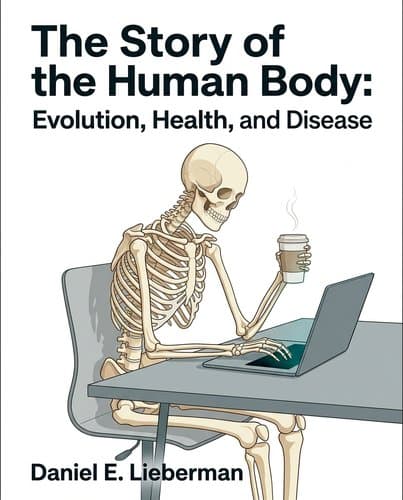
17736859_the-story-of-the-human-body
by Daniel E. Lieberman
Your cravings, back pain, and chronic disease aren't personal failures—they're your Stone Age body colliding with a modern world it never evolved for.
In Brief
Your cravings, back pain, and chronic disease aren't personal failures—they're your Stone Age body colliding with a modern world it never evolved for. Harvard evolutionary biologist Daniel Lieberman reveals how understanding this mismatch exposes why willpower fails and what actually prevents the illnesses slowly killing us.
Key Ideas
Modern disease reflects evolutionary mismatch
Chronic illnesses like type 2 diabetes, heart disease, back pain, and myopia are not signs of personal failure — they are predictable mismatches between Paleolithic biology and post-Paleolithic environments
Evolution optimized for reproduction not longevity
Evolution optimized your body for reproductive success, not health or longevity — your cravings for sugar, fat, and rest are features, not bugs, which is why willpower alone cannot override them
Adaptations trade present advantages for future risks
Every major human adaptation came with a trade-off: bipedalism gave us walking efficiency but back pain; big brains required dangerous childbirth; clear speech required choking risk. Understanding the trade-off explains the vulnerability
Treating symptoms without environmental change perpetuates disease
Dysevolution is the feedback loop where treating symptoms (orthotics, dental fillings, metformin) without fixing causes means each generation inherits the same harmful environment — your children will likely face the same mismatch diseases unless the environment changes
Soft environment creates structural deformities
Impacted wisdom teeth and flat feet are not genetic destiny — they are products of soft, processed diets and cushioned shoes failing to provide the mechanical stimuli jaw and foot bones need to develop properly. Hard gum and barefoot walking are not nostalgia; they are biology
Policy design beats individual willpower
Changing individual behavior through education barely works (a 15-week health course raised fruit intake 4%). The only interventions that match the scale of evolved instincts are environmental ones: taxes, regulations, urban design, and school policy — soft paternalism
Sustained activity prevents decline with aging
Hunter-gatherers like the Hadza often die in their late sixties and seventies without chronic illness. Long decline into disability is not biological aging — it is a modern, industrial invention that can be meaningfully reduced by sustained physical activity throughout life
Who Should Read This
Science-curious readers interested in Evolution and Biology who want to go beyond the headlines.
The Story of the Human Body: Evolution, Health, and Disease
By Daniel E. Lieberman
10 min read
Why does it matter? Because almost every chronic illness killing you was predictable — and preventable.
You probably assume your bad back, your crowded teeth, your creeping waistline, your failing eyesight — that these are personal verdicts. Bad genes, weak will, too many donuts. Here's the uncomfortable alternative: your body isn't failing you. It's succeeding, brilliantly, at surviving a world that vanished ten thousand years ago. The jaw that can't fit your wisdom teeth was shaped for chewing raw tubers all afternoon. The metabolism hoarding fat around your organs was forged during famines that haven't arrived. The eyes straining at your screen were calibrated for open savanna horizons. Daniel Lieberman's argument is stranger and more liberating than any diet book — and considerably more damning. Not of you, but of the loop we've built: a civilization that manufactures mismatches, then treats their symptoms, then hands the whole arrangement to the next generation, slightly worse.
You Are the Mystery Monkey: A Displaced Animal Surviving in the Wrong Habitat
In October 2012, wildlife officials in Tampa finally caught a rhesus macaque that had been living wild in the suburbs for over three years. The animal had survived by raiding dumpsters, dodging traffic, and outwitting every trap set for it. Locals made it a folk hero. Politicians used it as a metaphor. Most people marveled that a monkey native to southern Asia had carved out a life in suburban Florida.
Harvard evolutionary biologist Daniel Lieberman looked at the Mystery Monkey and saw something else entirely: us.
A macaque in Tampa is obviously out of place. But so, by the same logic, is every person sitting in an air-conditioned office eating a bag of chips. More than six hundred generations ago, every human alive was a hunter-gatherer — moving camp, foraging plants, hunting game. The modern world arrived, in evolutionary terms, about thirty seconds ago. Our bodies haven't caught up.
This mismatch is the uncomfortable engine behind one of the worst public health crises of our time. We live in an era that has largely conquered the diseases that once killed children in droves — smallpox, polio, plague. And yet chronic illness is building across the globe: type 2 diabetes, heart disease, certain cancers, osteoporosis, depression, myopia. These are not diseases of old age. They are showing up in middle-aged people, and increasingly in children. They are largely preventable. And they are getting worse.
Lieberman's argument is that the culprit is neither bad genes nor weak willpower. It's a mismatch. Evolution selects for reproductive success, not health or longevity. Our ancestors who craved sugar and stored every spare calorie as fat survived famines and had more children. Those cravings are still in us, expressed now in a world of unlimited cheap calories and desk jobs. The monkey survived in Tampa. Surviving in the wrong habitat, though, is not the same as thriving in it.
Walking Upright Was a Trade-Off, Not a Triumph — and Your Back Knows It
Bipedalism was not a promotion to a higher form of life. It was a desperate energy bargain.
Four to six million years ago, as African forests shrank and fruit became patchy and unreliable, early hominins faced a brutal arithmetic: travel farther per day to eat enough, or die. The problem was that the ape way of moving — bent hips, bent knees, that shuffling Groucho Marx lurch — is catastrophically expensive. Put a chimpanzee on a treadmill with an oxygen mask and you find it burns roughly four times more energy per kilometer than a human. A chimp can walk maybe two or three kilometers before its energy budget gives out. A human, expending the same calories, covers eight to twelve kilometers. That gap is the difference between finding enough food and starving.
Walking upright solved this by turning the leg into an inverted pendulum. Each stride vaults the body upward, storing energy at the peak, then recovering it as the body falls forward into the next step. Straight hips and straight knees make this mechanism work. Bent ones sabotage it, forcing constant muscular effort just to stay upright. The early hominins whose pelvises had shifted sideways — positioning the gluteal muscles to stabilize the torso with each step — could cover more ground for fewer calories. Natural selection did the rest.
But every trade-off costs something, and this one cost plenty. Upright walkers cannot gallop; where a lion does 70 kilometers per hour, even a world-class human sprinter tops out around 37, briefly. Early hominins wandering open ground were slow, tasty, and conspicuous. The architecture that made walking cheap also made the lower spine vulnerable, because an S-curve designed to balance a vertical torso is a spine that herniates under the wrong load. And the same climate pressures that rewarded efficient walking also shrank the fruit supply so severely that an entirely separate trade-off had to be struck in the teeth and jaw. Some australopiths — Au. boisei specifically — ended up with molars the size of thumbnails, cheekbones flared out like a soup plate, and jaw muscles so thick they left bony crests along the skull for extra attachment room. These were creatures spending half of every waking day grinding raw, fibrous tubers just to survive.
Your smaller, flatter back teeth are their direct inheritance. So is your aching lower back.
We Are Not Built for Speed — We Are Built to Run Prey Into the Ground
Imagine hiring a bodyguard who can't sprint, can't climb, and whose best punch would bounce off the animal he's supposed to protect you from. That's the human body on paper. Now imagine that same bodyguard can simply follow an attacker for four hours through midday heat until the attacker falls over dead. The job description changes entirely.
Persistence hunting reveals exactly this. A group of hunters singles out a kudu in the hottest part of the day. The animal bolts immediately, easily outrunning its pursuers. But the hunters don't need to outrun it — they only need to find it before it fully recovers, then flush it into another terrified gallop. The kudu cools by panting, but it can't pant while galloping. The hunters cool by sweating: five to ten million sweat glands secreting water across bare skin, evaporation pulling heat out of the blood beneath. So the kudu's core temperature creeps upward with each forced sprint while the hunters maintain theirs across thirty kilometers of open ground. Eventually the animal's legs buckle from heatstroke. The hunters walk up and finish the job without sophisticated weapons.
Every part of your body reflects this logic. Your gluteus maximus — the largest muscle you own — barely activates when you walk, but fires hard and constantly when you run, keeping your torso from pitching forward with each stride. Your Achilles tendon, more than ten centimeters long, loads like a spring on each footfall and returns that energy on the push-off, making running only thirty to fifty percent more costly than walking. These are not generalist features. They are a specialist's toolkit, honed for exactly one purpose.
The payoff wasn't just dinner. The high-protein diet that persistence hunting unlocked freed early humans from the digestive burden of a large gut — and the metabolic energy that had been running that gut got redirected upward, into a growing brain. Stone tools accelerated the same shift: by processing food outside the body, early humans offloaded work the gut used to do, shrinking it further. The running body and the thinking brain are the same adaptation, viewed from different angles.
The Price of Clear Speech Is That You Might Choke to Death on Your Lunch
Why can you choke to death on a sandwich when no other mammal can? The answer is the same reason you can talk.
Every other mammal has a throat arranged as a tube within a tube — a dedicated air passage nested inside the food passage, kept separate by the epiglottis pressing against the soft palate. A dog can drink and breathe simultaneously. A chimpanzee's food and air travel completely different routes. But when your ancestors evolved shorter, more retracted faces, the larynx dropped several centimeters down the neck, and with it went any hope of that seal. The epiglottis and soft palate are now too far apart to touch. Food and air share a single common space behind your tongue, which is why a too-large bite can block your airway entirely. Choking is the fourth leading cause of accidental death in the United States — not a rare misfortune, but a predictable tax on a specific anatomical arrangement.
That same arrangement is what allows clear speech. When the larynx drops, the vocal tract reconfigures into a resonating chamber that makes fine vowel distinctions possible. 'Your mother's dad' stops being mishearable as 'your mother is dead.' Precise, rapid communication becomes possible. The cognitive and social payoffs were apparently enormous enough that natural selection kept this trade-off in place across hundreds of thousands of years, even as people kept dying at dinner.
Lieberman finds this pattern everywhere in the human body: not design, but bargaining. Every gain cashed in against a specific cost, the terms set by whatever pressures existed when selection acted. The clear speech that built civilizations came bundled with a vulnerability that kills roughly 5,000 Americans a year. Evolution doesn't offer upgrades. It offers deals.
Agriculture Fed More People and Made Almost All of Them Sicker
Agriculture was an involuntary trap. The Natufians of the ancient Levant stumbled into it around twelve thousand years ago — a prosperous hunter-gatherer culture living in villages of up to 150 people, harvesting wild cereals, making jewelry, burying their dead with ceremony. Then a sudden climate collapse plunged the region back into near-Ice Age conditions within a single decade. Their population was too large to simply scatter back into nomadic bands. Some groups dug in and started cultivating, and once they did, they could never really stop. Farming feeds more children, and more children require more farming. Within a few generations, you're committed.
The bargain those first farmers struck was quantity of calories in exchange for quality of health. And the bodies that paid the bill are legible in the archaeological record. Cavity rates jumped from roughly 2 percent in foraging populations to 13 percent in early Neolithic farmers — not because farming invented sugar, but because a diet dominated by ground cereal paste gave mouth bacteria exactly what they needed to dissolve tooth enamel at scale. That's a trivial-sounding mismatch until you remember that a cavity reaching the jawbone, before antibiotics, could kill you through a spreading infection.
The more devastating accounting showed up in bone height. Early Neolithic farmers in the Middle East briefly grew taller as calories surged, then shrank again as population densities crossed a threshold that changed everything.
That threshold is the crux. Hunter-gatherers live below roughly one person per square kilometer — low enough that virulent diseases can't sustain themselves, because they burn through their available hosts before finding new ones. Early farming villages shattered that limit, and crowd diseases followed. Smallpox, measles, tuberculosis from domesticated cattle, influenza cycling through pigs and ducks and into human lungs: more than fifty diseases jumped from domesticated animals to their new human neighbors. The 1918 influenza pandemic alone — one outbreak, originating in barnyard animals — killed between forty and fifty million people, three times the toll of the war it followed.
None of this was chosen. It was a ratchet that started clicking the moment the first seeds went into the ground.
The Industrial Revolution Didn't Kill You with Plague — It's Killing You with a Chair
Think of the body as a budget ledger. For millions of years, the books nearly balanced: calories burned in the hunt against calories earned from the kill. Agriculture tipped the ledger slightly — settled life meant more food, more children, more infectious disease. Industry broke the accounting system entirely.
A coal miner in 1850 burned roughly 3,400 calories a day. A modern office worker burns around 775. That gap represents enough surplus energy, accumulated over a year of desk work, to run 62 marathons. Except no marathons get run. The surplus goes into fat cells, particularly the visceral kind packed around the abdominal organs. And here is where evolution's engineering becomes the problem: visceral fat is not a passive reserve. It is metabolically hyperactive, continuously dumping fatty acids straight into the liver. The liver, overwhelmed, converts the excess to triglycerides and releases them back into the bloodstream. Over time, fat cells signal to muscle and liver cells to stop listening to insulin — insulin resistance — and blood sugar climbs. The machinery is working exactly as designed. It simply wasn't designed for this.
The food side of the ledger compounds the problem in a way that is almost elegant in its viciousness. Sugar prices dropped 80 percent between 1900 and today, and the average American now consumes 100 pounds annually. It also arrives stripped of fiber — ground, processed, dissolved in beverages — which matters because fiber is what slows absorption. A wild apple's fructose trickles into the liver gradually; a soda's arrives in a single concentrated wave. Our ancestors absorbed perhaps 15 grams of fructose daily from whole fruit. The modern liver receives 55 grams, much of it from soda and processed food, faster than it can burn any of it. The liver does what it can: converts the overflow to fat, stashes some inside itself, dumps the rest into the blood. The body's fat-storage system is running at full capacity in an environment of infinite surplus, producing the metabolic syndrome — elevated triglycerides, insulin resistance, inflammatory cascade — that underlies type 2 diabetes, heart disease, and several cancers.
This is the condition the next section has a name for: dysevolution — the slow mismatch between a body scripted for scarcity and a world that has abolished it.
Treating the Symptom Is How We Pass the Disease to Our Children
Daniel Lieberman admits early in the book: when his daughter was young, he didn't pass his cavities to her. He passed on the diet that causes them. She eats the same processed, starchy foods he does. When she eventually gets a cavity, a dentist will drill and fill it — the same solution applied to the same problem, one generation later. The cavity gets treated. The environment that produces cavities gets inherited intact. That's dysevolution: not negligence, not malice, just a fix so effective that the underlying cause never has to change.
Wisdom teeth are the clearest example of what this erases from view. In museum collections of preindustrial skulls, fewer than five percent of people had impacted third molars. Today, impacted wisdom teeth are nearly universal in wealthy countries. The conventional story is genetic drift — skulls shrinking, teeth staying the same. But Lieberman's own lab experiments with hyraxes, small relatives of elephants, found something more disturbing: animals raised on soft, processed food grew shorter, narrower jaws than animals fed tough, chewy food with identical nutrition. Same calories, same protein — different jaw. Lieberman's conclusion for human children follows directly: the jaw grows in response to mechanical load, and modern children simply aren't generating enough of it. Food arrives so thoroughly mashed, pureed, and pre-softened that the jaw muscles barely register the effort. The bones respond accordingly. Then an oral surgeon removes the wisdom teeth, the parents pay the bill, and the children grow up and feed their own kids the same soft foods.
Every child who gets braces and impacted teeth removed is receiving excellent care for a condition that, for most of human history, required no care at all — because the jaw experienced enough mechanical stress during childhood to grow large enough for all its teeth. Orthodontia is not a sign that dentistry has advanced. It is a sign that chewing has declined, and we have become so proficient at treating the downstream consequence that no one asks what changed upstream.
The Only Fix That Matches the Scale of the Problem Is Changing the Environment Itself
If we know what's causing the epidemic of chronic illness — mismatched environments exploiting instincts we can't override — why can't we just tell people the truth and let them fix it themselves? We already tried. A well-designed fifteen-week health education course produced exactly one measurable behavior change: participants ate 4% more fruit. Instincts shaped across billions of years for sugar, fat, and salt don't yield to a semester of good intentions. The information campaign has been running for decades. The diabetes rate keeps climbing.
The money flows the same way as dysevolution itself: only 5% of the NIH budget goes to prevention research. The rest treats the downstream damage. Yet Lieberman points out that a $10-per-person investment in community-level interventions could save $16 billion in medical costs. We spend the enormous sum because it feels like medicine. The $10 feels like a guess. Paying to treat the symptom is legible and immediate; paying to change the environment that generates it is diffuse and slow.
So what actually works? Start with the concept, then the name: instead of lecturing individuals about their choices, you use collective institutions to reshape the environment those choices happen inside. Lieberman calls this soft paternalism. The evolutionary logic is straightforward — our ancestors never had to choose healthy lifestyles. Scarcity and physical necessity chose for them. We engineered that coercion away and kept the cravings it once served. Nobody evolved the capacity to resist a food system calibrated by scientists to our dopamine responses. Blaming individuals for failing is like blaming gravity for the fall.
The interventions Lieberman has in mind are modest in the way seatbelt laws were once considered radical. Mexico's sugar tax, introduced in 2014, cut soda purchases by roughly 12% within two years — the biggest drop among the heaviest consumers. The same logic extends to banning junk food marketing aimed at children too young to evaluate the manipulation, and making physical education genuinely compulsory rather than nominally so. None of these eliminate your right to make poor choices. They stop engineering the environment to guarantee you will. Culture built the feedback loop of dysevolution. Culture is the only lever large enough to break it.
The Question Worth Carrying Forward
Here is the uncomfortable gift Lieberman leaves you with: evolution has no stake in your flourishing. It spent three million years engineering cravings that were brilliant on the savanna and catastrophic in the break room. You are not weak for feeling them. You are, in the most literal sense, working as intended.
The question is whether intended is good enough.
No individual, however disciplined, can out-metabolize a food system built by scientists who understand your dopamine receptors better than you do. The lever isn't personal resolve. It's the environment those choices happen inside, and that environment was built — which means it can be rebuilt.
Think about the Mystery Monkey of Tampa Bay, who spent years navigating a landscape he never chose, improvising survival inside a habitat shaped entirely by other species' decisions. He couldn't change Tampa. You can change yours. Not alone, not quickly — but the capacity is real in a way it never was for him. Culture constructed the mismatch between the body you inherited and the world you live in. Culture, slowly and collectively, is the only thing large enough to undo it.
That's not pessimism. It's the most hopeful thing in the book.
Notable Quotes
“What are humans adapted for?”
“You are free to do as you wish as long as I don’t have to pay for it.”
Frequently Asked Questions
- What causes chronic diseases like diabetes and back pain?
- Chronic illnesses like type 2 diabetes and heart disease are predictable mismatches between bodies shaped by millions of years of evolution and the environments we've built in the last few centuries. "Your cravings for sugar, fat, and rest are features, not bugs, which is why willpower alone cannot override them." These instincts helped ancestors survive scarcity, but in modern environments of abundant processed food and sedentary lifestyles, they promote disease. Understanding disease as biological mismatch rather than personal failure reframes prevention and treatment. Evolution optimized your body for reproductive success, not health or longevity in the modern world.
- Is chronic disease just a matter of willpower?
- No. Evolution optimized your body for reproductive success, not health or longevity, so "your cravings for sugar, fat, and rest are features, not bugs, which is why willpower alone cannot override them." These instincts are deeply embedded in biology rather than character flaws. Individual behavior change through education barely works—a 15-week health course raised fruit intake only 4%, showing willpower approaches fail at scale. "The only interventions that match the scale of evolved instincts are environmental ones: taxes, regulations, urban design, and school policy — soft paternalism." Changing the environment, not relying on personal discipline, is the answer.
- What evolutionary trade-offs explain human vulnerabilities like back pain?
- Every major human adaptation came with a trade-off that explains modern disease vulnerabilities. Bipedalism gave us efficient walking but back pain; our large brains enabled complex thought but required dangerous childbirth; clear speech allowed language but created choking risk. Beyond these anatomical compromises, impacted wisdom teeth and flat feet result from modern soft, processed diets and cushioned shoes failing to provide mechanical stimuli jaw and foot bones need. "Hard gum and barefoot walking are not nostalgia; they are biology." These evolutionary constraints show why humans today struggle with problems our ancestors never faced.
- What interventions actually prevent chronic disease?
- The key is environmental change matching the scale of evolved instincts. "The only interventions that match the scale of evolved instincts are environmental ones: taxes, regulations, urban design, and school policy." Education-based approaches fail because willpower cannot overcome millions of years of evolutionary programming. Evidence comes from hunter-gatherers like the Hadza who "often die in their late sixties and seventies without chronic illness," showing that "long decline into disability is not biological aging—it is a modern, industrial invention that can be meaningfully reduced by sustained physical activity throughout life." Redesigning our physical and policy environment, not relying on personal responsibility, solves chronic disease.
Related Book Summaries

Read the full summary of 17736859_the-story-of-the-human-body on InShort