36703138_the-storytelling-edge
by Shane Snow
Storytelling isn't a creative talent—it's measurable infrastructure, and the brands that treat it as such consistently outcompete everyone else.
In Brief
The Storytelling Edge: How to Transform Your Business, Stop Screaming into the Void, and Make People Love You (2018) explains why storytelling is a measurable, learnable skill rooted in human biology — not a creative instinct.
Key Ideas
Four-element check ensures content excellence
Before publishing anything, run it through the four-element check: Is it relatable (does it connect to an existing identity or shared experience)? Does it introduce something genuinely novel? Does it create and sustain tension — a gap between what is and what could be? And is it fluent — does it let readers focus on meaning rather than mechanics?
Simplicity signals respect for readers
Write at the lowest reading level that doesn't sacrifice meaning. The most-read writers on every topic write simpler than their peers. Complexity signals effort; simplicity signals respect for the reader's attention.
Create-Connect-Optimize loop runs continuously
Run the Create → Connect → Optimize loop continuously — not as a launch campaign but as permanent operating rhythm. Upworthy's collapse came not from bad content but from stopping the loop when Facebook's algorithm changed. The loop must never stop.
Strip brand plugs, keep story
Strip the brand plugs from your branded content. Marriott's David Beebe won Emmy Awards by making his first note on every film 'remove the logo close-ups and the welcome script.' The story has to work without the sales pitch — or it isn't a story, it's an ad.
Story shapes perception more than quality
Stories shape product perception independently of product quality. Before assuming a product needs fixing, diagnose whether the story around it needs fixing first — a pirate ship paintjob transformed GE's MRI experience after tens of millions in engineering redesign had failed to.
Start storytelling now with consistency
Start the storytelling habit now, from wherever you are. Marriott's content empire started with a 76-year-old dictating one blog post per week into a phone. The compounding is in the repetition, not the production budget.
Who Should Read This
Business operators, founders, and managers interested in Marketing and Branding who want frameworks they can apply this week.
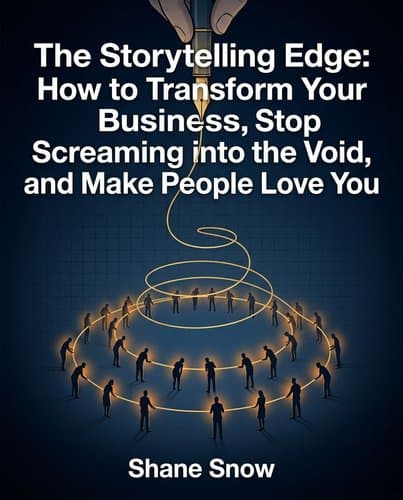
The Storytelling Edge: How to Transform Your Business, Stop Screaming into the Void, and Make People Love You
By Shane Snow
11 min read
Why does it matter? Because your competitor's story is already compounding — whether you're telling yours or not.
The assumption is comfortable: some people are just born storytellers. They have the gift. You either have it or you don't.
Here's what's inconvenient — when scientists strapped monitors onto people watching movies, a narrative triggered a chemical cascade that made strangers feel like tribe. Not metaphorically. Literally. That's not talent. That's pharmacology. And once you see storytelling as a mechanism rather than a mystery, the question stops being "am I creative enough?" and starts being "do I know how to use this thing deliberately?"
This book is about the four specific elements that make stories work on a human brain, a flywheel for building audiences that's been quietly running since the 16th century, and why the gap between brands who treat storytelling as infrastructure and those who treat it as decoration is already enormous — and accelerating.
Your Brain Treats a Good Story the Same Way It Treats a Trusted Friend
Shane Snow is sitting in a conference audience, bored enough to abandon his inbox. The speaker's slides are dense with text — the kind of presentation where slides replace thinking. Somewhere between email refresh number twelve and surrender, Shane ends up on Ryan Gosling's Wikipedia page and, for no particular reason, starts reading.
What he finds: a kid who moved constantly because his father was a traveling salesman. Parents who split. A childhood defined by bullying and an inability to read well into his teens. ADHD. And one afternoon, a decision to bring knives to school and throw them at his tormentors — because that's what Rambo would do. At twelve, Gosling begged his mother to let him audition for The Mickey Mouse Club. He got the part. And because she couldn't relocate to Orlando with him, he ended up living with Justin Timberlake's mother as his legal guardian. He learned to read. He learned to perform. He grew up.
Ten minutes later, Shane wanted to watch Gosling's movies. He watched The Notebook. He started telling anyone who'd listen how human Ryan Gosling was. People began introducing him at events as a "HUGE Ryan Gosling fan." He had formed a real relationship with someone he had never met, built entirely out of words on a screen during a dull Tuesday conference.
That sounds like sentiment. It's actually chemistry.
Around the same time, scientists packed volunteers into a movie theater, strapped monitors to their wrists and heads to track heart rate, breathing, and perspiration, then screened a James Bond film. When Bond dangled from a cliff, pulses spiked. People sweated. And their brains released oxytocin, a neurochemical that evolved to flag trusted tribe members. In early human history, oxytocin was how you figured out whether the stranger approaching your campfire was friendly or dangerous. The audience wasn't consciously deciding to care about a fictional spy. Their brains had already made that call at the chemical level.
This is what story does that a bar chart cannot: neuroscience research shows narratives can activate roughly five times the neural regions as a comparable fact delivered plainly, which means what you hear in a story sticks where plain information slides off. The mechanism isn't a metaphor. It's measurable.
Which means the belief that storytelling belongs to naturally charismatic people is a category error. A story doesn't work because of the teller's charm. It works because any brain (yours, your audience's) runs ancient software that responds to a well-built narrative the same way it responds to a trusted friend.
Every Story That Has Ever Gripped You Was Built From the Same Four Parts
Every story that has ever gripped you was built from the same four parts. They have names — Relatability, Novelty, Tension, Fluency — and once you see them operating, you can diagnose any story you've ever loved or hated.
George Lucas built Star Wars out of borrowed pieces. Darth Vader's mask was modeled on a kung fu helmet; the stormtroopers were inspired by a kung fu army; the speeders looked like American muscle cars; the spaceships resembled something NASA might actually build. The central arc — the humble farm kid thrust into an epic quest — came straight from mythologist Joseph Campbell's Hero's Journey. Star Wars felt startlingly new while being assembled almost entirely from familiar things. That's Relatability, the first element. Our brains resist what's too foreign. Wrap the strange in the familiar, and audiences lean in.
Novelty is the counterweight. We evolved to track what's new because new things could be threats, so the best stories use relatability to earn trust, then novelty to spend it. In Star Wars, that moment is the Mos Eisley Cantina: Lucas drops his farmboy into a bar full of creatures no human mythology had produced, playing instruments that don't exist, none of them remotely interested in Luke. Familiar kid, completely alien room. Your brain lights up. This is why the prequels collapsed while The Force Awakens earned a billion dollars despite critics calling it derivative. The prequels front-loaded unfamiliar characters and political intrigue before audiences had reason to care. The Force Awakens returned to familiar rhythms first, then earned the right to go somewhere new.
Tension is the engine. Aristotle put it this way: a great story establishes what is, then establishes what could be. The gap between those two things is your story, and the storyteller's job is to close one gap and open another, over and over. One of the book's authors needed to use the bathroom during the opening minutes of Mission: Impossible III — and held it through the entire scene where the villain presses a gun to the hero's wife's head and counts to ten. Pure structure doing exactly what structure is supposed to do.
Then there's Fluency — the most counterintuitive of the four. Running their own writing through a reading-level calculator, the authors found they both wrote at an eighth-grade level. Embarrassing — until they ran the same test on the writers they admired most. Ernest Hemingway: fourth grade. Cormac McCarthy, J.K. Rowling: similarly low. The most popular writers on any given topic write simpler than their peers.
Star Wars' fluency was the work of its editors — Marcia Lucas, Richard Chew, and Paul Hirsch — who cut the film fast at a time when sci-fi moved slowly and lingered on dramatic pauses. All three shared an Academy Award. The prequels moved fast too, but they weren't fluent. A first-time viewer watching all the films kept stopping to ask "who's this?" and "what's going on?" during the prequels. The originals absorbed her without a single interruption. Fluency means the audience stops tracking the machinery and lives inside the story.
These four elements work together. Relatability earns trust. Novelty earns interest. Tension earns investment. Fluency keeps all three invisible. And invisibility is the point — when a story is working, you don't notice what it's doing. You just can't stop.
Stories Aren't Marketing for Your Product — They're What People Are Actually Buying
GE product designer Doug Dietz had just spent tens of millions of dollars redesigning one of the company's most important medical machines, and he was standing in a hospital hallway watching a small child beg her mother not to make her go back inside it.
The machine was genuinely excellent: sleek, energy-efficient, technically superior to anything on the market. That wasn't the problem. What it lacked was a story that let a frightened six-year-old experience it as anything other than a threat. Strangers strapped you down and slid you into a dark tunnel for half an hour, alone, with instructions not to move or they'd start over. Technical merit didn't touch any of that.
His fix cost nearly nothing. Paint the machine like a pirate ship. Train the staff to stay in character. Send parents a storybook the night before, so children arrived at the hospital already living inside an adventure — the scan was the part where they had to hold very still on the lifeboat so the pirates wouldn't catch them. Kids who had begged not to return started asking if they could go again.
The machine didn't change. The story did. And that was the whole product.
Most organizations treat storytelling as something layered on top of a product's real value. The MRI case flips that assumption: story isn't the layer — it's the only way people experience the product at all. A razor blade bought wholesale from a factory in China and one engineered by Gillette are, metallurgically, close to the same thing. What separates them is entirely a narrative. Michael Dubin understood this when he launched Dollar Shave Club in 2012 with a ninety-second comedy sketch of himself walking a warehouse floor, deadpan to camera, asking "Are our blades any good?" and answering himself: "No. Our blades are fucking great." His razors were the cheaper product. His story wasn't. The video drove twelve thousand orders in forty-eight hours. Four years later, Unilever paid a billion dollars for the company, five times its annual revenue, and an early investor described the logic plainly: two things drive acquisition multiples, financial metrics and story.
Groupon grasped the same thing and took it somewhere weirder. They hired Second City comedy writers to invent fictional backstories for their deals, elaborate narratives behind coupons for dry cleaning and Thai food. Open rates climbed. The stories spread among people who never bought anything. Story value had detached from product value and was circulating on its own.
The gap between brands that understand this and brands that don't is compounding. Somewhere right now, a technically superior product is losing market share to an inferior one because the inferior brand has a story and the superior one doesn't. The ones producing content with intention are building relationships that survive algorithm changes and price wars. The rest are pushing product into a void.
The Loop That Built Every Great Publisher — and Why Stopping It Is Fatal
Upworthy's editors didn't make content in the traditional sense. Their method: find a video that deserved attention but hadn't gotten any, repackage it with a sharper headline and a better image, share it with a small cluster of Facebook users, and watch what happened. Did people finish watching? Forward it? Come back? Test twenty different headlines. Find the one that resonated. Blast that version to the email list. Find the next video. Repeat.
By 2013, Upworthy was growing five times faster than any media company before it — not because they were better writers or had a bigger budget, but because they had a tighter loop.
The authors call this the flywheel: Create → Connect → Optimize. The loop has been running for five hundred years. The same loop built the first mass media business in 16th-century Italy, when a group of writers — the original gossip columnists — gathered daily rumors from churches and barracks, printed them on the brand-new Gutenberg press, and distributed them around Milan. First optimization: hand-copying was faster than printing, so they ditched the press. Second: putting your name on the newsletter meant powerful people could have you killed, so they started writing anonymously and posting at night. Every constraint fed back into the next iteration. The loop is what remained.
Four hundred years later, the mechanism is identical. What changes is how fast you can run it.
Upworthy ran it at machine speed — until Facebook changed its algorithm to penalize their style of headline. Instead of running another cycle — adjusting what they created, finding a new channel, testing a different approach — they didn't adapt. Traffic didn't slow. It collapsed. The flywheel doesn't coast.
Every success story gets misread the same way. People attribute an audience to a great hire, a viral hit, or perfect timing. Sometimes those factors are real. But the engine beneath them is always the same loop running on a schedule. What makes Upworthy's fall instructive is that the content didn't get worse. The loop just stopped. Millions of readers who were there one month weren't there the next — not because they found something better, but because the algorithm that had delivered Upworthy to them had stopped doing so, and Upworthy hadn't found another way in.
The flywheel isn't a campaign with a launch date and a finish line. Every piece, every channel, every signal — did they finish, did they share, did they come back — feeds the next cycle. The moment you stop running it, you're not holding steady. You're already slowing down.
Your competitors, whether they know it or not, are running the loop right now.
One Story Changes a Mind. A Thousand Stories Build an Empire.
In 2007, Kathleen Matthews walked into Bill Marriott's office with a pitch. She'd spent twenty-five years as a television news anchor, and she knew what a good narrator could do for an audience. She wanted Marriott to start a blog.
Marriott was seventy-six. He'd never used a computer. His response: "Why the heck would anyone want to read a blog from me?"
He did it anyway — with one condition. He would dictate a single post each week. Someone else would type it. One post, once a week, from a man who'd never touched a keyboard.
Seven years later, Marriott International had content studios operating on five continents. Its short film Two Bellmen, staged inside a Marriott hotel, won an Emmy. The company struck licensing deals with Netflix and Hulu. Their real-time content center (nine screens behind glass, eight departments represented by swivel chairs) looked like something transplanted from a Hollywood production company into a hotel lobby in Bethesda, Maryland.
None of it was planned in 2007. It accumulated.
What every "we need to tell better stories" conversation misses: repetition is what turns intention into operation. Marriott didn't change his company's relationship with customers in one post. He did it in hundreds.
David Beebe, who eventually ran Marriott's content studios, brought the same rigor to the work itself. When he received the first cut of Two Bellmen, his first note was to strip out the brand signals — the logo close-ups, the scripted welcome lines. Audiences form relationships with stories, not logos. The habit only compounds if what you're repeating is actually worth repeating.
You don't need a content studio to start. You need a schedule and a willingness to show up again next week. The people and companies ahead of you aren't there because they once had a brilliant idea. They're there because they started earlier, kept going, and didn't stop.
The Unresolved Tension Worth Keeping
Franklin put it this way in Poor Richard's Almanack in 1738: either write something worth reading or do something worth writing about. Upworthy ran dozens of headline tests per story. Marriott's creative director stripped every branded moment from films that eventually won Emmy Awards. Those look like opposite philosophies — relentless optimization on one side, stubborn restraint on the other — but they share one commitment: the audience comes before the brand. That's what the systems amplify. Not cleverness. Not craft. What's already true about what you're making.
The cost isn't competitive; it's the years spent making things people would have loved, if they'd only found them.
Notable Quotes
“This is Shane—he founded Contently, and he's a HUGE Ryan Gosling fan.”
“Great writing speeds you along.”
“Where is the rabbit's foot?!”
Frequently Asked Questions
- What does The Storytelling Edge teach about storytelling as a business skill?
- The Storytelling Edge explains that storytelling is a measurable, learnable skill rooted in human biology—not a creative instinct. Shane Snow provides marketers and business leaders with a practical framework for crafting content that earns attention using principles like novelty, tension, and fluency. The book demonstrates how understanding these biological triggers transforms brand communication into stories people actually want to consume. This makes storytelling applicable to any business regardless of industry, budget, or existing creative expertise, emphasizing that storytelling ability compounds through practice rather than innate talent alone.
- What is the four-element check Shane Snow recommends for storytelling?
- The four-element check requires running content through four gates: Is it relatable, connecting to an existing identity or shared experience? Does it introduce something genuinely novel? Does it create and sustain tension—a gap between what is and what could be? And is it fluent, letting readers focus on meaning rather than struggling with mechanics? Before publishing anything, apply this framework to test whether your content functions as genuine storytelling. This four-part system distinguishes stories that earn attention from mere information or advertising that audiences ignore.
- What is the Create Connect Optimize loop in storytelling?
- The Create → Connect → Optimize loop must operate as a permanent business rhythm, not a one-time campaign. Create content, Connect it to audience interests, then Optimize based on results—and repeat endlessly. Upworthy's collapse illustrates why stopping the loop proves fatal: the platform produced strong content but failed when it abandoned the cycle after Facebook's algorithm changed. Without continuous repetition, storytelling loses momentum. The book stresses that compounding effects come from repetition, not production budgets, making consistent practice the true driver of storytelling success in any organization.
- Why should you remove branding from storytelling content?
- Stories shape product perception independently of product quality. Marriott's Emmy Award-winning filmmaker David Beebe applied a simple rule to every film: "remove the logo close-ups and the welcome script." As Snow explains, "The story has to work without the sales pitch — or it isn't a story, it's an ad." When content functions primarily as advertising, audiences naturally resist it. By letting the story stand alone without brand messaging, companies build content that audiences actively engage with. This principle transforms branded communication from ad-like content into genuine storytelling.
Related Book Summaries
Read the full summary of 36703138_the-storytelling-edge on InShort