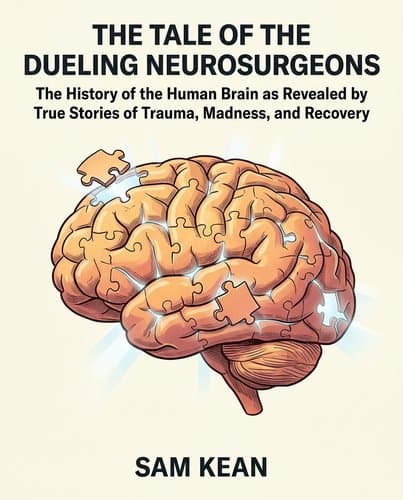
18774002_the-tale-of-the-dueling-neurosurgeons
by Sam Kean
Every quirk, delusion, and catastrophic breakdown of the human brain has secretly been a scientific discovery — and Sam Kean traces how jousting injuries…
In Brief
Every quirk, delusion, and catastrophic breakdown of the human brain has secretly been a scientific discovery — and Sam Kean traces how jousting injuries, cannibal epidemics, and accidental tamping irons taught us that memory, identity, and free will are just biology waiting to malfunction.
Key Ideas
Brain modules operate and fail independently
The brain is not a unified organ — it is a coalition of specialized modules that can fail in complete isolation. A single lesion can erase face recognition, fear, or the ability to name animals, while leaving everything else intact.
Repeated experience permanently reshapes brain circuitry
Neurons that fire together wire together: repeated experience physically reshapes neural connections, and the brain can redirect entire sensory systems — a blind person can learn to 'see' through their tongue. Plasticity is real, not metaphor.
Memory reconstructs rather than merely retrieves
Memory is not storage — it is reconstruction. Every time you recall a memory, the brain partially rewrites it. Declarative memory (knowing that) and procedural memory (knowing how) live in different brain systems and can be independently destroyed.
Emotion is prerequisite for rational decisions
Emotion is not the enemy of reason — it is its prerequisite. Without the limbic system's 'somatic markers,' the brain cannot prioritize among options, and high-IQ individuals with severed emotional circuits make catastrophically bad real-world decisions.
Consciousness narrates decisions made unconsciously first
The conscious 'self' is partly a post-hoc narrator. The left hemisphere routinely confabulates explanations for decisions made by the right hemisphere milliseconds earlier. Awareness and agency are not the same thing.
Neuroplasticity enables brain resilience beyond damage
The brain is more resilient than it looks. Mirror boxes, tongue-based vision, neuroplastic remapping after amputation — the system fights to maintain its functions even when the hardware fails. Damage is not destiny.
Who Should Read This
Science-curious readers interested in Neuroscience and Biology who want to go beyond the headlines.
The Tale of the Dueling Neurosurgeons: The History of the Human Brain as Revealed by True Stories of Trauma, Madness, and Recovery
By Sam Kean
15 min read
Why does it matter? Because the self you think you own is a biological process one blood clot away from being erased.
You probably assume your mind is a unified thing — a self that thinks, feels, remembers, and knows who it loves. That assumption is wrong. Every quality you consider essential to being you — your ability to recognize your mother's face, to feel fear, to remember yesterday, to plan tomorrow — occupies a specific physical address inside roughly three pounds of soft tissue. And we know this not from healthy brains, but from broken ones. A jousting accident in 1559. A tamping iron through a railroad worker's skull in 1848. A cannibalistic funeral in Papua New Guinea. A surgeon with a hardware-store drill and a patient who never consented to what came next. Again and again, catastrophe cracked open the skull and revealed what was inside — not a soul, not a ghost, but a collection of fragile, specialized circuits that can fail one at a time, taking exactly one piece of being human with them when they go.
We Only Understand the Brain When It Breaks
In the summer of 1559, a French king rode into a jousting lane for one last pass against a Scottish captain named Gabriel Montgomery. When their lances met, Montgomery's shaft exploded into splinters — and one jagged end raked across Henri II's unlatched visor, driving into his right eye. The visible wound was bad enough. But the real damage happened invisibly, as the rotational force sent Henri's brain sliding inside his skull, slamming soft tissue into hard bone and tearing open millions of neurons. No fracture. No external evidence of catastrophe. Every court physician said the king would live. He was dead in eleven days.
The only two doctors who predicted otherwise were Ambroise Paré, a battlefield surgeon who had spent decades watching men die from blows that left no marks, and Andreas Vesalius, the anatomist who had dissected more human brains than anyone alive. Both reasoned the same way: ignore the skull, focus on the brain. Henri's symptoms — seizures that struck only one side of his body, vision that flickered and failed, a headache that kept widening as the days passed — were a map. The brain controls each half of the body separately. The back handles sight. Spreading pressure means swelling, and swelling kills. Neither man needed Nostradamus to tell him where this was going.
The autopsy confirmed it exactly: the front of the brain was fine; at the back, the precise location both men had named, they found a patch of blackened tissue roughly a thumb's width wide.
Neuroscience began over a dead king's open skull. The brain's architecture doesn't announce itself in health — it surfaces when something goes wrong, and the right observer is paying close enough attention to notice what's missing.
The Brain Is Not One Organ — It's a Coalition of Specialists
The brain is not a general-purpose computer that processes everything through the same circuits. It is a coalition of hyper-specialized modules, each handling a narrow cognitive task — and each capable of failing in complete isolation from everything around it.
The clearest proof comes from prosopagnosia, the condition where a stroke or lesion destroys the ability to recognize faces. Sufferers walk past close friends without a flicker of recognition. Some ask guests to wear name tags at their own birthday parties. The brain damage is so targeted that every other visual faculty stays intact — they can still read, still navigate, still identify objects — yet the specific hardware for reading a human face is simply gone.
What makes this truly strange is the counter-case: a man identified in the literature only as C.K. After being struck by a car while jogging, he lost nearly all object recognition. At a buffet, everything looked like differently colored blobs; he stabbed his fork at random and ate whatever he speared. He once tried to shove a strange pink object out of his bed before realizing it was his own foot. Yet faces he could read brilliantly. He identified celebrities with portions of their features blacked out. He recognized caricatures of Elvis and Michael Jackson — exaggerated drawings that sent his face-recognition circuits into overdrive. On formal recognition tests he scored higher than people with undamaged brains.
Knock out one system and the other hums along untouched. The same pattern appears across dozens of other deficits — people who lose the ability to identify animals but not tools, or who can see colors perfectly but can no longer remember that lemons are yellow. Each gap is its own locked room inside the mind.
When one fails, the shape of the gap tells you exactly which circuit it was.
Neurons That Fire Together Wire Together — and That Changes Everything
Think of a dirt path through a field. The first person to walk it makes no mark. But walk the same line a hundred times and the grass dies, the soil compacts, and everyone gravitates toward the same route — not because it was planned, but because repeated use carved it into the landscape. Your brain works exactly this way.
When two neurons fire in close sequence over and over, the connection between them physically changes. The sending neuron packs more chemical messengers into its axon tip; the receiving neuron extends more receptor branches back toward it. The gap between them — the synapse — gets easier to cross each time. The rut deepens. This is what neuroscientists mean when they say neurons that fire together wire together: repetition doesn't just practice a skill, it restructures the hardware running it.
James Holman, a 19th-century British naval officer who went blind at twenty-five, turned this principle into a 250,000-mile travel career. He navigated by striking a hickory cane against the pavement every few steps and listening to what bounced back. Hard stone produced a sharp echo; a parked coach sent back something broader and softer; a hedge swallowed the sound entirely. Each click gave him a snapshot of the space around him — echolocation, the same basic mechanism bats use, requiring the brain to read subtle differences in the timing and texture of returning sound waves as spatial information.
What brain scans of modern echolocators reveal is startling: when they process those echoes, the visual cortex lights up. Not the auditory cortex. The brain region wired for seeing. After years of repeated use, sound-navigation circuits had burrowed into the same tissue that sighted people use to picture the world in front of them. The incoming signal was acoustic, but the brain's spatial machinery claimed it anyway, because that machinery processes spatial information regardless of where it originates.
Holman never saw Mount Vesuvius. He navigated its slopes by sound, while his visual cortex did the heavy lifting.
The Ghost in the Missing Limb Reveals the Brain's Body Map
What if phantom limbs aren't a psychological trick the grieving mind plays on itself, but evidence that your brain holds a literal physical map of your body — one that amputation cannot erase?
Silas Weir Mitchell, a Philadelphia neurologist treating Civil War amputees, was the first to take that question seriously. His patients arrived at what soldiers called Stump Hospital missing arms, legs, and combinations of both — casualties of the Minié bullet, a soft lead round that expanded on impact and shattered bone instead of passing through it. The Union alone performed 60,000 amputations. What Mitchell discovered when he actually talked to these men was striking: 95 percent of them felt their missing limbs. Not metaphorically. They felt cramping in vanished calves. They felt fingernails digging into phantom palms. One man reflexively raised a missing arm to catch his hat in the wind.
The strangest cases demolished any grief-response explanation. Mitchell found soldiers who had lost a limb in infancy — too young to form a conscious memory of it — and still felt a ghost there decades later. The brain wasn't mourning something it remembered. It was insisting on something it expected. Mitchell concluded that the brain carries a hardwired scaffold of the full body, a default four-limbed blueprint, and that blueprint simply refuses to update.
Modern neuroscience eventually revealed the mechanism. The motor cortex and somatosensory cortex each maintain a body map — specific patches of neural real estate assigned to each body part. The hand's territory is enormous, because fine-motor control and touch sensitivity require enormous processing power. When a hand disappears, that territory goes dark. Because the brain is plastic, adjacent areas move in fast, sometimes within days. The face region, which borders the hand region on the map, colonizes the vacant space. So when an amputee shaves his cheek, the crossed signals can make a missing thumb feel the razor.
The body map persists. The map gets scrambled. And the gap between what the brain commands and what it feels back becomes its own source of suffering — which is what neurologist V.S. Ramachandran figured out how to fix with a cardboard box and a mirror. When his patient D.S., who had been locked in a decade of phantom cramping, watched his real hand's reflection where his missing arm should have been and began moving it, his phantom fingers unfurled for the first time. His brain, which had been escalating its commands into the void, finally received confirmation that it had been obeyed. The cramps dissolved. The brain's map, fed the right information, stopped screaming.
A Misfolded Protein Can Eat Your Cerebellum — and Spread Like a Rumor
In the eastern highlands of Papua New Guinea, when a woman died of kuru in the mid-twentieth century, her female relatives gathered in a secluded grove, greased themselves against the cold, and dismembered her body with rock knives. They salted the organs, charred the bones to powder, and scooped the brains into bamboo tubes for steaming. They ate everything. The choicest morsels — genitals, buttocks, brain — went to the closest relatives.
That was the vector. The women and children who consumed the brains were the ones who died.
Kuru destroyed the cerebellum, a walnut-sized structure at the base of the skull that runs the brain's movement feedback loop. Every time your body makes a gesture — reaching for a glass, taking a step — the cerebellum checks what you're actually doing against what you intended and issues corrections. Wreck that circuit and your movements become a cascade of overcorrections: a lurching, flailing gait, eyes that twitch without stopping, and eventually a kind of helpless laughter — not from amusement, but from a misfiring brain that can no longer regulate the muscles of the face. Victims died within months of the first stumble.
For decades no one could explain the cause. Kuru brains showed no bacteria, no viral inflammation — none of the signatures biology associated with infection. Stanley Prusiner eventually proposed the answer that most colleagues dismissed as fiction: a rogue protein. Not an organism at all. A single misfolded chain of amino acids that, when it drifted near a healthy version of itself, grabbed it and torqued it into the same wrong shape. That corrupted copy did the same to the next protein it encountered, and the cascade grew exponentially until neurons died and the brain turned spongy. Prions survived autoclaves (pressure-cookers hot enough to sterilize surgical steel), radiation, and UV light, because nothing alive was there to kill. The infectious agent was the body's own chemistry, bent wrong.
That's where the next piece of the puzzle begins — not in a jungle, but in the wiring of ordinary emotion.
Without Emotion, Reason Becomes Useless
Emotions feel like the part of the mind that gets in the way — the static that clouds good judgment. The actual evidence runs the other direction: strip out emotion entirely, and rational thinking doesn't become crisper. It collapses.
Elliot was an Iowa accountant, a devoted husband, a reliable man by every measure until a baseball-sized tumor began compressing his prefrontal lobes. Surgeons removed it, along with large sections of damaged tissue. His IQ stayed in the 120s. His memory, language, and mathematical ability came back intact. What didn't come back was his ability to function.
Choosing a restaurant became an hours-long ordeal of comparing prices, parking, ambiance, and wait times — ending in no decision at all. He burned whole mornings reshuffling documents, cycling through organizational schemes without ever settling on one. He invested his savings in a fraudulent scheme and shrugged when it evaporated. He cheated on his wife of seventeen years and married a prostitute. When researchers later presented him with hypothetical scenarios along those lines, he could reason through the consequences perfectly well. In the abstract, he knew such choices were bad ideas. In his actual life, they made no impression on him.
Damasio identified what was missing. The tumor had severed the connections between Elliot's rational prefrontal cortex and his limbic system — the brain's ancient circuitry for fear, reward, and disgust. Normally those two regions are in constant dialogue. Emotions tag past experiences as rewarding or dangerous, and those tags bubble back up as gut feelings when we face similar choices again. They're not interrupting reason; they're supplying the raw material reason needs to operate. Without them, Elliot's frontal lobes received no signal about which option mattered. Every choice sat at exactly the same emotional weight — zero — so logic alone had nothing to sort.
Reason without emotion isn't freedom. It's a decision-engine with no inputs, spinning forever and going nowhere.
Your Brain Will Rewrite Your Memories Every Time You Recall Them
On the morning of September 1, 1953, a Hartford surgeon named William Scoville pressed a one-dollar hardware-store drill against a young epileptic's skull and began turning the crank. He removed a bottle cap's worth of bone above each eye, let the brain settle, and then threaded a metal tube deep into the temporal lobes. What he vacuumed out — three inches of hippocampus on each side — stopped the seizures cold. His patient's IQ climbed from 104 to 117. By every visible measure, the operation was a success. The only problem was that the man, known to history as H.M., would now eat three breakfasts if nobody stopped him, because he had no memory of the first two.
H.M. could hold a thought for about twenty seconds. After that, it dissolved. He repeated the same sentences to the same people minutes apart. He re-introduced himself to researchers he had met dozens of times. Decades passed and he remained anchored to 1953, genuinely puzzled that the world had moved on without him. What Scoville had removed wasn't just some tissue — he had eliminated the structure the brain uses to transfer experience into durable memory.
But here is where the story turns strange. A researcher named Brenda Milner sat H.M. down and asked him to trace a star shape while watching his hand only in a mirror — left and right flipped, every instinct wrong. He was terrible at it the first time. The second session he was better. By the third day he was tracing it smoothly, and he even remarked that it seemed easier than he'd expected. He had no memory of ever doing it before. None. Yet his hands knew.
Memory isn't one system — it's at least two. There's declarative memory, the kind you can narrate: names, facts, what you had for dinner. And there's procedural memory, the body's knowledge of how to do things, which lives in different neural hardware entirely. H.M.'s hippocampus was gone, so declarative memory was impossible. But the circuits governing motor learning were intact, and they kept accumulating skill in the dark, unbeknownst to him.
The deeper implication comes from reconsolidation. When you retrieve a memory, the brain doesn't play back a recording — it reconstructs the event, using the same molecular machinery that wrote the memory down in the first place. Block those proteins at the moment of recall and the memory evaporates. Which means every time you revisit a memory, you are partly rewriting it. What you remember most vividly is, in part, a story you've been drafting for years.
The Left Brain Will Invent a Story to Explain What the Right Brain Just Did
What's actually making your decisions right now — the part of you that narrates your life, or something running deeper that the narrator has never met?
Roger Sperry's split-brain patients gave neuroscience its most unsettling answer to that question. When surgeons severed the corpus callosum — the 200-million-fiber cable connecting the two hemispheres — patients initially seemed fine. Same personality, same speech, same memories. Then a graduate student named Michael Gazzaniga built a mechanical shutter that could flash an image onto one side of a screen for a tenth of a second, sending it into only one hemisphere.
When an image appeared to the right side of the screen, it entered the left hemisphere, which handles language. Patients saw it, named it, described it. When the same image appeared to the left side, entering the mute right hemisphere, patients flatly denied seeing anything at all — while their left hand pressed the response key under the table. The hand knew. The self didn't.
The machinery behind the narrator became clearest in a single experiment. Gazzaniga flashed a snow scene to one patient's right hemisphere and a chicken claw to the left. The patient's right hand selected a rubber chicken from a lineup of objects — that made sense, the left brain had seen the claw. His left hand chose a snow shovel — that also made sense, the right brain had seen the snowscape. Then Gazzaniga asked why he'd picked those things. The patient's left brain, which controls speech and had never seen the winter scene, couldn't say 'I don't know.' Instead it generated an explanation on the spot: the chicken goes with the claw, and you need a shovel to clean out the chicken shed. He was completely convinced. The right brain had acted; the left brain had authored a confident account of something it hadn't witnessed.
Neuroscientists call this the interpreter — the left brain narrating the whole mind's activity as though it were the author of all of it, filling in whatever it missed with a story that feels, from the inside, exactly like a memory. In split-brain patients the confabulation becomes visible because the two hemispheres are no longer sharing data. In the rest of us, the same process runs continuously and invisibly. The unified self you experience is real — but it is also partly a story your left hemisphere tells, after the fact, about decisions that were already made.
The Self Survives Even When the Brain That Made It Is Gone
On September 13, 1848, a railroad foreman named Phineas Gage turned his head at precisely the wrong moment, and a thirteen-pound iron rod — three and a half feet long, tapered to a point — shot through his left cheekbone, behind his eye, through his frontal lobe, and out the top of his skull. The rod whistled upward in a parabola and planted itself in the dirt twenty-five yards away, greasy with brain tissue. Gage was knocked flat. Within minutes he was talking. He climbed into an oxcart, rode a mile sitting upright, dismounted with minimal help, and when the doctor arrived, greeted him with the observation that there was plenty of work here for him. He never lost consciousness — not for a blink — because the iron had threaded a narrow tunnel through his brain without touching the reticular formation, the brainstem structure that acts as the mind's on-off switch.
Gage's personality did change. He became impulsive, foul-mouthed, and restless where he had been steady and deliberate. But the myth that he dissolved into a ruined drifter doesn't survive scrutiny. For seven years after the accident he drove a six-horse stagecoach along mountain trails in Chile — a job that required memorizing treacherous routes, controlling each horse independently, and collecting fares. His brain, damaged but plastic, had found new pathways for some of what it lost.
Then there is Clive Wearing. A musician and conductor, Wearing contracted herpes encephalitis in 1985 and woke up with almost no short-term memory — a window of awareness roughly seven seconds wide. Every few minutes he experienced what felt like the first moment of consciousness he had ever had. He kept a diary to prove it. Page after page reads the same way: 'NOW I AM AWAKE,' followed by a time stamp, followed by the same line crossed out by the next entry. He was trapped in a perpetual awakening, each one erasing the last. Yet every time his wife walked into the room — whether she had been gone five minutes or five hours — his face broke open with joy. The man who couldn't remember breakfast recognized her completely. Whatever she meant to him wasn't stored where the virus could reach it.
What Gage and Wearing together show is that the self isn't housed in any one place. It is a pattern distributed across memory, emotional attachment, procedural skill, and physical continuity, and it persists even when most of those threads are cut.
The brain is more fragile than we want to believe — a tamping iron, a virus, a tumor can rewrite who you are. But the architecture of the self is redundant in ways that trauma rarely reaches all at once. Whatever changes, something remains. That turns out to be the strangest and most durable finding in the whole history of neuroscience.
The Wreckage Is the Map
Here is the strange bargain at the center of this book: every clean fact we have about how your healthy brain works was paid for by someone's disaster. A jousting accident mapped the visual cortex. A railroad spike charted the moral architecture of the frontal lobe. A funeral feast in the highlands taught us what a protein gone wrong can do to a cerebellum. The brain does not volunteer its secrets. It surrenders them only when something breaks, and only if the right person is watching.
But look at what those breaks actually show you. A man with a hole through his skull drives a stagecoach for seven years. A man who forgets everything still loves his wife on sight. H.M.'s hands could thread a maze his mind had no memory of ever seeing. The self keeps insisting on itself through damage that should, by any reasonable accounting, have ended it. The brain is more breakable than you want to believe — and more stubborn than you had any right to hope.
Notable Quotes
“Here’s business enough for you.”
“the parts of the brain that looked good for something, I put back in,”
“The woman I love no longer finds me repulsive,”
Frequently Asked Questions
- What does The Tale of the Dueling Neurosurgeons teach about how the brain works?
- The book uses historical cases of brain trauma to reveal that the brain functions as a coalition of specialized modules rather than a unified organ. When examining what breaks in neurological cases—memory, identity, emotion, perception—readers discover the brain's modular architecture, its capacity for neuroplasticity, and insights into consciousness itself. Kean demonstrates that isolated lesions can erase specific functions like face recognition or fear while leaving other abilities intact, proving the brain isn't monolithic but a collection of independent yet interconnected specialized regions.
- What does The Tale of the Dueling Neurosurgeons reveal about neuroplasticity and memory?
- Kean reveals two critical insights: "Neurons that fire together wire together: repeated experience physically reshapes neural connections," and the brain can redirect entire sensory systems—blind individuals can learn to "see" through their tongue. Additionally, the book explains that "memory is not storage — it is reconstruction." Every recall partially rewrites memories, and the brain stores declarative memory (knowing that) and procedural memory (knowing how) separately, meaning each can be independently destroyed. This demonstrates both remarkable adaptability and memory's fundamental fragility.
- How does The Tale of the Dueling Neurosurgeons challenge common misconceptions about emotion and reason?
- The book challenges the assumption that emotion undermines rational decision-making. Instead, Kean argues that "emotion is not the enemy of reason — it is its prerequisite." Without the limbic system's 'somatic markers' to guide prioritization, the brain cannot effectively choose among options. The book presents cases of high-IQ individuals with severed emotional circuits who make catastrophically poor real-world decisions despite intellectual capability. This reveals that emotional processing is essential for functional reasoning, not an obstacle to it.
- What are the key insights about consciousness and the self in The Tale of the Dueling Neurosurgeons?
- The book presents consciousness as more fragmented than intuition suggests. Kean reveals that "the conscious 'self' is partly a post-hoc narrator" and "the left hemisphere routinely confabulates explanations for decisions made by the right hemisphere milliseconds earlier." This suggests that "awareness and agency are not the same thing"—we experience choices as conscious decisions even when our brain has already decided. Despite this unsettling view, Kean emphasizes resilience: the brain fights to maintain function, suggesting "damage is not destiny."
Related Book Summaries
Read the full summary of 18774002_the-tale-of-the-dueling-neurosurgeons on InShort