49234_the-third-chimpanzee
by Jared Diamond
Humans are 98.4% chimpanzee, and the tiny genetic gap that produced language, art, and civilization also produced genocide and ecological self-destruction —…
In Brief
The Third Chimpanzee: The Evolution and Future of the Human Animal (1991) examines what the 1.6% genetic difference between humans and chimps actually contains — and why the same traits that made us unique, from language to tribalism, also drive self-destruction.
Key Ideas
Small genetics create profound human difference
The genetic gap between humans and chimps is just 1.6% — smaller than the gap between two virtually identical-looking vireo songbird species. Our sense of human uniqueness is a story we tell ourselves, not a biological fact. But that 1.6% contains everything: language, art, and genocide.
Language decoupled culture from genetic evolution
Brain size alone didn't make us human. Neanderthals had 10% more of it and changed nothing for 100,000 years. Language was the trigger — and once it arrived, cultural evolution decoupled from genetics entirely, meaning human behavior can change in a single generation without waiting for a mutation.
Population efficiency trumped individual health
Agriculture is measurably worse for individual health than hunter-gathering: Greek and Turkish populations lost four inches of average height after the transition and haven't recovered thousands of years later. Farming won not because it was better for people but because it produced more bodies per acre.
Evolutionary roots of status and drugs
Status displays and drug use are expressions of an ancient evolutionary signaling program (Zahavi's Handicap Principle), not failures of willpower. Cigarette and whiskey ads work by targeting a buried instinct that once guaranteed honest fitness signals — recognizing that is the first step toward overriding it.
Language enables both art and genocide
Genocide and intergroup violence have direct primate precedents — chimps conduct coordinated territorial raids. The 'us vs. them' circuit predates humanity, and the same language capacity that enabled art and science also enables the dehumanizing propaganda that makes mass killing feel justified.
We repeat collapses despite knowing better
Pre-industrial peoples caused mass extinctions and ecological collapse wherever they spread — Easter Island, the American megafauna, the Anasazi woodlands. What's different now is that we have the scientific record of those failures and are repeating them anyway, which removes the one excuse our predecessors could honestly claim.
Who Should Read This
Science-curious readers interested in Evolution and Biology who want to go beyond the headlines.
The Third Chimpanzee: The Evolution and Future of the Human Animal
By Jared Diamond
9 min read
Why does it matter? Because the traits that made us human are the same ones that could destroy us.
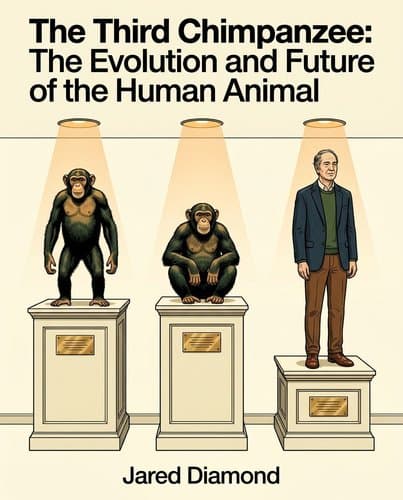
The genetic gap between you and a chimpanzee is smaller than you can probably imagine — small enough that an alien taxonomist would classify us as a third species of chimpanzee rather than a separate branch. That single fact, confirmed and unremarkable to molecular biologists, is almost never actually absorbed — and it's where Jared Diamond starts. What followed from that tiny fraction of DNA is the entire human story: language, art, agriculture, drug abuse, genocide, the systematic destruction of every ecosystem we've ever entered. The same evolutionary package that let us build the Sistine Chapel also drove the woolly mammoth to extinction and rationalized every atrocity we've committed since. Diamond's uncomfortable argument isn't that we're animals who occasionally act human. It's that we're animals whose most dangerous instincts are still running full-speed in a world they were never designed for. Understanding them clearly, without flattering ourselves, is the first step toward not being ruled by them.
You Share More DNA With a Chimp Than a Chihuahua Does With a Great Dane
Imagine walking through a zoo and pausing at the chimpanzee enclosure. Strip away the hair — theirs, not yours — and picture a few hairless humans in a neighboring cage. Two groups, no labels. Now guess how much DNA they share.
Most people guess somewhere around 50 percent. The answer is 98.4 percent.
A Great Dane and a Chihuahua look far more different from each other than a chimp and a human do, and yet dogs are a single species. Chimps and humans are not. The visible gap and the genetic gap point in entirely opposite directions. What you see when you look at a chimp tells you almost nothing about how closely you're related to it.
When DNA comparison studies mapped the primate family tree in the 1980s, the picture sharpened: monkeys differ from apes and humans by 7 percent of their DNA; orangutans by 3.6 percent; gorillas by 2.3 percent; chimpanzees by just 1.6 percent. Two songbirds, the red-eyed vireo and the white-eyed vireo, are nearly impossible to tell apart visually. Both belong to the same genus. They differ by 2.9 percent of their DNA. The genetic distance between you and a chimpanzee is smaller than the gap between two birds that expert birdwatchers regularly mistake for each other. Taxonomically, if you follow the logic of genetic distance, humans belong in the same genus as chimps. We are a third species of chimpanzee.
Everything that feels like evidence of a different order of being, from language and art to the capacity to kill one another by the millions, emerged from changes in roughly 1.6 percent of a chimp's genome. The question Diamond spends the rest of the book pursuing is how something that vast grew from something that small.
Neanderthals Had Bigger Brains Than Us and Changed Nothing for 100,000 Years
Somewhere in what is now France, around 80,000 years ago, a Neanderthal is shaping a stone. The technique is identical to what his kind has used for a hundred thousand years, and what they'll use for the next forty thousand. He has a brain roughly 10 percent larger than yours, hands powerful enough to crush bone your fingers couldn't crack, and a tool his great-great-grandmother would have recognized without a second glance.
That last detail is the puzzle. Brain size clearly wasn't the limiting factor — Neanderthals had more of it than we do. By the standard logic, they should have been building cathedrals. Instead, their tools didn't vary across ten thousand miles or a hundred thousand years. Not a single regional adaptation. Not a single iteration of improvement. Whatever was missing, it wasn't gray matter.
Vervet monkeys already communicate. Each grunt maps to a specific predator: the leopard-bark sends the troop into trees, the python-chatter makes them stand up and scan the ground. What they can't do is chain those signals into grammar. That, Diamond argues, is what Neanderthals were missing. "Leopard" is a reflex. "I spotted a leopard near the watering hole, moving our direction" is information you can act on, share, and remember.
Here's what grammar buys you: "Turn sharp right at the fourth tree and drive the male antelope toward the red boulder, where I'll spear it." That sentence coordinates a hunt across time and intention. Without it, two hunters can only gesture and react. With it, they plan, divide labor, and improve on failure. Language turns individuals into teams and failed attempts into lessons.
Once language arrived, culture stopped waiting for genetics. For millions of years, tools changed only when mutations did. The Cro-Magnons who appeared in Europe 60,000 years ago brought needles, fishhooks, barbed harpoons, cave paintings, and amber traded hundreds of miles from the Baltic. All of it within a geological eyeblink. No new skull shape, no new gene — just the capacity to share an idea across a campfire and have the next person make it better.
Agriculture Made Us Shorter, Sicker, and More Unequal — and Won Anyway
Agriculture is the invention we gave ourselves credit for, the moment our species stepped out of scarcity and into civilization. The bones suggest otherwise.
Dig up the skeletons of hunter-gatherers from Greece and Turkey during the last Ice Age and you find men who averaged five feet ten inches, women five feet six. Then look at the same region after farming took hold. By 4000 BC, men had shrunk to five three, women to five one — seven inches and five inches lost within a few thousand years. No catastrophe swept the region. People just started farming. Heights recovered slowly afterward, but modern Greeks and Turks still don't reach the stature of those pre-farming ancestors.
The collapse had a clear cause. Hunter-gatherers drew protein and micronutrients from dozens of wild species in combinations no wheat field can replicate. Kalahari Bushmen pull food from 85 wild plants; famine is nearly impossible. The Irish farmer in the 1840s had one crop, and when potato blight hit, a million people died. Farming also packed people into permanent settlements, and concentrated, sedentary, malnourished people were ideal conditions for diseases that couldn't gain a foothold in small, mobile bands: tuberculosis, cholera, smallpox, bubonic plague. It didn't just change what people ate. It built the infrastructure epidemic disease needed.
Farming also invented inequality. Hunter-gatherer bands can't accumulate — you can't haul surplus across the landscape, and social pressure demands sharing what you have. Settled farmers could store grain, and stored grain meant ownership, ownership meant class, and class meant some people could field armies while others went hungry in the same village.
And yet farming won. The skeletons make the case: it wasn't by improving lives. It was by producing more bodies per acre. Hunter-gatherer women spaced births around four years apart; they had to carry a child until it could keep up with a moving camp. Farming women in permanent settlements could have a child every two years. More people, faster. The arithmetic was merciless: ten malnourished farmers can still overpower one healthy hunter. Farming didn't defeat hunter-gatherers by making anyone healthier or happier. It won by outbreeding them, and in evolution, more bodies is all that ever needed to matter.
The Bowerbird, the Gazelle, and Why You Lit Your First Cigarette
One morning in New Guinea, Jared Diamond walked out of a village of circular huts and flower gardens and into something he assumed had been made by a child. A woven circular structure, eight feet across, fronted by a lawn of green moss covered with hundreds of objects sorted by color — red fruits beside red leaves, black fungi stacked tall by the door, every blue item tucked inside. The builder: a bird the size of a jay.
The bowerbird builds this to attract a mate. A female inspects several bowers before choosing, comparing weaving quality, decoration count, and adherence to locally learned aesthetic rules that differ by population (some preferring blue objects, others red or grey). What the bower actually measures is real: the structure weighs hundreds of times the bird's body weight; the best decorations get dragged dozens of yards through jungle; and rival males spend their days dismantling each other's work, so only the dominant ones end up with anything intact. Strength, construction skill, spatial memory, social dominance — all compressed into one structure, and difficult enough that inferior males simply cannot fake it.
A biologist named Zahavi figured out why. He called it the Handicap Principle: costly signals are honest because they're costly. A gazelle spotted by a lion will sometimes slow down and leap high with stiff-legged jumps, a behavior called stotting, instead of just running. The display looks suicidal. It isn't: a slow gazelle that stotted would be caught, so only the genuinely fast ones can afford the boast.
Now: why did you light your first cigarette?
Surviving that burning first drag signals, to some buried evolutionary program, "I'm robust enough to absorb toxins." Cigarette and whiskey ads have exploited this for decades, associating consumption with toughness and status, speaking to a signal system that cannot fact-check the claim. The difference is that the bowerbird's bower actually predicts his fitness. Chemical addiction doesn't. It severs the link between the signal and the quality being advertised, then locks the behavior in place long after the display has stopped working. What looks like self-destructive behavior is often a status signal whose evolutionary logic made sense long before addiction was possible. The ancient program fires on. The environment it was built for is long gone.
Chimps Wage War Too — Genocide Is Not a Human Invention
Status display gone wrong produces addiction. Territorial instinct gone wrong produces this.
Is genocide a human invention, something that emerged when we acquired ideology, weapons, and the capacity to hate strangers we'll never meet? Most people assume so. The evidence says otherwise.
Between 1974 and 1977, Jane Goodall watched a community of chimpanzees in Tanzania systematically destroy a neighboring band. Raiding parties of several males (sometimes joined by females) moved quietly into adjacent territory, located isolated individuals, and attacked them in coordinated ambushes. Over three years they killed at least several males and one female. The survivors fled or were absorbed. The territory was gone.
The chimps weren't fighting over a specific resource. Their campaign was organized, repeated, and directional — one group eliminating another. Structurally, it's indistinguishable from what four shepherds did in 1828 when they ambushed a group of Tasmanians, killed thirty of them, and threw the bodies off a cliff. The shepherds had language and justifications. The chimps did not. The outcome was the same.
Diamond's conclusion is uncomfortable: of all the traits we think of as distinctly human (art, language, agriculture), the one with the clearest animal precedent is coordinated intergroup killing. The "us versus them" circuit is not a malfunction of civilization. It is primate hardware, older than speech, running in a brain that was already wiring itself into bands and territories long before anyone had a word for enemy.
Which brings you to the part that's hardest to sit with. The same language capacity that produced the cave paintings at Lascaux also produced the propaganda machine. Complex speech lets you plan a collaborative hunt; it also lets you draft a doctrine explaining why the people across the river are subhuman. Nazis called Jews lice. French settlers in Algeria called local Muslims rats. South African Boers called Black Africans baboons. The dehumanization is not incidental — it is a technology, applied deliberately to silence the ancient reluctance to kill your own kind. Tell your soldiers the targets are vermin, and the ancient circuit that reserved its mercy for "us" resolves its conflict cleanly.
The gift and the curse are the same anatomy. Diamond's argument isn't that humans are uniquely monstrous. It's that the upgrade which made us capable of everything worth celebrating always came with the other side of the ledger.
We've Been Destroying Our World Since We Arrived — What's Different Now Is That We Know It
There's a difference between walking into a dark room and hitting a table you couldn't see, and walking into a lit room and hitting the same table. The first is misfortune. The second is something harder to forgive.
The Easter Islanders walked into the dark. When Polynesians first settled there around 400 AD, they found a lush, forested island in the middle of the Pacific. Over the next thousand years they cleared it — tree by tree, for timber, farmland, and the logs needed to haul enormous stone statues to ceremonial platforms. By 1500, the island held roughly 7,000 people and had raised more than 300 statues, the largest weighing 85 tons. It also had, by then, not a single tree left standing.
What followed was ecological logic without mercy. No trees meant no logs, so statue-building stopped mid-carve, some still half-finished in their quarries. No trees meant no canoes, so fishing ended. Erosion stripped the topsoil; gardens failed. A civilization capable of moving 85-ton stones across miles of terrain collapsed into clan warfare and cannibalism, its people sheltering in caves while rival groups toppled each other's statues. What had been a forested island became barren grassland; its population fell to less than a third. The monuments stand over the wasteland their builders created.
Here is what matters about the Easter Islanders — and the Maoris who drove New Zealand's moas (enormous flightless birds) to extinction within a few centuries of arriving, and the Clovis hunters who likely wiped out mammoths, horses, and giant ground sloths within a thousand years of entering the Americas: they had no warning. No one had documented what happens when you clear every tree from an island. No bone record told the Maoris that birds that had evolved without predators would be catastrophically easy to destroy. The destruction was real and total. The ignorance was genuine.
We do not have that excuse. We have the pollen cores from Chaco Canyon showing a woodland turning to desert as the Anasazi, the ancient Pueblo people of the American Southwest, burned through it. We have the stratigraphic record: layer after layer of Clovis spear points mixed with mammoth bones, then, above that, Folsom points (a later people's signature tool) and no mammoths. We have the current bird extinction rate running at 200 times the natural background. We have every case file from every civilization that destroyed its resource base and collapsed. We understand the sequence of symptoms. We are walking into a fully lit room.
We are the first species capable of reading those case files and choosing differently. Whether that capability translates into choice is the one question the evidence cannot answer for us.
Knowing Is Not the Same as Choosing
Here is the uncomfortable gift Diamond leaves you with: for the first time in 3.8 billion years of life on Earth, one species can read its own instruction manual. You can trace the logic of costly signals from a leaping gazelle to a Marlboro ad. You can follow the territorial raid from Tanzania to Auschwitz. You can see the pollen cores from Chaco Canyon in the satellite images of the Amazon. The chain is visible, end to end. That visibility is the only thing that has ever had a chance of breaking it — no prior species got even that much. But the same brain that assembled all this evidence also built the nuclear warhead and the factory trawler. Diamond doesn't tell you what to do with the contradiction. He just holds it open, steady, like a door. Whether you walk through it is, so far, the one thing the evidence can't predict.
Notable Quotes
“As we will see in chapter 6, apes have learned to use sign language, plastic symbols, and computers to communicate. Some have mastered”
“of hundreds of symbols. And wild vervets (or green monkeys) have a natural form of symbolic communication based on grunts, with slightly different grunts to mean”
“Turn sharp right at the fourth tree and drive the male antelope toward the red boulder, where I'll spear it.”
Frequently Asked Questions
- How genetically close are humans to chimpanzees?
- The 1.6% genetic gap between humans and chimps is smaller than the gap between two virtually identical-looking vireo songbird species, yet it contains everything that defines humanity: language, art, and genocide. This tiny difference reveals that human uniqueness isn't a biological chasm but rather a qualitative leap in what becomes possible through cultural evolution. Once language arrived, human behavior could change within a single generation without waiting for genetic mutations, decoupling cultural evolution from biological constraints entirely. This insight reframes human nature: we're not separated from nature by vast genetic distance, but rather defined by our capacity for rapid cultural transmission.
- Why did agriculture spread if it made humans less healthy?
- Agriculture is measurably worse for individual health than hunter-gathering. Greek and Turkish populations lost four inches of average height after transitioning to farming and haven't recovered thousands of years later. Farming won not because it was better for people but because it produced more bodies per acre—it was an evolutionary success in pure numbers, not in human wellbeing. This paradox reveals how systems can dominate not through superiority but through sheer reproductive output. Understanding this pattern helps explain why societies adopt destructive practices: they succeed numerically even when they diminish individual flourishing.
- Does primate behavior explain human violence and genocide?
- Genocide and intergroup violence have direct primate precedents—chimps conduct coordinated territorial raids. The 'us vs. them' circuit predates humanity, wired into our primate brains long before we developed language. But language, the same capacity enabling art and science, also enables the dehumanizing propaganda that makes mass killing feel justified. This dual nature of human cognition means violence isn't a moral failure imposed from outside but an expression of ancient instincts weaponized by our unique communicative abilities. Understanding this connection is crucial because it makes violence simultaneously more explicable and more preventable through conscious recognition of our buried instincts.
- Did early humans cause prehistoric extinctions?
- Pre-industrial peoples caused mass extinctions and ecological collapse wherever they spread—Easter Island, the American megafauna, the Anasazi woodlands. What's different now is that modern societies have scientific records documenting those failures, yet we repeat them anyway, which removes the one excuse our predecessors could honestly claim: ignorance. This pattern suggests ecological destruction isn't unique to industrial civilization but rather an expression of human nature itself when given access to resources. The tragic difference is that we know better and act anyway.
Related Book Summaries
Read the full summary of 49234_the-third-chimpanzee on InShort