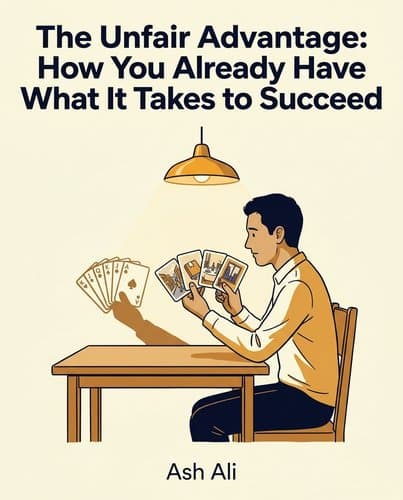
50714359_the-unfair-advantage
by Ash Ali
Forget hustle mythology—the founders who win aren't the hardest workers, they're the ones who honestly mapped their existing advantages and built around them.
In Brief
Forget hustle mythology—the founders who win aren't the hardest workers, they're the ones who honestly mapped their existing advantages and built around them. The MILES framework turns a clear-eyed audit of your money, expertise, network, and status into your most defensible competitive edge.
Key Ideas
Audit Your Assets Before Picking Startups
Run a MILES audit on yourself before choosing a startup: Money, Intelligence & Insight, Location & Luck, Education & Expertise, Status. The right idea is the one built around what you actually have — not the one that sounds most impressive in a pitch.
Founder-Product Fit Trumps Market Fit
Look for founder-product-market fit before product-market fit. If you don't have a clear unfair advantage in the space — lived proximity to the problem, relevant expertise, or a network in the industry — find a co-founder who does, or choose a different idea.
Ride Growing Markets Before Saturation Hits
On timing: target markets that are growing but not yet saturated. Being early forces you to educate the market at your own expense; being late means fighting entrenched winners. Macro trends (technological, societal) are the wave; the idea is just the surfboard.
Proximity to Problem Builds Unfair Advantage
Build your core insight from proximity to the problem. Be your target customer, talk obsessively to them, or (like Will Shu) physically do the work for nine months. Lived-experience insight is the unfair advantage competitors can't easily replicate.
Constraint Breeds Better Product Thinking
If you lack capital, build for early profitability rather than chasing the hyper-growth playbook. Financial constraint often produces better product thinking than excess capital — Shyp raised $62M and shut down; WhatsApp bootstrapped to 250,000 users before raising a cent.
Start Rolling Your Advantage Snowball Now
When unfair advantages compound, small early ones matter more than large late ones. Identify what you already have and start building on it now — the snowball that starts rolling first gets the most distance.
Who Should Read This
Business operators, founders, and managers interested in Startups and Business Strategy who want frameworks they can apply this week.
The Unfair Advantage: How You Already Have What It Takes to Succeed
By Ash Ali & Hasan Kubba
9 min read
Why does it matter? Because the hustle story you've been told is designed to make you blame yourself.
The working assumption most founders carry into their first pitch meeting: whoever grinds hardest wins. Up at 4am, hustle gospel, that forty-slide deck that took three sleepless months to polish. It's a story the startup world repeats constantly, and it's almost entirely wrong. The people actually winning aren't the ones who outworked everyone else — they're the ones who arrived with a specific stack of advantages, partly earned, partly the luck of whose living room they grew up in, and then built companies that fit that stack. Ask a billionaire point-blank whether hard work alone explains their outcome and a few honest ones will tell you straight: obviously not. The hustle myth depends on you never asking. This book asks. Then it hands you a framework — MILES — for taking honest inventory of what you already have, so you can stop chasing a blueprint built for someone else's advantages.
Working Hard Is Not Why Evan Spiegel Won
Evan Spiegel was in his early twenties, sitting across a venture capitalist who refused to budge on standard deal terms. Most first-time founders in that seat would have taken the deal. Spiegel looked at the VC and said: if you want standard terms, invest in a standard company. That firm came back and invested in Snapchat's next round.
That confidence looks like personality. It was actually infrastructure.
By the time Spiegel sat in that meeting, he had been prepared for it in ways most founders never are. He grew up in a multimillion-dollar Los Angeles household, attended an elite private school that also produced the co-founder of Tinder, and had private tutors at $250 an hour. His father was a prominent corporate attorney; his mother a Harvard Law graduate. When it came time for Stanford, his father's status as an alumnus and donor didn't hurt. Through family connections, Spiegel was introduced to Peter Wendell (one of the country's most-connected venture investors), who in turn introduced him to Eric Schmidt (then CEO of Google), the co-founder of YouTube, and Scott Cook, the founder of Intuit. Cook became Spiegel's personal mentor, then put money into Snapchat's first funding round.
None of that is in the deck Spiegel pitched. None of it shows up in the how-I-built-this interview. It's background — which is exactly why it matters. Background is invisible to the people who have it and incomprehensible to the people who don't.
Ali and Kubba's book isn't interested in making you feel bad about Spiegel's head start. It wants you to see it clearly, because the dominant story about startup success insists it isn't there. Work harder. Hustle more. Wake up at 4am. The self-help industry runs on this story because structural advantages don't sell courses. But Spiegel had already given the game away: "It's not about working harder," he said. "It's about working the system."
The point isn't that Spiegel didn't work hard. He clearly did, and Snapchat executed brilliantly on a genuine insight. Hard work operated inside a structure that had already cleared most of the obstacles. That structure compounds. Which means identifying yours, honestly and specifically, is where you start.
Small Advantages Don't Add — They Snowball
Imagine two runners who start from the same line, but one gets a five-second head start. Now imagine the course is a conveyor belt that accelerates as you gain ground: the further ahead you are, the faster it pulls you forward. That five-second gap doesn't stay five seconds. It becomes ten, then thirty, then the trailing runner can't see the other anymore.
That's the actual structure of advantage. Not addition but compounding.
Consider what happens when Canadian parents register their nine-year-old boys for hockey. League eligibility is determined by birth year, so a boy born January 2nd and a boy born December 30th play in the same cohort. But they're not the same. The January kid is nearly twelve months more physically developed — bigger, faster, better coordinated. Coaches read that as talent. He gets selected for the elite squad. More ice time, better instruction, more games. His skills sharpen faster. The December kid gets less attention and eventually drifts away. Look at the birth months of professional hockey players and they cluster heavily in the first quarter of the year, not because those players were inherently more gifted but because they happened to be born when it briefly mattered to be slightly bigger.
The initial edge, a few months of physical development between nine-year-olds, triggered a chain: stronger showing → better coaching → more practice → higher performance → greater opportunity. Each link made the next link easier to reach. Researchers call it cumulative advantage. The gap between players who started almost identically widened exponentially over time.
This is why unfairness runs so much deeper than any snapshot suggests. Small initial differences in advantage don't produce proportionally small differences in outcome. They produce enormous ones.
You Already Have an Unfair Advantage — You Just Haven't Named It Yet
What would it look like to map your own structural advantages with the same clarity?
Ali and Kubba built the MILES framework to answer that. MILES: Money, Intelligence and Insight, Location and Luck, Education and Expertise, and Status. Mindset sits underneath all five. Unlike most self-assessment tools, it counts circumstances alongside strengths: what you were born into, where you landed, and what your life forced you to understand before others did. Take Intelligence and Insight: it covers raw smarts and the specific convictions your biography instilled. That's what made Jan Koum.
Koum moved into social services housing as a child. No money, no status, no elite educational pipeline. He ended up worth around $10 billion when WhatsApp sold to Facebook. The technical foundation came from Education and Expertise; he sharpened his programming skills by joining a Silicon Valley hacker club. The primary edge, though, was Intelligence and Insight: growing up under Soviet-style communism gave him a visceral aversion to surveillance and data collection. In most industries, that conviction is irrelevant. In messaging apps of the early 2010s, it was the product. WhatsApp never monetized user data, and users trusted it for exactly that reason. The background that looked like nothing but disadvantage contained the insight that made the company.
The inventory works in all directions — location, education, status, and the advantages your specific biography handed you that you've never thought to name.
The playing field stays uneven. What changes is your ability to see your corner of it clearly.
The Best Startup Insights Come From Living the Problem, Not Studying It
Tristan Walker spent nine months at Andreessen Horowitz, one of Silicon Valley's most powerful VC firms, trying to find his startup idea. He considered obesity, banking, freight. Nothing clicked. Then one morning, dealing with the razor burn and ingrown hairs that come with coarse, curly hair, he realized: no company in the beauty industry was building specifically for men like him.
That was the insight behind Walker & Co., a shaving brand for men of color that Procter & Gamble acquired for an estimated $20 to $40 million.
Any market researcher at P&G could have found that gap with a few focus groups. Walker's edge was that he'd lived inside the problem every day. He didn't just know the gap existed; he understood what was wrong with every existing solution and what a better one would actually feel like to use.
Walker's path — Queens housing projects, father shot dead when he was three, boarding school, Wall Street, Silicon Valley — looked like disadvantage from the outside. From the inside, it contained the precise information a major consumer goods company didn't have and couldn't buy. That's what makes lived proximity an unfair advantage: it isn't available to whoever allocates the most research budget.
For founders who aren't their own target customer, the alternative is to earn that proximity deliberately. Will Shu had a surface-level insight when he moved from New York to London and noticed the food delivery scene didn't compare, but it was thin. After launching Deliveroo, he spent nine months riding as a delivery driver himself, eight hours a day, seven days a week. He talked to restaurant owners, other couriers, and customers at the door. His former banking colleagues started ordering Deliveroo specifically to see him show up on a bike. He once delivered to a man in Knightsbridge who used to sit near him at the bank and couldn't hide his shock. He assumed Shu must have lost everything. He hadn't. He was building a food delivery company with the kind of understanding no hired researcher could replicate.
If you're not close enough to feel what's broken, getting close isn't optional — it's the actual first job.
Timing Accounted for 42% of the Difference — the Idea Ranked Last
The idea is the last thing that separates successful startups from failed ones. Timing is first.
Bill Gross built one of the first startup incubators in the late 1990s and spent years trying to figure out why some of his portfolio companies succeeded while nearly identical ones failed. He compared his five best performers against five he'd been most optimistic about that folded anyway. His hypothesis: idea uniqueness would explain most of the difference. The data said otherwise. Timing accounted for 42% of the gap between success and failure. Team and execution came second. The idea ranked last.
That number should disturb anyone who has spent serious energy hunting for a truly original concept. Google wasn't the first search engine — Lycos, AltaVista, and Yahoo all preceded it. Facebook launched into a market that already had Myspace, Friendster, and half a dozen others. Spotify had iTunes and Napster before it. What differentiated these winners wasn't novelty; it was arriving at the right moment and executing cleanly.
Timing, unlike idea quality, is something you can actually read. Deliveroo's Will Shu first sketched his restaurant delivery concept in 2004. He couldn't launch until 2013 — not because he lost interest, but because he needed GPS tracking and consumer tablets that didn't yet exist. He waited nine years for the infrastructure to catch up. That patience was strategic intelligence, not delay.
The honest question this forces on any founder isn't "is my idea original?" but "is the world ready for this now?" Are there macro-shifts your product can ride, or are you paddling against them? If timing is wrong, even the cleanest execution produces a company that spent five years educating a market it never got to profit from. If timing is right, you don't need to be first. You just need to be ready.
Every Failed Startup Had a Good Idea — Not All Had the Right Founder for It
Ash Ali left Just Eat, then one of Europe's largest restaurant ordering platforms, after helping build it into a major food delivery company, and for a few months he simply hung around with his four-year-old daughter. He kept running out of ideas for what to do with her. So the solution seemed obvious: a monthly subscription box packed with creative activities for kids, delivered to parents who felt the same blank. He spent six months trying to launch it. Then he stopped.
The insight was real. The gap in the market was real. But Ash had never worked in subscription businesses, never worked in children's products, and had nobody in his network who could help with either. He was starting from zero in every direction that mattered. KiwiCo later built exactly this business and succeeded. Same idea. Different founders. Different outcome.
Founder-product-market fit, in practice, isn't about whether the idea is good. It's whether you are the right person for this idea — whether your specific advantage stack makes you the one who wins in this market rather than just the one who showed up.
Melanie Perkins didn't find her insight by studying the design software industry. She was teaching university students how to use Adobe products and watching them spend an entire semester just locating the buttons. She saw the problem from inside it, repeatedly, across hundreds of students. Investors spent years rejecting her for failing to fit any of the recognized patterns: no Stanford degree, no ex-Google pedigree, based in Australia, no tidy upward-trending graphs. She learned to kitesurf because Bill Tai, the investor she was trying to reach, hosted his networking events on the water. She worked out of a San Francisco shopping mall for three months. She revised her pitchdeck more than a hundred times. None of it would have held together without the original observation: she had seen, in a way Adobe executives hadn't, exactly what was broken about existing design tools. Nobody who hadn't stood in that classroom could have seen it. Canva eventually crossed a billion-dollar valuation.
The two stories mirror each other. Ash had an idea without the stack to execute it; people with the right stack took the same idea further. Perkins had an insight so thoroughly embedded in her own experience that two years of investor rejection couldn't shake her confidence in it.
Before you commit to a startup, the question isn't "is this a good idea?" It's "why am I the right person for this?" If the answer is clear (because you've lived inside the problem, because your background gives you access others don't have, because your expertise is actually relevant), you're in the right place. If the only answer is "because I thought of it first," Perkins spent two years getting doors slammed for less than that. The difference wasn't that she was more persistent — it was that the observation was genuinely hers.
The Audit Nobody Does Before They Build
Ash Ali grew up without money. Hasan Kubba had no degree, no Stanford pedigree, no warm intros to Sequoia. When they wrote this book, they weren't writing from comfortable hindsight. They were writing from the discomfort of running the audit on themselves and finding gaps they couldn't paper over. When Ash ran the inventory after his subscription box collapsed, the status column was nearly empty: no warm introductions, no angels who owed him a favor, no anchor customer who could carry the business past day ninety. That's what the MILES framework doesn't let you escape: it works in both directions. It shows you what you have, and it shows you what you don't. Both matter. The founders who build something real aren't necessarily the ones with the most advantages, but the ones who stopped executing someone else's blueprint and asked the harder question. Not "what's the hottest market right now" but "what problem could only someone with my exact history, my exact proximity, my exact stack — however unimpressive it looks from the outside — actually solve?" Most people never ask it. That's not an accident — the hustle story exists precisely so they won't.
Notable Quotes
“I want to invent a product that I can sell to millions of people that will make them feel good.”
Frequently Asked Questions
- What is the MILES model in The Unfair Advantage?
- The MILES model is a framework for identifying your existing competitive advantages before starting a business. It breaks down advantages into five categories: Money (capital), Intelligence & Insight (unique knowledge), Location & Luck (geographic and fortunate circumstances), Education & Expertise (credentials and skills), and Status (reputation and network). According to the book, "The right idea is the one built around what you actually have — not the one that sounds most impressive in a pitch." Rather than chasing trendy ideas, entrepreneurs should audit themselves to understand their strengths, then choose businesses leveraging these advantages. This approach aligns venture selection with realistic competitive positioning.
- What is founder-product-market fit?
- Founder-product-market fit means you possess a clear unfair advantage in your chosen market before pursuing product-market fit. This could be lived proximity to the problem, relevant expertise, or an established network in the industry. The book emphasizes that "If you don't have a clear unfair advantage in the space — lived proximity to the problem, relevant expertise, or a network in the industry — find a co-founder who does, or choose a different idea." This principle addresses why many founders fail: they pursue ideas in markets where they lack genuine advantage. Successful entrepreneurs either build around their existing advantages or partner with those who do.
- What does The Unfair Advantage say about timing when starting a business?
- Timing is critical; entrepreneurs should target markets that are growing but not yet saturated. The book explains that "Being early forces you to educate the market at your own expense; being late means fighting entrenched winners." Rather than focusing solely on product innovation, entrepreneurs should identify macro trends—technological or societal shifts—that create expanding markets. As stated, "Macro trends (technological, societal) are the wave; the idea is just the surfboard." This reframes entrepreneurship from personal hustle to strategic positioning within larger market movements. By selecting growing markets where you can establish early presence without bearing full education costs, you gain competitive advantages.
- How does proximity to a problem create an unfair advantage in business?
- Proximity to a problem creates an unfair advantage because it generates insight that competitors cannot easily replicate. The book recommends building "core insight from proximity to the problem" by being your target customer, talking obsessively to them, or physically doing their work. The example provided is Will Shu, who spent nine months physically working to understand the delivery problem before launching. This lived-experience insight—gained through direct participation rather than theoretical analysis—becomes a sustainable competitive advantage. Entrepreneurs without this proximity should develop it through intensive research or find co-founders who possess it.
Related Book Summaries
Read the full summary of 50714359_the-unfair-advantage on InShort