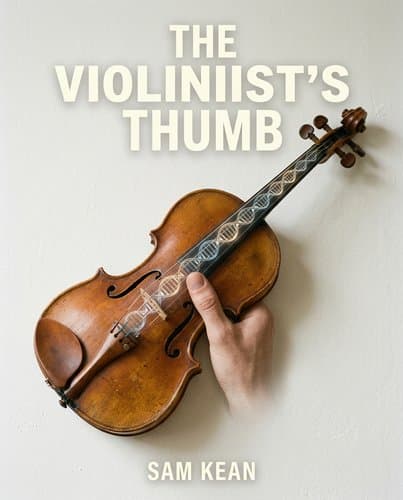
13528350_the-violinist-s-thumb
by Sam Kean
Your DNA is 8% ancient virus, part Neanderthal, and shaped by famines your ancestors survived—making the idea of a 'pure biological self' pure fiction.
In Brief
Your DNA is 8% ancient virus, part Neanderthal, and shaped by famines your ancestors survived—making the idea of a 'pure biological self' pure fiction. Sam Kean unravels the wild, accidental history written inside every human cell, where genius and disease share the same genetic switch.
Key Ideas
Relative Risk Without Baseline Misleads
A genetic risk is a probability, not a sentence — a '20% increased risk' for a disease affecting 1.6% of people is a small number wearing alarming clothes; always ask for the baseline before reacting to a relative risk
Genomes Are Evolutionary Theft Mosaics
Your genome is roughly 8% ancient virus DNA and less than 2% conventionally 'human' genes — the concept of a pure biological self is a fiction; what we are is a palimpsest of evolutionary thefts and mergers
Epigenetic Context Exceeds Genetic Sequence
Epigenetic effects — like a grandfather's famine reshaping a grandson's lifespan by decades — can be larger than the genetic sequence itself, meaning a genome read without environmental and ancestral context is an incomplete document
Africa Holds Greatest Human Diversity
The most genetically diverse humans on Earth are Africans; every non-African genome carries Neanderthal sequences from inter-species sex roughly 60,000 years ago — making racial hierarchies based on genetic 'purity' precisely backwards
Genetic Variants Carry Inevitable Trade-offs
The same genetic variant that enables an extraordinary capability (Paganini's hypermobile joints, Toulouse-Lautrec's unusual perspective) often carries a cost — genetic trade-offs are the norm, not the exception, which means 'fixing' a gene is rarely a clean proposition
Regulatory Networks Enable Complex Behavior
Gene count does not equal complexity — humans have roughly 26,000 genes, barely more than a fruit fly; our sophistication comes from regulatory layers, splicing, and epigenetic software that no single sequencing run fully captures
Who Should Read This
Science-curious readers interested in Biology and Evolution who want to go beyond the headlines.
The Violinist's Thumb
By Sam Kean
13 min read
Why does it matter? Because your DNA is not a blueprint for your fate — it's a record of four billion years of accidents, thefts, and near-extinctions
Sam Kean once spent $414 to have his DNA analyzed, then spent considerably longer staring at a disclosure box for Parkinson's disease he couldn't bring himself to open. Most of us would do the same — we approach our own genome as if it were a sealed verdict, and we're not sure we want to know the sentence. But The Violinist's Thumb argues that fear rests on a fundamental misunderstanding of what DNA actually is. It isn't a blueprint or a prophecy. It's a palimpsest, a manuscript written over and over — four billion years of catastrophe, viral theft, cross-species sex, and improbable luck, all layered on top of each other. You carry Neanderthal genes, ancient virus DNA, and epigenetic signatures from famines your ancestors survived. Your genome tells you far less about your fate than you feared, and far more about your history than you ever imagined.
The Founding of Genetics Was Undignified, Accidental, and Almost Lost to History
Picture Friedrich Miescher in the winter of 1869, arriving at his laboratory bench before dawn in a converted castle kitchen in Tübingen, propping open the windows, and waiting for the room to drop to around 35°F before he could begin work. He was there to study salmon sperm. Because salmon sperm degrades at anything approaching a comfortable temperature, Miescher had no choice but to work in conditions that were slowly, demonstrably killing him — he would die of tuberculosis decades later, the Swiss winters having done their part. On a tight budget, when his glassware broke he raided his wife's china cabinet to finish experiments. When he needed raw material, he squeezed salmon testes through cheesecloth to collect millions of swimmers. From this near-farcical squalor came the first isolation of DNA.
That detail matters because it punctures the assumption most of us carry into any account of scientific discovery — that the founders of genetics were working from elegant hypotheses in well-funded laboratories, advancing deliberately toward a conclusion they could almost see. The actual founding of genetics looks nothing like that. Miescher's supervisor initially refused to believe his results, forced him to repeat every experiment from scratch before allowing publication, and then attached a condescending editorial to his paper. The scientific community largely concluded that DNA was just a phosphorus-storage molecule — too chemically simple, with only four building blocks, to carry anything as complex as hereditary information. Miescher died in 1895 having never convinced anyone, including himself toward the end, that his discovery mattered.
Mendel's fate was grimmer for different reasons. His pea experiments had identified the gene as a discrete unit of inheritance — the original documentation of how heredity works, the notebooks and raw data behind one of the most consequential ideas in biology. In 1884, his fellow monks burned all of it. Not out of hostility to science. Mendel had spent his final years in an increasingly unhinged tax dispute with the Austrian government, and the bonfire was meant to close out the political embarrassment before the new abbot took over. The original documentation of how heredity works, destroyed because a monk had a fight with the Austrian tax authority.
Genetics wasn't discovered through scientific method so much as it survived, barely, despite frozen windowsills and a monk's bonfire. Which seems like the right way to understand a science that now carries enormous authority over how we think about human nature.
You Are Four Times More Virus Than Human — And That May Be Why You're Alive
What you call your DNA is not really yours. A fair fraction of it belongs, in any honest accounting, to ancient viruses that colonized your ancestors and never left. The Human Genome Project, completed around 2000, discovered that roughly 8 percent of the human genome consists of fossilized virus genes — about a quarter billion base pairs. Human protein-coding genes, by contrast, account for less than 2 percent of our total DNA. By volume, we are four times more virus than human.
The story of how this happened starts with a class of viruses called retroviruses — HIV is the most notorious living example — that pull off a genuinely alarming trick. After entering a cell, they convert their own RNA into DNA and splice that DNA directly into the host's genome. The cell, dutiful to the last, then copies those virus genes every time it divides. If the virus manages to colonize a sperm or egg cell, those genes pass to every subsequent generation. Over millions of years, this happened repeatedly, in waves, and the accumulated viral intrusions now sit throughout our chromosomes. Most of these sequences have since been scrambled by mutation into silence. But not all.
The mammalian placenta — the organ that defines our entire class of animals, that allowed mothers to carry developing young internally, that enabled the extended nurturing bonds we associate with being mammalian — evolved from virus genes. When an embryo implants in the uterine wall, it fuses with the surrounding tissue using specialized proteins. The DNA encoding those fusion proteins appears to have been stolen from the very mechanism retroviruses use to attach their outer membranes to a host cell before injecting their genetic payload. The placenta's uterine machinery also depends on a jumping gene called mer20, itself of viral origin, to switch roughly 1,500 uterine genes on and off during pregnancy. The organ that made mammals mammals was a repurposed infection.
Most of us carry an intuition about our genome as a personal document — bounded, authored by our own lineage. What the genomics era revealed instead is that the genome is more like a city built on ruins, with each layer of construction cannibalizing the materials of whatever collapsed before it. The traits we consider most distinctly human — the capacity to gestate and nurture living young, quite possibly the switching mechanisms that let us taste sweetness in starchy foods — may be evolutionary gifts from infectious agents that, at some earlier moment in primate history, simply failed to kill us quickly enough. The self encoded in your DNA is less an individual than a committee, convened across millions of years without anyone's consent.
The Genome That Almost Wasn't: How a Supervolcano Nearly Erased the Human Story
Consider the Toba supervolcano. Around 70,000 years ago, a mountain in what is now Indonesia blew apart so catastrophically that it dimmed the sun for roughly six years. Most of us have heard of Pompeii; Toba makes Pompeii look like a kitchen fire. The sulfurous cloud it threw into the upper atmosphere probably intensified an existing ice age, shrinking the African grasslands where early humans camped. The result, written into the DNA of every person alive today, is almost insultingly stark: despite seven billion humans now walking the planet, we carry less genetic diversity than approximately 150,000 wild chimpanzees. The numbers get worse the more you press them. Some estimates place the post-Toba human breeding population at a few thousand fertile adults. The most extreme reading: forty adults, worldwide. Picture a minor-league baseball stadium and then empty it almost completely.
That near-erasure is why the 'purity' of any human lineage is a fantasy worth abandoning. When early humans pressed out of Africa around 60,000 years ago, crossing into the Levant in small, genetically isolated clans, they met Neanderthals — and the encounter was not, apparently, entirely hostile. Enough interbreeding happened that modern Europeans and Asians carry roughly 2-4% Neanderthal DNA, absorbed in those ancient Levantine meetings. Modern Africans, whose ancestors largely stayed home and never encountered Neanderthals, typically carry none. The irony is precise enough to sting: the Victorian scientists who positioned Africans nearest the 'brutish' Neanderthal end of their hierarchies had it exactly reversed. The people most confidently declared subhuman are the only ones with no Neanderthal ancestry at all. The people doing the declaring are the hybrids.
What the genome keeps insisting is that we almost didn't make it. The story of human survival isn't a superior lineage marching forward — it's a species that came within a few dozen people of vanishing entirely, then stumbled into genetic windfalls by sleeping with its cousins. The committee nearly wasn't convened.
DNA Can Destroy You With the Same Mutation That Made You Extraordinary
Niccolò Paganini could snap a thick crystal saucer in half with one thumb. His rival Karol Lipinski watched him do it at a dinner table in Padua — just a slight flex, then a crack, and two shards on the tablecloth. Lipinski tried the same trick and couldn't come close. No one at that table could. The fingers that seemed too thin and strange to generate any real force had just casually destroyed a piece of crockery that no ordinary hand could touch.
Those fingers were the product of what medicine would classify as a disorder. Paganini almost certainly had Ehlers-Danlos syndrome, a condition that prevents the body from producing adequate collagen — the fiber that gives tendons and ligaments their stiffness. Without it, his joints bent in directions joints aren't supposed to go. He could drag his thumb across the back of his hand all the way to his pinky. He could twitch his middle-finger joints sideways, like tiny pendulums. This gave him the ability to play up to a thousand notes per minute, to reach intervals other violinists couldn't, and to perfect a technique called left-handed pizzicato — plucking with the same hand that was bowing, so that a single violinist could sound like two playing at once. Opera composer Rossini, a man who claimed he almost never cried, wept openly at a Paganini performance — which tells you something about what those strange hands could do.
The same mutation killed him. Collagen does more than limit joint flexibility — it holds the body's interior architecture together. Without enough of it, Paganini's lungs stayed weak, his digestion was chronically inflamed, his skin so fragile he was perpetually vulnerable to infection and fever. By his thirties he was canceling tours. His voice eventually went silent entirely. When he died at fifty-seven, his body had been failing publicly for decades.
DNA's most disorienting property is this: the variant that confers the gift and the variant that imposes the cost are not two different mutations. They are the same one. What medicine files under 'disorder,' evolution shrugged at — the flexibility that let Paganini do things no other human hand has done was inseparable from the frailty that made performing them a slow act of self-destruction. His genome didn't hand over the genius and then separately levy the disease as a tax; it handed them over as one indivisible package, the way the whole four-billion-year record hands things over. You don't get to separate the two. The pact comes whole.
Radiation, Resilience, and the Surprising Robustness of a Molecule We Keep Abusing
Tsutomu Yamaguchi owed his life, in part, to a forgotten rubber stamp. On the morning of August 6, 1945, a series of mundane accidents — a mislaid inkan, an elderly landlady's insistence on tea, a missed streetcar — deposited him near a Hiroshima potato field a fraction too late, which meant he hit the dirt before the blast wave reached him rather than standing upright when it did. He survived, then spent an entire night crossing a river on a single intact steel rail and riding a train home. That home was Nagasaki. Two days later, still bandaged, he was mid-sentence trying to explain the first bomb to a disbelieving supervisor when the room turned white again.
The gamma rays from both blasts punched through his cells in a millionth of a billionth of a second, creating free radicals that attacked the phosphate backbone of his DNA like rust eating through a pipe. And yet Yamaguchi lived until 2010, dying at ninety-three of stomach cancer — which, at ninety-three, might have found him anyway. His children were born healthy.
What protected Yamaguchi — and the genome generally — is not strength but redundancy. A mid-century club of physicists who bet their name-embroidered neckties on cracking the genetic code spent years hunting for an elegant mathematical cipher and found instead a sloppy, repetitive system where up to six different triplets can code for the same amino acid. That sloppiness turns out to be a shock absorber. A gamma ray rewrites a DNA letter. The new triplet still calls for the same amino acid. The protein folds correctly. The cell never knows anything happened. These are silent mutations, and they mean the genome can absorb an enormous volume of damage without a single protein failing — the molecular equivalent of a building whose walls can crack without the roof coming down.
Three billion years of evolution kept this messiness because organisms with cleaner, more fragile codes died faster. The genome is not a precise instrument that catastrophic events permanently shatter. It is a probability system under continuous, manageable assault — one that, most of the time, quietly fixes itself before you notice a thing.
Your Grandfather's Hunger Is Written Into Your Cells — And That Changes What a Genome Sequence Actually Tells You
What does it actually mean to read a genome? After decades of sequencing and billions of dollars, the Human Genome Project handed scientists the full three-billion-letter instruction set for a human being — and then the instruction set immediately started lying. James Watson and Craig Venter, the two most famous names in the entire enterprise, each published their own individual genomes as the triumphant capstone to the whole effort. Scientists pored over every base pair. Watson's sequence contained recessive mutations that, by the standard logic of genetics, should have left him both deaf and blind. Venter's carried markers for alcoholism, heart disease, and Alzheimer's. Watson was in his eighties, sharp and difficult as ever. Venter was approaching seventy and still founding companies. The letters said one thing; the lives said another.
The gap between those two accounts is where epigenetics lives. Whether any given gene actually fires depends on a layer of chemical switches sitting on top of the sequence: methyl groups that clamp genes shut, acetyl groups that pry them open. These switches are not encoded in the sequence itself. They are written by experience.
The most vertiginous demonstration of this comes from a remote Swedish farming village called Överkalix, where nineteenth-century crop records and church health registers survived long enough for modern researchers to compare them. Boys in that region between roughly ages nine and twelve — just before puberty, exactly when the body begins stockpiling cells that will eventually become sperm — were either feasting or starving depending on the harvest. If a boy gorged during that window, his future grandsons faced four times the normal risk of diabetes and, on average, died thirty years earlier than grandsons of boys who had gone hungry. Harald's buffet became Olaf's funeral, skipping a generation in between. The starvation didn't alter a single letter of Harald's DNA. Instead it reprogrammed the chemical switches on his pre-sperm cells, those switches then printed themselves onto actual sperm, and something of that imprint survived the embryo's normal attempt to wipe the slate clean. Thirty extra years of life, delivered through what a nine-year-old ate in a frozen Swedish winter.
This is what makes the genome sequence less a sentence than a list of words — the meaning depends entirely on which words are active, in which cells, in response to which history. Watson and Venter's frightening variants are probably sitting under methyl-group clamps, silenced by something in their particular developmental stories that no sequencing run captures. The sequence isn't wrong. It just isn't the whole story, and treating it as the whole story is like reading a musical score and thinking you've heard the performance. The notes are there.
The Race to Read the Genome Was a Human Comedy — and Its Punchline Is Humility
In June 2000, Bill Clinton stood at a White House podium next to two men who had spent two years publicly comparing each other to history's villains, and announced, with a straight face, that the race to sequence the human genome had ended in a draw. The truce was largely theater. Behind the scenes, Celera had been cutting down trees around its corporate campus to deny snipers a perch, and the FBI was warning Venter to check his mail for bombs. The $3 billion Manhattan Project of biology had conducted itself with the emotional register of a reality television feud.
All of which might have been worth it, if the genome had delivered what the boosters promised Congress: the genetic keys to cancer, heart disease, diabetes, the grand unified theory of human complexity. What it delivered instead was the gene count. Before sequencing began, scientists estimated humans had roughly 100,000 genes, with a few optimists whispering 300,000. As the data came in, the estimate dropped — 90,000, then 70,000, then 50,000 — and kept falling. When the final tallies from both teams converged around 26,000, the floor had gone out. A fruit fly manages its affairs with about 14,000. The distance between a fly and a human being, in raw gene count, is less than the difference between a studio apartment and a two-bedroom.
The sequencing didn't fail. It succeeded, and the success was the humiliation. We are not complex because we have more instructions than other creatures. We are complex because of how we read, edit, and layer the instructions we have — regulation, splicing, epigenetic switches, the whole extragenetic machinery that no sequencing run directly captures. Having the three billion letters turned out to be less like possessing a blueprint and more like holding a list of parts with no assembly guide. The race was real. The finish line, it turns out, wasn't the end of anything.
What the Parkinson's Update Actually Taught Him
Kean eventually had his own genome sampled, found a marker loosely tied to Parkinson's disease, and spent some time being quietly afraid. Then the science updated, the variant was reclassified, and he exhaled. Then it updated again, and the risk came back. What surprised him was that the second verdict landed softer than the first — not because the number had changed, but because he had. He knew, by then, what a number like that actually is: a probability wearing a costume, haunted by volcanoes and famines and ancient viruses that failed to finish the job and a grandfather's hunger in a Swedish winter. The four-billion-year argument your DNA is having with itself doesn't resolve into a clean diagnosis. It resolves into a story — one so ancient, so stolen, so improbably still going, that the honest response isn't dread. It's something closer to bewildered gratitude that the chain held long enough to reach you.
Notable Quotes
“fetish of examining objectionable fluids,”
“all the psychological ingredients of a war.”
“but that the eighth [consecutive] year of crop failure occurred.”
Frequently Asked Questions
- What is The Violinist's Thumb about?
- The Violinist's Thumb uses genetics to reframe what it means to be human. The book reveals that our DNA is roughly 8% ancient virus and less than 2% conventionally 'human' genes—meaning "the concept of a pure biological self is a fiction; what we are is a palimpsest of evolutionary thefts and mergers." Drawing on history, medicine, and molecular biology, Sam Kean shows how epigenetic effects—like a grandfather's famine reshaping a grandson's lifespan by decades—can be larger than the genetic sequence itself. The book challenges genetic determinism and explains evolution's trade-offs.
- What are the key takeaways from The Violinist's Thumb?
- The Violinist's Thumb reframes human genetics by revealing that DNA is part ancient virus, part Neanderthal, and shaped by ancestors' environments. Key insights include: genetic risk is probability, not fate (a "20% increased risk" for a disease affecting 1.6% of people is "a small number wearing alarming clothes"); your genome is roughly 8% ancient virus DNA; epigenetic effects can exceed genetic sequence in impact; the most genetically diverse humans are Africans; and genetic trade-offs are the norm. The book equips readers to interpret genetic risk accurately and understand epigenetics' role in human variation.
- How should you interpret genetic risk according to The Violinist's Thumb?
- Genetic risk is a probability, not a sentence. A "20% increased risk" for a disease affecting 1.6% of people is "a small number wearing alarming clothes"—alarming without proper context. Always ask for the baseline before reacting to relative risk, since people often misinterpret risk percentages, thinking doubled risk means guaranteed disease. Understanding absolute risk versus relative risk is essential for making informed medical decisions. The Violinist's Thumb emphasizes that genetic predisposition isn't destiny—environmental and lifestyle factors matter significantly in determining whether genetic vulnerabilities manifest.
- What does The Violinist's Thumb reveal about epigenetics?
- Epigenetic effects—changes in gene expression without altering DNA sequence—can be larger than genetic sequence itself. The Violinist's Thumb illustrates this with compelling examples: a grandfather's famine can reshape a grandson's lifespan by decades. This means "a genome read without environmental and ancestral context is an incomplete document." Epigenetics reveals how environmental stressors, nutrition, and experiences modify gene function across generations. The book demonstrates that genetic sophistication comes from regulatory layers, splicing, and epigenetic software beyond raw gene count, showing that DNA sequence alone doesn't determine biological outcomes.
Related Book Summaries
Read the full summary of 13528350_the-violinist-s-thumb on InShort