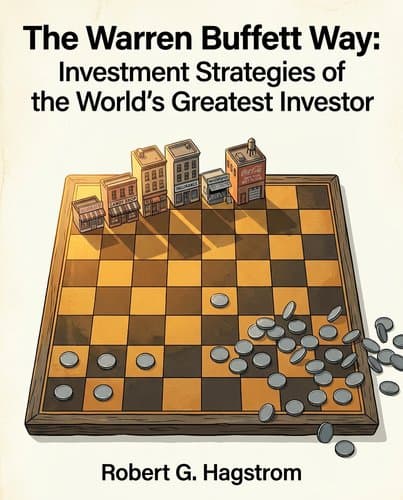
209956_the-warren-buffett-way
by Robert G. Hagstrom
Buffett's legendary returns aren't genius or luck—they're the predictable output of a handful of learnable principles, from calculating intrinsic value with…
In Brief
Buffett's legendary returns aren't genius or luck—they're the predictable output of a handful of learnable principles, from calculating intrinsic value with owner earnings to using Kelly formula position-sizing and ruthlessly enforcing a circle of competence across just 12 pivotal decisions.
Key Ideas
Intrinsic Value Before Purchase Price
Value a business before you look at the price — use owner earnings (net income + depreciation − maintenance capital expenditure) and discount future cash flows at the long-term bond rate to arrive at intrinsic value. Price is what you pay; value is what you get.
One-Dollar Premise Detects Capital Destruction
Apply the One-Dollar Premise: for every dollar a company has retained over 10 years, check whether market value increased by at least one dollar. If not, management is destroying capital — and that's a disqualifier regardless of how cheap the stock looks.
Half-Kelly Sizing Prevents Overconfidence
Use the Kelly formula as a position-sizing guide, then halve it. If you genuinely have a 70% probability edge on an investment, Kelly says bet 40% of your portfolio — but use half-Kelly (20%) to protect against overestimating your own confidence.
Quarterly Reviews Combat Myopic Loss
Stop checking your portfolio more than once a quarter. Myopic loss aversion means frequent evaluation makes you feel worse about volatility, triggering System 1 responses (selling, panic) that destroy the very returns patience is meant to capture.
Narrow Circle Compounds Competitive Advantage
Build a circle of competence and enforce it ruthlessly. Buffett made roughly 12 major investment decisions in 40 years that account for the bulk of his wealth. The constraint isn't a limitation — it's the source of the edge.
Intact Moat Opens Buying Opportunity
When the market panics around a specific company or sector, ask one question before looking at the price: is the economic moat intact? If the franchise is still there and only the price has moved, that's the discount window opening — not a warning sign.
Price Drops Signal Opportunity Not Risk
Never confuse volatility with risk. A stock that drops 40% in a year is only risky if the underlying business has deteriorated. If the business is intact, the price drop is opportunity. Redefining risk this way is not a personality quirk — it is the foundational move that separates Buffett's framework from modern portfolio theory.
Who Should Read This
Business operators, founders, and managers interested in Investing and Wealth Building who want frameworks they can apply this week.
The Warren Buffett Way: Investment Strategies of the World's Greatest Investor
By Robert G. Hagstrom
9 min read
Why does it matter? Because the assumptions you have about Buffett are backwards.
Most people treat Warren Buffett as a monument rather than a method — a freak of financial nature worth admiring but not studying, the way you might admire a cheetah's speed without expecting to run faster yourself. That assumption is comfortable. It also explains why almost nobody actually invests like him. The truth is more inconvenient: Buffett's returns aren't mysterious. They are the predictable output of about a dozen principles, applied rationally and consistently over decades. The principles aren't even complicated. What's rare is the psychological wiring to follow them while everyone around you is losing their mind. This book is a dismantling of the excuse that Buffett is simply an exception. He's not. He's a demonstration of what happens when ordinary intelligence meets genuine rationality — and refuses to flinch.
The Exception That Isn't an Exception
Warren Buffett's record is so extraordinary that most people use it as an excuse to stop thinking. A one-in-three-and-a-half-million statistical outlier, according to the academics — a 'five-sigma event.' The framing sounds rigorous while doing the opposite: it converts a methodology into a miracle.
Here's the number that should break that assumption. In 1965, Berkshire Hathaway's book value per share was $19. By 2012, it was $114,214. That's a 19.7% compounded annual gain — sustained for 47 years — outpacing the S&P 500 by more than 10 percentage points every single year. Luck doesn't compound like that. Luck has bad decades. A streak that statistically cannot be produced by randomness was produced by a method.
That method has a clear intellectual history. Robert Hagstrom spent years tracing Buffett's decisions back to their sources. What he found was a framework built from identifiable parts: Benjamin Graham's insistence on buying assets at a discount to their intrinsic worth, Philip Fisher's focus on business quality and management, and Charlie Munger's conviction that a truly great company is worth paying a fair price for. These aren't personality traits you're born with. They're frameworks you can learn.
The 'anomaly' framing is designed to make you feel like a spectator. Hagstrom's argument — and this book's — is that Buffett's results are the output of a repeatable system, with a traceable genealogy, testable principles, and 47 years of proof.
His Method Was Built by Three People, Not One
Late in 1971, Buffett was handed a proposal to buy See's Candies, a California chocolate chain with a loyal following and a clean balance sheet. The asking price was $40 million — or $30 million net of the cash on hand. By every instinct Graham had drilled into him, Buffett should have walked. The price was three times book value. Graham's whole framework rested on buying assets at a discount to what they were worth on paper, not paying a premium for something as intangible as customer affection for a box of chocolates. Buffett lowballed at $25 million. The sellers accepted — but only because Charlie Munger had spent enough time on him to shift something fundamental. Munger's argument was simple: a business that can raise prices without losing customers is worth more than its book value says, and the spread between what you pay and what it earns will only grow over time. A decade later, someone offered Buffett $125 million for See's. He passed. That quintupling in ten years was Munger's argument made concrete.
The modern Buffett had three architects, not one. Benjamin Graham gave him the bedrock: markets misprice assets, and buying with a margin of safety — paying substantially less than intrinsic value — is the only rational defense against being wrong. Philip Fisher, the growth investor who built portfolios around management quality and competitive durability, gave him a lens for evaluating what a business actually was, not just what its balance sheet said. Munger fused the two, pushing Buffett toward the conclusion that the quality of the business mattered more than the cheapness of the price.
In 1969, Buffett described himself as roughly 85 percent Graham and 15 percent Fisher. By the time Berkshire was buying See's, that ratio had shifted — and the direction of the shift is the actual story. Paying three times book value for a wonderful business turned out to be a better deal than paying half of book value for a mediocre one. Once that clicked, the whole framework reorganized around it.
The Twelve Tenets Are Really One Idea in Four Disguises
Buffett's twelve investment tenets look, on the surface, like a complex audit. Business tenets, management tenets, financial tenets, market tenets — four categories, twelve rules, a checklist long enough to feel professional. But run all twelve back to their source and they collapse into a single question: is this a wonderful business, run by rational people, that I can buy at a discount to what it's actually worth? Every tenet is that question wearing a different costume.
The management tenets make the clearest case. The most dangerous failure mode in business, Buffett concluded, is what he calls the institutional imperative — the mindless imitation of peers, where executives copy whatever rivals are doing regardless of whether it makes sense. He once put a list of 37 investment banking firms in front of Notre Dame students and walked through how every single one had failed. The conditions for success were ideal: trading volume on the New York Stock Exchange had grown fifteenfold, the firms were staffed with high-IQ people working brutal hours. All of them collapsed anyway. The institution generated its own momentum, capital followed the momentum, and no one stopped to ask whether any of it made sense. The tenet 'rationality in capital allocation' is just the antidote to that failure mode stated as a positive requirement.
The financial tenets do the same work from a different angle. Buffett's preferred metric, owner earnings, strips the accounting away to reveal actual cash: net income, plus depreciation and amortization, minus whatever capital expenditure is genuinely required to maintain the business. That number is what an owner actually pockets. The one-dollar premise then asks whether management is doing anything useful with what they keep: over a decade, every dollar retained should produce at least a dollar of new market value. If it doesn't — and plenty of conglomerates on acquisition sprees have failed this test badly — management is destroying wealth and calling it stewardship.
So when you run the full twelve-tenet checklist on a potential investment, you're really asking the same question twelve times, with increasing precision. Wonderful business. Rational people. Discount to intrinsic value. The tenets aren't a checklist — they're a single idea stress-tested from every direction.
Panic Is the Discount Window — If You Know What You're Buying
In 1973, the Washington Post was not a struggling newspaper — it had just broken Watergate. Its journalism was world-class, its franchise position in the D.C. market was unassailable, and any rational buyer could see the business was worth somewhere between $400 million and $500 million. The stock market valued it at $80 million. Buffett bought it.
The discount existed because the entire newspaper industry was drowning in labor disputes and inflation fears, and investors had decided the category was damaged goods. Buffett's reasoning cut straight to the structural reality: a newspaper that is the only one in town doesn't need to be good. It just needs to exist. Advertisers have no alternative. Subscribers have no alternative. Pricing power follows from monopoly position, not journalistic excellence. The panic had repriced the asset; it hadn't touched the economics.
This is what most investors get backwards: they hear Buffett talk about reasonable prices and picture a modest discount — maybe 10 or 15 percent below fair value. What the case studies show is that even in his post-Graham era, Buffett still hunts for dramatic mispricings. The mispricings appear during moments of institutional panic, when the market has conflated 'the industry is troubled' with 'this specific business is broken.' Those are not the same claim, and the gap between them is where the margin of safety lives.
When GEICO's stock collapsed from $61 to $2 in 1976, the market had decided the company was finished — overleveraged, under-reserved, probably insolvent. Buffett looked at the same evidence and asked a different question: was the business model still intact? GEICO sold car insurance directly to customers, cutting out agents entirely, which meant its costs were structurally lower than every competitor. That cost advantage hadn't moved. Only the price had. He invested.
The pattern across all nine case studies is identical: a real problem creates panic, panic creates indiscriminate selling, indiscriminate selling creates a price so far below intrinsic value that the margin of safety is obvious — but only to someone who has already done the work of understanding what the business actually is. You couldn't have spotted the Post at $80 million unless you'd already decided it was worth $400 million. The tenets aren't a formula for finding cheap stocks. They're the preparation that lets you recognize, when everyone else is running, exactly what you're looking at.
Concentration Is Conservative — The Math Most Investors Never See
Imagine you're handed a die that's been shaved — it lands on four, five, or six seventy percent of the time. How much of your money do you put on the next roll? Most people say 'a little, to be safe.' The Kelly formula says forty percent. The math is unambiguous: 2 times your probability of winning, minus one, equals your optimal bet size. At 70% odds, that's 0.4. Bet less and you're leaving compounding on the table; bet more and you risk ruin from a single unlucky streak. The formula isn't aggressive. It's the most rational response to an edge.
This is the mathematical foundation of what Hagstrom calls focus investing — concentrating capital in a small number of businesses whose odds you genuinely understand. The intuition Wall Street trains into people runs exactly opposite: spread the bets, reduce the exposure, never put too much in one place. That feels like prudence. Run 12,000 randomly assembled portfolios through the numbers and the result is unambiguous: the 15-stock portfolios beat the market one time in four. The 250-stock portfolios beat it one time in fifty. Diversification doesn't manage risk — it dilutes whatever edge you actually have.
The deferred tax calculation makes the same point from a different angle, and the numbers are almost offensive once you see them. One dollar invested at 20% annual returns, never sold over 20 years, compounds to roughly $692,000. The same dollar, traded actively and taxed at 35% each year, grows to about $25,200. The gap isn't a rounding difference — it's a factor of 27. Every time you sell a winner to rebalance, you hand a portion of your unrealized gain to the government immediately, instead of letting it keep compounding. The buy-and-hold investor is effectively borrowing from the tax authorities at zero percent. That's not sloth. That's structurally superior math.
The central paradox is this: the approach that looks reckless — putting 40% of your capital into a single position, holding it for decades, ignoring the urge to diversify — is the conservative choice for an investor who has genuinely done the work. Diversification is the rational strategy for someone who doesn't know what they own. For someone who does, it's a hedge against their own knowledge.
Your Brain Is the Market's Best Customer
The actual obstacle is neurological. Daniel Kahneman and Amos Tversky spent years running controlled experiments on how people respond to gains and losses, and what they found should change how you think about every investment decision you make. The pain of losing money is not equal and opposite to the pleasure of gaining it. It's two to two and a half times more powerful. Put a concrete number on it: lose $1,000 and the emotional impact is roughly what you'd feel from winning $2,500. That asymmetry isn't a personality flaw in anxious people — it's hardwired into human cognition. Kahneman and Tversky called it loss aversion, and it explains why investors sell winners too early (locking in the gain before it disappears) and hold losers too long (refusing to realize a loss that already happened).
Combine loss aversion with frequency of evaluation and the problem compounds. Checking your portfolio daily makes stocks feel emotionally worse than bonds — the volatility registers as a stream of small losses, each one landing with full neurological force. Check once a year and the emotional calculus flips: the annual view smooths the noise and stocks feel like the superior asset they mathematically are. The underlying returns haven't changed. Only the frequency of exposure has. This is why Buffett's structure at Berkshire — no quarterly earnings guidance, no obligation to react to daily price movements — isn't temperamental preference. It's a system deliberately designed to keep System 2 thinking, the slow analytical kind, in charge of decisions that System 1, the fast emotional kind, would catastrophically mishandle. That's a design principle, not a personality quirk, and it's replicable.
The market is effectively selling you your own psychology back to you at a markup. Every time panic reprices a sound business, it's because enough investors consulted their loss aversion instead of their analysis. That's the discount window Buffett walks through. You don't beat the market by knowing more than everyone else. You beat it by making fewer emotional errors — which turns out to be the harder thing, and the rarer one.
Patience Isn't a Personality Trait — It's a Cognitive Skill You Can Train
Patience is trainable. That's the claim most investors never hear — because it's more flattering to treat Buffett's temperament as a gift than to admit it's a skill you could develop and chose not to.
Buffett gave away the mechanism in a speech: IQ and talent are the horsepower of the motor, but output depends on rationality. Most people start with 400-horsepower motors and get 100 horsepower of output. The bottleneck isn't intelligence. It's the cognitive habits layered on top of it. Buffett's method is a System 2 machine — and the only way to run it is to build structures that keep System 1 from grabbing the wheel.
Jack Treynor named the distinction with precision. Simple metrics travel fast through markets and get priced in almost immediately. The only ideas that generate real opportunity are the ones requiring genuine reflection, specialized judgment, and deep familiarity with a specific business. Those ideas travel slowly — which means they stay mispriced longer. The investor willing to sit with a complex idea while everyone else trades on obvious data collects the gap.
That gap is unusually wide right now. The average mutual fund holding period has collapsed from a postwar average of six-plus years to mere months today. Competition for long-horizon edges has nearly evaporated. The market is more crowded at the one-week horizon than at any point in history, and nearly empty at the five-year one.
Concentration looks reckless. Long holding periods look passive. Ignoring daily price movements looks incurious. Each of those behaviors is System 2 protecting itself from System 1's worst instincts — and understanding why that protection is worth having is what the final section is about.
The Rarest Skill in Investing Isn't Analytical
Two questions feel almost identical. They produce entirely different investors.
"What will this stock do next week?" and "What is this business actually worth?" — that gap is the whole book. The market is engineered, almost perfectly, to keep you asking the first one: prices updating by the second, earnings calls every ninety days, financial media whose entire business model depends on you believing next week matters. That architecture isn't neutral. It's a machine for turning intelligence into noise.
Choose the second question and the horsepower comes online. The concentrated bets, the decade-long holds, the indifference to volatility — none of that is recklessness dressed up as wisdom. It's what your rationality looks like when it stops apologizing for itself.
Notable Quotes
“So why do smart people do things that interfere with getting the output they’re entitled to?”
“two kinds of investment ideas: (a) those whose implications are straightforward and obvious, take relatively little special expertise to evaluate, and consequently travel quickly and (b) those that require reflection, judgment, and special expertise for their evaluation, and consequently travel slowly.”
“If the market is inefficient,”
Frequently Asked Questions
- What is The Warren Buffett Way about?
- The Warren Buffett Way decodes the investment philosophy behind Warren Buffett's decades of market-beating returns. Hagstrom distills Buffett's approach into concrete, learnable principles — from calculating intrinsic value and sizing positions rationally to distinguishing volatility from real risk — giving readers a replicable framework for long-term investing. The 1994 book breaks down decades of successful investing methodology into actionable strategies that individual investors can apply. Rather than treating Buffett's success as mysterious talent, it reveals the systematic thinking and disciplined approach that generates consistent outperformance. Key concepts include owner earnings calculation, the Kelly formula for position sizing, and the critical importance of a well-defined circle of competence.
- How do you calculate intrinsic value according to The Warren Buffett Way?
- To calculate intrinsic value, use owner earnings — defined as "net income + depreciation − maintenance capital expenditure" — and discount future cash flows at the long-term bond rate. This approach prioritizes what a business genuinely earns and can distribute, rather than accounting earnings. The fundamental principle is "Price is what you pay; value is what you get." By comparing a stock's market price to your calculated intrinsic value, you identify a margin of safety. The owner earnings approach handles cyclical business fluctuations better than simple net income, making it particularly valuable for assessing manufacturing and capital-intensive companies.
- What is the One-Dollar Premise in The Warren Buffett Way?
- The One-Dollar Premise tests whether management has created shareholder wealth effectively. For every dollar a company has retained over 10 years, check whether market value increased by at least one dollar. If not, "management is destroying capital — and that's a disqualifier regardless of how cheap the stock looks." This filter eliminates value traps masquerading as bargains. Companies with strong competitive advantages and competent management convert retained earnings into proportional increases in market value. By applying this test, you avoid companies trading at low multiples but lacking the ability to deploy capital effectively.
- Why does The Warren Buffett Way distinguish between volatility and risk?
- "Redefining risk this way is not a personality quirk — it is the foundational move that separates Buffett's framework from modern portfolio theory." A stock dropping 40% annually is only risky if the underlying business deteriorates; if the business is intact, the price drop is opportunity. This redefinition directly challenges conventional finance, which treats price fluctuations themselves as inherent risk. By recognizing short-term market movements as opportunities rather than dangers, investors can maintain discipline and avoid panic-driven decisions during market downturns. When the economic moat remains intact, temporary price declines provide entry windows, not warning signs. This distinction fundamentally reshapes how investors evaluate actual business risk versus perceived market risk.
Related Book Summaries
Read the full summary of 209956_the-warren-buffett-way on InShort