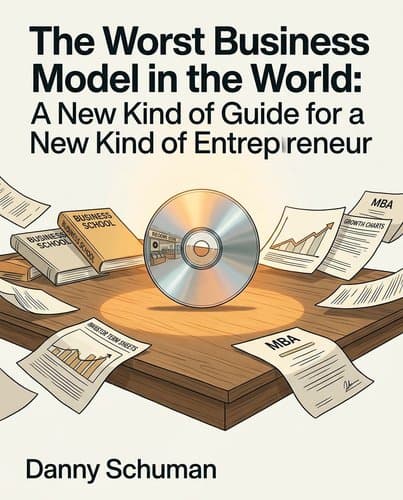
40605881_the-worst-business-model-in-the-world
by Danny Schuman
Ignore growth targets, skip the pitch deck, and never chase money—Danny Schuman accidentally built a thriving business by obsessing over customer delight and…
In Brief
The Worst Business Model in the World: A New Kind of Guide for a New Kind of Entrepreneur (2018) makes the case that prioritizing personal happiness and customer obsession over growth and profit is the most reliable path to a sustainable business.
Key Ideas
Real customers reveal actual business shape
Start with 1% of your vision, this week, with what you have — CD Baby launched for $500 and was profitable by month two. Real customers will reveal the actual shape of your business faster than any plan will.
Market silence means rebuild, not push
When a new idea or project fails to produce 'Wow, yes, I need this!' from multiple real people, don't push it harder — improve it, rebuild it, or invent something else entirely. The market's silence is information, not an obstacle.
Say yes only to genuine enthusiasm
Apply the Hell Yeah filter to every new commitment before saying yes. If you're not feeling genuine, specific enthusiasm — not politeness, not obligation — the answer is no. This protects your energy for the rare thing worth throwing yourself into completely.
Engineer delight into routine interactions
Engineer unexpected delight into mundane customer touchpoints: the order confirmation, the phone answer, the refund process. These moments spread because no one expects a company to care that much about them.
Document philosophy to build institutional memory
When you delegate a decision, explain the philosophy behind your answer, not just the answer itself — then ask someone to write it down. A manual built this way becomes institutional memory that eventually runs the company without you.
Choose your scorecard before others do
Define your personal grading system explicitly before external pressure sets it for you. Net worth, creative output, depth of impact, number of people helped — all are legitimate measures. The danger is building for years toward a scorecard you never consciously chose.
Who Should Read This
Business operators, founders, and managers interested in Startups and Business Strategy who want frameworks they can apply this week.
The Worst Business Model in the World: A New Kind of Guide for a New Kind of Entrepreneur
By Danny Schuman
10 min read
Why does it matter? Because the instincts that feel most unbusinesslike may be the only ones worth trusting.
Every MBA program runs on the same founding myth: bold vision, deliberate plan, aggressive growth, clean exit. Derek Sivers did none of it. He was a musician in Woodstock who couldn't get his CD into any online store, got annoyed, and built one himself. When friends asked if he could sell their CDs too, he said sure — just a favor. He turned down every investor who called. Danny Schuman, the book's author, spent twelve years on his own version of that same wilderness before he figured out what signal to listen for. Sivers tried, repeatedly, to stop the company from growing. Never wrote a business plan. Sold for $22 million.
Schuman's book isn't about Sivers's cleverness. It's about what his decade-long accident reveals: that the instincts most business advice dismisses as naive (refusing capital, staying deliberately small, optimizing for happiness over metrics) might be the only ones actually worth following. The question it keeps posing isn't how to build a business. It's what you're building one for.
The Pricing Model That Generated $10 Million Was Copied Word-for-Word from a Record Store Clerk
In 1997, Derek Sivers walked into a record store in Woodstock, New York, and asked the woman behind the counter how consignment worked. She explained it in one sentence. He went home and typed her exact words onto his website.
Those were the only two numbers CD Baby ever charged — thirty-five dollars to list an album, four dollars per CD sold — and six years later they had produced ten million dollars in revenue.
Most retellings skip this part. Sivers hadn't spotted a market gap or assembled a business plan. He'd built the site out of irritation. Online music retail in 1997 ran entirely through major distributors: the kind who took your inventory, held it for a year, maybe paid you back eventually, and expected you to buy your own shelf placement to compete against labels with actual money. He'd already sold fifteen hundred copies of his own CD at live shows and just wanted to put it online. When every retailer said he needed a distribution deal to do that, his reaction was roughly — fine, I'll build my own store.
Getting a credit card merchant account in 1997 (PayPal didn't exist) cost a thousand dollars in fees, three months of paperwork, and a bank inspector who drove out to verify the business was real. He taught himself to build a shopping cart.
When the BUY NOW button finally worked, he mentioned it to a musician friend. The friend asked if Sivers could sell his CD too. Sure — a couple of hours. Two more friends asked. Then strangers called: someone's friend had given them the number. He said yes to everyone. When two music bloggers announced it to their mailing lists, fifty musicians signed up in a single day.
He wasn't building a business. He was doing a favor and hadn't stopped.
The business model arrived the same way. His second-ever customer, someone in the Netherlands, emailed a week after buying to ask about new releases. Sivers was baffled; he'd built a credit card processor. The Dutch customer explained he thought it was a store. That single misreading was enough. Sivers rebuilt the whole concept around it.
That's the actual origin story: pricing lifted word-for-word from a stranger, a business built from saying yes to friends, and a pivot triggered by someone who misunderstood what the site was. No plan survived. Ten million dollars did.
Why Refusing Every Investor and Excluding Most Customers Made the Business Stronger
Investor money doesn't just fund operations. It purchases a claim on your attention. That's the hidden price tag, and attention is the actual business.
During the dot-com boom, funded founders Sivers knew couldn't explain what their businesses actually did. They talked about second rounds, encrypted database servers, pool tables in Midtown offices — everything except customers. The investor relationship had colonized the conversation. His well-funded peers spent a hundred thousand dollars on equipment he assembled for a thousand. None of those dollars reached a customer any better.
When investment firms called, weekly and reliably, the answer was always no. When they pushed on expansion, he said he wanted his business smaller, not bigger. That was the logic: investors don't buy you resources, they buy themselves a vote on what you optimize for.
The same instinct ran through how he chose his customers. When major record labels called wanting to feature their acts on CD Baby, the answer was flat: not allowed. This wasn't reluctance — it was the product. The site existed for musicians who had chosen not to sign their rights over to a corporation. Letting major-label acts in would dilute exactly the signal that made independent artists trust the platform. The exclusion wasn't policy. It was a declaration: you are the ones this was built for.
A folk-and-rock venue in Los Angeles, the Hotel Café has a strict no-talking rule, enforced mid-show: performers stop and tell talkers they're free to go anywhere else in the city. It became the most popular music venue in LA because it was the one place where you could actually listen. Shutting out the casual crowd was the entire value proposition for everyone who stayed.
Persistence Doesn't Mean Pushing Harder — It Means Shipping Something Better
For twelve years, Schuman pushed every door he could find — every marketing channel, every reasonable path — and nothing swung open on its own. Then something he built broke through. Not gradually; the response just changed. Instead of creating demand, he was managing it. He said it felt like finally writing a hit song.
You don't fully control which thing breaks through. But you do control whether you keep inventing until something does.
Schuman says he'd misread persistence all along: it means keep improving and inventing, not keep pushing what isn't working. Grinding on a project that isn't landing isn't grit. It's noise.
The practical signal is specific: present your idea or improvement to the world. If multiple people respond with something close to "Yes, I need this, I'd happily pay for it" — keep going. Anything less? Get back to inventing. Not to a better pitch. Not to more networking. Back to the thing itself.
The same discipline applies to your own decisions. Derek Sivers calls it Hell Yeah or No: collapse yes/maybe/no down to two options. Either something produces genuine "Wow, absolutely, Hell yeah" enthusiasm, or the answer is no. Schuman runs the same filter: if you're overcommitted or scattered, that's not a scheduling problem; it's a standards problem. You said yes to things that didn't clear the bar.
Both rules are the same rule: let genuine enthusiasm — from the market, or from yourself — be the signal. Not politeness. Not possibility. Actual excitement.
The Twenty-Minute Email That Became Twenty Thousand Word-of-Mouth Referrals
The deepest customer loyalty doesn't get built at the complaint desk — it gets built in moments no one was expecting.
When CD Baby shipped an order, the standard confirmation email said exactly what you'd expect: your order has shipped, let us know if it doesn't arrive, thank you for your business. Sivers spent twenty minutes replacing it with something else entirely. The new version treated a mass-produced CD like a priceless artifact, catalogued by specialists, passed through committees, dispatched with the gravity of a state funeral. Each step escalated the ceremony, the joke being that a $12 purchase was receiving the kind of attention usually reserved for diplomatic pouches and crown jewels.
The email was absurd. It was also the only business communication most people received that was trying to make them laugh rather than protect the company from liability.
Search "private CD Baby jet" and you'll find nearly twenty thousand results: customers who loved it enough to post it publicly and tell their friends. One transactional notification, written in an afternoon, generated thousands of new customers. No marketing campaign. No ad spend. Just Sivers deciding that his business had its own laws, and one of those laws was that every interaction — even the automated ones — should feel like it came from a person who actually wanted you there.
The Same Informality That Made CD Baby Human Also Made It Catastrophically Vulnerable
What does it actually cost to run a company the way CD Baby ran everything else — on instinct, on trust, with paperwork treated as a formality rather than a fact?
In Sivers's case: $3.3 million.
The chain of decisions that produced that number spans eight years and looks, at each link, completely reasonable. As a teenager, he'd been signing documents for his family business without reading them. Not from recklessness, exactly. More from habit. His father handled the complexity; Sivers just had to sign. When Sivers needed $20,000 to buy recording equipment, his father offered a solution: instead of a personal loan, start a corporation and let the family business buy shares. Sivers agreed, signed, and went back to making music. He didn't read closely enough to notice he'd sold ninety percent of his new company (Hit Media Inc.) rather than borrowed twenty thousand dollars.
Four years later, CD Baby existed. When the first check arrived made out to "CD Baby," he went to the bank to open a new account. The teller suggested a shortcut: just make it an alias on his existing Hit Media account. Saved a hundred dollars and about ten minutes. He said sure.
Eight years after the original handshake, when CD Baby had reached millions in annual revenue, his accountant called. Did he know that CD Baby was just a line item on his father's company's tax return? Did he know his father's company owned ninety percent of CD Baby?
He did not.
The informality that made CD Baby feel human — the improvised pricing, the handshake sensibility, the assumption that good intentions were enough — had no floor when it met legal structure. His father wasn't at fault; he'd assumed Sivers understood the documents. The bank teller was just being helpful. The whole disaster assembled itself from individually defensible decisions, none of which had felt like decisions at all.
To buy back what he'd accidentally signed away, he had to pay fair market value. The IRS doesn't let you repurchase ninety percent of a profitable business for the twenty thousand you once borrowed. The final bill: $3.3 million.
None of what made CD Baby worth that much needed to change. The lesson isn't that warmth is a liability or that every deal needs a room full of lawyers. It's that warmth operates between people, while legal structure operates in documents, and you actually have to read the documents.
He paid the bill. CD Baby kept running. The next decision came years later, and it was a different kind entirely.
He Tried to Stop the Company From Growing for Years — and Was Happiest After He Gave It All Away
On January 18, 2008, Derek Sivers sat down with his diary and posed a question he'd asked several times before: what if he sold CD Baby? Every previous time the answer came back with enthusiasm. Too much still to build, not a chance. This time, working through twenty planned projects and feeling nothing about any of them, with three acquisition offers landing in the same week and eighty-five employees in a building he'd stopped going to, the answer came out different. Writer Seth Godin's advice, when Sivers called, was four words: "If you care, sell." The logic was blunt: a founder without vision does his customers a disservice; better to hand it to someone who cares. He went to bed that night and slept longer than he had in months.
The company had grown against his explicit wishes at every stage — that part Sivers didn't hide. At twenty employees he'd vowed to hold it there. At fifty he'd sworn that was enough. When people asked what he was doing to grow CD Baby, his honest answer was that he was trying to get it to stop. The business kept growing anyway, and as it did, his stories about it got less happy. He was happier with five employees than with eighty-five. Happiest working alone.
None of that fits on a business school slide. You can copy the pricing model lifted from a record store clerk, the trick of turning each staff question into a written policy so it never has to be asked again, the absurdist shipping email. Those are tactics. The harder question (the one this book is actually about) is what you're grading yourself on before you start building toward it.
Sivers's own answer came down to what he did with the proceeds. Months before the deal closed, he transferred all CD Baby's assets into a charitable trust, irrevocably, before he could reconsider. When the disc manufacturing company Disc Makers paid $22 million, the money went to music education. Not from altruism, Sivers was careful to say. He just knew what made him happy, and having it locked away, beyond his own reach, was part of it. He called it idiot-proofing his own future. He lives without a house, a car, or a television, and describes the absence of things as his actual freedom.
At a billionaire's party, Joseph Heller told his host he had something the man would never have — enough. The word only means something if you've decided what it looks like before the business decides for you.
The Question Worth Building Toward
Here's the question the whole book is actually asking: by what measure would you know you'd won? Not the default answer — not revenue, headcount, the exit — but yours, chosen deliberately, before the business starts choosing it for you. Because it will. The momentum of building is strong enough to carry you somewhere impressive without ever asking whether impressive was the destination. Worth asking right now, before the next yes: what would enough actually look like for you, and did you decide that before the building started?
Notable Quotes
“Ah, screw it. I'll just set up my own online store. How hard could it be?”
“Could you sell my CD, too?”
“What are you doing to grow your company?”
Frequently Asked Questions
- What is the main argument of The Worst Business Model in the World?
- The book argues that prioritizing personal happiness and customer obsession over growth and profit is the most reliable path to a sustainable business. Danny Schuman makes the case that entrepreneurs who focus on customer satisfaction and their own well-being create more resilient, valuable companies than those chasing rapid growth. The guide provides practical tools for building something meaningful without sacrificing what matters to you, drawing on real examples and tested strategies.
- What are the key takeaways from The Worst Business Model in the World?
- The book teaches entrepreneurs to start small with limited resources, test ideas with real customers, and filter new commitments carefully. "Start with 1% of your vision, this week, with what you have" — CD Baby launched for $500 and was profitable by month two. Apply the Hell Yeah filter to commitments, requiring genuine enthusiasm, not obligation. Unexpected delight should be engineered into customer interactions, and when delegating decisions, explain the philosophy behind answers to build institutional memory.
- How did CD Baby exemplify the principles of The Worst Business Model in the World?
- CD Baby exemplifies the book's core principle: start small and let real customers guide your business. The example shows that CD Baby launched for $500 and was profitable by month two. Rather than requiring elaborate planning or significant capital, the business began with minimal resources and immediately validated demand with real customers. This approach reveals the actual shape of your business faster than any plan will, demonstrating how financial constraints and customer focus create sustainable, profitable ventures.
- What does the Hell Yeah filter mean in The Worst Business Model in the World?
- The Hell Yeah filter is a decision-making tool that protects your energy and focus by requiring genuine enthusiasm for commitments. The book states: "If you're not feeling genuine, specific enthusiasm — not politeness, not obligation — the answer is no." This filter prevents entrepreneurs from accepting projects out of habit or social pressure, reserving their effort for endeavors they truly believe in. By applying this standard consistently, you ensure that your time goes only to the rare thing worth throwing yourself into completely.
Related Book Summaries
Read the full summary of 40605881_the-worst-business-model-in-the-world on InShort