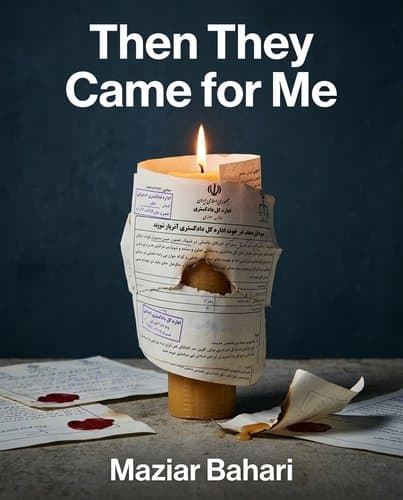
11500827_then-they-came-for-me
by Maziar Bahari, Aimee Molloy
Inside an Iranian interrogation cell, journalist Maziar Bahari discovered that surviving authoritarianism isn't about heroic defiance—it's about recognizing…
In Brief
Then They Came for Me (June) draws on Maziar Bahari's 118-day imprisonment in Iran's Evin Prison to expose how authoritarian interrogation systems manufacture confessions rather than uncover truth. Through his account, readers learn how these systems operate institutionally across regimes, and how strategic clarity — not heroic defiance — is what enables survival and resistance.
Key Ideas
Predetermined Conclusions Drive Authoritarian Interrogations
Authoritarian interrogation systems are not designed to find the truth — they arrive with a pre-written conclusion and use sensory deprivation, isolation, and threats against loved ones to manufacture the evidence for it. Understanding this architecture is the first step to not being destroyed by it.
Strategic Bureaucratic Recognition Enables Survival
The most effective survival strategy Bahari found was not heroic resistance but tactical recognition: his torturer was a bureaucrat who needed to show his bosses results. Feeding the system just enough to satisfy that bureaucratic need — without crossing the line of naming names — was what kept him alive.
Structural Absurdity Makes Systems Dangerous
Absurdity in authoritarian systems is not a sign of incompetence — it is the system's ideological closure made visible. When interrogators cannot distinguish satire from espionage or Chekhov from a Zionist agent, the opacity is structural, not accidental, and it makes the machine more dangerous, not less.
Survival Costs Cannot Be Separated
The forced confession was a performance Bahari could privately disavow, but the footage the regime recorded was real and was used. The book's most honest insight is that survival tools and their costs are not always separable — and pretending otherwise is its own kind of dishonesty.
Transparency Defeats Intimidation Through Exposure
Transparency is a more effective shield against state intimidation than silence. When Bahari went public about the threats against his family after his release, the frequency of those threats dropped — because the regime still cared about its image in the world, and naming the threat out loud removed the leverage of secrecy.
Repression Persists Through Institutional Structures
State repression is not primarily ideological — it persists across the Shah and the Ayatollahs, through different uniforms and different justifications, because the machinery of control is institutional, not philosophical. Recognizing this pattern across generations is what allows Bahari to name what is happening to him even while it is happening.
Who Should Read This
Readers who connect with first-person stories about Memoir and Political Figures and want to see the world through someone else's eyes.
Then They Came for Me
By Maziar Bahari & Aimee Molloy
13 min read
Why does it matter? Because the men who imprisoned Maziar Bahari were not evil geniuses — they were insecure bureaucrats, and that changes everything about how power actually works.
We want the monsters to be monstrous. We need the architects of suffering to be brilliant, driven by ideology, animated by some dark coherence — because that would make the terror legible, even containable. What Maziar Bahari discovered inside Evin Prison is considerably worse: his interrogator was a paranoid civil servant with a grudge, a master's degree he barely understood, and a genuine inability to grasp that Anton Chekhov was not a Zionist operative. The machinery that held Bahari for 118 days — that beat him for using exclamation marks he hadn't written (added, it turned out, by a translator), that arrested him partly because a comedian joked his codename was "Pistachio" — wasn't driven by genius or even conviction. It was driven by insecurity, bureaucratic momentum, and the need of small men to seem large. This is the book that explains, with a journalist's precision and a survivor's dark amazement, exactly how that machinery works — and what it costs to remain yourself inside it.
Three Generations, One Cell: The State Doesn't Change, Only the Uniform Does
The smell hit him first. Rosewater — the cheap, sweet kind dabbed on by devout men in Iran — mixed with sweat, flooding a bedroom in Tehran at eight in the morning on a June day in 2009. For one disoriented moment, Maziar Bahari thought he was six years old again, barefoot on a cool marble floor in the shrine city of Qom, his aunts beside him. Then he opened his eyes and found a Revolutionary Guard standing over his bed: six foot two, enormous-headed, thick glasses, carrying a prosecutor's warrant.
The man waking Bahari was thirty-one years old with a master's degree in political science. He had joined a fundamentalist military organization that didn't exist when Bahari's father was first arrested.
In 1954, the Shah's secret police came for Bahari's father, a communist labor organizer, and left him without toenails. In 1983, the Islamic Republic came for his sister Maryam — who had actually supported Khomeini's revolution — and sentenced her to six years in a sham trial where the judge wouldn't let her speak. Now, in 2009, the Revolutionary Guards came for Bahari himself, a cautious journalist who had spent years self-censoring, avoiding sensitive topics, rarely dating, limiting contact with foreigners. He had tried harder than almost anyone to stay out of the machine. The machine found him anyway.
Bahari's eighty-three-year-old mother, Molouk, had watched two previous regimes drag away two previous family members. When the guards arrived, she offered them tea. They declined. She pointed out that they had arrived uninvited at eight in the morning and were going through her son's belongings — and asked what exactly they thought imposing meant. They told her to put on her headscarf. She draped it halfway across her hair and walked away.
The flags changed. The arrests didn't.
The Green Movement Gave Two Million People a Reason to Believe — Which Made What Came Next So Much Worse
Bahari arrived back in Tehran three days before the June 12 election to find the city physically transformed. Twelve miles of Vali Asr Avenue had been lined the previous night by Mousavi supporters holding green scarves above their heads — green for the Islamic color of peace, adopted now as a declaration that Iranians wanted to live like the rest of the world. A motorcycle driver named Davood, who two weeks earlier had refused to vote because he assumed the regime would simply choose the winner, had taped a Mousavi poster to his rear window. Bahari's eighty-three-year-old mother, who had stopped voting years ago out of disgust, announced she would cast a ballot because of Ahmadinejad's rudeness in a televised debate. A secret Ministry of Intelligence poll — the regime's own internal numbers — showed Mousavi leading by as many as twelve million votes. The 2009 Green Movement was the most democratic thing Iran had produced in thirty years.
Then, at 5:30 in the afternoon on election day, while people were still standing in line to vote, the state-run Revolutionary Guards news agency announced that Ahmadinejad had won with over twenty million votes — announced it, with no attempt at plausibility, before the polls closed. When Bahari tried to reach the Ministry of Interior building where votes were being counted, police with high-voltage clubs told him to leave and threatened worse if he stayed.
What followed over the next week redefined what Bahari thought he understood about the regime's limits. Two million people marched in near-total silence from Revolution Square to Freedom Square — so many, and so calm, that Basij paramilitaries watched from behind curtains rather than confront them. Then Ahmadinejad called his opponents "dust and dirt," and the patience broke. Bahari filmed a young man in his twenties being shot off a fence outside a Basij compound, the body rolling slowly onto collapsed metal spars below. He knew as he filmed it — and the Basij filming him confirmed it — that he had moved from observer to target. He got the footage to a British television crew within hours. It aired worldwide.
His press card had protected him on dozens of previous assignments. It was a reasonable bet that it would again. The regime had, after all, issued hundreds of journalist visas specifically to show the world its democratic legitimacy. What Bahari hadn't yet absorbed was that the regime had just abandoned its interest in looking legitimate — and a journalist who had documented that abandonment was no longer a press freedom problem.
The Interrogation Room Is Not Designed to Find the Truth — It's Designed to Manufacture It
Interrogation rooms in thrillers are built around a lie: that someone across a table is trying to find the truth. Bahari's experience inside Evin Prison corrects this. The system he encountered was not designed to extract information — it was designed to manufacture a confession that had already been written.
The mechanics were sensory before they were psychological. A fluorescent bulb that never switched off erased the difference between three in the afternoon and three in the morning. The blindfold, mandatory whenever a guard appeared, meant Bahari's world shrank to sound and smell — specifically, the cheap rosewater cologne of his interrogator. He was assigned a number instead of a name. None of this was incidental cruelty; it was the factory's operating procedure. When you can't tell Tuesday from Saturday, when you can't see who's in the room, when your identity has been reduced to four digits, you lose the mental scaffolding that makes resistance feel rational. Resistance requires a sense that time is moving and that the present situation will eventually end. The light that never went off was designed to prevent exactly that sense.
The absurdity of what the interrogators believed — or performed believing — was not a flaw in the system. It was the system. Rosewater and a colleague once sat Bahari down to watch a clip from a satirical American comedy show. A Daily Show correspondent named Jason Jones had filmed an interview with Bahari in a Tehran coffee shop, wearing a checkered kaffiyeh and dark sunglasses, doing a joke character — a cartoonishly paranoid American spy. At one point, Jones introduced Bahari with the mock code name 'Pistachio.' Rosewater demanded to know why an American spy had dressed in spy's clothing and assigned Bahari a code name. He was not performing skepticism. He genuinely could not parse the concept of satire — his worldview had no room for the category. In a framework where every Western journalist is a CIA asset and every camera is an intelligence instrument, a comedian playing a spy is simply a spy who happened to be recorded.
The machine's real leverage was not confusion, though. It was love. A senior interrogator Bahari knew only as Haj Agha offered him tea and cucumbers and spoke pleasantly about the Islamic Republic's tradition of kindness. Then, almost as an aside, he mentioned that Paola — Bahari's wife in London — was five months pregnant. He knew the exact figure. The geometry was precise: cooperate, perform the scripted confession about orchestrating a Western media conspiracy, and there was a chance Bahari might be home before the birth. Refuse, and the counterespionage unit ran interrogations fifteen hours a day; investigations could take six years and end in execution. Haj Agha framed both options in the same conversational tone, as if discussing tea preferences. That was the point. The 'deal' wasn't a negotiation — it was a demonstration of how completely Bahari's future had been transferred into someone else's hands. The truth of what he had or hadn't done was not a variable in the equation at all.
A Man Who Can Call His Wife 'Sweetheart' Mid-Beating Is More Dangerous Than a Monster — and More Survivable
The belt had just come down across Bahari's thighs for the third time when Rosewater stopped. Not because he'd gotten what he wanted. His phone was ringing. He answered it with a gentleness that had been entirely absent from the previous twenty minutes: 'Hi, sweetheart. Is she all right?' He walked out into the hallway, voice soft, leaving Bahari alone with the welt rising along his leg.
Rosewater's own father, it turned out, had been tortured by the Shah's secret police so badly he still walked with a cane thirty years later. His son had grown up with that cane in the house and gone on to beat prisoners for the next government. The cycle was not logic — it was inheritance. Which made the man in the hallway cooing at his wife the same man who had just beaten Bahari for the excessive use of exclamation marks — marks added, for the record, by a translator. The fury had been real. So was the tenderness. They weren't contradictions. They were the same person: a government employee trying to satisfy his bosses, keep his job, and get home to his family. Not a monster. A man. And a man, Bahari realized, could be managed.
Weeks later, Rosewater asked, with apparent sincerity, whether Bahari thought he was a good interrogator. The question belonged in a performance review, not a cell. Bahari, guided by the internal voice of his father, understood exactly what was being offered. He called the beatings something like chemotherapy: painful, yes, but forcing honesty out of him. He described Rosewater's style as an art, a balance of brotherly warmth and fatherly discipline. Rosewater accepted this without irony. 'It's my art,' he agreed.
The strategy Bahari had arrived at was not capitulation and not heroic refusal. It was narrower and stranger than either: give the interrogator enough successful outcomes to satisfy the people above him, without surrendering anything that would damage real people. Perform cooperation. Feed the bureaucracy just enough to keep it from escalating. A man protecting his job has limits that a true ideological zealot does not — he needs wins he can report upstairs, not martyrs he has to explain. Bahari had been trying to resist the system as though it were a monolith. What the phone call revealed was that it was made of people, and people can be read.
But it was also, for Bahari, the crack in the wall. A man who has absorbed that much contradiction without examining it is not driven by conviction. He is driven by routine. And routine, unlike belief, has pressure points.
The Absurd Is Not Comic Relief — It Is the System Working as Intended
Rosewater arrived at an interrogation session with a printout of Bahari's Facebook profile. Among his memberships: the Pauly Shore Alliance, a joke group he had joined with a friend years earlier, built around a minor American comedian best known for playing idiots in forgettable 1990s movies. Rosewater placed the printout on the table and wrote at the top, with complete seriousness, 'Describe your connection to Pauly Shore.' He was applying the same investigative gravity he had brought to Bahari's Newsweek credentials. Somewhere inside Evin Prison, a Revolutionary Guardsman was presumably assigned to build a dossier on a B-list comedian who had not made a significant film in fifteen years.
The Chekhov interrogation was the same logic sharpened to a point. Rosewater found Bahari's membership in an Anton Chekhov fan group and demanded to know whether the man was a Jew. Bahari explained that Chekhov was a nineteenth-century Russian playwright, long dead. Rosewater noted that the name ended in 'ov' — a suffix he associated with Jewish identity — and remained unconvinced. When he added that Herzl, the founder of Zionism, had been Russian, Bahari made the mistake of correcting him: Herzl was Hungarian. Rosewater grabbed Bahari's neck and squeezed. Knowing too much about Jews was itself the evidence.
During the filmed confession sessions, Bahari's mouth produced the required words — BBC, CNN, Euronews, New York Times — while his mind ran through the baby books waiting for him at home: What to Expect When You're Expecting. My Boys Can Swim! The dissociation was the only resistance available, and it cost nothing to take from him because he never showed it.
A system that cannot be penetrated by fact is not a broken system — it is an immune system. Every correction becomes proof of complicity. Every explanation confirms the conspiracy. You cannot argue your way out of a framework that processes argument as attack. The only move available is the one Bahari eventually found: perform the script, protect the people behind you, and wait.
The Confession Was a Performance — but the Footage Was Real
What does it mean to lie in order to survive — and does the lie cost you something even when it's entirely justified?
Bahari's father had his toenails pulled out by the Shah's secret police and named no one. His sister Maryam survived a mock execution, six years in solitary, and beatings administered by cable on the soles of her feet, and she broke nothing. Their integrity was the family inheritance. So when Haj Agha — a senior interrogator who spoke in the warm tones of a university dean — offered Bahari a script and a film crew, he was measuring himself against all of that.
The deal was precise. Bahari would be dressed, shaved, and filmed reciting Haj Agha's words about the 'cultural NATO' of Western journalists who had manufactured the Green Movement as a velvet revolution against Islam. In exchange, he might go home before his child was born. The alternative — transfer to the counterespionage unit, fifteen-hour interrogations, investigations lasting up to six years, possible execution — had been laid out with the same pleasant tone used to offer tea.
He agreed. And then he argued with his dead father about it.
The argument, held in Bahari's head while he curled on his cell floor, reveals exactly how much the decision cost. He needed permission, and his father — conjured from memory and grief — gave it: don't name names, the hallucinated voice said, but say whatever they want and get out. Nobody believes the nonsense anyway. This was pragmatic wisdom delivered as paternal absolution, and Bahari accepted it because he needed to.
The filming had the texture of a particularly grim piece of theater. Bahari was handed a sweaty blue shirt from a pile of options, seated before a succession of state television crews, and read Haj Agha's lines about the evil Western media. His one act of resistance was to keep the blindfold visibly on his lap while the cameras rolled, hoping any viewer would understand what they were seeing. While his mouth recited language about cultural infiltration and foreign conspiracy, he was mentally composing a list of pregnancy books he intended to read when he got back to London.
The morning after the confession, Rosewater beat him harder than before.
That is the detail the reader needs to sit with. The confession was not a transaction that completed — it was an opening bid. Rosewater now wanted Bahari to name six specific political figures the Guards were targeting: former presidents, senior clerics, opposition candidates. The scripted television appearance had given the regime footage it could use; what they needed next was someone to perform a live accusation against men who were still dangerous to them. Bahari had not survived the machine by cooperating with it. He had invited it deeper in.
Whether his father's permission was wisdom or rationalization remains genuinely open. The footage exists. The regime broadcast it. The blindfold on his lap was not visible enough to save him from being what it showed.
Freedom Is Not the End of the Story — It Is When the Real Accounting Begins
The weeks that followed the confession brought more interrogations, more demands for names. Then, one evening in October, they simply let him go.
At 9:54 on the evening of October 17, 2009, Bahari was driven out of Evin Prison after 118 days, 12 hours, and 54 minutes. He went straight to his mother's apartment. Someone offered him a glass of whiskey. He wanted it badly. He didn't pour it — convinced, in the reptile part of his brain that the interrogation room had rewired, that Revolutionary Guards might burst through the door and add alcohol to his file. He was free and he was still in the prison. That's what 118 days of conditioning does: it follows you home.
The flight to London was when the second strangeness set in. Once the plane crossed into Turkish airspace, strangers started approaching him. They knew his name, asked about his pregnant wife, wanted details about Rosewater. His private terror had been a global news story while he was living it. He had been, simultaneously, a man curled on a cell floor composing crossword puzzles and a cause célèbre whose name Hillary Clinton had said aloud on television. Those two people had to merge somewhere over Turkey.
They don't entirely, which is what the book closes on. Rosewater's real name is Colonel Javadi — born 1978, master's degree in political science, still running interrogations at Evin, still convinced Bahari is a spy, still apparently following his every move. The threat against his mother's house for jumping bail continues. Bahari is free in London with Paola and their daughter Marianna, and his mother is in Tehran waiting for a knock on the door.
His answer to all of this is not a press conference or a lawsuit. It's a package he imagines mailing to Evin Prison: a plane ticket to New Jersey, a collection of Chekhov plays, a Leonard Cohen album, and a new perfume. The joke is the argument. What Javadi cannot fathom — what the entire apparatus of the Islamic Republic was designed to prevent — is the idea that exposure to the world might simply make a person more human. The most subversive thing Bahari can do is insist on being one. The package never gets sent. The imagining of it is enough.
The Package He Never Sent — and Why It Matters That He Imagined It
The package never gets sent. That's the whole point. Bahari doesn't need Javadi to receive a plane ticket or learn anything about Chekhov — he needs to remain the kind of person who would imagine sending it. That's the real battle, and it's quieter than you'd expect: not fury, not forgiveness, but the daily refusal to let the machine's logic colonize your own thinking. His mother's house is still watched. Rosewater still clocks in at Evin. The exile is permanent. Nothing got resolved. But somewhere in that imagined package — the plays, the music, the perfume that isn't rosewater — is an argument the Islamic Republic has no answer for: that the man who spent 118 days trying to erase Bahari is still, stubbornly, a person. The most subversive thing Bahari can do is insist on being one. The system needs you to forget that about yourself. He didn't.
Notable Quotes
“Mr. Bahari, you’re suspected of espionage. You have been in contact with a number of known spies.”
“A car is coming to take you to the counterespionage unit. There, you will be interrogated more … shall we say, aggressively? Sometimes up to fifteen hours a day. We are done playing games with you. It is time for you to talk.”
“Our agents there are prepared to subject you to every tactic necessary. The investigation can take between four and six years.”
Frequently Asked Questions
- What is Then They Came for Me about?
- Then They Came for Me is Maziar Bahari's account of his 118-day imprisonment in Iran's Evin Prison, co-written with Aimee Molloy. The book exposes how authoritarian interrogation systems are designed to manufacture confessions rather than uncover truth. Bahari reveals how these systems operate institutionally across regimes, using sensory deprivation, isolation, and threats against loved ones to extract pre-determined confessions. Rather than a tale of heroic defiance, the book presents strategic clarity as what enables survival and resistance. Through his experience, Bahari demonstrates how understanding the architecture of interrogation—including its bureaucratic logic and structural absurdities—is essential for surviving state persecution.
- How did Maziar Bahari survive in Evin Prison?
- Bahari's survival depended on recognizing his torturer's bureaucratic needs rather than attempting heroic resistance. The interrogator was a functionary who needed to show results to his superiors, not an ideological zealot. Bahari's strategy involved feeding the system just enough to satisfy that bureaucratic requirement without crossing the line of naming names or implicating others. This tactical recognition that "his torturer was a bureaucrat who needed to show his bosses results" became his key survival tool. By understanding the machinery of interrogation as an institutional process with its own internal logic, rather than as pure sadism, Bahari could navigate its demands without destroying himself or betraying others.
- What does Then They Came for Me reveal about authoritarian systems?
- The book reveals that authoritarian interrogation systems are architecturally designed to manufacture predetermined confessions rather than discover truth. These systems exploit sensory deprivation, isolation, and threats against loved ones to extract confessions proving a pre-decided conclusion. Bahari demonstrates that absurdity in authoritarian systems is not incompetence but ideological closure made visible—when interrogators cannot distinguish satire from espionage or literature from sedition, this opacity is structural and makes the system more dangerous. Additionally, Bahari shows that state repression persists across different regimes not because it is ideologically driven, but because the machinery of control is institutional and self-perpetuating across governments and generations.
- What is the most important takeaway from Then They Came for Me?
- The most important takeaway is that transparency proves more effective than silence against state intimidation. After his release, when Bahari publicly disclosed the regime's threats against his family, those threats decreased—because the government feared international consequences and lost its leverage through secrecy. This reveals a critical vulnerability in authoritarian control: regimes depend on silence and isolation to maintain power. The book also emphasizes that survival requires accepting moral complexity. Bahari's forced confession was a performance he could privately disavow, but the filmed footage was real and weaponized, showing that survival tools and their costs are not always separable—pretending otherwise is its own kind of dishonesty.
Related Book Summaries


Read the full summary of 11500827_then-they-came-for-me on InShort