222376492_this-is-for-everyone
by Tim Berners-Lee
The inventor who gave away the web for free now explains exactly which architectural decisions—the third-party cookie, the royalty-free protocol, the 1993…
In Brief
The inventor who gave away the web for free now explains exactly which architectural decisions—the third-party cookie, the royalty-free protocol, the 1993 public domain gift—created both its power and its vulnerabilities, and presents Solid, a working protocol already deployed for 6.5 million citizens, as the technical blueprint to reclaim it.
Key Ideas
Individual design decisions shaped web's dual nature
The web's most consequential design decisions were made not by committees but by one person under deadline pressure — the double slash, the DNS anchor, the royalty-free protocol — and each created both the web's universality and its specific vulnerabilities. Understanding which decision created which vulnerability is more useful than blaming 'tech companies' in the abstract.
Third-party cookies architected surveillance capitalism
The third-party cookie, not corporate greed, is the architectural origin of surveillance capitalism. It was introduced by Netscape as a convenience feature during the browser wars and was never part of Berners-Lee's original design. Naming it means we can reverse it.
Openness requires active governance infrastructure
Donating the web to the public domain in 1993 was the decision that saved it from becoming a walled garden — and simultaneously made it ungovernable. Openness is not inherently protective; it requires active governance infrastructure (W3C, royalty-free standards, net neutrality law) to remain open.
User-controlled pods power intention economy
The 'intention economy' is a concrete alternative to the attention economy, not a slogan. It requires a data architecture where your information lives in a pod you control, AI agents access it only with your permission and for your stated purpose, and no third party can monetize the query. Solid is the working protocol. Flanders has deployed it for 6.5 million citizens.
Technical choices concentrate or redistribute power
Berners-Lee's deepest uncertainty — whether liberal democracy is 'locked in' — is the most honest framing of what the fight for an open web actually is. The technical choices made now for AI data architecture are not product decisions; they are decisions about whether the next phase of the internet concentrates power further or redistributes it.
Who Should Read This
History readers interested in Artificial Intelligence and Futurism who want a deeper understanding of how we got here.
This Is for Everyone: The Unfinished Story of the World Wide Web
By Tim Berners-Lee
12 min read
Why does it matter? Because the man who gave the web to the world for free is now fighting to take it back — and he knows exactly which design decisions handed it to the wrong people.
He gave it away. No patent, no licensing fee, no equity stake — just handed the architecture of the modern world to anyone who wanted it, which turned out to be everyone. That act of almost reckless generosity is why you can read this sentence. It's also, uncomfortably, why a server somewhere is already building a profile from the clicks that brought you here. The same choices that made the web universal — refusing to own it, to restrict it, to charge for it — also made it impossible to protect. Berners-Lee understood this eventually, and what makes this book unusual is that he's precise about his own role in the disaster: which decisions, which naming conventions, which technical concessions opened the doors that Facebook and authoritarian governments walked through. He also has a plan — and he calls it Solid.
A Particle Physicist's Employee Draws the Future in Snow
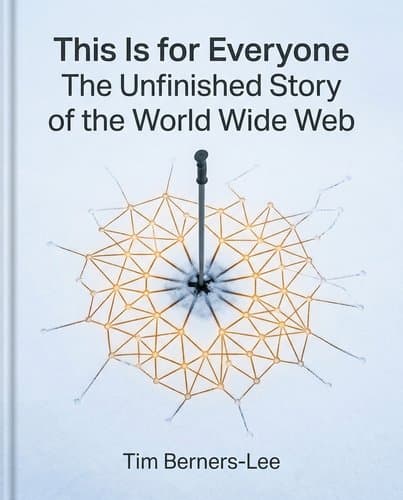
Meryl Dalitz was trying to enjoy a day on the ski slopes. Tim Berners-Lee had other ideas. At some point during what was meant to be a peaceful outing in the Swiss mountains, he stopped, picked up a ski pole, and began drawing in the snow — tracing out the architecture of what would become the World Wide Web. Meryl could not follow the diagram. What she could read, clearly enough, was his urgency.
The man sketching information systems in melting snow was not a Silicon Valley founder. He had no patents, no investors, no management experience. He was a thirty-four-year-old programmer at CERN, a particle accelerator in Geneva whose actual mission was to smash protons together and study the debris. His job was keeping CERN's computers talking to each other across a 27-kilometer underground tunnel. The web was not his assignment.
The frustration that drove him to that ski slope had a specific origin. CERN was a gathering of scientists from more than twenty countries, all chasing the same physics, and they could not share information with each other in any reliable way. One researcher's accelerator calibration data sat in a French-language Unix directory; another's lived on an 8-inch floppy disk in a locked cabinet; a third's was buried under a coffee cup on a desk in German. The only system that actually worked was the standing-height coffee table near the facility's machine room. You learned how to operate a piece of equipment by physically intercepting the person who ran it mid-conversation, getting an introduction to whoever else you needed, and hoping they happened to walk by.
Berners-Lee looked at that informal human network — serendipitous, multilingual, surprisingly effective — and asked whether software could do the same thing. Not organize information into tidy folders and hierarchies, but capture the sprawling, associative way knowledge actually moves between people. His prototype program, which he named Enquire after a Victorian household encyclopedia on his parents' bookshelf, linked any two pieces of information to each other without forcing them into predetermined categories. It looked less like a filing system and more like the coffee table conversations it was trying to replace.
The idea he was drawing in the snow was that insight, scaled to the entire internet.
The Gift That Created the Trap: Why Giving the Web Away Was Both Heroic and Catastrophic
Here is the uncomfortable truth about the most generous act in computing history: giving something away for free does not make it safe. On April 30, 1993, CERN's director of research Walter Hoogland signed a declaration releasing every line of Berners-Lee's web code — the protocols, the server, the browser — into the public domain. No royalties. No restrictions. Anyone could use it, modify it, build on it. The decision was heroic, and it was also the moment the web became impossible to protect.
The lesson that pushed Berners-Lee toward that declaration came from watching a competitor die in real time. Gopher, a rival navigation protocol that was actually more popular than the web as late as 1993, was killed not by a lawsuit or a superior technology but by a single announcement. The University of Minnesota, which ran Gopher, hinted that it might someday charge licensing fees. It never did. But the suggestion alone was enough. Users fled immediately and the technology collapsed. The internet's early culture treated freedom from cost as something closer to a moral absolute than a preference. Berners-Lee understood the message: the web had to be free, legally and permanently, or it would face the same sudden death.
So he pushed CERN to give everything away, and the web survived and spread precisely because no one could be charged for using it. That openness dissolved every barrier to adoption. A teenager in Finland, a librarian at Stanford, a student in Illinois — all could build on the same foundation without asking permission. The web grew because it belonged to everyone.
But belonging to everyone also meant belonging to no one in particular — including no one with the authority to prevent its architecture from being captured. The same open protocols that let Justin Hall post bootleg recordings of Jane's Addiction from his college dorm also let any corporation insert itself between every user and every page, hoarding the behavioral data that clicked through those royalty-free hyperlinks. Openness at the protocol layer created a vacuum at every layer above it. The web had no landlord, which meant it had no locks. What filled that vacuum — the advertising platforms, the surveillance infrastructure, the attention economy — was not a betrayal of the web's design. It was, in the most unsettling sense, a fulfillment of it.
The Sliding Doors Moment That Changed the Entire Internet
In 1992, Berners-Lee packed his NeXTcube into boxes and drove it to a developers' conference in Paris, hoping to show Steve Jobs the World Wide Web. He set up at a folding table in the exhibition hall alongside dozens of other hopeful developers, loaded his browser, and waited. Jobs worked the room slowly, pausing at each table. He was almost there — a few steps away — when an aide leaned in and whispered something. Jobs turned and walked out. He never came back.
Berners-Lee, recounting this decades later, still sounds genuinely deflated. But his regret isn't personal vanity. Jobs had built the NeXT computer around what he called 'interpersonal' computing — technology that connected people rather than just processed data. The web was, as Berners-Lee puts it, the NeXT's killer application: the actual fulfillment of that promise. Jobs would have understood it instantly, just as the first people to see a demo always did. From that recognition, anything might have followed — Jobs's design sensibility woven into the web's early DNA, NeXT instead of Apple as the dominant platform, a version of the web shaped by someone who cared obsessively about elegance.
What makes this more than wistful speculation is what the chapter keeps showing you: the web's trajectory depended on a cascade of decisions and accidents, any one of which could have branched differently. Gopher, a rival protocol that was actually more popular than the web as late as 1993, died because a university merely hinted it might charge licensing fees someday. Marc Andreessen's team at Illinois came within a meeting of successfully rebranding the web as 'Mosaic,' burying Berners-Lee's name entirely. Al Gore pushed through $600 million in congressional funding that paid for the browsers that brought the web to ordinary people — and was then mocked for years over a quote that was simply misreported.
The web felt inevitable in retrospect. It wasn't. It was a series of near-misses pointing in every direction at once, held together by specific people making specific choices at specific moments — and, occasionally, by an aide arriving a few seconds too early.
The Third-Party Cookie Was a Trojan Horse, and Everyone Let It In
Surveillance capitalism is not what greed looks like when it invades the internet. It is what happens when one small design decision, made without malice, compounds for thirty years without correction.
When Netscape introduced the cookie during the first browser war of the mid-1990s, it was sold as a convenience feature. Without cookies, you would have to re-enter your password every time you visited a site. That part was true and genuinely useful. But Netscape's implementation went further: third-party cookies could be planted on your browser not by the site you were visiting, but by any advertiser whose code happened to run on that page. When you left, those cookies left with you, invisible stowaways tracking where you went next and what you clicked. The architecture had a new purpose — not helping you remember your login, but helping someone else remember you.
Berners-Lee is precise about what this replaced. His original web tools contained no mechanisms for collecting user data at all. That wasn't an oversight. It was a design principle: the web was a place to find and share information, not a surface for gathering behavioral intelligence about the people using it. The cookie quietly inverted that. Users became the observation subject; their movements, preferences, and anxieties became the product.
How far that logic eventually ran can be measured against a single list. By 2016, Facebook's advertising platform offered hundreds of targeting categories for purchase — not just age and location, but whether you were pregnant, whether a friend had recently divorced, whether you were a conservative trying to pass as a liberal, and how often in the past year you had searched the phrase 'am I dying.' Berners-Lee cites that last one without editorial comment. It doesn't need any. The URL you type in a medical panic was always meant to connect you to information. It was never meant to be a data point in a commercial profile.
The mechanism that made this possible is specific and nameable: third-party cookies, engagement algorithms that optimize for attention regardless of what holds it, and data silos that trap everything you generate inside a single corporation's servers. None of these are laws of nature. They are engineering choices, made at particular moments by particular companies. The data since collected is stark: teenagers averaging 4.8 hours of social media daily face double the rates of anxiety and depression. Berners-Lee's counter-proposal — a system he calls Solid, built around personal data stores that you control — proceeds from exactly this logic. If a design decision created the problem, a different design decision can undo it. The cookie was a Trojan horse. But Trojan horses can be sent back.
What a rebuilt web might actually look like is easier to see if you start with a structure that has lasted two and a half millennia — and ask what it got right that we didn't.
The Same Open Door That Let In Justin Hall Let In the Doom-Scroll
What if the thing Berners-Lee designed the web to do is exactly the thing now destroying it?
In the autumn of 1994, AOL opened its service to the public internet, and every informal norm that had governed online discourse since the beginning — a kind of academic civility its practitioners called netiquette — dissolved overnight. Seasoned users called it the Eternal September, because each September a new university cohort would flood onto the internet and need weeks to absorb the culture. The AOL moment was a September that never ended. What replaced netiquette was, in Berners-Lee's own description, something raucous, funny, and crude. He loved it. His protocols had been designed for exactly this kind of messy human energy. A freshman named Justin Hall proved the point immediately, building what may have been the first blog from his dorm at Swarthmore — bootleg Jane's Addiction recordings, a photograph of Cary Grant reportedly on acid, personal diary entries nobody had asked for. The democratic opening had done its job.
Now trace that same opening forward thirty years. The mechanism never changed. What changed was who was optimizing for it, and why. The early blogosphere ran on hit counters — you could see how many people had read your post, which made you want to write something worth reading. Platforms inherited that psychology and industrialized it: the hit counter became the like button, the like button became a training signal, and the training signal taught an algorithm that human attention sticks longest to content that makes people angry or afraid. Surgeon General Vivek Murthy has since measured the result: teenagers averaging 4.8 hours of social media daily face double the rates of anxiety and depression compared to lighter users. The Eternal September produced Justin Hall. The same mass adoption, run through the same appetite for engagement, produced doom-scrolling. Berners-Lee calls this a design issue, not a human failing — a precise distinction. The opening was not the mistake. What was placed inside it was.
Flying Over the Parthenon, Wondering If Civilization Is Locked In
Ten of them flew to Athens in August 2001 for the funeral of Michael Dertouzos, the MIT lab director who had made so much of the web's institutional life possible. Seated next to W3C chairman Jean-François Abramatic as the plane crossed the Aegean, Berners-Lee found himself peering down at the Acropolis and asking, almost involuntarily, whether liberal democracy might now be permanent — whether a civilization built on networked information had finally made authoritarianism structurally obsolete. Abramatic said yes. Of course yes. Technology and democracy were growing in concert; another dark age was simply unimaginable.
Five days later, they were sitting in a library in Cambridge, Massachusetts, running through W3C strategy, when someone interrupted to say the Twin Towers were coming down. They found a news stream and watched. When it was over, Abramatic turned to Berners-Lee and said, quietly: 'I take it back — about civilization being locked in.'
That exchange is the engine underneath everything Berners-Lee built afterward. Not rage at bad actors, not techno-optimism about the next protocol, but genuine, unresolved uncertainty about whether the open web was a stabilizing force or just another communications technology that could go either way — like the printing press, which delivered both the Reformation and centuries of religious war, or radio, which carried both the BBC and Goebbels.
The Contract for the Web, published in 2019 on the web's thirtieth anniversary, reads differently once you understand that. Its nine principles — split between governments, companies, and citizens — aren't the confident policy agenda of someone who knows how the story ends. They're closer to a treaty drawn up by someone who knows it might not. One principle asks governments to keep the internet running continuously; its target was regimes like Iran's, which blacked out the network for a week in 2019 to prevent protest coordination. Another sets a specific affordability threshold — one gigabyte of mobile data costing no more than two percent of average monthly income — and that goal has now been met in Tanzania, where a gigabyte runs to about eighty-four cents. Measurable, achieved, real.
Berners-Lee is not a pessimist. But he is something more useful: a person who has stopped assuming that good outcomes are the default trajectory of complex systems, and started treating them as things you have to fight for, continuously, with specific tools. That uncertainty — held honestly rather than resolved prematurely — turns out to be the clearest thing in the book.
Your Data Is Not the App's Data: The Specific Fix Berners-Lee Has Been Building for a Decade
Imagine you stored your money not in a bank account you controlled, but scattered across dozens of separate vaults — one owned by the supermarket where you shop, one by the insurance company, one by a search engine — and each vault's owner could inspect your balance, charge you for access, and sell the information to anyone willing to pay. That is, more or less, exactly what happens to your personal data today. Bruce Schneier calls this arrangement 'digital feudalism': corporations hold your information as landlords hold property, and you are a tenant with no lease.
The fix Berners-Lee has been building, a protocol called Solid, is the architectural reversal of that arrangement. Instead of your data living inside Facebook's servers or Google's servers or your hospital's servers, it lives in a personal store — he calls it a pod — that you own and control. Apps don't receive your data; they request access to it, on terms you set, which you can revoke at any moment. The data stays put. The permissions travel.
Solid is not vaporware. In Flanders, the Dutch-speaking region of Belgium, Minister-President Jan Jambon — a former IBM executive who understood the technology well enough to stake his region's digital infrastructure on it — recorded a video in 2020 telling 6.5 million people that their interactions with regional government would now flow through personal data pods. A joint venture called Athumi, operated in partnership with Berners-Lee's commercial venture Inrupt, runs the infrastructure. Every Flemish resident who uses a government service has a pod. It works the way broadband works: a utility, not a product.
The difference between that model and the current one becomes clearest in a demonstration Inrupt ran internally in late 2024. An AI assistant called Charlie was asked a simple question: what running shoes should I wear? In default mode, with no personal data, it returned generic advice about arch support and heel cushioning — the same answer it would give anyone. Then the engineers switched it to personal mode, granting Charlie temporary access to fitness and financial data stored in a private pod. It named two specific shoes, with detailed reasoning grounded in the person's actual gait patterns and spending range. The data never left the pod. No advertiser saw the query. No shoe company was invited to bid on the recommendation. Charlie was working for the person asking, not for whoever had purchased the right to intercept the question.
Berners-Lee calls the gap between those two modes the difference between the attention economy and the intention economy. One monetizes your distraction; the other serves your actual goal. The distinction sounds philosophical until you see it running in production in Belgium.
The Ski Pole and the Pod
The man who drew a network in the snow was not trying to build a platform. He was trying to capture something he already observed: that the connections between people matter more than any single node in the system. Thirty-five years later, Solid is that same conviction rebuilt with scar tissue. He gave the first web away and watched the open space fill with surveillance. He is building the second one knowing that openness is not a shield — it is an invitation that requires active governance to keep it honest. Whether that governance arrives in time is not a rhetorical question. Abramatic standing at a news screen in Cambridge, quietly withdrawing his confidence in civilization's trajectory, gave you the only truthful answer available. The outcome is open. Which means someone, somewhere, is drawing in the snow right now — and what they sketch next depends entirely on who is watching, and whether they are paying attention.
Frequently Asked Questions
- What is This Is for Everyone about?
- This Is for Everyone traces how specific design decisions in the web's original architecture enabled surveillance capitalism—and how those decisions can be reversed. Tim Berners-Lee explains the technical origins of data exploitation, from third-party cookies to centralized platforms, and outlines a concrete alternative built around user-controlled data pods and the Solid protocol. The book argues that understanding which design decision created which vulnerability is more useful than blaming 'tech companies' in the abstract. It presents both the problem and a workable solution for a more open internet.
- How did the third-party cookie enable surveillance capitalism?
- The third-party cookie, not corporate greed, is the architectural origin of surveillance capitalism. It was introduced by Netscape as a convenience feature during the browser wars and was never part of Berners-Lee's original design. Naming it means we can reverse it. This reveals that surveillance capitalism wasn't inevitable from the web's beginning—it resulted from a particular technical decision made under specific commercial pressures. The significance is that the problem becomes solvable through architectural changes and technical design choices rather than relying on corporate ethics or government regulation alone.
- What is the Solid protocol and the intention economy?
- The 'intention economy' is a concrete alternative to the attention economy, not a slogan. It requires a data architecture where your information lives in a pod you control, AI agents access it only with your permission and for your stated purpose, and no third party can monetize the query. Solid is the working protocol. Flanders has deployed it for 6.5 million citizens, demonstrating that the concept can scale to serve millions of users. This architecture shifts control from centralized platforms to individual users.
- What are the key design decisions that shaped the web's vulnerabilities?
- The web's most consequential design decisions were made not by committees but by one person under deadline pressure—including the double slash, the DNS anchor, and the royalty-free protocol. Each created both the web's universality and its specific vulnerabilities. Understanding which design decision created which vulnerability is more useful than blaming 'tech companies' in the abstract. Donating the web to the public domain in 1993 saved it from becoming a walled garden but simultaneously made it ungovernable, requiring active governance infrastructure to remain open.
Related Book Summaries
Read the full summary of 222376492_this-is-for-everyone on InShort