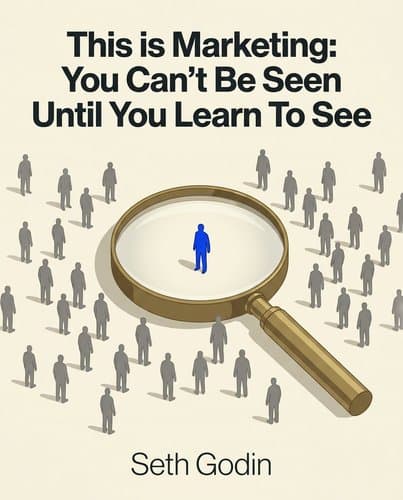
40549476_this-is-marketing
by Seth Godin
Great marketing isn't about reaching everyone—it's about finding the fewest people who specifically need your change and having the courage to serve only them.
In Brief
Great marketing isn't about reaching everyone—it's about finding the fewest people who specifically need your change and having the courage to serve only them. Godin teaches you to sell the emotion underneath your product and claim the market corner your competitors are too afraid to own.
Key Ideas
Know Exactly Who You're Serving
Before writing a word of copy, finish this sentence specifically: 'My offering is for people who believe ___ and want ___.' If you can't complete it with a real person in mind, you're not ready to market — you're still making the key before you've found the lock.
Start With Your Minimum Viable Audience
Name the smallest number of people whose enthusiastic support would make your project viable — not 'everyone,' not 'anyone who might be interested,' but a real minimum. Build exclusively for that group before expanding.
Find What You're Actually Selling
Ask 'what does this enable emotionally?' five times in a row about your product, going one layer deeper each time. Stop when you hit something like safety, respect, belonging, or control. That last answer is what you're actually selling — and what your marketing should be organized around.
Claim Your Differentiated Market Position
Locate your offering on an XY grid by picking two attributes your specific audience cares about, plotting every alternative, and finding the unclaimed corner. The most-populated quadrants are where differentiation is hardest; the overlooked edges are where you can be the clear and obvious choice.
Keep Brand and Direct Spending Separate
Separate brand spending from direct spending completely, and never mix them. Direct ads must be measured — cost per click, cost per order, lifetime value math — and only run if the numbers are positive. Brand ads must be patient and unmeasured. Confusing the two is how most marketing budgets quietly disappear.
Make Sharing Boost Social Identity
Before finalizing any product, service, or piece of content, ask: what does someone gain in status or identity by telling their friends about this? If the answer is nothing, you haven't designed for word-of-mouth — and you'll have to pay for every customer you ever get.
Go Deeper With Believers First
Identify your version of 1,000 true fans — the people who would genuinely miss you if you stopped — and serve them more deeply before trying to reach anyone new. Going deeper for existing believers almost always outperforms going wider for strangers.
Who Should Read This
Business operators, founders, and managers interested in Marketing and Branding who want frameworks they can apply this week.
This is Marketing: You Can't Be Seen Until You Learn To See
By Seth Godin
9 min read
Why does it matter? Because your instinct to reach more people is exactly what's keeping you invisible.
Most marketing advice shares the same diagnosis: the problem is reach. Not enough people know about you. Buy more ads, grow the following, get in front of more eyeballs, and the rest takes care of itself.
Godin's first move cuts that assumption off at the source.
More reach doesn't fix the problem. It amplifies it. Every dollar spent chasing attention before you can answer two questions is wasted: Who, specifically, is this for? What specific change are you trying to make in their life?
Until you can answer both — precisely, uncomfortably specifically — you're not ready to market anything. You're just making noise at scale.
This book will make you feel like you've been doing marketing backwards. You have been. So has almost everyone else. That's not an insult. It's where this starts.
Every Marketing Problem Is Really a Change Problem
The goal isn't attention. It's a specific change, for a specific person. The ads, the followers, the press hits come after — if they come at all. Most people start there anyway.
Seth Godin's argument is about sequence. Most people build the product first, then go hunting for buyers. He runs it backward: find who needs something, then build what they need.
Penguin Magic built its entire business on finding the buyer before building the product. The old magic shop was a dim storefront struggling for customers. Penguin started with a precise observation: professionals don't drive the magic trick market, because they perform for different audiences every night and need only a small repertoire. Amateurs are the market. They face the same friends and family every time, which means they need a constant supply of new material. That single insight shaped everything Penguin built.
Every trick on the site is demonstrated in a video that shows the effect but withholds the method. The secret is the product. The video creates desire; the purchase resolves the tension. Those demonstration videos have been watched over a billion times, at zero distribution cost. Reviews are written not by anonymous internet users but by practicing magicians — a demanding crowd that makes the ratings credible. Hundreds of community lectures and live conventions keep the whole ecosystem self-reinforcing.
Godin's point is that Penguin never separated product from marketing. The withheld secret creates tension. Peer review builds trust. The convention floor builds belonging. The product did the marketing from day one.
Change follows fit. Attention follows change. The sequence matters.
The Smallest Audience You Can Survive On Is the Only One Worth Chasing
A teaspoon of thief-detector dye turns an entire swimming pool permanently bright purple. The same teaspoon dropped into the ocean vanishes.
Your message works the same way. The ocean doesn't notice.
Find the smallest body of water you can survive in, then drop the dye there. The Grateful Dead found theirs.
By every conventional measure, the Dead should have been forgotten. They had one Top 40 Billboard hit across their entire career. While the Turtles and the Doors racked up radio plays, the Dead were playing marathon sets for a few thousand devoted followers. In 1972 (a year Godin considers a creative peak), the average Dead show drew five thousand people. For over a decade, they watched other acts outsell them without changing their approach.
Then comes the accounting: $350 million in concert revenue during Jerry Garcia's lifetime, another $100 million after his death, most of it at an average ticket price of $23.
The Dead built for the smallest viable audience and made that audience the engine of growth. They encouraged fans to record their shows — radical at a time when most acts viewed bootlegs as theft. Those recordings spread hand to hand, pulling in new listeners who then had to see the band live, because the tapes made you feel you were missing something essential. True fans supported the Dead completely: following the tour, buying everything, converting everyone around them.
Kevin Kelly, founding editor of Wired, later named this pattern: a thousand true fans. People who clear a weekend for your tour date, who buy whatever you announce before they know what it is. A thousand of them is enough to sustain a creative career. The math compounds because a true fan doesn't just mention you — they drag someone to the show, hand over the recording, make it personal. The person they recruit tends to become a true fan for exactly the same reason. Most people trying to build something skip this stage entirely, contorting themselves for anonymous masses before they have fifty people who would miss them.
In 1972, five thousand people at a show. A decade later, an American institution. That only happens when you've built something unmistakably for people ready to move like that. Somewhere in your market, those people exist. You've been passing them over to chase people who will never care as much.
No One Has Ever Actually Bought a Quarter-Inch Drill Bit
A village in rural India, midday heat. Godin and a small team have set up a table for VisionSpring, a social enterprise selling reading glasses at three dollars a pair, manufactured for two.
The setup seems foolproof. Many visitors are past the age where close vision starts to blur. Most aren't wearing glasses. Through the sheer fabric of their traditional shirts, Godin can see rupees in their pockets. Each person tries a sample pair and sees immediately. The price is low. The supply disappears in an hour.
And still, two out of three walk away without buying.
Godin sat in the sun for an hour. Then he made one change: he removed all the glasses from the table. Instead of inviting customers to choose from ten displayed styles, he handed each person a working pair. "Pay us three dollars if you want to keep them. Otherwise, hand them back." That single change doubled sales.
The deeper failure was subtler. Godin had been staging an experience for someone who finds shopping pleasurable: browse, compare, choose. For people in genuine poverty, buying something new is a risk that can cost dinner. Shopping as fun is a story the comfortable tell. He had imported his own narrative without knowing it. The lesson: any story that stops working belongs to the teller, and insisting on it anyway is a form of arrogance.
Harvard Business School professor Theodore Levitt said people don't want drill bits — they want holes. Godin keeps asking why. The hole enables a shelf. The shelf enables a tidy room. The tidy room enables calm. Building it yourself yields a sense of competence and respect. Keep pulling the thread and you land not on a product feature but on a feeling — the desire to be capable and at peace.
The product is just the road. The destination is always a feeling.
Two mistakes follow from missing this. The first is assuming people make rational choices, weighing features and price to optimize utility. The second is assuming they share your narrative about what a purchase means. Godin didn't just sell the wrong glasses. He was telling the wrong story to people he'd never actually listened to.
The Six Words That Explain Every Purchase Decision
Why did a school budget fail in a small New York town, then pass two to one just eight days later, with no new arguments made, no new facts presented?
Godin names the question everyone is actually asking, usually without saying it aloud: "Do people like me do things like this?" His claim is that this question, unspoken and often unconscious, precedes virtually every meaningful decision a person makes. Identity comes before logic.
When the vote failed, a group of activists had eight days until the revote. They abandoned flyers and rallies. Instead, they tied a hundred blue ribbons to a tree outside the middle school at the center of town.
Within days, families across town were hanging blue ribbons from their own trees. Thousands of ribbons. Dozens of families who had stayed quiet through the entire political debate. The message was purely tribal: people in this town, in this Blue Ribbon district, support their schools. The budget passed two to one.
The ribbons changed one thing: the visible answer to a question everyone in town was already asking. What do people like us do here? Once that settled, behavior followed.
Godin names the engine running underneath: status. Nobody in that town was reasoning toward a conclusion. They were watching their block. The ribbons didn't change the argument. They changed where everyone stood relative to the community around them. Status is always relative, always perceived, and always moving.
He draws a sharp distinction between two modes. Dominion is hierarchical: who has more, who ranks above whom. A young Maasai warrior killing a lion was running on dominion. The act elevated his standing among the men in his village. Affiliation is lateral: am I in sync with the people I want to be like? The family hanging a blue ribbon was running on affiliation. The act said: I belong here. Different people run different clocks, often in the same room, and reading which one your audience is measuring is the first job of any marketer who wants to make change.
Change also requires tension, but a specific kind. Fear paralyzes. Tension is different: a gap under pressure that only closes by moving forward. Every day someone remains outside a group that people like them have joined, the gap is felt. The only release is motion. What the activists did was make the gap visible — this is what people in this town already do — creating a small, solvable pressure that only showing up could relieve.
Three gears turning together: identity drives the question, status gives the question its charge, tension converts the charge into action. The activists changed a vote without winning a single argument. That's the work.
You Can't Buy the Trust That Makes People Talk About You
Every Friday morning in 2015, Tuma Basa updated a Spotify playlist called RapCaviar. Within months, three million people were waiting for it. Within three years, nine million.
Spotify hired him to compete with Apple's DJ-curated playlists. What he built instead was something neither company had planned for: a permission asset. Nine million listeners who had opted in, who expected to hear from him, who checked on Friday mornings like a ritual. When Basa added Cardi B before anyone knew who she was, those nine million people who trusted his ear passed her along. Trust transfers. Spotify owns no radio spectrum, no printing press. They own the right to show up in nine million people's lives, welcomed and expected.
Permission works like this: make a promise and keep it. Basa's was simple: the next important thing in hip-hop, every Friday. Listeners don't just stay; they become distribution. When a friend asks what to listen to, a RapCaviar subscriber says "I have exactly the thing." The word travels horizontally, and each transmission carries the subscriber's credibility along with it.
People don't spread what matters to you. They spread what makes them look good. "Look at my taste." "Look at what I spotted first." When someone recommends RapCaviar to a friend, they're showing the friend something about themselves: plugged in, ahead of the curve, worth listening to. The spread happens because it benefits the person spreading.
Evangelism has to be designed in from the start. Slack understood this structurally: the software is more useful when your colleagues are on it, so existing users have a selfish reason to recruit. The message that converted holdouts wasn't a campaign — it was one coworker saying "you're missing out." True, and felt. The only way to close that gap was to sign up.
Attention is available for purchase. Trust isn't — and it's the one that multiplies. The design question is: what does the person who spreads this gain by spreading it?
Not Sharing What You Could Offer Is a Form of Theft
Hesitating to share your work isn't modesty. It's a choice to deprive someone of something they need.
Godin's logic is simple and a little uncomfortable: if your offering is genuinely worth more than what you charge (if it weren't, no one would buy it), then every person you don't reach has lost a bargain. The student who never found your class. The manager who never saw the tool that would have saved her. Not offering isn't neutral. The gap between what you had and what they needed is a cost they paid without knowing it.
The fear underneath hesitation feels personal: the worry that sharing means being judged, and judgment means being found wanting. Godin says this is a category error. When a potter's work breaks in the kiln, that's information about the clay or the temperature or the technique. It's not a verdict on the potter. Marketing failure works the same way: wrong story, wrong person, wrong channel, wrong moment. These are craft variables. They can be adjusted.
The good-enough chain makes this concrete. Good enough ships. Shipping creates engagement. Engagement builds trust. Trust opens the door to learning, then to promises, then to people who keep showing up. Perfection skips this entire sequence by refusing to start it. That's not higher standards. It's a way of avoiding the risk of being seen. And while you're waiting to be ready, someone who needs what you have is still waiting.
The obstacle is a story you're telling yourself. "I'm not ready." "It could be better." "No one is asking for this." These feel like honest assessments. They're marketing — aimed at yourself. Change the story and you change what's possible.
Ship. Then make it better.
The Story You Keep Telling Yourself About Your Work
The question you've been asking — how do I get more people to notice me? — is the wrong question, and Godin knows why it feels so natural. It centers you. It makes the work about your visibility instead of someone else's need. Swap it for a harder one: what specific change do I want to make, and who is already waiting for someone to make it? That question points outward, toward a real person with a real problem. When you find that person, the story isn't about you anymore. It's about the gap between where they are and where they want to be, and whether what you're offering closes it. That's the whole job. Everything else is noise you convinced yourself was signal.
Notable Quotes
“People like us do things like this”
“can focus your actions and help you deal with the nonbelievers (in your head and in the outside world). Change is best made with intent.”
“We're not supposed to say that. We're certainly not supposed to want to say that. But we must.”
Frequently Asked Questions
- What is This is Marketing by Seth Godin about?
- This is Marketing reframes marketing as finding your smallest viable audience and serving them with precision instead of broadcasting to everyone. The book teaches you to identify who specifically needs what you offer, what they're really buying beneath the surface, and how to earn their trust and word-of-mouth rather than pay for attention. Drawing on strategy, psychology, and brand-building principles, Godin argues that before you can be seen, you must learn to see—understanding your audience deeply is the foundation of effective marketing. The approach emphasizes serving a specific group exceptionally well before expanding to new markets.
- How do you identify your target audience in This is Marketing?
- In This is Marketing, Seth Godin emphasizes specificity as marketing's foundation. "Before writing a word of copy, finish this sentence specifically: 'My offering is for people who believe ___ and want ___.' If you can't complete it with a real person in mind, you're not ready to market — you're still making the key before you've found the lock." Identify your smallest viable audience—the minimum number of people whose enthusiastic support makes your project viable—and build exclusively for them first. This precision-first approach eliminates wasted effort on broad appeals.
- What are the key takeaways from This is Marketing?
- This is Marketing teaches how to build effective marketing around your specific audience. Key principles include identifying people who believe certain things and want certain outcomes, defining your smallest viable audience, understanding the emotional drivers behind purchases, and positioning your offering where it faces least competition. The book also separates brand and direct marketing spending, emphasizes designing for word-of-mouth so people gain status from sharing, and focuses on serving your "1,000 true fans" deeply before reaching new audiences. Each principle connects to the core idea that precision-targeted marketing beats broad broadcasting.
- Who should read This is Marketing by Seth Godin?
- This is Marketing benefits anyone responsible for promoting a product, service, or idea—from entrepreneurs and small business owners to marketing professionals and nonprofits. The book speaks especially to those frustrated by traditional advertising approaches or looking to build sustainable, word-of-mouth-driven businesses. Godin's framework works for anyone struggling to define their audience or position their offering clearly in a crowded market. Whether you're launching a startup, rebranding an established business, or trying to break through marketing noise, the book provides actionable frameworks for precision-targeted marketing. It's particularly valuable for those skeptical of paid advertising's efficiency.
Related Book Summaries
Read the full summary of 40549476_this-is-marketing on InShort