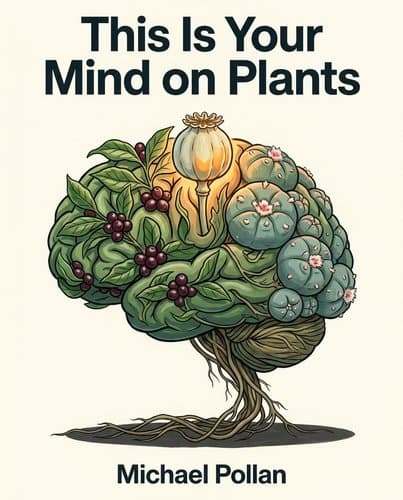
56015023_this-is-your-mind-on-plants
by Michael Pollan
Caffeine built the Enlightenment, opium makes surgery possible, and psilocybin is entering FDA trials—yet governments criminalize molecules based on political…
In Brief
Caffeine built the Enlightenment, opium makes surgery possible, and psilocybin is entering FDA trials—yet governments criminalize molecules based on political fear, not pharmacology. Pollan dismantles the arbitrary line between drug and food, exposing who really controls your right to alter your own mind.
Key Ideas
What gets banned shows political fear
Check what your government permits versus bans — the list reveals who those in power feared, not what those molecules do to a body. The FDA's definition of 'drug' is circular; the real sorting mechanism is political.
Forfeiture seizes assets before conviction
Civil asset forfeiture means the government can seize your home for a drug offense without charging you with a crime. The standard of proof is preponderance of evidence, not beyond reasonable doubt — a fact worth knowing before you assume the legal system is tracking harm.
Consciousness alteration is universally human
The desire to alter consciousness is universal across every known human culture and tens of thousands of years of history. Moral frameworks that treat it as weakness or sin are at war with the archaeological record.
Drug ideas occasionally reshape civilization
The 'cultural mutagen' frame is a useful tool: most drug-inspired ideas are noise, but the signal — when it appears — has occasionally reshaped civilization. Caffeine may have helped produce the Enlightenment. Psilocybin is now in FDA trials for depression. The categories keep moving.
Politics determines poison and medicine
The pharmakon — medicine, poison, scapegoat — is the honest frame. The same opium that causes overdose deaths makes surgery endurable. The same psilocybin that can unravel a mind is entering clinical trials. The molecule doesn't know which category it's in; only the politics do.
Who Should Read This
Science-curious readers interested in Neuroscience and Policy who want to go beyond the headlines.
This Is Your Mind on Plants
By Michael Pollan
10 min read
Why does it matter? Because the word "drug" tells you more about power than about chemistry.
Most people assume the government drew these lines somewhere near the science — that the FDA has put morphine on one side and coffee on the other because pharmacology demanded it. This turns out to be wrong in a precise, almost comic way. The FDA's own legal definition of a drug is circular. What actually predicts a molecule's legal status has almost nothing to do with its toxicity — it has to do with who is taking it, and what disruption their altered state might cause to people who hold power. Once you notice this, the word "drug" stops being a neutral description. It becomes a political act. And you start asking what else we've handed over without noticing — starting with the question of who gets to ask.
What You're Allowed to Put in Your Mind Depends on Who You Are, Not What the Molecule Does
What the categories actually track is political fear. Consider peyote. The cactus produces mescaline, a hallucinogen Indigenous communities across North America have used ceremonially for centuries — in structured rituals, under the guidance of elders. Federal law treats this as protected religious practice: Native Americans may use peyote in their ceremonies under the First Amendment. Anyone outside those tribal communities possessing the same cactus commits a federal felony. Same molecule. Same ceremonial context. Different person — different crime. The law draws a social boundary, not a chemical one.
Drug law answers a question about social order: who is using this substance, and does that threaten the people in charge? Caffeine sharpens workers, lifts productivity, keeps the economy moving — so coffee flows freely through every airport and office on earth. Psychedelics, by the 1960s linked to people rejecting authority and social norms, were banned. The pharmacology of neither changed. The politics did.
That same logic is now reversing for psychedelics. Psilocybin is still Schedule I — officially, no accepted medical use, high abuse potential — while researchers show it can treat depression and end-of-life anxiety. Oregon legalized psilocybin therapy in 2020; FDA approval looks increasingly likely. The reclassification, when it comes, will arrive by regulatory pen stroke, not new chemistry.
What these molecules actually do inside a human brain turns out to be the stranger and more interesting story.
Plants Spent Millions of Years Building These Molecules as Weapons — Then Offered Them as Gifts
Imagine designing a defense system when you can't move. A plant can't flee what eats it, so it fights with chemistry: alkaloids accumulate in its tissue, bitter enough to send most predators looking elsewhere. Caffeine, morphine, mescaline: all began this way, as unwelcome surprises for anything that tried to eat the plants producing them.
But lethality turned out to be a bad strategy. A toxin that kills every caterpillar it touches quickly selects for the rare caterpillar with a mutation conferring resistance. Within a few generations, the plant faces descendants immune to its poison. Evolution favored plants that developed subtler weapons: molecules that disrupt animal cognition rather than shut it down entirely. Confusion and disorientation don't select for resistant pests the way death does. These molecules reliably scramble the nervous systems of the creatures that eat them, making those creatures less likely to return, without generating the evolutionary pressure that outright lethality would.
Then caffeine made a turn that upends the whole picture. Certain flowering plants (some coffee relatives among them) put caffeine not in their leaves or bark but in their nectar. Nectar is an offering, the sweetness a plant produces specifically to attract pollinators. But at the doses delivered through nectar, caffeine doesn't harm bees — it sharpens their memory. Bees that drink caffeinated nectar remember visited flowers more reliably, making them more faithful and efficient pollinators. The plant had repurposed its weapon as a recruiting tool: a small dose of the same molecule, once a deterrent, now kept workers loyal and coming back.
You drink your morning coffee downstream of this relationship, which was already ancient long before humans appeared. Our neural architecture shares deep evolutionary roots with the nervous systems these molecules were designed to disrupt. They weren't built for us. We walked into a mutualism that plants and insects had been refining for tens of millions of years, and found that it worked on us too — sometimes as poison, sometimes as pleasure, sometimes, improbably, as medicine.
If the Desire to Alter Consciousness Is Universal Across Every Culture, It Cannot Be a Character Flaw
What would it mean if the urge to alter consciousness turned out not to be a character flaw, a weakness, or a sign of cultural decay — but instead something closer to a biological expectation?
Every known human culture has found at least one plant or fungus that changes the mind. Not most cultures. Every one. That's the kind of pattern evolutionary biology takes seriously. Natural selection is ruthless about behaviors that cost fitness without returning it: if reaching for psychoactive plants reliably shortened lives, reduced reproduction, or weakened communities, the trait would have been culled from our lineage long ago. Its universal persistence is its own argument. The urge must be paying something back.
The Enlightenment offers a test case. When coffeehouses spread across Europe in the seventeenth century, they replaced taverns as the centers of intellectual life. The shift wasn't incidental. People who had been drinking alcohol through most of their waking hours switched to a stimulant that promotes focused, sequential, analytical thinking. Caffeine's arrival may have helped create the cognitive conditions for the Age of Reason. One molecule, applied at civilizational scale, possibly nudging history. No one planned it: a trade route opened, a taste spread, and the thinking of a continent shifted along with it.
That framing changes what's at stake in the drug war. Prohibition does more than restrict individual choices. It forecloses the cultural variation that occasionally, unpredictably, produces the next turn in human thought.
The Drug War Was Never About Drugs: A Writer's Living Room, a Civil Forfeiture Law, and a Confession
The abstract argument arrived at Pollan's door on a clear winter afternoon in 1996. Two criminal defense lawyers drove up to his farmhouse in Cornwall, Connecticut, ate lunch with Pollan and his wife Judith, then moved to the living room, where the senior attorney, in the measured cadence lawyers use when the news is very bad, explained what publishing the poppy essay would actually mean.
Pollan had expected to hear about a search warrant. What he heard was worse. Under civil asset forfeiture laws that Congress amended in 1984 and the Supreme Court had upheld, the federal government could seize his house and land without charging him with a crime or convicting him. The standard wasn't "beyond reasonable doubt" but a preponderance of evidence that the property had been involved in a drug violation. What would establish that preponderance? In the lawyer's judgment, the article alone would be enough. Seed order records would corroborate it. So would the poppies that had already dropped seeds and would come up the following spring whether Pollan wanted them to or not. His family's home could be "convicted" even if he never was.
The drug war's actual logic becomes visible here. We imagine it as a machine aimed at traffickers and dealers, at distribution networks and professional operations. What Pollan's afternoon in his own living room revealed was something different: a legal apparatus powerful enough to destroy a journalist's life for writing about gardening, with no trial required, structured so that publishing the act was legally equivalent to committing it. The article became a confession. The confession, an asset forfeiture case. The case, a mechanism for taking the house.
Pollan sat on his familiar sofa and understood he was no longer a journalist writing about plants. He was a defendant. He cut the recipe. He cut the description of the tea's effects. He copied those pages to a floppy disk, gave it to his brother-in-law for safekeeping, and didn't find it again for twenty-four years. It turned up under a daybed in his writing studio, on a Zip drive that needed a computer consultant with a basement full of obsolete equipment and a free piece of software called LibreOffice to open.
That same summer, while federal agents quietly pressured florists and seed companies to suppress information about ornamental poppies, a pharmaceutical company called Purdue Pharma, headquartered sixty miles from Pollan's garden in Stamford, Connecticut, launched OxyContin. Purdue's marketing assured doctors the drug was safer and less addictive than other opioids and pushed it aggressively for arthritis, back pain, and workplace injuries. The Sackler family, who owned the company, earned $35 billion. More than 230,000 people died of OxyContin overdoses, and four out of five new heroin users in the subsequent decades had started with prescription opioids. The legal drug built the crisis. The illegal gardener faced losing his house.
One of the men who designed the drug war had explained this two decades before Pollan planted his seeds. John Ehrlichman, Nixon's domestic policy adviser, went to federal prison for his role in Watergate. In 1994, two years before Pollan's poppies went in, he told journalist Dan Baum what the apparatus was actually for. Nixon's White House had two enemies: the antiwar left and Black communities. Making it illegal to be against the war, or to be Black, was impossible. But by associating those groups with marijuana and heroin, then criminalizing both heavily, the administration could do something functionally equivalent: disrupt communities, arrest leaders, break up meetings. "Did we know we were lying about the drugs?" Ehrlichman said. "Of course we did."
The law that put Pollan's house at risk was built on a lie that its architects freely admitted. What it actually protected — not public health, not community safety, but political arrangements — was hiding in plain sight, the same way the government insisted domestic opium was impossible to grow while a Connecticut gardener was doing exactly that, sixty miles down the road from the company that was building the real opioid crisis with full federal approval.
In the Darkened Room, No One Could Say Whether What Just Happened Was Medicine
Across a darkened living room, Pollan hears his wife Judith crying softly. She's somewhere he can't reach — not because the room is large, but because Taloma, their ceremonial guide, has forbidden speech. No words, no touch. He sits with his fourth cup of Wachuma, a mescaline-containing cactus brew, and listens.
Judith is working through her dead father's pain. She had met him in a previous medicine journey, and he'd told her she no longer needed to carry his burden. But she couldn't accept it. The weight had become part of her identity, woven into her relationship with her mother, her sense of who she was. Letting it go felt like losing herself.
Taloma pushes her: "We make the world with our words. Say it. Say the words right now." Judith can't.
So Taloma administers the tobacco ceremony, a juice shot directly into the sinus cavity. Judith's body seizes. Guttural sounds come from her throat. Her body sways in what Pollan describes, honestly, as looking like faith healing, while Taloma works her hands over Judith, ritualistically pulling out what she calls knots of bad energy.
Then at dawn, passing the talking stick, Judith says the words. The first time she says them in the future tense. Taloma catches it. Judith repeats them in the present tense. She smiles.
Something happened. Pollan witnessed it. He can't tell you what it was.
That uncertainty is the whole book compressed into one scene. Was the change Wachuma's mescaline dissolving the ego's grip? Was it the ritual — hours of ceremony, candlelight, shared breathing in the dark — creating a space where Judith could finally move? Was it Taloma's insistence on the present tense? Was it placebo? The answer is genuinely not available, and Pollan doesn't pretend otherwise. His self-experimentation isn't a confession of belief. It's a refusal to falsify the data by calling it one thing.
The Greeks called this irreducible ambiguity pharmakon: medicine, poison, and scapegoat. The third meaning is the strangest: the substance a society pins its pathology on, blamed for conditions that produced it. The same molecule, the same dose, all three at once. The opiates that killed fifty thousand Americans in 2019 are the same opiates that make surgery endurable and ease people through death. The word doesn't ask you to resolve which is true. It asks you to hold both.
The drug war's real cost wasn't only the arrests or the forfeitures. It was fifty years of refusing the pharmakon, insisting that molecules were simply good or bad, that the question had a clean answer. Judith in that darkened room, changed in some way that her husband witnessed and cannot explain, is what that clean answer was designed to make unspeakable.
The Question the Drug War Was Designed to Prevent You From Asking
The pharmakon doesn't ask you to pick a side. The same compound that ends a life in a parking lot holds a person still while their chest is opened, carries the dying gently toward the edge. That is not a contradiction. It is the molecule's actual nature, and the drug war spent fifty years making it illegal to notice.
What prohibition really cost wasn't freedom — it was clarity. The ability to ask: at what dose, in what context, with what intention, for whom? Those are the only questions that generate useful answers. The molecules were always just molecules. What we decided they meant was a choice about power, dressed up as chemistry — who got to use them, who got punished for it.
Those four questions were always the only ones that mattered. Everything else was what happens when you decide not to ask.
Notable Quotes
“of the crime of manufacturing opium regardless of whether I am ever charged, let alone convicted, of that offense. Under the civil forfeiture statute, the standard of proof is much lower than in a criminal prosecution; the government need only demonstrate”
“defend, indemnify you and hold you harmless from and against any and all costs, expenses and losses of any kind.”
“We are our own best healers,”
Frequently Asked Questions
- What is 'This Is Your Mind on Plants' about?
- Michael Pollan examines three psychoactive substances—opium, caffeine, and mescaline—to argue that the line between drug and food, medicine and poison, is political rather than pharmacological. He traces how governments regulate consciousness to serve power, not public health, and reveals what the history of these plants shows about the human drive to alter the mind. The book challenges conventional categories, demonstrating these distinctions are fundamentally political choices rather than scientific certainties about how molecules affect bodies.
- How does drug regulation serve political power rather than public health?
- Drug policy reveals political priorities, not pharmacological facts. What your government permits versus bans reveals who those in power feared, not what those molecules do to a body. The FDA's definition of 'drug' is circular; the real sorting mechanism is political. Civil asset forfeiture allows governments to seize property for drug offenses without criminal charges, using preponderance of evidence rather than beyond reasonable doubt. These mechanisms demonstrate that drug regulation maintains political control over consciousness, not public health protection.
- Is the desire to alter consciousness universal across human cultures?
- Yes, the desire to alter consciousness is universal across every known human culture and tens of thousands of years of history. This archaeological record contradicts moral frameworks treating consciousness-altering impulses as weakness or sin. Understanding this universal drive suggests it reflects something fundamental to human nature rather than indicating pathology or moral failing. Pollan argues this historical perspective should reshape how we regulate and think about psychoactive substances, challenging the premise that the impulse itself is aberrant or requires control.
- What is the pharmakon and how does it frame our understanding of drugs?
- The pharmakon—medicine, poison, scapegoat—is Pollan's honest frame for understanding psychoactive substances, capturing how the same molecule can fulfill all three roles. The same opium that causes overdose deaths makes surgery endurable. The same psilocybin that can unravel a mind is entering clinical trials. Pollan pairs this with the 'cultural mutagen' frame: most drug-inspired ideas are noise, but occasionally the signal reshapes civilization (as caffeine may have during the Enlightenment). The molecule doesn't know which category it's in; only the politics do.
Related Book Summaries
Read the full summary of 56015023_this-is-your-mind-on-plants on InShort