55835996_uncommon-sense-teaching
by Barbara Oakley
Re-reading feels productive but leaves nothing in long-term memory—the methods that seem most effective are neurologically the least effective.
In Brief
Uncommon Sense Teaching: Practical Insights in Brain Science to Help Students Learn (2021) exposes why common teaching methods — re-reading, passive note review, and block practice — fail to build lasting memory. Drawing on neuroscience, it gives teachers concrete techniques like retrieval practice, spaced interleaving, and structured direct instruction that exploit how the brain actually consolidates learning.
Key Ideas
Retrieval Struggle Builds Permanent Neural Links
Replace re-reading and note-scanning with retrieval practice: close the book, write down everything you can recall, then check. The struggle to retrieve is the mechanism that builds the neural link — looking at material again does not.
Strategic Pauses Accelerate Memory Consolidation
Pause direct instruction every 5–10 minutes for 1–2 minutes of low-stakes retrieval. These pauses accelerate hippocampal-to-neocortex consolidation; they are not interruptions to learning but the moment learning actually occurs.
Interleaving Topics Strengthens Long-Term Learning
Interleave problem types and topics instead of practicing one type until it is fluent before moving to the next. Students will make more errors and grumble — that is the signal the technique is working, not evidence it should stop.
Stimulus-Free Rest Consolidates Learning
Protect the Pomodoro rest break: no phones, no social media, no new content. Incoming stimuli can push newly encoded hippocampal material out before it transfers. Eyes closed, a short walk, or petting a dog all qualify; scrolling does not.
Unexpected Praise Releases Learning Dopamine
Reserve unexpected, genuine praise rather than uniform positivity. The brain releases learning-enhancing dopamine only for surprises; consistent encouragement becomes predicted and loses its synaptic effect.
Direct Instruction Enables Productive Discovery
Use direct instruction — I do, We do, You do — before releasing students to discovery or inquiry tasks, especially for biologically secondary content (math, reading, formal writing). Students need the initial neural template before self-directed exploration becomes productive rather than frustrating.
Immediate Feedback Prevents Error Consolidation
Check exit tickets at the classroom door before students leave, not at home that night. Misinformation consolidates overnight just as reliably as accurate information, and a sentence-stem prompt works better than open recall for students with lesser working-memory capacity.
Who Should Read This
Curious readers interested in Neuroscience and Teaching and the science of how the mind actually works.
Uncommon Sense Teaching: Practical Insights in Brain Science to Help Students Learn
By Barbara Oakley & Beth Rogowsky EdD & Terrence J. Sejnowski
9 min read
Why does it matter? Because the study habits your students trust the most are working against them.
Here's a student every teacher has taught: attentive in class, every homework problem completed, genuinely trying. Then the test lands on the desk and something goes wrong. The instinct is to diagnose anxiety, or inherited difficulty, or a bad testing day. But what if the real problem is structural — predictable from the neuroscience, and entirely invisible to both the student and teacher while the lesson is happening? The methods that feel most like teaching (clear explanations, worked examples, re-reading notes) are doing something specific to the brain. They keep information alive in working memory, which feels indistinguishable from knowing it, right up until the moment retrieval is required and there's nothing there. The gap between a lesson that felt successful and a test that revealed almost nothing is not a mystery — it's an architecture, and it's visible in the brain.
The Homework Session That Looked Like Learning Was Just Working Memory Theater
Katina sits down after dinner with her algebra textbook. She skims the examples. They make sense, they look familiar. So she moves straight to the homework problems, running her finger along each solved example while she writes her answer. When a problem doesn't match the template, she nudges it until it does. An hour later, she closes the book. She understands this. She's ready.
She isn't.
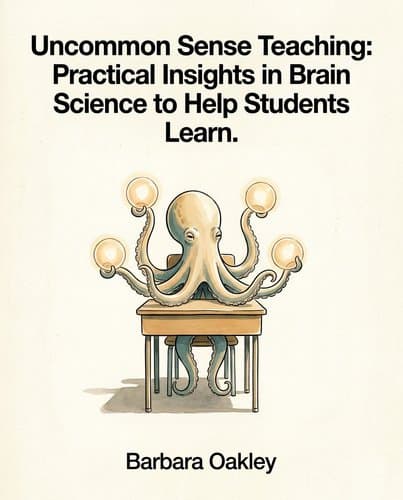
Here's the counterintuitive part: Katina's session looked productive because it felt productive. Following an example, comparing your answer to a model, rereading notes until they seem clear — these all keep information exactly where you don't want it: in working memory, the brain's temporary holding pattern. Think of working memory as an octopus juggling up to four balls. The moment Katina closes the book, they drop.
The dangerous property of working memory isn't that it's limited. It's that it feels identical to long-term memory while it's active. Katina looks at a solved problem and thinks she has it, because she does, right then, in working memory. What she can't feel is whether anything has actually transferred to the neocortex (the brain's slower stable storage), where connections stay when the book is closed and come back when she needs them on a test. They haven't. Because she never once forced the information out of her own head without looking. Every step of her session — finger on example, eyes on notes — was the octopus doing the work. Long-term memory requires a different kind of pressure: pulling information out independently, before you can look. That's when neural connections actually strengthen.
That diagnosis has a name: when students describe test anxiety, they're sometimes identifying something more precise — the panic of reaching into long-term memory on exam day and finding it nearly empty. The anxiety is real. The diagnosis is wrong.
For teachers, this lands in an uncomfortable place. Katina finished her homework. She paid attention in class. You taught clearly. And the test reveals almost nothing stuck. That is not a motivation problem. It is a mechanism problem, and it has a solution.
The Student Who Could Not Stop Failing Was Building Something the Geniuses Could Not
The clearest picture of that mechanism comes from someone who looked like the problem itself.
Santiago Ramón y Cajal spent most of his childhood being expelled. Schools across 1860s Spain turned him away: poor working memory, behavior problems, a fixation on drawing when he should have been studying. His father eventually stopped trying to redirect him and simply gave up. None of this suggested a future Nobel Prize.
Yet Cajal became the father of modern neuroscience. And his own account of how that happened is the counterintuitive part: he attributed his breakthroughs not despite being a slow, struggling learner, but because of it.
The fast learners he worked alongside — the fast processors who arrived at an answer before anyone else had finished reading the question — had a hidden vulnerability. They were right so often that they had almost no practice being wrong. When they were wrong, they had the cognitive horsepower to rationalize their way around the error rather than correct it. Intelligence, deployed defensively, kept them from changing their minds.
Cajal's slower processing meant he could not pull this off. When he hit a wall, he had to find another way through. His own expression, his own path. And that repeated rerouting was precisely what exposed the gaps and assumptions that faster minds skated past. The struggle was not a detour to understanding. It was the mechanism of understanding.
Here's what this means for the classroom: working memory speed predicts who answers first, not who learns most deeply.
The Hippocampus Is a Temporary Index, Not a Hard Drive — and It Fades by Next Month
The authors give their three characters names: Hip (hippocampus), Neo (neocortex), and a conductor standing in for working memory. The names earn their keep.
Hip is fast and precise. He doesn't store what you learn — he indexes where that information lives scattered across Neo's neural connections. Neo holds the actual content, but her grip on new material is weak and slow to form. So when you try to retrieve something recently learned, Hip is the one who whispers: third shelf, left side, next to the red book. Without that whisper, the information is effectively unfindable.
The trouble is that Hip's index doesn't last. During breaks and sleep, he turns away from the conductor and faces Neo, repeating the index until she builds enough connections to retrieve the material on her own. This is where real learning happens: not during the lesson, but in the quiet afterward. Cognitive neuroscientist Erin Wamsley found that even seconds-long rest breaks during a learning session trigger memory-related activity that predicts later test performance. Hip needs those pauses. He can face the conductor or face Neo, but not both at once.
Here's the counterintuitive part: Hip's responsiveness creates a convincing illusion of mastery. A student who crams the night before an exam has fresh indexing links. Hip whispers confidently the next morning, Neo follows along, and the student writes correct answers. A month later, Hip's index has faded — it was never designed to be permanent — and Neo never consolidated the material through repeated retrieval. The student reaches in and finds almost nothing. This is not forgetting. It is the predictable expiration of a system that was always temporary.
The goal of teaching, by this logic, is to make Hip unnecessary — to give Neo enough practice that she can retrieve the material directly, without the index. That requires time and repeated retrieval, the one pressure that forces consolidation. Cramming provides neither. It borrows against a loan that comes due the moment the exam ends.
The Techniques That Feel the Hardest Are Doing the Most Work
The techniques that build durable learning feel worse while they are working, and the discomfort is the evidence that consolidation is happening.
Beth Rogowsky, one of the book's authors, had her English students seemingly locked down on literary devices. After direct instruction on similes, metaphors, personification, and onomatopoeia, they produced definitions on demand and aced the test. Blocked practice worked: similes in a cluster, then metaphors in a cluster, fluency arriving fast. Understanding was somewhere else entirely.
When Beth sent them into actual texts to find devices scattered across paragraphs (mixed together, unlabeled, the way they appear in real writing), they couldn't do it. An obvious example of onomatopoeia sat in plain sight; they missed it. They knew the definition; they couldn't recognize the thing. Blocked practice had trained working memory to match a name to an example while the name was right in front of them. Remove the label, and working memory had nothing to reach for.
So Beth ran interleaved scavenger hunts. Every new piece of literature became a search for all the devices at once, randomly distributed, no clustering. Students grumbled. The slowness was real — that sense of reaching for something just out of grasp that blocked practice never produces. Months later, those same students were embedding onomatopoeia and personification deliberately into their own writing and explaining exactly why they chose each device. The difficulty was the mechanism: interleaving makes the brain detect patterns across varied examples rather than match categories to templates, and that's the encoding that survives long after the lesson ends.
The same logic applies to the Pomodoro break. Say a student finishes twenty-five minutes drilling organic chemistry and immediately picks up her phone. The notifications push the hippocampus's fresh encoding out before it can transfer to long-term memory: like new passengers crowding into a subway car, shoving others off at the wrong stop. The break has to stay quiet.
The thread through both: a smooth, fast, low-friction technique lets working memory perform without asking the neocortex to consolidate. The harder one is doing the actual work.
Hard Material Cannot Be Discovered — It Has to Be Built, Circuit by Circuit
Renovating a house reveals an inconvenient truth: you cannot run new electrical wire wherever you want. It has to follow the paths already carved through the walls: the conduits, the existing runs, the structural constraints. The brain works the same way. New skills cannot colonize arbitrary territory; they have to grow into regions whose existing function is close enough to borrow from.
Cognitive neuroscientist Stanislas Dehaene spent years mapping what the brain actually does when people learn to read. His finding: regardless of culture, alphabet, or whether the script uses Chinese ideographs or Arabic letters, reading always commandeers the same region — the one evolution built for recognizing faces and objects. Numbers invade a different region: the one that originally estimated rough quantity. The same real estate gets repurposed in Tokyo, Lagos, and São Paulo.
Between ages one and two, toddlers triple their vocabulary with only a few exposures per word, because evolution built dedicated hardware for language acquisition. Biologically secondary material (long division, semicolons, anything evolution never built dedicated hardware for) must be constructed by hijacking circuits that were never meant for it, and that construction cannot happen through discovery alone. A novice facing an algebra problem for the first time confronts thousands of possible moves and only a handful of correct ones. Working memory can hold maybe four items at once. Without scaffolding through the first steps, students with lower working memory capacity burn out before they've built even the faint initial connections that make later independent problem-solving possible.
Direct instruction builds the scaffold that makes real discovery possible. The difficulty of constructing that scaffold is not an obstacle — it is the signal that the brain is actually working.
Every Teacher Response Is Either Wiring or Unwiring Your Students' Neurons
The first teacher is lining her class up. She already pictures it: thirty seconds, clean. When students muddle the first attempt, she raises her voice. That moment does something specific inside each child's brain: dopamine neurons stop firing. The sudden drop signals neurons to disconnect from the connections they were forming. The children learn, in a literal synaptic sense, that this teacher means something negative and that lining up means dread. They drag their feet. She concludes she has bad students again.
Down the hall, the other teacher runs the same routine. When her class begins to line up, she says something unexpected — give yourself a hug, a stretch, isn't it great to move — in a voice that catches them off guard. Dopamine surges through the brain regions involved in learning. Those surges feel good and simultaneously strengthen the synaptic connections forming at that moment. The children learn, in the same literal sense, that lining up feels good. They move faster next time.
Here's the counterintuitive part: being uniformly positive is a neurological miscalculation. If every assignment earns praise, every response gets enthusiastic feedback, the brain stops registering any of it. Expected rewards build motivation, but they don't fire the dopamine spike — the brain already predicted them, so there is nothing to rewire. It's the sporadic, genuine, slightly surprising burst of recognition that actually accelerates learning. The teacher who saves real praise for moments that earn it is doing more synaptic work than the one who delivers it continuously.
The same logic governs stress. Moderate transient stress — cramming for a big test, presenting to the whole school — releases adrenaline and cortisol in amounts that strengthen synaptic connections, like a primer coat that lowers the resistance between neurons trying to connect. Too much flips the effect. A timed quiz, a cold-call question in front of peers, a deadline the student actually feels: these hit the productive zone. The teacher's job is to keep the needle there.
What Happens in the Last Two Minutes of Class Determines Whether Today's Lesson Survives the Night
What is the actual function of the last two minutes before the bell?
Most lesson plans treat closure as whatever is left after the real work is done. The neuroscience says it is the real work — and if those minutes are lost to students packing bags and shuffling toward the door, the hippocampus will consolidate whatever is already in their heads overnight, accurate or not.
The architecture that makes closure possible starts much earlier in the period. The authors name a specific ratio: for elementary students, five minutes of instruction then one minute of retrieval; for secondary students, ten minutes then two. These are not rest breaks. They are the consolidation window — the pause when the hippocampus can begin pressing fresh material into the slower, deeper neocortex.
Then comes closure. An exit ticket built from the focus question (a single prompt posed at the lesson's opening that names what students should be able to answer by the end) gives you a real signal about where each student landed. The authors are specific about what to do next: check the tickets at the door. Not that night at your desk, not tomorrow morning. Tonight, a wrong answer consolidates with the same efficiency as a right one. A student who leaves believing the Confederates held the artillery advantage will wake up tomorrow with that error wired more firmly in place. Catching it at the door costs thirty seconds. Catching it three weeks later costs the lesson.
The Difference Between "I've Got It" and Actually Having It
The gap that matters most is the one neither you nor Katina can feel while it's forming. Katina closes her textbook feeling ready. You finish a lesson satisfied with the pacing. Both experiences are real. Working memory is doing exactly what it was built to do. What neither of you felt was whether anything transferred to the slower architecture that has to hold the weight next month.
The plannable version fits on a sticky note: talk for ten minutes, then stop and make students pull it out without looking. Check the exit tickets before they leave. Praise the unexpected effort, not the routine one. Interleave problems before fluency arrives. Let Beth's scavenger hunt be the template — not for literary devices, but for any skill you've been drilling in blocks.
Two things that belong near that sticky note: on tests, start with the hardest problem, give it two minutes, then move on. Your brain keeps working on it while you answer the easier ones. And when a lesson produces something beautiful enough to post, pause and ask whether any retrieval happened. Pinterest-worthy output and effortful learning feel identical in the moment. They don't show up the same way on next month's test.
Then carry one question into every lesson: what happened today that required students to reach into their own heads rather than their field of view? If the answer is nothing, the lesson performed. It did not teach.
Notable Quotes
“before ideas begin slipping from the mind, as you can see in the”
“I suffer from test anxiety”
“I feel panic when I reach into long-term memory and nothing's there.”
Frequently Asked Questions
- Why do re-reading and passive note review fail to build lasting memory?
- Re-reading and passive note-review fail because "the struggle to retrieve is the mechanism that builds the neural link — looking at material again does not." Uncommon Sense Teaching explains that looking at material multiple times creates an illusion of fluency without encoding lasting memories. True learning requires retrieval practice: students must close the book and write down everything they can recall, then check their answers. This effortful struggle to retrieve information, not repeated exposure, consolidates learning into the brain's long-term storage. Recognition may feel like learning but doesn't build the neural connections needed for retention.
- How do brief pauses during direct instruction help students learn?
- Brief retrieval pauses every 5–10 minutes during direct instruction accelerate learning by facilitating hippocampal-to-neocortex consolidation. Uncommon Sense Teaching explains that these pauses "are not interruptions to learning but the moment learning actually occurs." During these 1–2 minute pauses, teachers prompt low-stakes retrieval—asking students to recall what they've learned without notes or references. The effort to retrieve information activates the neural mechanisms needed to consolidate learning from short-term to long-term memory. These pauses work because retrieval practice, rather than re-exposure to material, is the actual mechanism of memory consolidation.
- What does interleaving mean, and why do students grumble when using it?
- Interleaving means mixing problem types and topics together instead of practicing one type until mastery before moving to the next. When teachers implement interleaving, "students will make more errors and grumble — that is the signal the technique is working, not evidence it should stop." Uncommon Sense Teaching explains that the struggle and mistakes signal productive learning, not failure. Interleaving forces the brain to distinguish between different problem types and build flexible neural representations. While blocked practice feels smoother and more fluent, interleaving creates stronger, more transferable learning by increasing cognitive demand during encoding.
- What should students do during Pomodoro rest breaks to protect memory consolidation?
- Students should protect rest breaks from phones, social media, and new content because "incoming stimuli can push newly encoded hippocampal material out before it transfers." Uncommon Sense Teaching specifies that "eyes closed, a short walk, or petting a dog all qualify; scrolling does not." The brain requires genuine mental downtime for the hippocampus to consolidate recent learning and transfer it to long-term storage in the neocortex. Phone-free, stimulus-free breaks are essential to learning—the quality of rest time matters as much as active study time. Students who scroll during breaks undermine memory consolidation.
Related Book Summaries

Read the full summary of 55835996_uncommon-sense-teaching on InShort