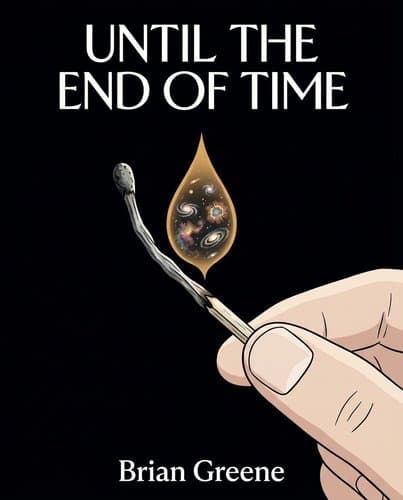
46114262_until-the-end-of-time
by Brian Greene
Entropy will eventually erase every star, atom, and thought — yet the same law guaranteeing that heat death is what produced consciousness, art, and meaning in…
In Brief
Until the End of Time (Febr) traces the universe from its origins to its final moments, showing how the same laws that drive cosmic decay also gave rise to stars, life, consciousness, and culture.
Key Ideas
Entropy enables emergence of organized systems
Entropy — the second law of thermodynamics — is not just about decay; the same law that guarantees eventual disorder is what enables stars, life, and thought to form in the first place. Without entropy increasing overall, no local pocket of order could ever emerge.
Universal genetic code reveals single origin
Every living organism on Earth runs on identical molecular machinery: the same triplet-codon genetic code and the same ATP-turbine energy system. This universality is overwhelming evidence for a single common ancestor and suggests life, once started, runs one playbook.
Consciousness emerges from sufficient physical complexity
Consciousness and free will are not separate from physical law — they are what physical law looks like when matter achieves sufficient complexity. The difference between you and a rock is not that you transcend causality but that your particles can execute an incomparably richer range of responses.
Death awareness drives all human culture
Religion, art, and science share a single underlying engine: mortality-awareness firing through evolved cognitive tendencies — overactive agency-detection, theory of mind, attraction to minimally counterintuitive concepts. All human culture is, at root, the universe processing its own impermanence.
Cosmic finitude makes present truly precious
The cosmic timeline ends in a specific, calculable sequence — last stars at ~100 trillion years, last atoms if proton decay holds, last possible thought around 10^50 years — and internalizing this makes the present feel genuinely rare and precious rather than ordinary.
Meaning is human creation not discovery
Meaning is not timeless or self-contained: personal death intensifies significance, but species extinction drains it. This proves meaning was never waiting in the universe to be discovered — it was always something made inside an ongoing human conversation, which makes the charge to create it more urgent, not less.
Who Should Read This
Science-curious readers interested in Physics and Evolution who want to go beyond the headlines.
Until the End of Time
By Brian Greene
9 min read
Why does it matter? Because the physics of impermanence is also the physics of meaning — and understanding one changes how you experience the other.
Most of us keep a quiet partition in our heads: science handles the mechanisms; meaning lives somewhere else — in religion, art, love, the stories we tell about who we are. The partition feels like protection.
Brian Greene wants to dismantle it. Not because meaning is an illusion, but because the partition was always wrong. The same thermodynamic forces that guarantee the universe will eventually erase every trace of life are the forces that produced consciousness in the first place — creatures who notice they will die, who cannot stop reaching for something permanent, who invented philosophy, physics, and God in response. The doom and the longing have the same source. Once you see that, the question of where meaning comes from stops being a theological puzzle and becomes something stranger — and the answer, when it comes, is not what you were looking for.
Entropy Doesn't Just Destroy Things — It's the Reason Stars, Life, and You Exist
Think of entropy the way most people do: the universe's slow clean-up crew, dismantling everything you've built, spreading perfume through a room until no corner smells more of jasmine than any other. Disorder wins, order loses, end of story. That intuition is half-right. The half it misses is the reason you exist.
Take an enormous cloud of hydrogen gas floating in space. With too little gas for gravity to matter, molecules drift outward until they're uniformly distributed: maximum disorder, entropy satisfied, nothing more to see. But pack in enough mass that every molecule feels the gravitational pull of all the others, and something strange happens.
As outer molecules drift away from the center, gravity tugs them back, slowing them down. Slower molecules mean lower temperature. Meanwhile, molecules closer to the center fall inward, picking up speed. Higher speed means higher temperature. The cloud spontaneously develops a hot, dense core and a cool, diffuse shell — not despite entropy, but because of it.
Now the twist. Heat always flows from hot to cold — that's why your morning coffee never reheats itself on the counter. So heat flows from the hot core toward the cool shell. You'd expect this to equalize temperatures. Instead, the opposite happens: the core, having surrendered energy, contracts further under gravity, its molecules accelerating inward, heating up even more. The shell, absorbing heat, expands outward, its molecules slowing further, cooling even more. The gap widens. The cycle amplifies itself with no natural limit.
One brake exists: when the core reaches extreme heat and density, atomic nuclei fuse rather than merely bounce off each other. That fusion releases enormous outward pressure, halting the collapse. A stable, blazing point of light locks into place.
A star has assembled itself with no design, no direction, and no violation of the second law. Total entropy went up. The local order in the core was purchased by a larger surge of disorder in the surrounding shell and in the light streaming outward into space. Entropy wasn't defeated by the star's formation. Entropy required it.
The same logic, scaled and varied, eventually produces planets and oceans. The law that guarantees everything falls apart is the same law that assembled it.
Every Living Thing on Earth Has Been Running the Same Molecular Software for Four Billion Years
Every bacterium, baobab, and human nervous system runs on the same molecular machinery. Not similar machinery — identical machinery, inherited from a single common ancestor roughly four billion years ago. The variety of life on Earth is a surface phenomenon. Underneath it, there is one trick, run on continuous loop.
Here is what that trick looks like at scale. Right now, as you read this, your cells are running turbines — nanoscale protein machines embedded in membranes no thicker than a few dozen atoms. Electrons stripped from food cascade through a series of chemical reactions, each hop releasing a small burst of energy. That energy pushes protons across a membrane, packing them densely on one side. When those protons are allowed back through the turbines, they spin, and the spinning drives two molecules together into ATP, the cell's energy courier. ATP travels to wherever work needs doing, snaps apart, and the pieces return to be recharged.
A single cell burns through ten million ATP molecules every second. Your body, with its tens of trillions of cells, consumes something like 10²⁰ per second. In the time it takes to read a single sentence, you synthesize five hundred million trillion fresh ATP molecules — then another three hundred million trillion before you finish the next one.
The genetic code is identical, too. Every organism translates DNA into proteins using the same three-letter cipher: a particular sequence of chemical bases always specifies the same amino acid, in seaweed and in Sophocles alike. Same energy system, same information system. No exceptions.
A common ancestor, viewed from the inside, isn't a fossil. It's a set of instructions your cells have been executing, uninterrupted, for four billion years.
Your Sense of Who You Are Depends Entirely on Which Particles Happen to Be Moving Through Your Head
That same molecular machinery, scaled up and networked into a brain, produces something the ATP cycle alone cannot explain: a sense of being someone.
Decades ago in Amsterdam, Brian Greene experienced what he later called one of the most terrifying nights of his life. No external threat — no fire, no violence. His mind had fractured into endless copies of itself, each convinced it had finally grasped true reality, each then annihilated by the next version, which revealed the previous reality to be illusion, and everything Greene cared about along with it. The loop ran without stopping. Without mercy.
The explanation, once you accept that the brain is the self, is almost simple: a small cluster of foreign molecules had entered his brain and rearranged what was already there. Same laws as always. Different molecular configuration. The unified sense of being himself (the inner voice, the feeling of reliable authorship over his own thoughts) vanished completely. When the molecules cleared, it returned.
Most of us carry a strong intuition that consciousness is the one thing that can't be reduced to particles. The redness you see, the weight of a memory, the felt sense of deciding something — these seem categorically different from anything describable by equations. Philosopher David Chalmers gave a name to why: the "hard problem." It isn't hard to explain what neurons do mechanically. It's hard to explain why any of that mechanical activity produces subjective experience at all. A thought experiment from philosopher Frank Jackson shook Greene more than any of the others: a color-blind neuroscientist who masters every physical fact about how we perceive color still seems to learn something new the first time she actually sees red. The implication is that no amount of physical knowledge captures what experience is like from the inside. Jackson eventually recanted the argument — but not before Greene felt its full weight.
Amsterdam cuts through the philosophy with a kind of brute directness. Greene didn't arrive at a different sense of self by thinking differently. His selfhood dissolved because his brain chemistry changed. When the chemistry stabilized, the self reassembled. The hard problem isn't wrong — it identifies something genuinely difficult to articulate. But the Amsterdam episode points toward the answer: consciousness feels non-physical because it's a model the brain builds of itself, and that model omits its own machinery. What looks like an inner ghost is what the physics feels like from inside the mechanism.
Art, Religion, and Science Were All Invented by a Brain Terrified of Its Own Extinction
What if the division between religion, art, and science is less real than the brain that produced all three?
One night alone in the woods — matches spent, fire unlit, every creak amplified by darkness — Greene scratched a face onto his tarp. Round eyes, a rough nose, a mouth that almost smiled. He knew it was plastic and ink. But the terror receded anyway. He had created company where there was none.
That reflex is the root of human culture. Our brains are wired for agency-detection, the survival circuit that assumes the rustle in the grass is a predator rather than wind, because mistaking a leopard for a branch is fatal while mistaking a branch for a leopard costs you only embarrassment. Natural selection loaded the gun toward false positives, wiring us to populate our surroundings with attentive minds. The creatures that stick in the mind sit in what Pascal Boyer calls the "minimally counterintuitive" zone: beings that violate one or two expectations (no body, unlimited power, omniscient attention) while staying familiar in everything else (jealousy, favoritism, the need to be appeased). That's exactly what gods are. The scratched face on the tarp and the watching deity overhead run on identical circuitry.
Religion was the first elaborate product of this machinery. But art and science emerged from the same factory. When early humans painted deep in caves — a considerable physical ordeal for anyone not deeply motivated — they encoded emotional experience into lasting form, training the cognitive flexibility that lets a mind hold real and imagined simultaneously without losing track of which is which.
What binds all three is mortality. Greene's evolved brain recognizes its own finitude (and yours does too) and cannot sit still with that recognition. Religion names and appeases the forces governing a life that ends. Art gives form to what reason can't reach: the lyricist Yip Harburg put it simply, words make you think a thought, music makes you feel a feeling, but a song makes you feel a thought. Science maps the mechanism with mathematical precision. Three instruments, one orchestra. The performance is human culture. The conductor is the knowledge that we die.
Physics Can Calculate the Date of the Last Possible Thought
1.3 billion years ago, two black holes smashed together, releasing more energy than every star in the observable universe at once. As the shockwave crossed our galaxy, Einstein was writing his first papers on gravitational waves, unaware any particular wave was already in transit. A detector in Louisiana registered its arrival. Deep time had arrived on schedule.
The same precision extends to the future. Greene maps what comes next onto the Empire State Building as a timeline: each floor represents a duration ten times the one below, so floor 10 is roughly now (13.8 billion years after the big bang).
Around floor 11, the sun swells large enough to vaporize Earth's oceans and strip its atmosphere. By floor 12, accelerated cosmic expansion pushes every distant galaxy past a cosmological horizon — receding faster than light can bridge the gap, gone from view forever. Future astronomers look out at darkness and conclude the universe is static. They're wrong, but the evidence proving it will be permanently out of reach. The last stars burn out by floor 14. Surviving planets spiral into their cold, dead host stars by floor 23, bled of orbital energy by gravitational waves, the same process that made Louisiana shake. By floor 38, protons themselves decay. Every atom in every rock, ocean, and body dissolves into lighter particles. The physical scaffolding is gone.
Thought might still outlast matter. A mind that continuously cools itself, slowing its processes and stretching each thought over longer intervals, can think an infinite number of thoughts on a finite energy supply, the same way the infinite series 1 + ½ + ¼ + … sums to a finite number. But the accelerated expansion of space generates a permanent background temperature: faint warmth radiating from a distant cosmological horizon at about 10⁻³⁰ kelvin. Once the Thinker cools below that floor, the universe stops accepting its waste heat. One more thought, and the Thinker overheats in its own excess entropy.
By floor 50 — 10⁵⁰ years after the big bang — the last possible thought occurs.
That number sounds remote. It contains the entire current age of the universe more than a billion billion billion billion times over. You are already inside this sequence — a few steps up the building.
Your Own Death Makes Life Feel More Real; Humanity's Extinction Makes Everything Pointless — and That Distinction Changes Everything
At an off-Broadway talkback following a play about an impending asteroid strike, Greene got carried away by the crowd and declared that Earth was just an average rock orbiting an average star in an unremarkable region of an average galaxy. If an asteroid took us out, the universe wouldn't blink. An elderly woman challenged him: which news would hit you harder — learning you have one year to live, or learning that in one year Earth would be destroyed?
Greene gave a glib answer that night. Later, turning the question over, he found it unexpectedly illuminating. The two scenarios pull in opposite directions. A personal death sentence tends to sharpen the world: moments acquire weight, conversations matter more, the ordinary becomes vivid. But learning that humanity would be erased produced something different: futility. Would he keep working on his physics research if no one would build on it? Finish the book he was writing if no one would read it? Send his children to school with no future to prepare for? No.
Philosopher Samuel Scheffler pressed on exactly this asymmetry: how would you behave if you knew that thirty days after your own death the rest of humanity would vanish? Your own approaching death concentrates attention. Learning that the human project ends shortly after you do drains the enterprise of reason. His conclusion: we need a future populated by people for the concept of "mattering" to function at all. Value doesn't float free; it runs on the assumption that minds ahead of us will receive what we make.
This is the book's final inversion. We arrive assuming impermanence is meaning's enemy — if everything ends, what's the point? The thought experiment reveals the actual architecture. Personal death, the most intimate form of impermanence, makes life feel more real. What collapses meaning isn't the finitude of individual lives but the erasure of the human future that receives them. Meaning was never a property of the cosmos waiting to be discovered. It was always extended forward (made, carried, handed on), and its weight comes precisely from the rarity of minds capable of making it. We are brief, and that brevity is not incidental to why any of this matters. It is why.
The Brief, Improbable Window Where Something Can Matter
Here is where the physics delivers its strangest gift. You've traveled the full arc — hydrogen clouds collapsing into stars, identical molecular turbines spinning in every living cell, consciousness dissolving and reassembling with a shift in brain chemistry, all of it converging toward a final thought at 10⁵⁰ years and then silence. And the lesson is not grief. It's something closer to vertigo, then steadiness. The entire span of human civilization occupies a sliver of the timeline so thin it wouldn't register on any scale Greene could draw. That narrowness is not the obstacle meaning has to overcome. It is the source of meaning's weight. You are particles — briefly, improbably — arranged into something that can wonder at its own impermanence. The universe never hid an answer inside itself. It left you with the stranger, more honest task of making your own.
Notable Quotes
“Earth is a pedestrian planet orbiting an unremarkable star in the suburbs of an ordinary galaxy. If we're taken out by an asteroid, the universe won't so much as blink. In the grand scheme of things, it just won't matter.”
“Which news would affect you more,”
“being told you have a year to live or that in a year earth will be destroyed?”
Frequently Asked Questions
- What is Until the End of Time about?
- Until the End of Time traces the universe from its origins to its final moments, examining how entropy and evolution are the fundamental engines behind cosmic decay and the emergence of stars, life, consciousness, and culture. Greene demonstrates that the same physical laws governing the universe's eventual heat death also enable the temporary pockets of complexity—including human civilization—that make existence possible. The book argues that understanding the universe's calculable endpoint transforms how we perceive the present moment and our place within an incomprehensibly vast timeline.
- How does Brian Greene explain the relationship between entropy and the origin of life?
- Entropy — the second law of thermodynamics — is not just about decay; the same law that guarantees eventual disorder is what enables stars, life, and thought to form in the first place. Without entropy increasing overall, no local pocket of order could ever emerge. Greene explains that what we typically think of as the universe's decline is simultaneously the mechanism that permits all complexity, including biological life and human consciousness. This reframes entropy from a force of destruction to the fundamental prerequisite for existence itself.
- What does Greene argue about the nature of meaning and its connection to mortality?
- According to Greene, meaning is not timeless or self-contained: personal death intensifies significance, but species extinction drains it. This proves meaning was never waiting in the universe to be discovered — it was always something made inside an ongoing human conversation, which makes the charge to create it more urgent, not less. Greene argues that mortality-awareness drives all human culture alongside evolved cognitive tendencies. Understanding that meaning is constructed rather than discovered places responsibility on each generation to actively participate in creating significance within our finite existence.
- What is the cosmic timeline that Greene describes for the universe's end?
- Greene describes a specific, calculable cosmic timeline: last stars at approximately 100 trillion years, last atoms if proton decay holds, and last possible thought around 10^50 years. Internalizing this sequence makes the present feel genuinely rare and precious rather than ordinary. These precise calculations reveal that consciousness and complexity have an extraordinarily narrow temporal window in cosmic history. The sheer brevity of Earth's habitable period reframes human existence as improbably fortunate, transforming how we understand our moment in time and the urgency of how we spend it.
Related Book Summaries

Read the full summary of 46114262_until-the-end-of-time on InShort