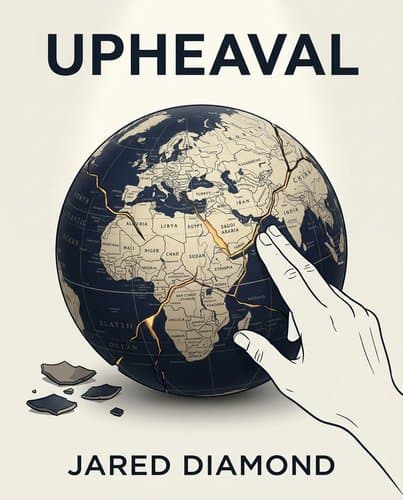
41716904_upheaval
by Jared Diamond
Nations and people in crisis share one counterintuitive secret: selective change beats total reinvention. Diamond reveals how Finland, Japan, and others…
In Brief
Nations and people in crisis share one counterintuitive secret: selective change beats total reinvention. Diamond reveals how Finland, Japan, and others navigated catastrophe by ruthlessly distinguishing what to keep from what to discard—a framework equally powerful for your own turning points.
Key Ideas
Name Specific Problems Before Systemic Change
Before deciding what to change in a crisis, list specifically what has gone wrong — not everything, just the concrete things. This 'building a fence' technique from crisis therapy separates necessary change from panic-driven overhaul. If you can't name what broke, you can't fix only that.
Balance Over- and Underestimation Simultaneously
Honest self-appraisal requires checking in both directions: you may be simultaneously overestimating ability in one area and underestimating it in another. Diamond overestimated his language skills and underestimated his science — both at the same time. A useful proxy: are you generalizing from a single failure to a global conclusion about yourself?
Establish Non-Negotiables Before Crisis Strikes
Identify your non-negotiables before crisis forces the question. Finland stayed clear that independence was the line; everything else — territory, prestige, even press freedom — was negotiable in service of that one thing. Without that prior clarity, everything feels like it must change at once.
Study Solutions From Comparable Contexts
Seek first-hand exposure to how comparable people or countries have solved similar problems — borrowing solutions is one of the most powerful and least-used crisis tools. Ideology fills exactly the gap where knowledge should be. The army officers who launched Japan's catastrophic war had never left Japan; the man who knew better had visited American factories.
Track Early Indicators of Compromise Erosion
Political compromise is a structural asset, not a personality trait. It erodes slowly through campaign finance, geographic sorting, and media fragmentation — and collapses suddenly. Track the early structural indicators (filibuster rates, cross-party socializing, fundraising time) rather than waiting for dramatic symptoms.
Institutional Accountability Plus Generational Truth Needed
National self-examination requires both an institutional mechanism with teeth and a generation that grew up knowing the truth. Germany needed both Fritz Bauer's prosecutions and the 1968 cohort who came of age hearing them. Either condition without the other is insufficient — which explains why honest national reckonings are so rare.
Learn From Other Countries, Reject Exceptionalism
The refusal to learn from comparable countries — what Diamond calls American 'exceptionalism' — is itself a crisis factor, not a strength. Canada, same language and geography, has 80% public support for immigration. The solutions to America's most intractable problems exist in countries most Americans can't locate on a map.
Who Should Read This
History readers interested in World History and Geopolitics who want a deeper understanding of how we got here.
Upheaval
By Jared Diamond
10 min read
Why does it matter? Because crisis doesn't transform you — it forces the audit you've been avoiding.
Most people assume that surviving a crisis means becoming someone new — that the person (or nation) that comes out the other side has shed the old self entirely. But that's not what happens. Not in the survivors of Boston's Cocoanut Grove fire in 1942, not in Finland facing the Soviet army, not in post-war Germany, not in contemporary America. What actually emerges is always a mosaic: old and new elements fused together, sometimes sitting uneasily side by side. The hard part isn't change. It's the audit that comes before it — the ruthless, honest reckoning with which parts of you still function and which parts are dragging you under. Get that diagnosis wrong, and the crisis becomes permanent. What Diamond found across six countries is that recovery almost never came down to resources or luck. It came down to honesty — specifically, whether a nation could look at itself without flinching.
The Crucial Question Isn't What You Gain From Crisis — It's What You Protect
Imagine your house catches fire. Standing in the smoke-stained wreckage, the instinct is that everything must go. But a good architect doesn't begin by ordering a demolition crew. She walks the rooms first, tapping walls, testing beams: what's actually compromised, and what's still sound?
Jared Diamond argues that this is the skill that separates people and countries who navigate crises well from those who don't. The crisis itself isn't the hard part. The audit is.
Consider Britain between 1956 and 1961. In five years, the country scrapped its last battleships, watched race riots break out on its own streets, began surrendering African colonies, and suffered the Suez Crisis, a public humiliation that exposed its inability to act independently as a world power. Britain had commanded the largest fleet, the greatest wealth, and the most far-flung empire in history. The crisis was real.
What Britain did next is instructive. It shed the empire, became a multiethnic welfare state, reoriented its foreign policy — and kept the pound, the monarchy, and its seat among the world's six wealthiest nations. Decades later, Britain wasn't a new country. It was a mosaic: old identity and new pressed together, sometimes uneasily.
The word is selective — not change, not preservation. Selective. Because the real challenge in any crisis is the audit: which parts of yourself are actually broken, and which parts just feel broken because everything around them is?
Diamond Spent Months Misreading His Own Abilities — In Both Directions Simultaneously
In the summer of 1959, Jared Diamond sat on a park bench in Paris with his parents and came within an afternoon of abandoning science forever.
He was 21, a year into his PhD at Cambridge, and convinced he had failed. His lab work on electric eels had produced nothing. His gallbladder experiments, simplified because he couldn't manage the equipment for the eel work, kept returning voltage readings of zero, which in 1959 meant either broken instruments or dead tissue. Meanwhile he'd spent a month in Finland learning the language by ear alone, the way a child does, and it was effortless. The contrast felt like a verdict: quit the science, move to Geneva, become a UN simultaneous translator.
He was wrong — in both directions at once.
He'd overestimated his language ability and underestimated his science ability, two errors pointing opposite ways, each making the other invisible. On languages: Swiss translators reach fluency with multiple languages before age eight, accents and all. Diamond hadn't spoken his first foreign language until eleven, hadn't lived outside the US until twenty-three, and still carries a recognizable American accent in every language he knows. Love of a thing is not mastery of it.
On science: he had generalized from one failure to a verdict on his entire capability. He couldn't engineer a chamber to measure ion movement in electric eels, so he concluded he couldn't do science. What he'd missed was that the zero-voltage readings weren't a sign of broken equipment. The gallbladder turned out to be genuinely anomalous — it transports positive and negative ions in equal quantities, producing no net charge, hence no transport voltage. His instruments were fine. He had stumbled onto an original finding.
His father, on that Paris bench, had one suggestion: just try another half-year before making an irreversible decision. That bought enough time for the truth to surface. You can be wrong about yourself in two opposite directions at the same time, and both errors feel like clarity. Countries, it turns out, make the same two errors on a much larger scale.
Finland Didn't Win Its War — It Made Losing Expensive Enough to Survive
In the winter of 1940, small groups of Finnish soldiers held islands in the frozen Gulf of Finland as Soviet forces crossed the ice toward them. Their commanders delivered simple orders: no rescue would come. Stay, kill as many Soviets as possible, and accept death. They stayed.
That willingness to die without any prospect of winning captures how Finland survived. The country entered its war against the Soviet Union (170 million people, 500,000 troops, thousands of tanks) with 120,000 soldiers, almost no anti-aircraft guns, no modern artillery, and orders to hold fire until attackers were close enough to save ammunition. Finnish leaders knew full military victory was off the table. The goal, as one veteran explained to Diamond years later, was to make Soviet victory cost enough that Stalin would tire of paying it. Using skis and white camouflage, small Finnish units moved through roadless winter forest, cut Soviet road columns into segments, and annihilated them one by one. Soviet losses eventually reached roughly 500,000 dead against Finland's 100,000. That ratio forced Stalin to negotiate rather than occupy.
The military campaign bought time. Finland used it to build an architecture of survival. For the next 35 years, Finnish governments censored their own press, canceled the Finnish publication of Solzhenitsyn's Gulag Archipelago, imported inferior Soviet manufactured goods, and once extended a presidential term by emergency parliamentary decree specifically to avoid unsettling Moscow. When other democracies condemned Soviet invasions of Hungary and Czechoslovakia, Finland stayed silent. American newspapers called it capitulation. Finnish President Kekkonen had one question in return: concessions in exchange for what?
Finland had identified one non-negotiable: political independence, the right to remain self-governing. Everything beyond that was available for sacrifice — prestige, trade autonomy, the freedom to criticize a neighbor in print. Stalin himself, when asked why he hadn't installed a communist government in Helsinki as he had across Eastern Europe, reportedly said that with Paasikivi (Finland's president and chief diplomatic architect) managing relations, he had no need for the Finnish Communist Party.
The fence held. It enclosed exactly one thing.
The Men Who Started Japan's Most Catastrophic War Had Never Left Japan
In 1998, Diamond found himself at a dinner in Tokyo across from a retired steel executive in his nineties. Somewhere in conversation, the old man mentioned that in the 1930s he'd toured American steel factories.
What he saw there never left him. U.S. manufacturing capacity for high-quality steel was fifty times Japan's. Fifty. He came home certain that war with America would be suicidal, said so, and nobody listened.
The officers who launched Pearl Harbor in 1941 had never made that trip. They'd never walked an American factory floor, never watched a production line run, never seen what a fifty-fold gap looks like from the inside. Ideology and confidence filled the space where knowledge should have been. They had talked themselves into believing America was too comfortable to fight a real war. Wrong by a factor of fifty. Within four years Japan's cities were ash.
What makes this bitter is the contrast with Meiji Japan — the government that rebuilt the country after American warships forced it open in 1853. They operated from the opposite premise: you cannot plan against what you haven't observed. In 1871, the new government sent fifty officials to tour the United States and a dozen European countries for nearly two years. They visited factories, met heads of state, attended schools, and returned with five volumes of documentation. Then they borrowed selectively — the German constitution, the British naval model, French civil law — because their own envoys had seen these things working. Japan went to war only when first-hand assessment said it could win.
The steel executive knew because he'd done what the Meiji envoys had done. He'd gone and looked.
Germany Did Something Almost No Country Has Been Able to Do: Hold Judgment on Itself
Most countries that commit great wrongs eventually produce leaders who apologize for them. Germany did something harder: it built a mechanism that forced ordinary citizens to testify against themselves.
Fritz Bauer was a German Jewish lawyer who fled to Denmark after the Nazis rose to power and returned in 1949. The Nuremberg trials had dispatched the top leaders. What remained untouched was the vast middle layer of the atrocity — the pharmacists, the camp guards, the soldiers on the eastern front. Bauer's conviction was that this was precisely the problem. Mass murder on the Nazi scale doesn't happen without mass ordinary participation, and a country that attributes everything to a handful of evil leaders has learned nothing. As the chief prosecutor for Hesse, a German state, he spent two decades hauling those ordinary Germans into German courts to answer for what they had done.
Most prosecutions failed. German juries acquitted defendants into the 1960s, and Bauer received death threats. The significance wasn't the convictions — it was the testimony, repeated in exhaustive public detail, year after year: who gave which orders, who followed them without being forced to, who committed crimes while insisting they were simply doing their jobs. The trials couldn't enforce accountability. What they could do, and did, was force awareness.
Here's what makes Germany's case so rare: awareness alone wasn't enough. The generation that came of age hearing Bauer's trials, children born around 1945 who grew up knowing what their parents had done, had to live long enough to run the country's schools, museums, and curricula. By the 1970s, they were. German children began learning about the camps in school and visiting them on field trips. When Diamond and his wife (her parents were concentration camp survivors) exited the highway at Dachau in 1982, they expected a museum. What they found was an indictment: German-language exhibits tracing the Nazi rise, the persecution of Jews and others, and the deaths in the camps, with no deflection. Germany's own hand, pointing at itself.
The trials gave the next generation a public record they couldn't look away from, and that generation ended up running the schools. That's what makes the German reckoning so rare. Diamond names the countries that didn't manage it: Indonesia, Japan, the United States. Think about what that list includes.
Democracies Don't Need Tanks to Destroy Themselves
What would it actually take to end American democracy? Most people picture something external and dramatic — tanks, a strongman seizing the airwaves, troops in the streets. Diamond's answer is quieter and more unsettling: democracies rarely die from the outside. They erode from within, through the slow degradation of one structural feature: the willingness to compromise.
In 1967, Diamond's Chilean friends told him with genuine pride that their country was different from other Latin American nations. Chile had long democratic traditions, peaceful transfers of power, a military that stayed out of politics. "We Chileans know how to govern themselves," they said. Six years later, the Chilean air force bombed the presidential palace while army tanks shelled it from the street. The dictatorship that followed set records for government-sanctioned sadism that held for decades: thousands killed, a hundred thousand driven into exile. When Diamond attended a dinner party three months after the coup, seventeen of eighteen guests predicted the military government would last two years. The one who said seven was considered absurd.
Diamond's point isn't that the US is Chile. It's that Chile wasn't supposed to be Chile either.
The mechanism isn't armies. It's the degradation of compromise itself, which happens incrementally and therefore invisibly, until it doesn't. Here's what the numbers show: across the entire first 220 years of the US Senate, 68 presidential nominees were blocked by filibuster. In the four years after Barack Obama's 2008 election, Republican senators blocked 79. That's more than the preceding two centuries combined. This isn't a story about one party. It's a story about what happens when a norm of restraint breaks: it breaks completely, because the incentive to retaliate overtakes the incentive to cooperate, and neither side assumes the other will play by the old rules.
Campaign finance drives candidates toward ideological donors who actively punish compromise. Social media collapses information into competing realities sealed off from each other. None of this requires a general. A democracy can arrange its own dismantling, piece by piece, while everyone inside it insists the guardrails are holding.
Diamond closes the US chapters with one sentence worth sitting with: there is no way China or Mexico can destroy the United States. Only Americans can do that. Chile itself is instructive here — Pinochet's junta lasted fifteen years before Chileans voted him out in a 1988 plebiscite he had designed expecting to win. Recovery was possible, but it cost a generation. Whether the US faces a version of that reckoning will depend, Diamond argues, on whether the country can recognize the crisis while there is still time to build a different kind of fence.
The Crisis Pattern Is Learnable — But the Window for Learning It Isn't Infinite
The framework Diamond built from these case studies isn't limited to national crises. It scales. The same behaviors that drove Finland's survival and Meiji Japan's transformation — honest self-appraisal, selective borrowing, willingness to name what's broken — don't stop working when the problem gets bigger.
Climate change, nuclear weapons, inequality: their scale can make those behaviors feel inadequate. But the counter-argument is empirical. Global cooperation has already worked in cases that looked structurally impossible.
Consider the ozone layer. By the 1970s, chlorofluorocarbons in every refrigerator and aerosol can were dissolving the atmosphere's UV shield. The damage was invisible, the science was disputed, and the chemical industry lobbied hard against restrictions. The nations most responsible had every economic incentive to delay. And yet in 1987, the Montreal Protocol produced a binding global agreement that held, and the ozone layer is now recovering. Enough nations acknowledged the crisis, accepted shared responsibility, and used other countries' research as models: the same behaviors that drove Finland and Meiji Japan.
The European Union adds a second data point, with a different mechanism. After two wars killed tens of millions of Europeans in thirty years, Adenauer's generation didn't trust goodwill. They built interdependence deliberately: coal and steel pooled first, then markets, then currency, until the economic cost of war became structurally prohibitive. No EU member has fought another since.
Neither example promises easy extension to harder problems. But both show the same thing: these behaviors aren't uniquely national. What doesn't scale is the assumption that the window for honest self-appraisal stays open indefinitely. It doesn't.
The Mosaic You'll Become Either Way
The Cocoanut Grove survivors who never did the grief work didn't stay the same — they just became different in ways no one chose for them. That's Diamond's quietest and most uncomfortable point. Skipping the audit isn't preservation. The mosaic forms either way; the only question is whether you had any hand in which pieces held.
The pattern is learnable. Finland proved it under artillery fire, Germany proved it across a generation of shame, Meiji Japan proved it by sending officials to walk factory floors before deciding anything. The habit has a name by the end: build the fence first. Figure out which part of yourself is actually broken, and which part only feels broken because everything around it is. That distinction, Diamond argues, is the whole game.
What isn't real is unlimited time. The window for choosing which parts of yourself survive is open for exactly as long as you have a crisis to navigate. After that, something else decides.
Notable Quotes
“Our aim was instead to make Russia's victory as slow, as painful, and as costly for the Russians as possible.”
“cut Finland at the waist”
“and we wish that the”
Frequently Asked Questions
- What is Upheaval about?
- Upheaval examines how individuals and nations navigate crises by drawing on case studies from Finland, Japan, Germany, and beyond. The book argues that successful recovery depends not on wholesale reinvention but on honest self-appraisal — identifying exactly what broke, preserving what still works, and borrowing proven solutions from comparable situations. Rather than panic-driven overhaul, Diamond offers a practical framework for managing both personal and collective crises with clarity and purpose. The work combines historical analysis with actionable guidance for understanding what truly needs to change during upheaval.
- What is the 'building a fence' crisis technique in Upheaval?
- The 'building a fence' technique from crisis therapy is Diamond's method for distinguishing necessary change from panic-driven overhaul. Before deciding what to change, list specifically what has gone wrong — not everything, just the concrete things. This approach separates panic reactions from targeted problem-solving. If you can't name what broke, you can't fix only that. The technique forces specificity: rather than concluding 'everything is wrong,' you identify discrete failures requiring repair, preventing organizations or individuals from throwing out working systems alongside broken ones during crisis response.
- How does Upheaval use national case studies to illustrate crisis recovery?
- Diamond draws on case studies including Finland, Japan, and Germany to demonstrate how different nations navigate upheaval. Finland exemplifies how identifying non-negotiables—in its case, independence—allows flexibility elsewhere. Germany's example requires both institutional mechanisms (Fritz Bauer's prosecutions) and generational truth-telling (the 1968 cohort). Japan's military leadership failed partly because they never left Japan and lacked first-hand exposure to American industrial capacity. These cases collectively illustrate that successful crisis management combines honest self-assessment, identification of core values, learning from comparable nations, and institutional accountability structures that enable genuine reckonings.
- What does Upheaval say about learning from other countries during crisis?
- Upheaval argues that seeking first-hand exposure to comparable solutions is one of the most powerful and least-used crisis tools. Diamond emphasizes that 'ideology fills exactly the gap where knowledge should be.' The refusal to learn from comparable countries—what Diamond calls American 'exceptionalism'—is itself a crisis factor, not a strength. Canada, with the same language and geography as America, demonstrates 80% public support for immigration while the U.S. struggles with this issue. The book contends that solutions to America's most intractable problems exist in countries most Americans can't locate on a map, yet remain overlooked.
Related Book Summaries


Read the full summary of 41716904_upheaval on InShort