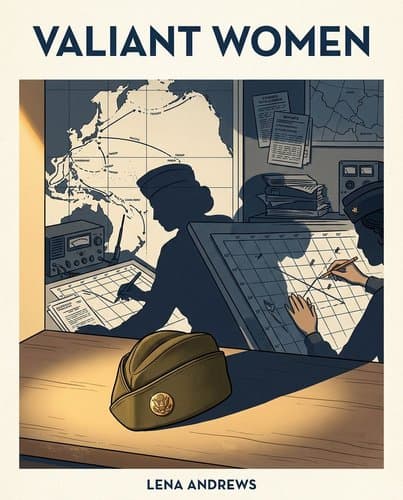
61858962_valiant-women
by Lena Andrews
The Allied victory required women not as a gesture of inclusion but as the only solution to an unsolvable manpower equation — and the systematic erasure of…
In Brief
Valiant Women (Augu) reveals that women were not a wartime supplement but an arithmetical necessity — the only solution to a manpower equation the military could not solve on its own.
Key Ideas
Women filled military's only personnel gap
The military's eligible male pool in 1942 was not 133 million — it was closer to 10 million after the military's own age, race, occupational, and medical filters. Women were not a supplement to this pool. They were the only available solution to an equation with no other answer.
Institutional necessity denied institutional welcome
Institutional necessity does not produce institutional welcome. Every branch that arithmetically needed women simultaneously fought to exclude them — and opening each door required individual political campaigns, personal lobbying, and legislative battles. Dr. Margaret Chung lobbied the WAVES into existence from the outside and was denied membership three times.
Essential work rendered invisible as support
The most operationally critical work women did in WWII — oceanographic surf prediction, serial-number production analysis, precision instrument repair, cryptographic operations — was categorized as 'support.' Support work rarely enters victory narratives, even when a specific landing or campaign depended on it directly.
Women held duty without institutional authority
Authority and responsibility are separable, and institutions will separate them when admitting people they did not choose to admit. Mildred McAfee's summary of her WAVES directorship applies to every first entry into a professional space: 'You didn't even earn it. You just had to kind of demand it.'
Sixties feminism returned to WWII advances
The women's liberation movement of the 1960s was not a beginning. The US military published accurate female sexual health information before Betty Friedan wrote The Feminine Mystique. Understanding WWII makes the 1960s fights look less like first attempts and more like returns to ground already taken and lost.
Who Should Read This
History readers interested in Military History and World History who want a deeper understanding of how we got here.
Valiant Women
By Lena Andrews
10 min read
Why does it matter? Because 350,000 women won a war the history books say men fought alone.
Here's the conventional story: women kept the home fires burning while men won WWII. Nurses tended wounds. Typists kept the paperwork moving. The real work happened elsewhere, done by someone else.
That story is arithmetically impossible.
The math was against it from day one, and the military planners knew it. A two-front global war cannot be fought, built, and supplied by one narrow cut of the population. Women weren't invited in as a gesture of inclusion; they were conscripted by math.
The interesting question is what happened after: how 350,000 women who had been structurally essential to Allied victory became a footnote before the surrender ink was dry — and what that tells you about a liberation movement that began decades earlier than anyone admits.
Women Didn't Volunteer Their Way Into the War — They Were Required by the Math
In 1940, the United States had a population of 133 million people. That sounds like an inexhaustible manpower reservoir — until you apply the filters the military actually used. The Army wanted White men between 20 and 45. Start there and you've already cut to 25 million. Then subtract the more than five million Black men who were nominally eligible but severely constrained in how they could serve. Now you're at 20 million. Then the deferments: men working in essential factories, men with treatable medical conditions, men whose absence from industrial jobs would slow the production of the very equipment the front lines needed. By the Army's own calculation, fewer than ten million Americans — less than eight percent of the population — were actually eligible once you counted what the war also needed from them at home.
And here was the second bind: the men most prized by military recruiters were the exact same men most prized by the factories building the tanks, aircraft, and ships. Draft everyone, and American industrial production, already racing to supply the largest military force in the country's history, collapses. Defer too many, and the front lines go hungry. The equation had no clean solution.
Marshall saw this clearly. In May 1940, as France was falling and the United States was still officially at peace, he testified that "personnel is our most serious deficiency." Later, as the math hardened, he put it plainly in a memo: "The demands on manpower would be so great that a large number of women should be incorporated in the Army's effort." Not welcomed. Incorporated. The word does the work.
The standard story of women in WWII breaks down here. The version usually told is that women answered a patriotic call, stepping up while men stepped away. It leaves out the part where senior commanders ran the arithmetic and concluded they had no choice. More than 350,000 women would eventually serve in uniform. They weren't filling a gap the military generously opened. They were filling a gap the military had no other way to close.
Every Service That Needed Women First Fought to Keep Them Out
Every Sunday in San Francisco, Dr. Margaret Chung hosted dinner.
The guests were naval aviators and submariners, young men drawn initially by her reputation as a Chinese American physician, then by something harder to name. She fed them ribs and Americanized Chinese food, then conducted formal adoption ceremonies with engraved rings, vows of dedication, and a standard she set herself: you had to be "a good guy, who can fly, who's not afraid to die." She called them her fair-haired bastards. By 1937, she had 500 adoptive children. By 1942, over 1,500, including Admirals Nimitz and Halsey, Senator Albert Chandler, and Representative Melvin Maas, a Marine Reserve colonel who sat on the House Naval Affairs Committee.
Her network was not incidental to the WAVES. It was the WAVES.
When Chung visited the Bureau of Aeronautics and asked where she could enlist, she was told federal legislation would need to be passed first. The Navy, at that moment, was stalled in a budget dispute over whether to integrate women into the naval reserve or keep them in a separate auxiliary, going nowhere fast. Bureau after bureau had already answered a 1941 survey with variations of "do not visualize a need."
Chung called Son #447. Within two days of her request, Maas introduced the bill on the House floor. Chung then recruited Alice Roosevelt Longworth, whose social influence in Washington spanned both parties, along with Senator "Happy" Chandler and the sister of Roosevelt's executive secretary, then hosted a dinner for Senate Democrats. The WAVES were signed into law on July 30, 1942.
She applied to join three times. The first two times, she was asked to wait. The third time, she was told she was 51 — over the age limit — and no exceptions would be made. The institution that owed its existence to her had no room for a possibly queer, middle-aged, Chinese American woman.
The Chung story shows in miniature what was true across every branch. The Navy's bureaus didn't want women. The Marine commandant, General Holcomb, stated plainly that he didn't believe women could serve any useful purpose in his Corps. The Army had shelved its own detailed studies on the question in 1931 because, as one memo put it, "no one seems willing to do anything about it." When Representative Edith Nourse Rogers introduced the WAAC bill, Representative Somers called it "the silliest piece of legislation I have ever seen."
What changed the outcome, in each case, wasn't the institution recognizing value it had overlooked. It was outside pressure made undeniable: a congresswoman who introduced a bill regardless of Army approval, a physician who called in a decade's worth of social capital, a military calculus that simply ran out of eligible men. The institutions didn't open to women. They were forced open, by women operating almost entirely outside them — and then, as often as not, they closed again the moment the woman who'd done the forcing tried to walk through the door.
Women Weren't Filling Desks — They Were Navigating the Pacific and Cracking German Production
In the spring of 1945, a team of women at the Navy's Hydrographic Office in Washington was working late. They were predicting surf conditions on Hagushi Beach, Okinawa. The Navy wouldn't authorize landing 60,000 troops until this team declared the sea safe enough. The team's leader was Mary Sears, a marine biologist who had spent her career studying frogs.
She had three Radcliffe degrees, including a doctorate on pigment migration in frog eyes, and had trained under the founding figures of American oceanography. When the Navy recruited her in 1942, she was handed a problem no official source could solve: amphibious assault doctrine was new, the Navy was planning landings on dozens of Pacific islands it had almost no data on, and landing craft were routinely sunk by coral reefs, irregular ocean floors, and unexpected currents. What her team had to work with: a fifty-year-old Dutch publication and some prewar Japanese academic surveys.
They made it work. Sears pulled every available scrap — Navy vessel records, colonial charts, scientific journals, and in some cases calibrated guesswork — and translated it into assessments commanders could act on. Her first independent project, a debris-drift study across both oceans, became the authoritative rescue guide for downed pilots and sunken crews. By 1944, her unit was producing intelligence on every major Pacific target for the next two years of operations: the Marianas, Palau, the Kurils, the Makassar Strait, Cam Ranh Bay.
At Okinawa, her team's verdict came back favorable. The landing proceeded. The ocean behaved exactly as they had predicted.
Three thousand miles away, a different intelligence problem was playing out. Germany had nearly doubled aircraft production in 1944, even as Allied bombers kept flying missions into the Reich. Economist Richard Ruggles's team needed to know whether those missions were working — whether 40,000 men dying in the air war had accomplished anything. Their method: reverse-engineer German production rates from serial numbers on captured equipment. Katherine Keene was doing that work, copying field reports from tire depots and equipment dumps across the European theater. When General Donovan came personally to honor the team, she wasn't in the office. She was at a tire depot.
"Support work" was an institutional label, not a description of function. Sears wasn't peripheral to the invasion. She was the intelligence it rested on. When she said the ocean was ready, 60,000 men walked into it. Keene was doing the same thing in Europe: figuring out whether the air campaign was working, one serial number at a time.
The Military Gave Women the Work While Withholding the Authority to Do It
When Mildred McAfee walked into Rear Admiral John Towers's office to discuss how the WAVES could support naval aviation, she expected a planning conversation. What she got was a complaint: "Where have you been all this time? We've been clamoring for these WAVES and nobody's ever listened to us."
McAfee hadn't known about his requests: as a lieutenant commander, she was too junior to attend the meetings where bureau chiefs discussed personnel needs.
Admiral Jacobs had told her, when she accepted the WAVES directorship, "You'll be in charge, and this will be your baby." What he hadn't told her was that her office held responsibility for the women's program without authority over any of the bureaus whose decisions actually shaped it. When disputes arose between her staff and the bureaus, no one had been designated to break the tie. When her subordinates brought ideas forward, the men in charge rejected them — not on their merits, but because women had proposed them. That was the first failure: responsibility without the power to use it.
McAfee's response was an influence campaign she found genuinely embarrassing. She instructed her staff to get their ideas in front of the relevant men and let those men believe the ideas were their own. "How perfectly stupid to resort to this technique," she said, "when we were there to do a job." On authority: "You didn't even earn it. You just had to kind of demand it."
The second failure was starker. Women who served without full military status also served without legal protection. When Oveta Culp Hobby traveled to Daytona Beach to recruit WAAC volunteers for an overseas deployment, she listed exactly what their auxiliary status meant: no military burial, no life insurance, no pension, no veterans' medical care, permanent discharge from military hospitals if the disability was lasting. Then she asked for volunteers. Three hundred women stood up at once.
Congress converted the WAAC to the Women's Army Corps in June 1943, conferring full military status. Eighty percent of the women already serving re-enlisted when given the choice to leave. They had performed the work first, and received the protections — if at all — as an afterthought.
Women's Disappearance from WWII History Was Engineered, Not Accidental
How does a record involving 350,000 people disappear? The forgetting wasn't passive drift. It was manufactured, starting during the war itself, and women were left to carry it as personal failure rather than coordinated attack.
In June 1943, a syndicated columnist named John O'Donnell published a claim that the War Department had secretly agreed to distribute contraceptives to WAAC members, with Eleanor Roosevelt's blessing. The implication was plain: servicewomen were being encouraged to sleep with soldiers. The column was fabricated. His only factual hook was that recruiting standards had been briefly lowered, inadvertently admitting women with "vice records" — less than one half of one percent of all recruits. He inflated this into scandal.
The damage was immediate. Parents and husbands flooded WAAC units with panicked calls. The government suspected Axis propaganda. The FBI found something more damning: the rumors had originated entirely within the United States, spread by Army personnel, Navy personnel, Coast Guard personnel, businessmen, and civilians. No foreign hand required. The WAAC's own slogan, "Release a Man to Fight!," had already given resentful soldiers a human target for their anger at being pushed toward combat. O'Donnell's column handed that resentment a public platform.
The smear converted institutional hostility into private shame. An enlisted WAAC named Amelia Madrak walked home through her neighborhood after the article appeared, holding her head high, certain everyone was watching. She made it inside, shut the door, and broke down. "I couldn't understand," she said later, "how my eagerness to serve our country could have brought such shame on us all."
That sentence is the mechanism. The smear didn't need to be widely believed — it only needed to make women doubt whether the question of their worth was settled. And it did. Women who had predicted Pacific surf conditions for 60,000-troop landings and done every job that freed men for the front left their service wondering whether the attack on their character had been, in some way, fair.
The Women's Liberation Movement Was a Recovery Operation, Not a Revolution
Imagine a building cleared out in a crisis. The occupants leave their desks and files and institutional knowledge, expecting to return. A generation passes. Their children organize and protest and fight for access to the same building. The history books call it a breakthrough. No one mentions the earlier tenants.
The women's liberation movement has always been told as revolution. The more accurate word is recovery. Before Betty Friedan published The Feminine Mystique in 1963, the US military had issued servicewomen a guide called Sex Hygiene — frank, detailed, covering anatomy, pregnancy, venereal disease, and menopause. Before Gloria Steinem launched Ms. magazine in 1972, the Navy had been publishing the WAVES News Letter. Before Mary Tyler Moore made pants on a woman a cultural statement, the Army Air Forces had already issued trousers to its pilots as standard equipment. These weren't progressive gestures. They were the unremarkable operational choices of an institution that had absorbed 350,000 women and needed to function.
When the men came home, women were displaced. The institutional precedents, the bureaucratic infrastructure, the demonstrated capability — all of it stayed. Women didn't. The feminists of the 1960s weren't staking new ground. They were reclaiming a deed.
The legal history makes this visible. In 1973, Air Force Lieutenant Sharron Frontiero sued the federal government for the same housing and medical benefits the military automatically extended to wives of male personnel. Her legal team included Ruth Bader Ginsburg. The court ruled 8-1 for Frontiero. The argument worked because a prior generation of women had already served within the institution, without full legal protections, creating a record against which the discrimination was legible. Recovery requires something to recover from.
Dorothy Stratton, in 1995, typed a measured letter to her local newspaper editor asking why his 50th-anniversary coverage had omitted women who served. Seventeen years later, Michelle Obama stood on a pier in Alameda and gave the order: "Officers and crew of the US Coast Guard Cutter Stratton, lay aboard and bring our cutter to life." The same woman who had to remind a journalist she existed had a warship named after her.
The women's movement didn't build from zero. It started from a loss.
The Ground Had Already Been Won Once
The women of WWII didn't need anyone to tell them what they were capable of. They already knew. Merle Caples — who had served as a WAAC driver and was, at 98, still surprised the question came up — knew it. Dorothy Stratton knew it well into her nineties, still correcting the record in letters to editors. The tragedy the book leaves you with isn't that women had to fight for equality in the decades that followed. It's that the fight was a retrieval operation: capabilities already demonstrated, positions already held, ground already occupied and then methodically cleared out once the emergency passed.
The next time you encounter a story about a woman doing something "for the first time," ask the prior question: was this actually a first? Or was it a return? The answer, more often than you'd expect, is that someone already proved it possible — and was then pushed out of the building before the history books arrived.
Notable Quotes
“that the creation of a Women's Reserve was taken up by the Navy as much because it feared that if it did not move, Mrs. Rogers would, and along lines which the department did not want.”
“Women Accepted for Volunteer Emergency Service,”
“an unnamed but dangerous combat theater.”
Frequently Asked Questions
- What does Valiant Women reveal about women's military service in WWII?
- Valiant Women reveals that women were not a wartime supplement but an arithmetical necessity — the only solution to a manpower equation the military could not solve alone. With the eligible male pool actually around 10 million after military filters, women filled a critical operational gap. The book demonstrates how each branch simultaneously needed and fought to exclude women, requiring individual political campaigns and legislative battles for entry. This reframes women's wartime service from volunteer support to institutional necessity.
- Why did the military need women during WWII but resist admitting them?
- Despite arithmetically needing women to solve their manpower crisis, every military branch fought to exclude them. The eligible male pool of merely 10 million after military filters meant women were the only available solution. Yet opening each door required individual political campaigns, personal lobbying, and legislative battles. Dr. Margaret Chung lobbied the WAVES into existence from outside but was denied membership three times. This pattern reveals that institutional necessity does not produce institutional welcome—resistance persisted even when women's entry was mathematically essential.
- What were women's critical roles in WWII that got erased from history?
- Women performed operationally critical work in WWII—oceanographic surf prediction, serial-number production analysis, precision instrument repair, cryptographic operations—yet this work was deliberately categorized as 'support.' Support work rarely enters victory narratives, even when specific campaigns depended on it directly. This erasure was not accidental but resulted from deliberate institutional design. The most advanced technological and intelligence operations relied entirely on women's contributions, yet these roles remained invisible in official military histories. This demonstrates how institutions systematically obscure women's most valuable work.
- What does Valiant Women say about women's liberation and WWII?
- The women's liberation movement of the 1960s was not a beginning but a return to ground already taken and lost. The US military published accurate female sexual health information before Betty Friedan wrote The Feminine Mystique, decades before mainstream culture acknowledged women's needs. Women had held authority and responsibility in critical military roles, yet institutions systematically separated these elements when admitting unwelcome members. Mildred McAfee's statement about her WAVES directorship captures this dynamic: "You didn't even earn it. You just had to kind of demand it." Understanding WWII reveals 1960s fights as reclamations.
Related Book Summaries


Read the full summary of 61858962_valiant-women on InShort