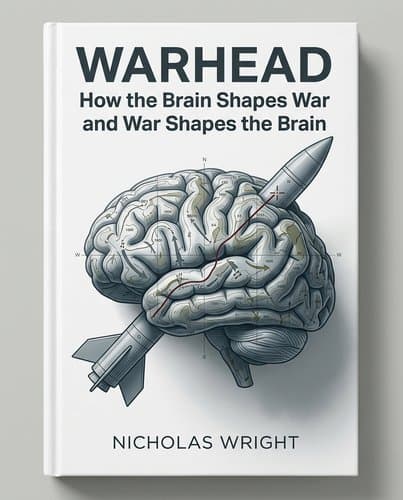
217387899_warhead
by Nicholas Wright
The brain that kept our ancestors alive on the savanna is now making nuclear decisions in the Situation Room—and that mismatch is terrifying.
In Brief
The brain that kept our ancestors alive on the savanna is now making nuclear decisions in the Situation Room—and that mismatch is terrifying. Wright reveals how prediction errors, metacognition, and the neurology of aggression quietly determine who wins wars before the first shot is fired.
Key Ideas
Surprise beats firepower in strategic battle
Treat prediction error as a strategic variable: the side that generates surprise in the enemy's model — not necessarily the side with superior firepower — wins the psychological battle that determines whether material advantages can be exploited at all.
Audit dangerous scenarios you instinctively ignore
Audit the branches your decision tree is pruning: the scenarios that feel too unpleasant or unlikely to model seriously (Rick's dismissal of war over Ukraine; Suez planners ignoring Arab reaction) are precisely the ones that produce catastrophic strategic surprise.
Aggressive minority determines collective fighting capacity
The 'will to kill' follows a skewed distribution — wars are decided by a neurological minority — so building effective defense means identifying and developing the small fraction of individuals wired for aggressive action while designing the broader system around the majority who will support rather than fight.
Control expectations as powerfully as terrain
Perception is a controlled model, not a passive feed: controlling the expectations your adversary brings to a situation (through deception, surprise, or information operations) is as powerful as controlling terrain, because it determines what they are neurologically capable of noticing.
Interrogate your uncertainty before critical decisions
Metacognition is trainable and measurable: explicitly interrogating your own uncertainty before a decision — asking 'what would make me wrong?' rather than 'how do I confirm what I already believe?' — is the specific skill that separated Petrov's restraint from catastrophe and Tetlock's superforecasters from credentialed experts.
Capabilities shape intentions, not the reverse
Capabilities create intentions: the RAF shifted to area bombing because it had the planes to do it, not because of moral deliberation — which means the proliferation of AI and autonomous weapons systems is already shaping strategic choices regardless of the wisdom of the people nominally in charge.
Who Should Read This
Curious readers interested in Neuroscience and Decision Making and the science of how the mind actually works.
Warhead: How the Brain Shapes War and War Shapes the Brain
By Nicholas Wright
11 min read
Why does it matter? Because the brain you think helps you see clearly is the one making war feel impossible — right up until it isn't.
A psychiatrist laughed in a North London pub in late 2021 when his friend suggested Russia might invade Ukraine. Smart man, reasonable argument, completely wrong three months later. The friend was Nicholas Wright — neuroscientist, Pentagon adviser — and his book isn't really about why the psychiatrist was wrong. It's about why he was so certain. Because that certainty, that civilizational confidence that serious war belongs to a previous chapter of history, turns out to be a feature of the brain rather than a conclusion of the evidence. Every generation that has grown up in peace makes the same mistake: treating its own moment as the exception. And that mistake isn't just Rick's problem — it's the structure of how all of us are wired to evaluate threat. Warhead is the explanation for that wiring — and for the dozen other cognitive patterns, built into us from the brainstem up, that make conflict feel unthinkable right until the tanks cross the border.
18 Wargames, 18 Losses: The Comfortable Assumption That Gets Democracies Killed
Late 2021. Nicholas Wright — neuroscientist, occasional Pentagon consultant — tells his friend Rick, a psychiatrist, that he's writing a book about war and the brain. Rick laughs. He listed the usual reasons — American military dominance, the sheer irrationality of the risk — and was certain. Three months later, Russian tanks crossed into Ukraine in the largest European land war since 1945.
What makes that conversation worth dwelling on isn't Rick's wrongness — it's how reasonable his certainty felt. He was a smart, educated professional whose mental model of the world simply didn't have a slot for major interstate war. That model was built in an era when Western military dominance was so total it made conflict seem almost unthinkable. The problem is that the world stopped matching the model, and the model didn't update.
Wright had been sitting on a number that made Rick's confidence look fragile. U.S. military planners had run eighteen consecutive wargames simulating a conflict over Taiwan. American forces lost every single one. Not most. All eighteen — and in several simulations, U.S. carrier groups were sunk within the first week. That statistic doesn't appear in the news cycle or get folded into the casual assumptions of educated professionals over beers. It sits in planning documents while people like Rick construct their sense of safety from headlines and historical momentum.
The gap Wright's book is actually about isn't hardware or defense budgets. The more dangerous gap is cognitive: the refusal to model the world as adversaries actually experience it rather than as it feels comfortable to assume. Democracies raised on the idea that major war is a historical relic aren't just underprepared materially. They've stopped thinking clearly about threat. And as Wright argues from page one, that is a brain problem before it is anything else.
France Didn't Lose a Battle in 1940 — It Suffered a Massive Prediction Error
The brain processes incoming information by constantly generating predictions and measuring how far reality deviates from them. When the gap is small, behavior continues smoothly. When the gap is catastrophic, the whole system seizes.
On May 13, 1940, French General Alphonse Georges received news that German Panzer forces had crossed the Meuse at Sedan. The French Army was widely considered the finest in Europe. It had more tanks than Germany, more artillery, more trained men. None of that mattered in the moment Georges slumped into his chair and wept. "Our front has broken at Sedan," he said. "There has been a collapse." Captain André Beaufre, who witnessed the scene, wrote that it made a terrible impression on him — not the military setback, but the dissolution of the command itself.
What happened at Sedan was not primarily a tactical failure. It was a neurological one. The German Blitzkrieg had been designed, deliberately, to generate prediction errors too large for an adversary's brain to absorb and recover from. The speed of the Panzer advance, the use of airborne troops deep behind Allied lines, the choice of the Ardennes — a forest everyone assumed was impassable — each element maximized the gap between what the French expected and what they encountered. Heinz Guderian had even published a book in 1937 explaining exactly this strategy, titled Achtung — Panzer!. French officers had access to it. They simply couldn't update their model of the world fast enough once the reality started arriving.
The prediction-error system that failed Georges traces to the brainstem — the part of the brain that registers when reality departs from expectation and triggers the cascade of responses we experience as alarm, paralysis, or desperate improvisation. Under normal conditions this system is what allows armies to adapt. Under conditions of extreme novelty and speed, it overwhelms instead. The French command didn't lose its nerve in any simple moral sense. It suffered a biological overload — a delta between expectation and reality so large that the system governing will and decision-making froze.
Firepower and logistics are the ingredients. Prediction error is the weapon. The side that can generate maximum surprise while maintaining its own grip on events holds the advantage that no order of battle can fully capture.
Only 15-25% of Soldiers Actually Fired Their Weapons. Wars Are Won by a Neurological Minority.
The will to fight aggressively is distributed about as evenly as Olympic talent. Army Lieutenant Colonel S.L.A. Marshall spent years interviewing American infantrymen after close combat in World War II and arrived at a finding that should have upended every assumption about how armies function: in a typical firefight, only 15 to 25 percent of soldiers fired their weapons at all. The rest held their positions, performed support tasks, or simply did not shoot. The pattern held in the air. Fewer than one percent of U.S. Air Force pilots accounted for roughly a third to forty percent of all enemy aircraft destroyed — an approximate range, but the direction is unambiguous. Military effectiveness isn't the product of a unified fighting force. It's the product of a small neurological minority operating inside a much larger group.
The machinery behind this is the amygdala, the brain's threat-detection engine, buried deep beneath the cortex. The amygdala processes fear — but fear isn't the opposite of courage. It's the biological precondition for it. People born with Urbach-Wiethe syndrome, which destroys amygdala function, don't become fearless warriors. They become chronic victims, unable to register looming threats or feel the urgency that drives survival behavior. Without fear correctly calibrated, you don't fight better. You simply don't notice that you should.
What separates the fifteen percent isn't the absence of fear — it's a neurological configuration that allows them to act through it. Wright notes that modern militaries are beginning to use augmented reality systems and physiological sensors during training to identify these individuals earlier, not to eliminate restraint, but to find the soldiers whose brains translate threat into controlled aggression rather than paralysis. The insight is uncomfortable but clarifying: armies don't win because everyone fights. They win by finding the few whose amygdalas process danger as a trigger rather than a stop sign, and building everything else around them.
The Rat That Planned a Route It Had Never Walked: How the Brain Simulates Wars Before They Happen
Imagine you could rehearse a dangerous journey without taking a single step — test a route, feel where it goes wrong, and arrive at the other end knowing whether to commit. It turns out you already have that capacity. So does a rat.
In one experiment, researchers placed rats in a maze where some sections were visible but physically off-limits. When a researcher dropped food into an inaccessible area, the rats sat still — but their hippocampal neurons fired in sequences tracing routes into places those animals had never physically entered. The brain was simulating paths through territory it had only observed. Not remembering a past experience. Pre-experiencing a possible future, working through the causal structure of the maze as a model rather than as a place.
Wright's point is that this is the foundational machinery of strategic thought. The hippocampus doesn't just file memories. It runs simulations. It takes what you know about how a world is structured and generates candidate futures from that knowledge, offline, before you commit to action. When you call this process planning in a military commander, it sounds like conscious deliberation. When you see it in a rat running invisible corridors in its sleep, you start to understand it as something older and more automatic — a feature of brains generally, not a special achievement of human reason.
The transfer of this capacity between adversaries is where it gets unsettling. In 1940, the British Royal Navy launched a carrier-based air attack on the Italian fleet at Taranto, demonstrating for the first time that battleships in a defended harbor could be neutralized from the air. A Japanese naval delegation studied the operation carefully. Fourteen months later, a remarkably similar template arrived over Pearl Harbor. The Japanese hadn't copied a tactic. They had absorbed a model of what was possible, run it through their own simulation, and found it worked.
Strategy, then, is a competition between models — who can simulate what, how far ahead, with how much fidelity. The war of models begins long before anyone fires a weapon, in the same neural architecture that let a stationary rat navigate a maze it had never walked.
Your Brain Isn't Watching the World — It's Generating It, and Enemies Know How to Hack the Feed
What actually happens when you see the world? The intuitive answer — light enters the eye, signals travel to the brain, reality appears — turns out to be wrong in a way that changes everything about how wars are won and lost.
The eye sends far less information to the brain than most people assume. The visual cortex fills the gaps with a running prediction of what should be there, based on expectation and context. You are not watching the world. You are watching your brain's best guess about it, updated — selectively and incompletely — by incoming sense data.
Pearl Harbor and Midway are a controlled experiment in that same mechanism. On December 7, 1941, some American observers saw Japanese aircraft close enough to make out the pilots' faces — and still could not process what they were seeing. Their brains were locked onto a model in which that airspace contained friendly training flights. The sensory data was there; the expectation wasn't. The model won. Six months later at Midway, Admiral Nimitz used intercepted Japanese communications to pre-load his commanders with the correct expectation: the Japanese would attack from the northwest, targeting a specific point, at a predictable time. Outnumbered in ships and aircraft, the Americans destroyed four Japanese carriers and lost one. The difference between the two battles wasn't firepower. It was whose model of the situation was accurate when the moment arrived.
Once you see this architecture, military deception stops being trickery and becomes neuro-engineering. The goal isn't to hide something — it's to corrupt the enemy's predictive model so badly that accurate sensory data can no longer correct it. Before El Alamein, British planners disguised artillery as lorries and moved real lorries where no attack was planned, training German aerial reconnaissance to expect a pattern that wasn't coming. The German model updated around the fake. The real attack landed somewhere that, according to every signal the Germans had processed, made no sense.
Leaders Don't Shape Events — They Shape the Models Other People Carry in Their Heads
June 1944. Two national armies, built on different doctrine, different slang, different assumptions about how orders should flow, coordinating the largest amphibious landing in history. Eisenhower understood that the operational problem was also a neurological one: before a single landing craft touched the beach at Normandy, British and American officers had to model each other's intentions accurately enough to act as a single organism. When he punished an American officer for calling a colleague a British son of a bitch — not for the insult, but for the nationality attached to it — he was protecting the shared mental model that made joint command possible. Driving a wedge between the two staffs meant two separate models of what the other side would do next; in the fog of Normandy, that gap would kill people.
Leadership, at its core, is a mentalizing problem. The temporoparietal junction and precuneus — the parietal cortex machinery — build a working model of what another person believes, intends, and will do next. A leader's job is to plant accurate models in enough other heads that thousands of people can act coherently without constant instruction. The German concept of Auftragstaktik, later adopted by the Allies as Mission Command, is institutionalized mentalizing: rather than prescribing every move, commanders communicate their intent — what success looks like — and trust subordinates to use their own modeling capacity to get there. Guderian didn't tell his Panzer crews which roads to take to the Channel coast. He told them to get to the Channel coast by whatever route worked — a principle the German Army called getting a ticket to the last station.
Hitler's failure was the mirror image. After Stalingrad, he stopped updating his model of his own commanders' capabilities — overriding Guderian's advice on the Eastern Front and insisting on holding ground that his generals told him couldn't be held, because his model of what the Wehrmacht could do had frozen in 1941. He never built the coordination with Japan that could have stretched Soviet reserves past breaking. The mentalizing faculty was there; he refused to use it. Coalition-building and deception turn out to be expressions of the same underlying system — one asks you to accurately model allies, the other to corrupt an enemy's model of you. Both require the same neural architecture.
Whose model of the social world stayed calibrated under pressure.
The Prefrontal Cortex Prunes the Decision Tree — and Sometimes It Cuts the Branch That Would Have Saved You
Think of the prefrontal cortex as a chess grandmaster who has learned, over a lifetime, that certain openings lead to positions too painful to play. So he stops calculating them. The lines disappear — not because they're losing, but because they're uncomfortable.
The PFC manages what would otherwise be an unworkable explosion of possibilities. A single tactical nuclear incident — say, a Russian detonation over Ukraine — immediately branches into dozens of response scenarios, until the tree is functionally infinite. The grandmaster truncates: he stops calculating twenty moves out. He prunes: he avoids lines that feel emotionally painful. He chunks: he labels whole sequences as lost positions without working them through. These tools are what make planning possible at all. They're also where plans go fatally wrong.
The 2003 Iraq War is a near-perfect anatomy of pruning failure. The decision to invade wasn't made by foolish people — it was made by experienced officials who had access to the same intelligence about sectarian fragmentation, dissolved institutions, and regional power vacuums that anyone paying attention could see. They pruned those branches. The scenario in which removing a government produces not stability but a decade-long insurgency was unpleasant to compute, so it got cut before it ever reached conscious deliberation. The PFC's efficiency tools don't announce themselves when they operate. They simply make certain futures invisible, and the leader experiences this as clarity rather than blindness.
What makes this genuinely unsettling is that intelligence amplifies the problem. A sharper prefrontal cortex chunks more confidently, prunes faster, truncates with greater authority. The mechanisms that produce decisive, sophisticated thinking are the same ones that systematically hide the futures a leader finds psychologically inconvenient — regardless of how smart that leader is. The comfortable assumption isn't a failure of information. It's a feature of the machinery doing the thinking.
One Soviet Officer, Five Phantom Missiles, and the Only Faculty That Can See the Whole System
Just past midnight on September 26, 1983, a Soviet early-warning computer announced that five American nuclear missiles were inbound. Lieutenant Colonel Stanislav Petrov had roughly twenty-five minutes before they would detonate on Soviet soil. His job was to alert his superiors. Instead, he paused and interrogated the alarm itself. The data felt too clean, too certain — and certainty, in his experience, didn't arrive this neatly. Why only five missiles? A genuine first strike would launch hundreds. He sat with his doubt for minutes that must have felt geological, then declined to report. The satellite had been fooled by sunlight reflecting off clouds.
Petrov wasn't smarter than the system that failed. He did something the system couldn't do: he turned the scrutiny back on itself. He didn't just process the alarm — he asked how much he should trust his own processing. That second-order move, thinking about the quality of your thinking rather than just its contents, is what neuroscientists call metacognition, and Wright argues it is the most consequential faculty the brain possesses for navigating high-stakes uncertainty.
It also happens to be measurable. The frontal pole contains more gray matter in people who are better calibrated between their actual accuracy and their confidence in it. This is distinct from IQ. Intelligence tells you how well you process information; metacognition tells you how accurately you know how well you're processing it.
Philip Tetlock's forecasting research made this concrete in a different register. When IARPA staged a tournament to find who could predict global events most accurately, teams from MIT and top universities were consistently beaten by ordinary volunteers selected for one specific trait: they updated their predictions explicitly and proportionally when new evidence arrived. Not expertise. Not credentials. The metacognitive habit of treating their own current beliefs as provisional data to be revised. Wright places this alongside the historians who have calculated roughly a one-in-three probability of major catastrophic conflict before mid-century — a figure that looks different once you understand that the faculty most likely to prevent it is also the one least likely to appear on any capability assessment.
The military implication Wright draws is uncomfortably direct. The absence of this faculty in leadership — the refusal to interrogate comfortable assumptions about adversaries, about post-invasion stability, about which scenarios are even worth calculating — is not a personality flaw. It is a measurable deficit in a specific neural capacity. And unlike weapons gaps, it rarely shows up on any balance sheet. Petrov's pause lasted minutes and cost nothing. What it prevented is the kind of question that belongs in the same sentence as civilization.
The One-in-Three Bet, and What Sadat Proves About It
Wright's one-in-three estimate isn't an invitation to despair — it's a calibration. And it applies to a faculty that, occasionally, actually works. When Sadat flew to Jerusalem in 1977, he didn't end the stalemate by acquiring better weapons or smarter advisors. He first asked what might actually be true rather than what his model insisted must be — then walked into the Knesset and generated a prediction error inside everyone else's thinking. The architects of the Marshall Plan made the same move: instead of running the post-1918 script that had produced the next war within a generation, they asked what a defeated nation actually needs to stop being dangerous, and answered differently. That sequence — self-interrogation before action — is the same move Petrov made in a Soviet bunker when he decided his own instruments were probably lying, the same move Nimitz made before Midway, and the same move Rick failed to make in a pub. The comfortable assumption isn't a failure of information. It's a failure of a specific, trainable faculty. You now know which one. The question Wright leaves you with isn't whether catastrophe is coming. It's whether you're willing to model the scenarios your brain finds too unpleasant to compute.
Notable Quotes
“Will North Korea launch a new multistage missile before May 10, 2014?”
“there have been lively, self-confident commanders who have exploited the principle of surprise—the means whereby inferior forces may snatch victory, and turn downright impossible conditions to their own advantage.”
“the rapid movements and flexible handling of our Panzers bewildered the enemy.”
Frequently Asked Questions
- What is Warhead about?
- Warhead (2025) by Nicholas Wright applies neuroscience to military strategy and decision-making. The book explains how prediction error, perception, and metacognition shape why leaders and soldiers behave as they do during conflict. Wright demonstrates how understanding these brain-based mechanisms can improve strategic decision-making, help anticipate adversary behavior, and illuminate how emerging technologies like AI are already reshaping military choices. The work provides concrete analytical tools for strategists, policymakers, and informed readers seeking to understand modern warfare.
- What are the key takeaways from Warhead?
- Warhead's key takeaways include: prediction error is a strategic variable—the side that generates surprise wins the psychological battle, not necessarily the side with superior firepower; strategists must audit decision trees to identify pruned scenarios that create strategic surprise, such as Ukraine or Suez; perception is a controlled model, so managing adversary expectations is as powerful as controlling terrain; metacognition is trainable and measurable—interrogating your own uncertainty separates sound decision-making from catastrophic error; and capabilities create intentions, meaning AI proliferation inherently shapes military strategy regardless of human wisdom.
- How does prediction error drive military strategy in Warhead?
- According to Warhead, "the side that generates surprise in the enemy's model — not necessarily the side with superior firepower — wins the psychological battle that determines whether material advantages can be exploited at all." This reframes conventional military strategy: instead of prioritizing raw firepower, leaders should focus on creating mismatch between enemy expectations and reality. Strategic surprise—generating prediction error in an adversary's mental model—becomes the decisive factor in translating material advantages into actual victory. Understanding and exploiting prediction error thus becomes central to effective military strategy and tactics.
- Does Warhead address emerging technologies like AI in military conflict?
- Yes, Warhead extensively addresses how emerging technologies, particularly AI, are reshaping military strategy. Wright explains that "capabilities create intentions"—technological capabilities drive strategic choices regardless of deliberation about their wisdom. He illustrates this with the RAF's shift to area bombing, which occurred because the capability existed, not from moral deliberation. According to Wright, AI proliferation is already shaping military decisions regardless of the wisdom of leadership. The book demonstrates that having powerful military technologies will drive their use in ways that transcend traditional strategic reasoning, making this understanding essential for policymakers.
Related Book Summaries
Read the full summary of 217387899_warhead on InShort