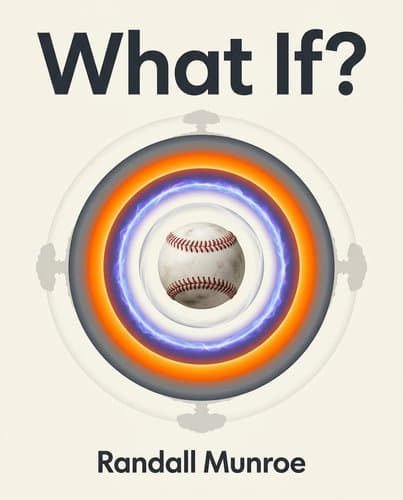
21413662_what-if
by Randall Munroe
Absurd hypotheticals—like what happens if you hit a baseball at 90% the speed of light—turn out to be the sharpest tools for understanding real physics.
In Brief
Absurd hypotheticals—like what happens if you hit a baseball at 90% the speed of light—turn out to be the sharpest tools for understanding real physics. Randall Munroe answers ridiculous questions with genuine rigor, revealing more about how the universe works than any textbook dares to.
Key Ideas
Fermi estimation is learnable by all
Back-of-the-envelope Fermi estimation — the same tool used to calculate a mole of moles or orbital velocity — is learnable by anyone willing to care about a question, not reserved for people born with a 'math brain.'
Extremes create qualitative phase changes
When a physical system is pushed to extremes, the results are qualitatively different, not just quantitatively larger: chemistry becomes nuclear events, atmospheric deceleration becomes plasma, and a counting unit becomes a moon.
Physics pursues accuracy over comfort
The rigorous physics method is neutral about whether answers are terrifying or reassuring: a spent nuclear fuel pool is safer than a sidewalk; a supernova's neutrinos would still kill you at 2.3 AU. The method's job is accuracy, not alarm.
Reaching orbit requires horizontal velocity
Space isn't far away — it's sideways. Getting to orbit requires ~8 km/s of horizontal velocity, not altitude. Most of rocket fuel is spent on sideways acceleration, which is why every spacecraft uses air-braking instead of rockets to slow down.
Evolution leaves extinct threat patterns
Evolution leaves ghost pressures: the pronghorn still runs at 55 mph from predators extinct for 10,000 years. Our institutions, fears, and intuitions may similarly be optimized for environments that no longer exist.
Plastic becomes humanity's geological record
Humanity's most permanent legacy is not architecture or language but a layer of processed hydrocarbons — plastic — readable in the geological record a million years from now. The 'Anthropocene' is already written in stone.
Who Should Read This
Science-curious readers interested in Physics and Learning who want to go beyond the headlines.
What If?
By Randall Munroe
10 min read
Why does it matter? Because the universe doesn't care whether your question is dignified.
A baseball thrown at ninety percent the speed of light doesn't behave like a baseball anymore. The air molecules can't move aside in time, so they fuse with it — nuclear fusion, triggered by a fastball, consuming the stadium in an expanding sphere of plasma. The batter, per official MLB rules, is technically entitled to first base. That's the entire premise of this book in one pitch: take an absurd question with total seriousness, and reality turns out to be stranger and more violent than any answer you could have invented. Randall Munroe treats the gap between "silly hypothetical" and "profound physics lesson" as nonexistent, because it is. The same reasoning that calculates supernova neutrino doses also figures out whether you could boil tea by stirring. If you've ever wondered what question that reasoning might be waiting to answer for you, you've already found the right guide.
A Baseball at 90% the Speed of Light Triggers Nuclear Fusion — and the Batter Gets First Base
The pitcher releases the ball. Seventy nanoseconds later, the game is over — along with the stadium, the surrounding neighborhood, and any reasonable expectation of a normal afternoon.
That's the actual timeline Randall Munroe works out when he applies particle physics to a simple question: what happens when a baseball is thrown at 90% the speed of light? The premise sounds like a joke setup. The answer reads like a nuclear incident report.
At 600 million miles per hour, the ball moves so much faster than the air molecules in its path that those molecules are, for practical purposes, frozen in place. They don't have time to flow around the ball the way aerodynamics would normally demand. Instead, the ball slams into them hard enough to force atoms on its surface to fuse with atoms in the air. That's nuclear fusion — not as a metaphor, but literally the same process that powers the sun — triggered by a baseball. Each collision releases gamma rays. The gamma rays rip electrons from surrounding air molecules, turning the atmosphere inside the stadium into an expanding bubble of superheated plasma radiating outward from the pitcher's mound at close to the speed of light.
The ball erodes, shedding fragments that trigger still more reactions. By the time 70 nanoseconds have elapsed, what reaches home plate isn't a baseball anymore — it's a bullet-shaped debris cloud still moving at a substantial fraction of the speed of light. The batter has no warning: the light from the pitcher's release arrives at the batter's eyes at nearly the same instant the debris cloud does.
The blast levels everything within roughly a mile. From a hilltop outside the city, you'd watch a light brighter than the sun slowly resolve into a mushroom cloud, and then the shock wave would arrive and start pulling trees apart.
Munroe's closing observation is that under Major League Baseball Rule 6.08(b), since the batter was struck by the pitch, they are technically entitled to advance to first base. The rule doesn't specify that first base needs to still exist. This is the signature move of the whole book: rigorous reasoning pushed far enough that the punchline is structural — reality, examined carefully, is both funnier and more catastrophic than you expected.
Scaling Familiar Things to Extremes Doesn't Produce Familiar Results — It Produces Planetary Catastrophes
The periodic table exercise proves this row by row. The first two rows of element-bricks are awkward but survivable: some gas drifts away, some metal tarnishes, fluorine starts eating through things and would destroy your lungs if you inhaled a trace of it. By the third row you have white phosphorus igniting on contact with air and sulfur catching fire in the fluorine cloud, so now your building is probably burning. The fourth row adds burning potassium and toxic arsenic smoke. More rows, more fire, more poison, more mess — scaling up produces a bigger version of what you already have.
Then you hit the sixth row, and the scaling produces something qualitatively different. The problem is astatine. Because of its extreme radioactivity and a half-life measured in hours, a liter-sized cube of the stuff would instantly vaporize under its own heat — a column of superheated gas that gives third-degree burns to anyone nearby and delivers a lethal radiation dose in the time it takes to blink. The chemists who study astatine suspect it has a black surface, but no one actually knows, because the material refuses to exist long enough to observe. The documentation for working with astatine would be a single prohibition: don't.
That's still recognizable as a radiation disaster — a bad one, but local. You'd have paperwork; your institution might survive. The seventh row doesn't produce a radiation disaster. It produces a nuclear detonation. The heaviest elements are so unstable that a cube of any of them decays within seconds, releasing all that energy simultaneously. No chain reaction — just a reaction, all at once. You and the surrounding periodic table become plasma. The mushroom cloud reaches the stratosphere. The fallout is, in the book's precise phrasing, a kind of periodic table in reverse: everything decaying into everything else as fast as possible. The contamination would exceed Chernobyl by thousands of times, and cleanup would stretch across centuries.
Scaling a familiar thing up doesn't give you a bigger version of the familiar thing. Somewhere in the sixth row, the experiment crossed a threshold into a domain where different physics governs entirely, and your intuitions about the earlier rows actively misled you about what was coming. You started by stacking cube-shaped bricks. You ended with a regional nuclear catastrophe.
This is the sensation Munroe's book produces repeatedly: the creeping recognition that your sense of how scales relate to each other is broken. Bigger isn't just more. At sufficient extremes, it's something else — and the gap between what you expected and what happened is the physics.
The Same Method That Calculates a Mole of Moles Also Deflates Your Nuclear Fears
The question Munroe applies his usual method to: what happens to a swimmer in a spent nuclear fuel pool? Every 7 centimeters of water cuts the radiation reaching you in half. The fuel rods sit at the bottom of a pool roughly 4 to 5 meters deep. Run the halving layers and the radiation at the surface becomes negligible — not 'manageable' negligible, but actually lower than the background radiation you absorb walking down a normal street. The water above the fuel rods shields more aggressively than open air ever could. From a radiation standpoint, the swimmer treading water above those rods is in a safer environment than the sidewalk outside the facility.
The real constraint on survival isn't the nuclear material — it's aerobic capacity. You'd drown from exhaustion somewhere between 10 and 40 hours in. Same timeline as any pool.
The Leibstadt reactor incident from 2010 makes the principle concrete. A diver working in a Swiss spent fuel pool picked up an unidentified piece of tubing from the bottom and put it in his tool basket. The tubing turned out to be protective casing from a reactor core monitor, sheared off accidentally four years earlier and intensely radioactive from neutron exposure. When the basket broke the surface, room alarms fired immediately. The diver survived. His whole-body dose was elevated but not lethal, and only his hand — an extremity that tolerates radiation better than the organs — received a serious hit. The surrounding water had done the shielding work even as he held the object. His hand was the only part of him that couldn't put centimeters of water between itself and the source.
Munroe ends the chapter by calling a friend who works at a research reactor and asking what would happen to a trespasser attempting to swim in their fuel pool. The answer: gunshot wounds, well before reaching the water. The security team is the actual threat. The physics of the fuel, worked through carefully, had already stopped being the threat several paragraphs earlier.
The method doesn't reliably produce catastrophe — it produces accuracy. Sometimes accuracy means a baseball erases a neighborhood. Sometimes it means the radioactive pool is the safest part of the facility.
The Pronghorn Is Running from Predators That Went Extinct 10,000 Years Ago — and So Are We
Imagine you're a sprinter who trained for years to outrun a competitor who retired before you were born. You still run those splits. You can't stop — the speed is built into you at a cellular level. That's the situation of the pronghorn, and Munroe uses it to argue that evolution is less a history book than a haunted house.
The pronghorn, North America's fastest land animal, can sustain 55 miles per hour over long distances. Its current predators — wolves, coyotes — top out around 35 mph in a sprint. The speed is wildly excessive for the threats the animal actually faces, which is exactly Munroe's point: the pronghorn isn't running from wolves. It's running from the dire wolf, the short-faced bear, and the sabre-toothed cat, all of which vanished roughly ten thousand years ago in the extinction wave that swept North America shortly after humans arrived. Those animals were faster, heavier, and more lethal than anything stalking the plains today. The pronghorn evolved to survive them — and it's still carrying that survival machinery, generations after the threat dissolved. The ghost of the predator is written into the prey's legs.
The same logic runs in reverse when Munroe turns it on us. The pronghorn carries a record of what threatened it; we carry a record of what we made. Rain, wind, and eventually glaciers will strip every skyline from the geological record — the Chrysler Building will leave less trace than a sandbar. But humanity has already authored one genuinely permanent mark: a global layer of plastic. We've pulled petroleum from the ground, converted it into polymers our chemistry barely knows how to undo, and spread it across the entire surface of the planet. A million years from now, that layer will still be readable in the strata — an unmistakable chemical signature left by a civilization that otherwise left no forwarding address.
The pronghorn runs from extinct predators. Our plastic outlasts everything we build. The things that will represent you aren't the ones you'd choose.
Everybody Jump: The Physics Is Harmless. The Gathering Is an Extinction Event.
At noon, everyone on Earth jumps. Seven billion people launch themselves half a meter into the air, every foot striking the ground in a simultaneous roar that rolls across Rhode Island like thunder. The planet moves — specifically, less than the width of a single atom, because Earth outweighs humanity by a factor of more than ten trillion, and our collective vertical leap is, from the planet's perspective, indistinguishable from nothing. The jump is fine. The jump is the last fine thing that happens.
The problem is everything that follows. Five billion phones surface from pockets within seconds of landing, and every one of them shows no signal — the cellular networks collapse instantly under a load they were never built to survive. The 150 outbound lanes of road threading out of Rhode Island could, under ideal conditions, empty the state's actual population of roughly a million people in a few hours. They cannot do anything meaningful for seven billion. T. F. Green Airport in Warwick could run at five times its normal capacity for years and never make a dent in the crowd. The world's entire shipping fleet, converted to passenger transport, would still leave most of humanity on the shore.
The logistics collapse is compounded by a communication problem that makes coordination nearly impossible. If you picked two people at random from that crowd, there's roughly an 8% chance they share a language — meaning almost every pair of strangers who meet cannot ask for water, cannot explain where they're going, cannot organize anything. Rhode Island becomes a patchwork of improvised hierarchies, collapsing as fast as they form. Grocery stores empty. Fresh water runs out. Within weeks, the chapter concludes, the state is a graveyard of billions.
Munroe offers no recovery arc here — no equivalent of the Moon restoring Earth's tilt, no consolation physics. The survivors rebuild atop the ruins, the planet's orbit unchanged, the population greatly reduced. The jump, the question everyone asked, was harmless. The gathering was the extinction event. The method that found safety in a nuclear fuel pool and comedy in a relativistic baseball finds nothing redemptive in this one — and the absence is its own kind of answer.
Neutrinos Are So Ghostly They Pass Through the Earth — But a Nearby Supernova Would Still Kill You With Them
Neutrinos are so indifferent to ordinary matter that a trillion of them stream through your hand every second, courtesy of the Sun — and on average, one will actually collide with an atom somewhere in your body roughly once every few years. The whole Earth is transparent to them. Particle accelerators can fire a neutrino beam at a detector on the other side of the planet and aim straight through the middle. No tunnel required.
So when the question is how close to a supernova you'd need to be for its neutrinos to kill you, it sounds almost incoherent — like asking how many feathers it would take to knock you over. The answer runs the two extremes against each other and produces a very specific, very unsettling number.
A core-collapse supernova releases roughly 10⁵⁷ neutrinos — one for every proton in the collapsing stellar core that converts to a neutron. At one parsec, about 3.26 light-years out, the total radiation dose you'd absorb from all those neutrinos amounts to about one five-hundredth of the dose from eating a single banana. Completely harmless. But neutrino flux follows the same inverse-square law as light: cut the distance in half, quadruple the dose. Work backward from a lethal dose of 4 sieverts and the fatal distance is 2.3 astronomical units — roughly the distance from the Sun to the asteroid belt.
At that range, the neutrinos are your smallest problem. Core-collapse supernovae happen inside massive stars, so at 2.3 AU you'd already be somewhere inside the outer layers of the star itself, incinerated long before the neutrino dose became relevant. But that's what the number actually tells you: the ghost particles that pass through planets without noticing them would still be dense enough, at that distance, to deliver a lethal radiation dose on their own, independently, if everything else somehow left you untouched. Scale overwhelms permeability. The feather, moving fast enough, knocks you flat.
Caring About the Question Is the Precondition for Science — Not the Other Way Around
A five-year-old sits across from his mother and asks how many soft things exist in the world. He doesn't wait for an answer. Each house has roughly four pillows, he reasons, and about fifteen magnets — so that's nineteen objects, multiply by the number of houses, and the planet probably contains three billion soft things and five billion hard things. Hard things win.
Munroe tells this story in the tenth-anniversary edition, and his first instinct is the familiar one: this is what a math person looks like as a child, the personality revealing itself early. Then he rewatches some episodes of a PBS show called Square One that he caught as a kid — specifically a segment called Mathnet, a police-procedural parody where detectives solved crimes using estimation. They calculated the weight of a sofa-sized hamburger. They figured out how far a helicopter could fly while carrying a house. That's the conversation he was having with his mother. He wasn't expressing an innate trait. He was imitating a method he'd seen on television.
The distinction matters. If the method can be learned from two TV detectives, the precondition for science isn't genius — it's exposure to someone who took a question seriously.
Science is a process for answering questions about things we care about, and the caring has to come first. It is not a stockpile of true facts. There is, Munroe notes, no scientific rebuttal to nihilism. If you don't care about the question, no amount of methodology rescues you.
What followed the book's publication was evidence for the claim. At signings, children had memorized the chapters and invented their own scenarios. A decade later, Munroe started meeting those same children as adults — now entering physics programs, engineering labs, careers in science. The questions had been ridiculous. The outcome was real. The tools required to figure out what a relativistic baseball does to a stadium are the same tools that model climate systems or design vaccines. The absurd question is the honest entry point. It turns out people will learn a lot of thermodynamics if someone first makes them care about what happens when a baseball reaches 90 percent of the speed of light — and the answer, it turns out, involves a nuclear fireball and a serious question about whether the batter is entitled to first base.
The Question Is the Method
The five-year-old counting pillows wasn't doing science — he was doing something prior to science, which is caring enough about a question to take it seriously. Everything else followed from that. The methodology that calculates supernova neutrino flux and the methodology that estimates global pillow count are the same methodology, separated only by years of accumulated caring. Munroe's book works because it never pretends the ridiculous questions are a warm-up for the real ones — they are the real ones, wearing a different costume. Somewhere out there are 10^92 possible tweets that no human will ever read (Twitter's character limit means the space of possible tweets is almost incomprehensibly larger than the number of tweets that will ever actually exist), a mole's worth of moles orbiting each other somewhere between the Earth and Moon (a mole is 6×10^23 — enough moles to form a ball roughly half the Moon's orbit, slowly collapsing under their own gravity), immortal beings slowly finding each other across geological time. The universe didn't save its strangeness for the questions we thought to ask first. It was always this strange. You just had to care enough to look.
Notable Quotes
“that stuff just doesn’t want to exist.”
“I’m Gonna Be (500 Miles).”
“You’d die pretty quickly, before reaching the water, from gunshot wounds.”
Frequently Asked Questions
- What is What If? about?
- "What If?" by Randall Munroe applies rigorous physics and Fermi estimation to absurd hypothetical questions like what happens if you assembled a mole of moles or fired a baseball at 90% the speed of light. By taking ridiculous scenarios seriously, the book builds genuine scientific intuition for reasoning quantitatively about any problem, no matter how outlandish. Readers learn that back-of-the-envelope Fermi estimation—the same tool used to calculate a mole of moles or orbital velocity—is learnable by anyone willing to care about a question, not reserved for those with innate mathematical talent.
- What are the key insights from What If?
- "What If?" demonstrates that physical systems behave qualitatively differently when pushed to extremes. Chemistry becomes nuclear events, atmospheric deceleration becomes plasma, and a counting unit becomes a moon. The book prioritizes accuracy over sensationalism—a spent nuclear fuel pool is safer than a sidewalk, while a supernova's neutrinos would still kill you at 2.3 AU. Readers learn that space isn't far away—it's sideways, and orbital mechanics depend on horizontal velocity at approximately 8 km/s, not altitude. This explains why most rocket fuel achieves sideways acceleration and every spacecraft uses air-braking to slow down.
- What does What If? teach about space and rockets?
- "What If?" reveals that space isn't far away—it's sideways. Getting to orbit requires approximately 8 km/s of horizontal velocity, not altitude, which is why most rocket fuel is spent on sideways acceleration rather than upward thrust. This fundamental insight explains why every spacecraft uses air-braking instead of rockets to slow down upon re-entry. By understanding that orbital mechanics depend on velocity rather than height, readers gain insight into why rocket design prioritizes horizontal acceleration. The book uses this example to demonstrate how back-of-the-envelope physics reveals counterintuitive truths about humanity's most significant technological achievements.
- What does What If? say about humanity's lasting impact?
- Humanity's most permanent legacy is processed hydrocarbons—plastic—readable in the geological record a million years from now, according to "What If?" This insight suggests that the Anthropocene is already written in stone, making plastic our most enduring contribution to Earth's history. Beyond material legacy, the book explains that evolution leaves ghost pressures: the pronghorn still runs at 55 mph from predators extinct for 10,000 years. This principle extends to human institutions and fears, which may be optimized for ancient environments that no longer exist. Recognizing these evolutionary artifacts encourages reassessing whether current behaviors remain adaptive.
Related Book Summaries


Read the full summary of 21413662_what-if on InShort