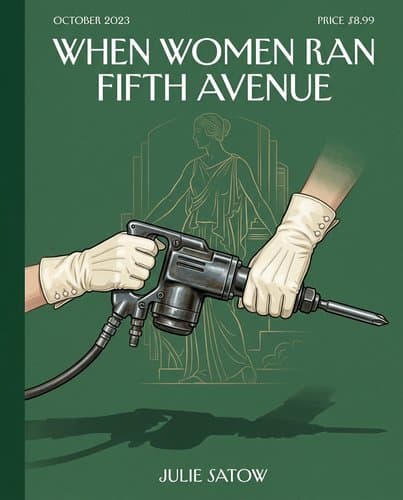
198563695_when-women-ran-fifth-avenue
by Julie Satow
The women who built America's most iconic department stores—from Lord & Taylor to Henri Bendel—wielded consumer insight as a competitive weapon, only to be…
In Brief
The women who built America's most iconic department stores—from Lord & Taylor to Henri Bendel—wielded consumer insight as a competitive weapon, only to be erased from the histories they shaped. Satow recovers their radical strategies and reveals how outsider status became both their greatest advantage and their ultimate vulnerability.
Key Ideas
Real Customer Problems Beat Credentials
Consumer insight is strategic intelligence: Hortense's advantage wasn't business training — it was having been a broke mother in a bad dressing room. The people closest to the actual customer problem often see solutions that credentialed experts miss.
Women Masked Competence to Navigate Power
Outsider status requires a cover story: Dorothy Shaver knocked on wood at board meetings and performed uncertainty to protect ideas she'd already decided to implement. Navigating hostile institutions sometimes means disguising your competence — which is a real cost, not just clever tactics.
Personal Identity as Moat and Liability
Curation beats scale until it doesn't: Geraldine Stutz's entire strategy was making Bendel smaller and more specific while every competitor grew larger. It worked — until the store became so identified with her personal taste that it couldn't survive her departure. Irreplaceable identity is a competitive moat and a succession crisis simultaneously.
Excluded Voices in Celebrated Progress
Liberation that excludes isn't liberation: The department store was celebrated as a safe, democratizing space for women — but Maggie Walker's experience shows that this liberation operated on a whites-only basis. Coordinated economic warfare, not consumer indifference, closed the St. Luke Emporium.
Culture Gets Destroyed in Sales
What gets sold gets unmade: All three women built institutions that were eventually sold by people who didn't understand what they'd bought. The specific culture — the Friday Morning Lineup, the 'American Look,' the Debutante department — was the asset, and it was the first thing destroyed. Who controls the sale controls the legacy.
Who Should Read This
History readers interested in World History and Business Leaders who want a deeper understanding of how we got here.
When Women Ran Fifth Avenue
By Julie Satow
12 min read
Why does it matter? Because the women who built American retail were erased from its history — and the same forces that built their stores tore them down.
Ask anyone who built the great American department stores, and they'll name men: Macy, Bloomingdale, Bonwit. They're not wrong — those men put their names on the buildings. But the buildings were often failing when the women arrived. A housewife from Utah who'd never held a job. A doll-maker from Arkansas with a suitcase and a sister. These women didn't just manage stores — they invented American fashion, turned display windows into theater (Lord & Taylor's holiday windows stopped Manhattan foot traffic), dressed the military, and made a place to buy gloves into a stage where women exercised power unavailable anywhere else. Then they were underpaid, outright forgotten, or watched their life's work get jackhammered off a building by a man using a fake name. Julie Satow is here to correct the record. The women who got erased turn out to be more interesting than the men whose names stuck.
The $10 Dress That Built a Fifth Avenue Empire
Picture Hortense Odlum in a Manhattan bargain basement in 1916: twenty-five years old, a baby napping back in Brooklyn, ten dollars in her purse, and a Thanksgiving business dinner looming. She needed a dress. What she found were racks crammed with fabric disasters — cheap chiffon buried under ribbons and beading, each ornament advertising the shoddy construction underneath. A saleswoman glanced at her budget and waved her toward the discount corner without a word. Hortense grabbed the least offensive option, a black chiffon, hoping it would improve in her bedroom mirror. It looked worse. She wore it anyway. It made her look fifty.
Not the origin story you'd expect for the woman who would eventually run Bonwit Teller, Fifth Avenue's most prestigious women's store, and triple its sales in three years. Business school case studies credit executives with frameworks, mentors, market analysis. What Hortense had was that dressing room. The humiliation was specific and instructive: she had experienced, from the inside, exactly what it felt like to be a woman with a modest budget who still wanted to look like herself — and to be treated as though that desire was an inconvenience.
Two decades later, when Floyd Odlum's investment firm acquired a near-bankrupt Bonwit Teller and Hortense found herself in charge, she called in a roomful of veteran garment manufacturers and told them she wanted simple, well-cut dresses in quality fabrics — nothing more. The men pushed back with the confidence of people who'd spent careers deciding what budget shoppers deserved. Hortense told them she'd prove it. She opened two new departments, one targeting young professional women, one aimed at fashion-conscious younger shoppers, and stocked them with exactly the unfussy, well-made clothes she had once desperately needed. The crowds came. By 1938, annual sales reached $9.5 million.
Her male colleagues couldn't have arrived at that insight. They had never stood in that dressing room.
The Liberation Had a Color Line
In April 1905, Maggie Lena Walker opened the St. Luke Emporium in Richmond's Jackson Ward: four stories, an electric sign out front, colored wax figures in the windows, a full shoe department, dry goods, ready-made dresses. By any measure, it was exactly the kind of modern retail operation the press celebrated when white women ran it. Walker had already made history as the first Black woman to charter a bank. The Emporium was her next move — a place where Black women could earn real wages and Black shoppers could buy without humiliation.
Which is when the department store revealed its other face.
White Richmond's response was immediate and organized. Before the store opened, white merchants tried to buy Walker out — first offering $4,000 over asking price, then raising the bid to $10,000, roughly $350,000 today. She refused both times. So they formed the white Retail Dealers' Association and launched a coordinated attack on her supply chain, sending warning letters to every wholesaler who did business with Walker — including vendors in New York — threatening boycotts if they kept selling to her. Suppliers began demanding immediate payment on outstanding balances, refused to extend credit, and some stopped dealing with the Emporium altogether. A store lives on inventory. No inventory, no store.
Walker understood exactly what was happening. They weren't waiting for her to fail, she said — they were moving to crush her while she was still too small to fight back. The Emporium survived seven years before closing in 1912, its first-year sales of over a million dollars in today's terms having collapsed by more than sixty percent.
The liberation the department store promised had always carried an asterisk. Maggie Walker found it in the fine print. The women who followed her into retail leadership were white, which meant the industry's other forms of resistance — the ones this book is mostly about — were the only ones they ever had to face.
The 'American Look' Was Stolen from Paris
Dorothy Shaver was promoting Claire McCardell's sportswear as a homegrown alternative to Parisian artifice — authentic, American, liberated from French influence — when the inconvenient backstory was still recent enough that the people who'd lived it were very much alive.
Elizabeth Hawes, one of the first designers Shaver would later showcase under that American banner, spent her mid-1920s in Paris doing something closer to industrial espionage than fashion apprenticeship. The operation ran on a simple premise: you stole what you could and bought what you had to. Hawes worked for a copy house run by a woman called Madame Doret, whose entire business model required physically possessing the original before replicating it. One afternoon, Hawes borrowed her beaver coat and used it as a smuggling garment. She collected a stack of fresh Chanel dresses from a collaborating Paris-based buyer — an agent planted at the house to facilitate exactly this — tucked them under the coat, and rushed them to Doret's back rooms. Fitters worked fast: patterns traced, fabric samples cut from hidden seam allowances, every button and belt noted. Then Hawes jammed the dresses back under the fur, returned them before they were missed, and watched the copies ship to New York on the next fast boat.
American department store buyers made Hawes look restrained. At Chanel's showroom — already a controlled, hostile environment designed to catch exactly this kind of theft — buyers stuffed fabric samples into mink pockets, tore fringe from garments to send home for copying, and eventually walked off with a belt, which got belts banned from fitting rooms thereafter.
Shaver inherited this industry. The 'authentic' American designs she championed were built on it. The triumph was genuine. The clean hands were a story.
To Survive the Boardroom, You Had to Pretend You Didn't Belong There
What does it take for a woman to run a major corporation when the men around her believe, with genuine conviction, that she probably shouldn't? Dorothy Shaver found out. By the time she became president of Lord & Taylor in 1945, earning $110,000 a year — Life magazine noted this was roughly a quarter of what the president of IBM made — she had developed a technique for surviving boardrooms that deserves its own case study. After steering every argument to her preferred conclusion, Dorothy would lean back and say, with apparent sincerity, 'Darned if I know whether we ought to do that or not.' She knocked on wood at board meetings. She let male vice presidents walk away convinced the winning idea had been theirs. The performance was deliberate and precise: she called it making men feel superior, and noted they 'love to feel' that way. The press cooperated, publishing dispatches about her fear of thunderstorms and her habit of doing her own hair. A woman running a thousand-person retail operation, described through her hairstyle and her weather anxieties.
Hortense Odlum played the same game with different props. Her cover story at Bonwit Teller was the 'frightened woman' — the housewife who simply noticed what other housewives wanted. Floyd's framing, 'Women know what women want in a store,' was the only justification male ownership would accept for putting her in charge, and Hortense leaned into it, presenting her decisions as instinct rather than strategy, naïveté rather than analysis. The hat department relocation she pushed through over management's explicit objections — the one that tripled hat sales and converted window-shoppers into paying customers across multiple floors — got attributed to a hunch. The two clothing departments she designed from scratch, built on a decade-old memory of being condescended to in a bargain basement, got framed as common sense. When grizzled garment manufacturers told her she didn't understand the difference between budget shoppers and real customers, she didn't argue. She said she'd prove it. Then she did. Then she described herself as surprised.
The performance was the job inside the job.
Geraldine Stutz Saved a Dying Store by Making It Smaller
Every competitor in the late 1950s was chasing the same thing: bigger stores, suburban branches, broader inventory, more of everything. Geraldine Stutz saved Henri Bendel by going in the opposite direction, and she was thirty-three years old when she did it.
When Maxey Jarman handed her the keys to Bendel in 1957, the store was losing a million dollars a year on three million in sales — a dowdy relic that had coasted on its founding reputation for decades. Stutz spent her first months observing rather than acting, watching how Bergdorf Goodman and Bloomingdale's had grown impersonal at scale. Then she made her move. Working with display director H. McKim Glazebrook, she tore out the ground floor's long glass counters and replaced them with a winding marble road lined with tiny, self-contained boutiques. A Baroque scarf shop. A Palladian millinery with hats custom-made on the premises. A circular gift shop selling stationery pressed with real flowers. Each space was its own small world. Glazebrook called it the Street of Shops. Andrew Goodman, Bergdorf's president, called it the Street of Flops. Others labeled it Jerry's Folly. The men running the industry thought they were watching a young woman decorate herself out of business.
Stutz ignored them and went further. She killed the Paris couture shows entirely — an almost inconceivable decision for a store built on fashion authority — and sent buyer Jean Rosenberg to wander the side streets of European cities instead. In a Paris shop window Rosenberg spotted a rack of unusual sweaters, walked in, and met the woman who had made them: a shy designer named Sonia Rykiel. Rosenberg bought the sweaters and moved on.
Then Stutz installed the Friday Morning Lineup: every week, beginning at 8:30 a.m., designers — grandmothers with leather garter belts, refugees with hand-sewn evening wear, accountants moonlighting as bag makers — queued at the service entrance for a chance to show their work to a Bendel buyer. The corridor was overheated and the audiences sometimes lasted ninety seconds. Fifteen percent of the store's merchandise came through that back door. Stutz's directive to her buyers contradicted everything the industry assumed about retail: buy only what you'd drool over yourself, and forget what you think will sell.
Within five years, the red ink was gone. The Street of Flops had turned a profit. What looked like contraction was precision — Stutz had not made Bendel smaller so much as she had made it impossible to replicate.
Every Victory Came With a Price Tag They Didn't Set
Hortense Odlum ran Bonwit Teller for six years, transformed a nearly bankrupt store into one of the most profitable in the country, grew sales by close to two hundred percent, and managed a staff of fifteen hundred people. When she left in 1940, her salary was listed at roughly nineteen thousand dollars. Her male replacement, William Holmes, was already earning more than twice that as a vice president — and when he was promoted into the job Hortense had just vacated, his pay rose to fifty thousand dollars. Same chair, same office, same store she'd rebuilt from nothing. His salary comes to more than a million dollars in today's terms. Hers, at her peak, to less than half that.
Then there is what happened after. Hortense's final years were spent in a small house on Floyd Odlum's California ranch — the same Floyd who had handed her Bonwit's as partial compensation, the book makes quietly clear, for an affair that had been running for years before she found out. She had dementia by then. She would wander outside, confused, looking for her ex-husband, who was somewhere on the same property and paying no attention. A staff member would bring her back inside. Bruce, the son she had raised largely alone while building a department store empire, reportedly greeted the news of her death with the words 'the old witch is finally dead' — this is in the historical record, though not independently confirmed. She had told interviewers, in her later years, that the biggest satisfaction of her life was urging someone else toward success. It reads, in retrospect, less like a personal philosophy than a defeat dressed in dignified language.
Dorothy Shaver's accounting was different in texture but similarly revealing. She became Lord & Taylor's first female president in 1945, earned a salary Life magazine called the highest ever published for a woman executive, and was never once appointed to the executive committee of Associated Dry Goods, the parent company whose stores she was dramatically outperforming. When she died in 1959, her salary was five thousand dollars more than her male predecessor had earned fourteen years earlier. To put that plainly: fourteen years of record-breaking performance had bought her a five-thousand-dollar advantage over a man who'd held the job when she was still climbing toward it. The gap between what these women built and what they were allowed to own — in pay, in institutional standing, in the basic dignity of being recognized as architects rather than accidents — never closed. The victories were real. The price tags were set by someone else.
The Same Singularity That Saved Bendel Made It Impossible to Defend
Karol Kempster, who had run Henri Bendel's cosmetics department for years and built it into one of the most profitable in New York, had tried to leave twice after Leslie Wexner bought the store in 1985, and twice Wexner had kept her by raising her salary. Then he called her into Geraldine's old office and told her, with apparent seriousness, that he wanted her to design soaps in phallic shapes. She walked out, called Revlon, and was hired before the day was over.
The soul of the store Stutz had built — the Friday Morning Lineup at the service entrance, the Street of Shops, the buyers instructed to stock only what made them drool — had depended entirely on a single, non-transferable authority: Geraldine's taste, exercised as moral fact. That was also its fatal flaw. A store built around one person's sensibility has no organizational immune system once that person is gone. Wexner's associates arrived from Ohio in matching khakis and blue button-downs and began converting the stationery nook — where leather-bound books and writing instruments once sat — into a stack of cashmere sweaters with garish SALE signs. The witty window displays that had been Bendel's signature were replaced with a mannequin in a garter belt, flat on her back, legs propped on a couch. The pneumatic-tube cash system came out; computerized registers no one knew how to use went in. Each change was individually explicable as a business decision. Together, they were erasure.
Stutz negotiated her buyout and left through the service entrance in 1986 — the same door where designers and grandmothers and refugee seamstresses had once lined up on Friday mornings for a ninety-second audience with a buyer. She never went back.
The pattern holds across each woman in this story: Hortense Odlum built a store and ended her years wandering a California ranch in confusion; Dorothy Shaver ran Lord & Taylor for fourteen years and died earning five thousand dollars more than her predecessor had made at the start. Geraldine Stutz built something that could not be replicated or transferred, which meant that once it had to be sold, it could only be destroyed. The vulnerability and the genius were the same thing.
The Women Were Jackhammered Off the Building Too
Robert Miller was looking out his eleventh-floor window one afternoon in 1980 when construction workers appeared on the facade of the Bonwit Teller building across the street and began swinging jackhammers into a pair of fifteen-foot Art Deco bas-reliefs — stylized female figures, partly draped, that had adorned the building for decades. He watched them shatter. Donald Trump had purchased the property and promised the sculptures to the Metropolitan Museum of Art. Then he changed his mind. His spokesman, calling himself 'John Baron' — an alias Trump used when phoning reporters — told the press the reliefs were 'without artistic merit' and worth less than nine thousand dollars in resale value. The Met never got them. Nobody did. They came down in pieces.
The metaphor is almost too neat, but there it is: female figures, jackhammered off a building that women had built, by a man who didn't think they were worth preserving. Hortense Odlum had turned Bonwit Teller from a near-bankrupt store into one of the country's most profitable retailers. Lord & Taylor closed permanently in 2021. Bendel shuttered in 2019. The Bonwit building is now Trump Tower. You could walk past all three sites today and find no trace of the women who ran them — which was, it turns out, not an accident so much as a policy.
What the Bas-Reliefs Were Actually Worth
Here is what stays with you: a man paid $100 million for a building and then claimed the women carved into its facade were worth less than a used car. No one stopped him. Robert Miller watched from across the street while the jackhammers swung, apparently the only person in New York who couldn't believe what he was seeing. Mattering, it turns out, has never been sufficient protection against someone deciding, in broad daylight, that you were worth less than nine thousand dollars.
Notable Quotes
“It was horrible. I was twenty-five and it made me look fifty,”
“I started for a department store in Manhattan that someone had told me had good, inexpensive clothes,”
“I knew really that it was all wrong for me, but I was nearly reduced to tears, and I had to have something,”
Frequently Asked Questions
- What is When Women Ran Fifth Avenue about?
- When Women Ran Fifth Avenue chronicles the overlooked women executives who shaped American retail at Saks, Lord & Taylor, and Henri Bendel. The book reveals how figures like Dorothy Shaver and Geraldine Stutz leveraged consumer insight and navigated institutional resistance to build retail empires. It explores the strategic intelligence behind their success, from understanding customer problems to curation strategies that beat pure scale. Ultimately, the book examines why their substantial contributions were erased once the institutions they built were sold to new owners who didn't understand or preserve the specific culture and practices that made these stores special.
- Who are the pioneering women featured in When Women Ran Fifth Avenue?
- The book features several pioneering women including Dorothy Shaver at Lord & Taylor, Geraldine Stutz at Henri Bendel, and Maggie Walker at the St. Luke Emporium. Hortense also features as an example of how consumer insight from lived experience—in her case, understanding problems from being a broke mother in a bad dressing room—provided strategic advantages that traditional business credentials couldn't match. These women built major retail institutions and shaped American consumer culture, though their legacies were largely forgotten after the stores changed hands. The book highlights patterns of institutional erasure despite their transformative contributions.
- How did female retail executives succeed despite institutional resistance?
- These women employed distinctive strategies despite hostile institutional environments. Consumer insight was their primary competitive advantage—rooted in lived experience closer to actual customer problems than credentialed experts possessed. Outsiders like Dorothy Shaver masked their competence by performing uncertainty, protecting ideas they'd already decided to implement. Geraldine Stutz pursued curation over scale, making Henri Bendel smaller and more specific while competitors expanded. This created powerful differentiation, though Bendel became so identified with her personal taste that it couldn't survive her departure. These calculated approaches turned outsider status and observed consumer needs into sustainable competitive advantages.
- Why were the female retail executives' contributions forgotten?
- Institutional erosion followed each store's sale to new owners. The specific cultures and practices that made each store distinctive—the Friday Morning Lineup, the 'American Look,' and the Debutante department—became early casualties of new ownership. These cultural elements were the true assets, but new proprietors didn't understand or preserve them. The book also documents how the department store's celebrated status as a "safe, democratizing space for women" was actually exclusionary: the St. Luke Emporium's closure resulted from coordinated economic warfare against Black entrepreneurs, not consumer indifference. Who controlled the sale controlled the legacy.
Related Book Summaries



Read the full summary of 198563695_when-women-ran-fifth-avenue on InShort