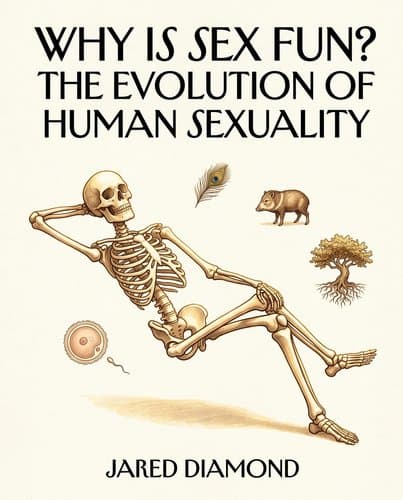
1991_why-is-sex-fun-the-evolution-of-human-sexuality
by Jared Diamond
Human sexuality's strangest quirks—hidden ovulation, permanent breasts, menopause, devoted fathers—aren't biological accidents but an interlocked evolutionary…
In Brief
Why Is Sex Fun? The Evolution of Human Sexuality (1997) uses evolutionary biology to explain the seemingly strange features of human sexuality — concealed ovulation, permanent breasts, menopause, and biparental care — as interlocking adaptations that made civilization possible.
Key Ideas
Sexuality's odd traits enabled civilization
Human sexuality's 'weird' traits — concealed ovulation, permanent breasts, biparental care, menopause — are not accidents; they're interlocking adaptations that enabled language, culture, and civilization
Cooperative families emerge from parental conflict
The cooperative human family is not the natural default but the surprising outcome of an evolutionary standoff between parents whose genetic interests frequently diverge
Big-game hunting is mating display strategy
Men's big-game hunting in hunter-gatherer societies functions primarily as a mating display rather than family provisioning — a pattern that maps onto many status-seeking behaviors in modern life
One trait serves contradictory evolutionary functions
Concealed ovulation likely evolved in two stages for opposite reasons: first as an anti-infanticide strategy in promiscuous societies, then co-opted to bind monogamous pairs — meaning the same trait can serve contradictory evolutionary masters
Knowledge becomes reproductive value in menopause
Female menopause is an active adaptation, not a breakdown — older women's accumulated knowledge is worth more to their descendants' survival than the high-risk offspring a post-40 pregnancy would produce
Instincts designed for ancient environments persist
Understanding the evolutionary logic behind jealousy, infidelity, or parental conflict doesn't make these feelings disappear, but it offers the only real leverage available: recognizing that an instinct was designed for a different environment than the one you're living in
Who Should Read This
Science-curious readers interested in Evolution and Biology who want to go beyond the headlines.
Why Is Sex Fun? The Evolution of Human Sexuality
By Jared Diamond
11 min read
Why does it matter? Because your most 'natural' feelings are evolutionary strategies wearing a disguise
You think your love life is personal. It isn't. Every fight about commitment, every twinge of jealousy, every reason you find someone attractive — these feel like you, but they're actually millions of years old, running on hardware built for a world you've never seen. Here's what's strange: biologists can look at 4,300 mammal species and identify exactly one that forms long-term pair bonds, raises children cooperatively, has sex in private, hides ovulation, and stops reproducing decades before it dies. That species is you. To every other animal on the planet, your romantic life would look like performance art. Jared Diamond's argument is that this strangeness wasn't accidental — it was the foundation of everything that makes us human. Understanding it won't fix your relationships. But it will show you exactly what you're actually fighting about.
You Are the Weird One: How Human Sex Looks from the Outside
Imagine your dog could talk — not just bark and whine, but actually observe and reason. Now imagine asking it what it makes of your sex life. Its answer, Diamond suggests, would be something between bewilderment and disgust. You have sex when the woman clearly isn't fertile. You have sex during pregnancy, when conception is impossible. You close the door. And those sounds from the guest room? That's John's mother — she went through menopause years ago, she can't reproduce, and she's still at it. From the dog's perspective, the whole business is inexplicable waste.
Against that backdrop, the cluster of traits we call 'normal' human sexuality is actually a highly specific bundle of anomalies. Most mammal females advertise ovulation clearly — a visual signal, a scent, a behavioral display — and their interest in sex largely switches off once that fertile window closes. Humans do neither. Add to that: enduring pair bonds, fathers who actively raise children, couples who live among other couples rather than in isolated territories, a strong preference for private sex, ovulation so well concealed that women themselves often can't detect it, and a female reproductive lifespan that ends decades before death. Each item on that list is unusual among the roughly 4,300 mammal species on the planet. Together they constitute something that demands explanation — not acceptance as a default, but a genuine evolutionary puzzle about why one primate species ended up so far outside the mammalian mainstream.
Parenting Is a Cold-Blooded Race to Desert Your Partner
Parental cooperation is the surprising outcome of an evolutionary standoff, not the starting point. At the moment a human egg is fertilized, the mother and father are, in genetic terms, adversaries — each one's optimal strategy is to make the other bear the cost of raising the child while escaping to produce more offspring elsewhere.
Diamond frames this as a game of chicken. Both parents would gain most by deserting, but if both desert, the offspring dies and both lose. So who blinks first? The answer follows from three structural asymmetries stacked almost entirely against women.
First, investment. A human egg is roughly a million times the mass of a single sperm. By the moment of birth, after nine months of pregnancy and years of energetically expensive nursing, a mother's physical outlay is so vast that threatening to walk away is an empty bluff. She has already lost too much to abandon the project.
Second, foreclosed opportunity. A pregnant or nursing woman gains nothing genetically by mating again — she cannot produce another child any faster. A man faces no such constraint. Each ejaculate contains around 200 million sperm; he could, in theory, father a child every 28 days, indefinitely. Morocco's Emperor Ismail the Bloodthirsty, who left behind hundreds of acknowledged children, is the logical extreme of this arithmetic. No woman, under any social arrangement, could approach anything like it. That gap in potential output is not a cultural artifact — it is the structural reason why genetic self-interest pulls men toward variety in a way it cannot, by biology, pull women.
Third, paternity confidence. A mother always knows the child is hers. A father, given internal fertilization, cannot be certain. Investing years of care in a rival's child is the worst outcome evolution can produce for a male, which is why male paranoia about fidelity is not a personality flaw but a predictable adaptation.
Human fathers do, despite all this, stick around — because our infants are helpless for so long that a deserting father typically watches his genes die in infancy. Cooperation emerges not from love as a starting condition, but from two genetic self-interests that happen to align. What's strange about that alignment is how fragile its foundations are — and how much weight we've built on top of them. The warmth of family life sits on top of a cold calculation.
Men Don't Hunt to Feed Their Families — They Hunt to Get More Mates
Why do men hunt? The obvious answer — to bring food home to their wives and children — turns out to be largely wrong, and the real answer is considerably less flattering to men.
Anthropologist Kristen Hawkes spent years measuring exactly what Aché hunters in Paraguay actually brought back from the forest. The numbers puncture the myth cleanly. A woman gathering palm starch averaged 10,356 calories per day — reliable, predictable, enough to feed herself and her children regardless of luck or weather. The men pursuing big game averaged only 9,634 calories, and because a hunter returns empty-handed on roughly one day in four, his median haul was far lower still. Men are physically stronger than these women; if they switched to pounding palm starch, they'd outperform them. Instead they keep gambling on peccaries.
The second blow to the provider story is what hunters do with meat when they do get it. A successful Aché hunter doesn't bring his kill home to his family — he shares it across the entire group, with anyone nearby, good hunters and poor ones alike. Hawkes's data show that three-quarters of everything an Aché person eats was acquired by someone outside their immediate household. By the traditional logic, this makes no sense. If hunting were about feeding your children, you'd feed your children.
Hawkes's explanation is cleaner and more unsettling. Aché women, when asked to name the likely fathers of their children — meaning the men they were sleeping with around the time of conception — named skilled hunters at a rate far above their numbers. A man who kills a peccary and shares it with the camp doesn't just feed people; he broadcasts his quality to every woman present. The meat is less a meal than a signal.
When Hawkes ran the numbers, she found that under most realistic conditions, the show-off strategy passes on more genes than the provider strategy does. The hunter-gatherer family is not a cooperative unit efficiently deploying its members. It's a household built on partly shared and partly opposing interests, where 'bringing home the bacon' has always meant something closer to 'making myself look good.'
Recreational Sex Is an Evolutionary Masterstroke — But For Whom?
The French emperor Napoleon III died mid-coitus. So did Nelson Rockefeller. These are not accidents of history — they're reminders of how much sex costs: energy, time, exposure to predators, the risk of injury, the immune toll of sperm production. Natural selection is ruthless about waste. When an adaptation carries genuine survival costs, evolution needs a compelling reason to keep it. So why did recreational sex — sex timed deliberately to achieve nothing, during pregnancy, after menopause, on days nowhere near ovulation — survive the cut?
The answer most people reach for first is obvious: because it feels good. But that dissolves into a tighter question. Natural selection shaped pleasure to track reproductive outcomes. Dogs enjoy sex too, but only at estrus, when it matters. Something specific happened in our lineage to decouple sexual pleasure from fertility — and figuring out what requires understanding a prior mystery: why human ovulation became invisible in the first place.
Two evolutionary biologists, Alexander and Noonan, built what's called the daddy-at-home theory around a simple thought experiment. Suppose women advertised ovulation the way female baboons do — an unmistakable visual signal on the single fertile day of the month. A man would know exactly when his partner was fertile, mate with her then, and spend the other twenty-eight days looking for other women. He'd feel safe leaving home because he'd know his partner couldn't conceive while he was gone. For a species whose infants require a decade of care to survive, that arrangement would be catastrophic. But hide ovulation, and everything shifts. A man who can't detect fertility has to stay close and mate frequently just to have any shot at paternity. He can't safely wander, because any day he's gone could be the day. The concealment becomes a leash — physiological and ruthlessly effective.
The anthropologist Sarah Hrdy challenged this with a different lens: infanticide. In gorillas, when a new male takes over a group, he kills the existing infants — not out of cruelty, but because those infants carry a rival's genes. A female whose infant is killed resumes ovulation sooner, and the killer then fathers her next child. It's horrifying, and evolutionarily logical. Hrdy's insight was that a female who mates with many males simultaneously solves this problem. If multiple males could each plausibly be the father of her infant, none can be confident the infant isn't his. The murderous calculus disappears. Concealed ovulation, combined with near-constant sexual availability, makes paternity ambiguous — and that ambiguity protects infants.
These two theories predict opposite things: Alexander and Noonan say concealed ovulation promotes monogamy; Hrdy says it promotes promiscuity. When biologists analyzed 68 primate species and mapped ovulatory signals against mating systems and evolutionary history, both turned out to be right — in sequence. Concealed ovulation appears to have originated in promiscuous or harem-based ancestors, consistent with Hrdy's anti-infanticide explanation. But once concealment was in place, it didn't stop there. It was recruited again, in lineage after lineage, to enable the shift toward monogamy — precisely the mechanism Alexander and Noonan described. The trait evolved to serve one purpose, then got conscripted for another.
Recreational sex is the downstream consequence of all this — an elegant residue of an arms race between infanticidal males and the females who outmaneuvered them, repurposed into the glue of cooperative parenting. What feels like pleasure for its own sake is a fossil of a survival strategy so successful it changed what family means.
The Human Penis Makes No Functional Sense — Which Is Exactly the Point
The human penis is almost certainly a social signal, and its intended audience is probably other men.
Here's the anatomical problem. A gorilla weighs twice as much as a man and has an erect penis roughly an inch and a quarter long. An orangutan, smaller than a gorilla but still larger than a human, manages about an inch and a half. A human male, the smallest of the three, averages five inches. There is no mechanical explanation for this fourfold disparity. Orangutans copulate in more positions than humans do, including mid-air while hanging from branches, and their average session lasts fifteen minutes against four for the typical American man. The smaller equipment handles everything fine.
What Diamond proposes instead is that the human penis followed the same evolutionary logic that produced the peacock's tail. In runaway selection — a mechanism first described by biologist Ronald Fisher — once females develop a preference for a trait, males with that trait reproduce more, their sons inherit it, their daughters inherit the preference, and the structure inflates across generations until its costs outweigh its benefits. A penis that kept growing beyond functional requirements would have snowballed exactly this way: not because it improved performance, but because it became a conspicuous advertisement of something harder to fake. Any male who squanders biosynthetic energy on an oversized organ and survives anyway is announcing surplus genetic quality. The waste is the message.
The strongest evidence that the penis operates as a display comes from highland New Guinea, where men encase their penises in decorative gourds called phallocarps — some reaching two feet long, often bright red or yellow, angled upward, and swapped out daily according to mood. Diamond noticed these men considered themselves naked without the gourd, despite otherwise wearing nothing at all. What the phallocarp reveals is what humans instinctively want the organ to look like when social performance, rather than reproduction, is the goal. And the audience for that performance appears to be male rivals. Survey data consistently shows women report indifference or mild aversion to the sight of a penis. Men in locker rooms, Diamond observes drily, measure each other.
Women Stop Having Children in Middle Age Because Grandmothers Are Worth More Than Babies
In 1976, Jared Diamond visited Rennell Island in the Solomon Archipelago and asked local people which wild fruits were safe to eat. His middle-aged informants eventually ran out of answers and took him to a hut at the edge of the village, where an elderly woman sat in the dim interior — blind with cataracts, barely able to stand, needing her food pre-chewed by relatives. She was also the most important person on the island. Sixty-six years earlier, a cyclone the Rennellese called the hungi kengi had leveled the forest and destroyed every garden. People survived by eating wild plants they'd never touch in ordinary times, and doing that safely required knowing which ones were poisonous, which weren't, and how to cook the dangerous ones into something edible. The old woman had been a child during that disaster, old enough to remember. She was the last one who did. If another cyclone came through — and in that part of the Pacific, it would — her memories were the difference between survival and mass poisoning.
That scene is Diamond's most powerful argument for why human female menopause exists at all. The obvious answer — that we simply live longer now and reproduction hasn't caught up — collapses on inspection: every other organ extended its lifespan with us. The reproductive system is the sole exception.
The cruel arithmetic behind this runs in several directions at once. A woman over forty faces roughly seven times the childbirth mortality risk of a twenty-year-old, and the probability of bearing a child with a chromosomal disorder like Down syndrome climbs from about 1 in 2,000 at age twenty-five to roughly 1 in 10 in the late forties. Meanwhile, she has likely already raised several children who still need her guidance, food, and protection for years to come. Each new pregnancy gambles her life — and therefore their futures — against diminishing odds of producing a healthy infant. Stopping is not failure. It's portfolio management.
But the Rennell Island scene goes beyond individual portfolio management. In preliterate societies, the oldest women in a community were its hard drives. They carried the knowledge of what the forest contained, which plants killed you in a bad season and which could save you, what a sky that looked like this had meant the last time anyone saw it. That knowledge couldn't be written down and couldn't be reconstructed quickly. When an older woman died in childbirth, she didn't just leave behind her own orphaned children — she took an irreplaceable archive with her, one that her entire extended kin group depended on.
Menopause, then, is an adaptation that trades a small number of late, high-risk infants for the long-term survival of many existing descendants. The trait that modern culture frames as loss or limitation is the same trait that made accumulated wisdom transmissible across generations — which is another way of saying it's part of what made us human.
The Same Forces That Built Civilization Built the Battle Between the Sexes
Think of an arch. The individual stones — long pair bonds, helpless infants, concealed ovulation, grandmother wisdom, male show-off strategies — each look like separate structural problems. Pull any single one out and the whole structure falls. They hold each other up.
That interlocking logic is Diamond's deepest claim. Concealed ovulation nudges men toward staying home, which enables biparental care, which permits the long childhood that makes language and tool use learnable. Remove the concealment and you get baboon-style mating — accurate, efficient, and incompatible with the childhood long enough to produce a person who could write, or build, or remember a cyclone. Diamond's provocation is that recreational sex and menopause belong in the same sentence as upright posture and large brains. They aren't side effects of civilization; they are structural supports.
But the same forces that locked this system together also locked in its tensions. Men are genetically incentivized to be show-offs — and the data from Aché hunters shows that under many realistic conditions, the show-off strategy genuinely outperforms devoted provisioning. Women are incentivized to marry providers and sleep with show-offs. Neither party is behaving irrationally. Both are following logic selected for over millions of years. The cooperative nuclear family is less a stable equilibrium than a brittle arrangement, held together partly by physiology — the sexual glue of constant availability — and under constant pressure from the divergent interests built into each partner's biology.
Knowing this doesn't dissolve any of it. The infidelity still hurts. The absent father still damages the child. But Diamond's argument offers something precise: the conflicts aren't accidents of individual character or failures of modern culture. They are the shadow cast by the same evolutionary architecture that produced everything else that makes us distinctively human.
The Distance You Can Actually Gain
What shifts isn't the feeling. It's the story you attach to it. You can know with complete clarity that jealousy is a paternity-confidence mechanism shaped over millions of years for a world you no longer inhabit — and feel it tear through you anyway, unchanged. Diamond promised that understanding your evolutionary wiring creates distance from your instincts; the honest verdict is barely. Instead of this is who I am, you get this is what I inherited. That's a smaller gift than Diamond's preface implies, but it's a real one.
And it cuts both ways. The same architecture that installed jealousy also built grandmothering, language, and the long childhood that made culture possible. Your most corrosive impulses and your most distinctly human capacities share the same blueprints. You don't get one without the other — which means the question was never how to escape your biology, but what to do inside it.
Notable Quotes
“I am going to walk off and find a new partner, and you can care for this embryo if you want to, but even if you don’t, I won’t!”
Frequently Asked Questions
- What is Why Is Sex Fun? The Evolution of Human Sexuality about?
- The book uses evolutionary biology to explain seemingly strange features of human sexuality—concealed ovulation, permanent breasts, menopause, and biparental care—as "interlocking adaptations that enabled language, culture, and civilization." Drawing on anthropology and genetics, Jared Diamond provides a scientific framework for understanding the evolved instincts still driving modern behavior in relationships, families, and social hierarchies. The work demonstrates how these unusual traits aren't accidents but rather coordinated evolutionary solutions. It bridges evolutionary science with insights into why humans developed complex societies and how ancestral adaptations continue shaping contemporary conduct and relationships.
- What does Diamond explain about the evolutionary purpose of female menopause?
- "Female menopause is an active adaptation, not a breakdown — older women's accumulated knowledge is worth more to their descendants' survival than the high-risk offspring a post-40 pregnancy would produce." Rather than a biological failure, menopause represents an evolved trade-off where extended post-reproductive life becomes more valuable than continued reproduction. Grandmothers' knowledge enhances their grandchildren's survival rates, making the cessation of childbearing an adaptive strategy. This challenges the common assumption that menopause is merely deterioration. Diamond's framework explains why humans uniquely experience extended post-reproductive lifespans, and how this adaptation connects to the cooperative family structure that enabled human civilization.
- What does Diamond say about male hunting as a mating display?
- "Men's big-game hunting in hunter-gatherer societies functions primarily as a mating display rather than family provisioning — a pattern that maps onto many status-seeking behaviors in modern life." Rather than essential nutrition, hunting demonstrates prowess and resource access to attract mates. This costly signaling explains why men engage in risky displays despite limited caloric returns. The evolutionary logic illuminates modern male behavior: career ambition, expensive purchases, and achievements often operate as mating displays. Understanding this ancestral origin provides insight into persistent gender differences in status-seeking and explains how evolutionary pressures continue shaping contemporary social hierarchies and relationship dynamics.
- How does understanding evolutionary biology help with modern relationships?
- Understanding the evolutionary origins of human behavior offers practical perspective on relationships. As Diamond notes, "Understanding the evolutionary logic behind jealousy, infidelity, or parental conflict doesn't make these feelings disappear, but it offers the only real leverage available: recognizing that an instinct was designed for a different environment than the one you're living in." This framework helps explain why certain impulses feel so powerful despite changing social contexts. Recognizing jealousy or parental conflict as ancestral adaptations doesn't eliminate them but offers realistic leverage: you can acknowledge the instinct while consciously choosing different behaviors suited to contemporary life.
Related Book Summaries
Read the full summary of 1991_why-is-sex-fun-the-evolution-of-human-sexuality on InShort