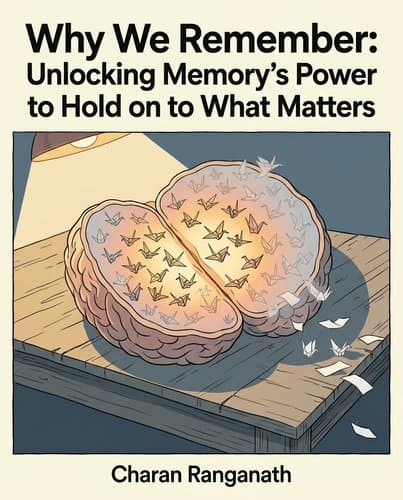
157981712_why-we-remember
by Charan Ranganath
Memory isn't a recording device—it's a creative, reconstructive system whose 'flaws' are actually powerful features. Neuroscientist Charan Ranganath reveals…
In Brief
Memory isn't a recording device—it's a creative, reconstructive system whose 'flaws' are actually powerful features. Neuroscientist Charan Ranganath reveals how to exploit curiosity, spacing, and retrieval to learn faster, remember what matters, and understand why your most confident memories may be your least accurate.
Key Ideas
Active retrieval beats passive re-reading for retention
Stop trying to passively re-read or re-watch material to learn it — self-testing with deliberate retrieval effort is the single highest-leverage change you can make to how much you retain, even though it feels harder and less satisfying in the moment.
Confidence in memories inversely correlates with accuracy
Treat your most confident memories with the most skepticism, especially ones you've told as stories many times. Each retelling is a rewrite. The vivid detail you're sure about may be the one most contaminated by subsequent reconstruction.
Presence without devices strengthens memory encoding
When you want to remember an experience, put down the camera. Offloading memory to a device reduces the brain's own encoding — the events you're most present for are the ones you'll remember most sharply, even if they're chaotic.
Curiosity activates dopamine-hippocampus learning state effectively
Use curiosity as a learning tool deliberately: getting genuinely curious about a question before seeking the answer activates the dopamine-hippocampus sponge state, which improves memory not just for the answer but for everything surrounding it.
Spaced practice across varied contexts improves retrieval
Space out study or practice sessions across different environments and contexts rather than massing them in one sitting — context-independence is what makes a memory retrievable when you actually need it, not just when the original cues are present.
Emotional memories amplify details while blurring context
Understand that emotional memories are selectively amplified, not globally accurate. High-stakes events produce strong memories of the most salient detail (the gun, the face) while systematically blurring surrounding context — which is why eyewitness certainty and eyewitness accuracy can point in opposite directions.
Who Should Read This
Science-curious readers interested in Neuroscience and Learning who want to go beyond the headlines.
Why We Remember: Unlocking Memory's Power to Hold on to What Matters
By Charan Ranganath
11 min read
Why does it matter? Because the memory you trust most is probably the one that's changed the most.
You've forgotten more today than you'll ever realize. A name that vanished mid-handshake. A password conjured three minutes ago, gone. A conversation you'd swear happened differently than everyone else remembers. The instinct is to conclude something has gone wrong — that your brain is leaking, degrading, failing at its most basic job. But what if that instinct is the actual mistake? I've spent decades studying memory, and the finding is both unsettling and oddly freeing: your brain was never built to record. It was built to survive. The forgetting, the distortion, the emotions that hijack what you think you know — none of it is malfunction. It's the machine working exactly as designed. The real question is what, precisely, it was designed to do.
Your Brain Was Designed to Forget — and That's the Point
You're standing in your own kitchen, absolutely certain you had a reason for walking in here. The reason is gone — which is exactly the point.
Neuroscientist Charan Ranganath figured this out early in his career: the brain was never designed to store everything. It was designed to store the right things. Once you understand that, forgetting stops feeling like a personal failure and starts looking like the mechanism that makes useful memory possible.
Consider what Ranganath found when he dug out old home videos of his daughter Mira's birthday parties. He had filmed most of them himself, camera raised, dutifully capturing the cake and the candles. Watching the footage decades later, nearly all of it felt completely unfamiliar — not like remembering, but like watching someone else's home movie. Then there was the party he hadn't really filmed: the year Mira turned eight, when his careful plan collapsed into thirty minutes of painted ceramic cats, a SpongeBob piñata he eventually had to destroy with a golf club, and a tug-of-war on muddy grass that ended with children covered in rope burn and sugar. That party he remembers in precise, almost painful detail.
The difference wasn't time or importance. When he was behind the camera, his brain outsourced the experience to the lens and stopped encoding the sounds, smells, and feelings that make a memory distinctive enough to survive. When the party descended into chaos, he was fully inside it — and the brain, wired to flag the unexpected and emotionally charged, built something that would last. Everything else — the license plates, the background conversations, the cereal box text — got filtered out so the signal could get through.
Forgetting isn't what happens when memory fails. It's what memory is actually for — a question worth sitting with before we ask what the brain chooses to keep, and why.
Memory Isn't a Filing Cabinet — It's a Time Machine Built for the Future
Imagine a GPS that only stored where you'd already been. Nostalgic, maybe, but useless for getting anywhere. That's roughly how most people picture memory — a record of the past, sitting in storage. The brain built something stranger and more useful than that.
Here's the puzzle that Endel Tulving spent years trying to explain: how can a person know that Paris is in France but not remember learning it? How can a teenager recite how much of the Earth's surface the British Empire covered at its peak, then come back from lunch unable to say what he ordered, what the restaurant looked like, or which way they walked to get there? The facts survived. The experience didn't.
That teenager was Jon — a research subject who had sustained hippocampal damage early in childhood. His case is strange enough to sit with for a moment. It wasn't that Jon's memory was generally bad. It was surgically specific: history, geography, vocabulary all intact; personal experience gone. Tulving, a psychologist working in Toronto in the 1970s, had a name for the difference. Semantic memory is the general knowledge you carry without any sense of when or where you acquired it. Episodic memory is the ability to mentally return to a specific moment — not just the fact of what happened, but the context around it.
The hippocampus is what makes episodic memory possible. Its job isn't to store what happened — it's to bind what happened to when and where it happened. Think of it less as an archive than an indexing system. And that context-stamping is why the capability exists at all. When your environment or circumstances change, you need to learn the exception to the rule without erasing the rule itself. This is actually a problem AI systems have never solved cleanly: train a neural network on eagles and hawks, then introduce a penguin, and the network glitches — learning that this bird swims corrupts everything it learned about birds flying. Humans don't have this problem, because the hippocampus files each event separately. The rule and the exception coexist, indexed to different moments.
Memory isn't built to preserve the past. It's built to orient you in the present — and keep you from making yesterday's mistakes tomorrow.
The Brain Doesn't Store Memories — It Stores the Ingredients
Here is a claim worth sitting with: your brain has never stored a single memory. Not one. What it stores instead are the ingredients — and it cooks the dish fresh every time you remember.
The clearest evidence comes from an fMRI experiment designed by one of Ranganath's graduate researchers, who filmed two colleagues going about ordinary errands. One clip showed a colleague picking through a canned-food aisle at a supermarket; another showed a second colleague reading at a local café. Unremarkable stuff. But when subjects watched these short films inside a brain scanner, the patterns were striking. One region of the default mode network — a set of brain areas once dismissed as idle-mind circuitry — lit up consistently for any supermarket scene, regardless of who was in it. A separate region tracked the person on screen regardless of where they were. The DMN wasn't filing away 'colleague at the supermarket on Tuesday.' It was storing something more abstract: a template for supermarket-ness, a template for person-ness. The hippocampus held what you might call the instruction sheet — a record of how those reusable pieces should be assembled into this specific memory, this particular occasion.
Memory works like LEGO. The DMN keeps the bricks sorted by type. The hippocampus holds the diagram showing how they go together. Sit with that for a second: every time you remember something, you're not playing back a file. You're rebuilding the model from stored components, and the hippocampus is reading off the assembly instructions.
That architecture is beautifully efficient. A British psychologist named Frederic Bartlett saw the dark side of it first. He had English university students read a Native American folktale full of culturally unfamiliar details — canoes, seal hunting, spirit warriors. When they recalled it later, they hadn't simply forgotten parts. They had replaced them. Canoes became boats. Seal hunting became fishing. The students weren't lying; they were reconstructing, filling gaps in actual memory with what their existing knowledge said should have been there. Their schemas — the technical term for these cultural blueprints about how the world works — stepped in where the raw trace ran thin.
This is both the superpower and the vulnerability of the system. Schemas let you walk into any supermarket you've never visited and feel immediately at home, navigating by inference rather than experience. But when your memories are incomplete — which they always are — your brain fills in the rest with what it expects, not necessarily with what happened.
Emotion Doesn't Cloud Your Memory — It Rewrites the Contrast Settings
Why does a traumatic memory feel so precise, so unassailable — and yet leave entire swaths of the experience blank? The answer has everything to do with what noradrenaline does to a brain under threat.
When your survival circuits fire — real fear, real danger — your brain doesn't simply record more. It records differently. Noradrenaline floods the brain and acts like the contrast dial on a photograph: it cranks up certain details until they're almost overexposed while dropping others into darkness. Get mugged at gunpoint and your brain will encode the gun in extraordinary resolution. The mugger's shoes? Gone. The color of the wall behind him? Gone. This isn't a flaw in your attention — it's the mechanism working exactly as designed. A brain that spread equal recording resources across everything would be useless in a crisis. The one that locked onto the weapon kept you alive.
That intense feeling of vividness — the way an emotional memory seems to play back like high-definition footage — creates a confidence that isn't warranted. Every time you revisit the scene, the amygdala reactivates the raw physical sensations of the original moment. Your heart rate climbs a little. Your body braces. That visceral immediacy gets mistaken for completeness. But imagine if it weren't: imagine waking up one morning and finding that a memory you've replayed a hundred times — a car accident, a betrayal, a moment of real fear — has lost all its charge. You can recite what happened but feel nothing about it. That's what amygdala damage does. Now flip it. Hippocampal damage produces the stranger outcome: the dread survives without the memory that explains it. You feel afraid of something, and you have no idea why. The feeling and the fact are stored separately, and they can be separated.
Eyewitness testimony is built on this asymmetry, and it doesn't hold up well. The witness who is most certain, whose memory feels most vivid, is often the one whose amygdala was working hardest — which is precisely the condition under which entire categories of detail went unrecorded. Emotional intensity makes memory more selective, and it makes you more confident you have the whole picture. What you actually have is the gun, in high resolution, burned into your mind — and a pair of shoes that simply never made it into the frame.
The Memory You Trust Most Is the One You've Recalled Most Often
The memory you trust most — the one you've told so many times it plays back in your head like a movie — is probably your least accurate one. Every time you retrieve a memory, especially one you've told before, you don't just replay it. You update it.
The neuroscience here is unsparing. When the hippocampus pulls up a stored experience, it does so in whatever context you're in right now — your current mood, your current knowledge, your current assumptions about how things turned out. Those present-tense details bleed into the reconstruction. The memory gets filed back slightly altered. The next time you retrieve it, you're retrieving last time's edited version. Repeat this over twelve years of dinner parties and television interviews, and you don't have a memory. You have a copy of a copy of a copy, each generation a little more distorted than the last.
Elizabeth Loftus has spent her career documenting exactly this. She is arguably the world's foremost researcher on how memories go wrong — the scientist whose lab work has been cited in hundreds of criminal appeals. Which is what made it so striking when it happened to her. After a relative told her she had been the one to discover her mother's body floating in the pool decades earlier, Loftus began to remember. Hazy images surfaced. Details accumulated. She grew genuinely convinced she had witnessed the drowning firsthand — until another family member confirmed the truth: her aunt had found the body. Loftus had not repressed a memory. She had constructed one, assembled from suggestion, imagination, and repeated attempts to recall something that had never been hers to remember in the first place.
The expert became the subject. If it can happen to someone who literally wrote the textbook on false memories, the mechanism is not a quirk of the credulous — it's structural.
The rehearsed memories are the dangerous ones. The stories we've refined through retelling. Each retelling felt like remembering; each one was also an editing session. The original event sits further back with every pass, increasingly inaccessible beneath layers of reconstruction. Confidence grows as accuracy declines — the two move in opposite directions.
That asymmetry has real costs. Jennifer Thompson was absolutely sure she remembered the face of the man who had attacked her. What she actually remembered, by the time she testified, was a face her brain had rebuilt — updated each time police confirmed she was on the right track. Ron Cotton spent a decade in prison before DNA evidence freed him.
Memory isn't less trustworthy because it's old. It's less trustworthy because it's been used.
Struggle Is the Signal — Why Testing Beats Studying Every Time
It's the night before the exam. You've read the chapter three times, each pass smoother than the last. The words feel familiar. You close the textbook satisfied, maybe even a little confident. You've got this.
That feeling is the trap.
Henry Roediger and Jeff Karpicke ran a study that should permanently recalibrate how you think about studying. They split students into two groups, both working with passages from an English-language test-prep book. One group read the passages roughly fourteen times. The other group read them three or four times, then spent the remaining time testing themselves — trying to recall the material from scratch, producing wrong answers, struggling, checking. When both groups were assessed right after the sessions, the re-readers felt more confident, and their scores reflected it. Fourteen passes through the same material produced better immediate results than a handful of reads plus some uncomfortable self-quizzing.
A week later, everything had flipped. The re-readers retained about half of what they'd learned. The self-testers held onto more than 85 percent.
The reason is what Ranganath calls error-driven learning — which sounds clinical until you realize what it means for every exam you've ever crammed for. When you reread a chapter, your brain is doing something effortless: recognition, not retrieval. The material feels known because you've just seen it. But smooth familiarity produces almost no durable encoding, because the brain isn't correcting anything. When you test yourself, your hippocampus produces a blurry, imperfect reconstruction of what you learned. That imperfection is the point. The struggle exposes weak connections in the cell assemblies carrying the memory, and the brain gets to work strengthening what's useful and pruning what isn't. You're not relearning the same thing again; you're fixing exactly the parts that are fragile.
The discomfort you feel when you can't quite retrieve something — that friction — is the signal that genuine encoding is happening. Ease is the warning sign.
Stop rereading. Close the book and try to reconstruct what it said. Get it wrong. Check. Repeat. The failure is the lesson, and the lesson will still be there next week.
Memory Is a Story You Tell With Other People — Which Is Why It Changes
Memory isn't only built in study sessions or quiet moments of reflection. It gets rebuilt every time you talk about it.
Charan Ranganath almost drowned on a creek in California, and his first instinct was to never speak of it again. The paddleboard trip with his friend Randy had gone spectacularly wrong — lost glasses, broken fins, a raging current, five hours in the dark clawing through brambles — and the part that stayed with him was being wedged between two fallen trees, clinging to his board in rushing water, genuinely unsure he'd make it out. That memory belonged to the version of him who panicked.
Then other people got involved.
His wife teased him about the judgment call. His daughter pointed out he was lucky to be breathing. And as Ranganath and Randy started retelling the story to friends and colleagues, something strange happened — each retelling shaped how he actually remembered what had occurred. The two men would riff off each other's recollections, and the cascade of obstacles they'd overcome started to feel less like a catalog of failures and more like the plot of an epic. The memory didn't just get reframed; it got rewritten. What he retrieved the next time he thought about that afternoon was different from what he'd retrieved the time before. Other people's reactions had become part of the memory itself.
Memory has a least intuitive feature: the moment you tell someone about an experience, you hand them a co-authorship credit. When you reconstruct a memory in conversation, you're rebuilding it in the presence of an audience whose responses — laughter, skepticism, validation — seep into the reconstruction before you store it again. You're not reporting a fixed record. You're editing a draft, and the people in the room are part of the editing process. Social retelling is one of the primary mechanisms by which what happened gets updated. Other people aren't just hearing your story. They're changing it.
The Remembering Self Is Always Writing the Next Chapter
The frustration with memory has always been aimed at the wrong target. You were never supposed to have a recording device — you were given something stranger and more useful: a system that rebuilds the past in service of the future, updating the draft every time you retrieve it. That's not a bug. That's the whole point. Once you see it clearly, the question shifts. Not why can't I hold on to more? but what am I actually trying to build? Test yourself until retrieval feels easy. Be present enough that your brain has something worth encoding. The memories worth keeping aren't the ones you captured — they're the ones you lived so fully that your brain decided, on its own, to hold on.
Notable Quotes
“An eagle is a bird. It has feathers, wings, and a beak, and it flies.”
“A crow is a bird. It has feathers, wings, and a beak, and it flies.”
“A hawk is a bird. It has feathers, wings, and a beak, and it flies.”
Frequently Asked Questions
- What is 'Why We Remember' about?
- Why We Remember: Unlocking Memory's Power to Hold on to What Matters explains that memory is not a passive recording but a reconstructive process shaped by emotion, context, and biology. Written by neuroscientist Charan Ranganath, this 2024 book explores why memory's apparent flaws are actually features that serve important functions. Ranganath provides readers with evidence-based strategies for learning more effectively, evaluating the accuracy of their own memories, and understanding how the past shapes personal identity. Rather than focusing on memory problems, the book reframes apparent limitations as adaptive features of human cognition.
- What are the most effective learning strategies from 'Why We Remember'?
- The single highest-leverage change you can make to retention is self-testing with deliberate retrieval effort. Stop trying to passively re-read or re-watch material to learn it, even though deliberate retrieval feels harder and less satisfying initially. Space out study sessions across different environments and contexts rather than massing them in one sitting — context-independence makes memories retrievable when you need them. Additionally, use curiosity deliberately: getting genuinely curious about a question before seeking the answer activates a dopamine-hippocampus state that improves memory not just for the answer but for surrounding context.
- Why does Ranganath recommend putting cameras away during experiences?
- When you want to remember an experience, put down the camera. Offloading memory to a device reduces the brain's own encoding — the events you're most present for are the ones you'll remember most sharply, even if they're chaotic. This finding challenges common practice of recording every moment, suggesting that documenting experience undermines your brain's ability to encode it. Rather than trusting technology to preserve memories, engaging your full attention during experiences produces stronger, more vivid personal recollection. The apparent convenience of recording comes at a significant cognitive cost.
- How does emotion affect memory accuracy in this book?
- Emotional memories are selectively amplified, not globally accurate. High-stakes events produce strong memories of the most salient detail (the gun, the face) while systematically blurring surrounding context. This creates a counterintuitive problem: eyewitness certainty and eyewitness accuracy can point in opposite directions. Your most confident memories deserve the most skepticism, especially ones you've told as stories many times. Each retelling is a rewrite, potentially contaminating vivid details with subsequent reconstruction. The vividness you're sure about may be the detail most contaminated by reconstruction.
Related Book Summaries
Read the full summary of 157981712_why-we-remember on InShort