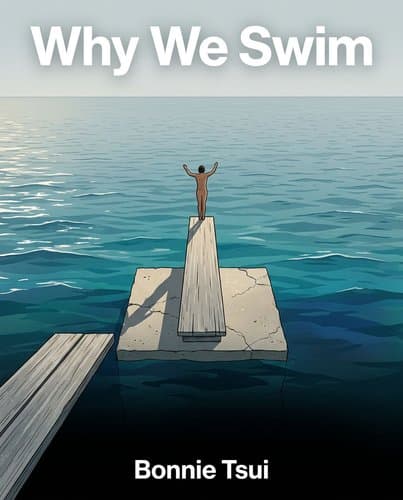
52905471_why-we-swim
by Bonnie Tsui
Humans are the only great apes that cannot swim instinctively—and that biological gap is exactly where our most remarkable qualities live.
In Brief
Humans are the only great apes that cannot swim instinctively—and that biological gap is exactly where our most remarkable qualities live. From Bajau divers who genetically evolved larger spleens to ancient legends that saved villages from the 2004 tsunami, swimming reveals who we truly are.
Key Ideas
Human swimming is learned, not innate
Swimming is not instinctive for humans — great apes cannot swim at all, and when scientists taught chimps, they reinvented their own stroke rather than using the paddle every other mammal has. Every human swimmer is a product of cultural transmission, not biology.
Legends encode survival wisdom about water
Oral traditions about water can encode life-saving survival information across millennia with no written language. The Moken legend of Laboon — 'seven roller waves, arriving once every two generations' — saved every villager when the 2004 tsunami killed 230,000 people in the surrounding region.
Water living genetically reshapes humans
Sustained immersion in water over generations can change human biology at the genetic level. Bajau free-divers have spleens 50% larger than mainland relatives — and Bajau who have never dived have the same enlarged spleens. Natural selection favored the trait across centuries of aquatic life.
Segregation created lasting drowning disparities
The racial gap in American swimming — Black children drown at five times the rate of white children — is a direct, traceable consequence of deliberate exclusion from public pools in the mid-20th century, not a natural disparity. A policy choice that continues to cost lives.
Pools dissolve identity and build connection
A swimming pool strips identity markers more completely than almost any other shared environment. Uniform, rank, nationality, and experience all become invisible in a swimsuit — which makes pools uniquely powerful tools for building human connection across every conceivable divide.
Swimming rehearses mortality, heals physiology
Entering water that could kill you and surviving functions as a concrete rehearsal for confronting mortality. The physiological benefits are also real: swimming reduces blood pressure by nine points on average — more than other forms of exercise — partly because water pressure actively pushes blood toward the heart.
Swimming holds grief and gratitude together
The etymology of 'flow' (Old English flood → Latin weep → Sanskrit swim → Greek float) embeds sorrow inside elation. The deepest reason to swim is not performance but something more like grief-and-gratitude together — which is why Thoreau called it a religious exercise, not a workout.
Who Should Read This
Science-curious readers interested in World History and Biology who want to go beyond the headlines.
Why We Swim
By Bonnie Tsui
10 min read
Why does it matter? Because the species that cannot swim instinctively has been entering water for ten thousand years anyway — and that gap is where everything interesting happens.
In Baghdad, soldiers practiced survival strokes in palace pools while mortar rounds landed nearby. Humans have been doing something like this for ten thousand years — entering water we're not built for, finding ways to stay in it.
Most great apes sink at depth. We have no instinctive stroke, no buoyancy advantage, none of the gifts that carry dogs, bats, and elephants through water. What we have instead is improvisation: cork life jackets, fishhooks carved from crocodile jawbones, samurai swimming schools built around ocean currents. In Why We Swim, Bonnie Tsui traces that long improvisation and finds, in each story, something essential about why we keep going back.
Every Other Mammal Swims by Instinct. You Don't.
Place a two-month-old face-down in water and something unexpected happens. She holds her breath. Her heart rate drops, automatically, to conserve oxygen — the mammalian dive reflex, still running underneath. It looks like instinct. It feels like proof we belong in the water.
The reflex fades. As the nervous system matures, the impulse retreats, and what looked like an ancient aquatic inheritance turns out to be a ghost of one. Most land mammals never lose it — drop a dog in a lake and it paddles without thinking, the stroke already there. Great apes are the exception. When researchers taught chimpanzees to swim, the apes didn't find the doggy paddle waiting inside them. They invented a froglike kick from scratch. Paleobiologist Paul Sereno has a name for what this makes us: "secondary swimmers." My parents met at a pool in Hong Kong, which means swimming has always felt like something handed down. It is — just not biologically. Biology hands us a trace and then takes it back.
The Crawl Stroke You Know Took Ten Thousand Years to Build
Here's what that kind of knowledge looks like at full scale.
Suppose you've never seen a tsunami. The sea is behaving strangely — receding from shore, the water around your boat swirling in wrong directions. What do you do? For most people, the honest answer is nothing useful. No individual alive could, from personal experience alone, recognize what those signs mean.
The Moken of Thailand and Myanmar live on houseboats and coastal stilts, their children growing up diving and reading currents, knowing the sea the way most of us know a street we've walked for years. On December 26, 2004, the most destructive tsunami in recorded history killed 230,000 people across the coastlines of South and Southeast Asia.
Every Moken survived.
On the Surin Islands, someone noticed the sea pulling back from shore and warned their community. They reached higher ground before the first wave arrived. Two dozen Moken guiding snorkelers offshore read the wrongness in the currents and steered their boats into deep water. Moken fishermen in Myanmar waters saw a swirling pattern around their vessels and headed out to sea immediately. Nearby squid fishermen, without that knowledge, were killed when the waves rose.
No living Moken had ever seen a tsunami. What they had was a story. Elders carried the legend of Laboon — the "seven roller waves," arriving once every two generations, a force of total destruction. The story was how the knowledge survived the centuries between events. Oral tradition, across a people with no written language, held what no individual could have held alone.
The Sea Has Been Editing Human Bodies for Thousands of Years
You might assume adapting to water is mainly a matter of practice — log enough hours, and you get better. But what happens to a people who stay close to the sea not for one lifetime, but for hundreds of generations?
The Bajau people of Malaysia, Indonesia, and the Philippines have lived at sea for centuries, free-diving to 200 feet to hunt fish along the ocean floor. Their spleens are roughly 50 percent larger than those of their mainland neighbors. That matters because of the mammalian diving reflex: when you submerge, the spleen contracts and releases a surge of oxygenated red blood cells into the bloodstream — more oxygen, more time underwater. Marine mammals with larger spleens dive deeper. Bigger spleen, longer dive.
Bajau people who have never dived in their lives carry the same enlarged spleens. It isn't training. A genetic variant linked to spleen size appears at far higher rates among the Bajau than among their land-dwelling neighbors. Natural selection explains why: across hundreds of generations, people who carried that variant survived the sea life better. The water didn't edit the individual. It edited the lineage.
Here the earlier argument about culture filling the biological gap runs into something harder to answer. Culture explains the Moken reading a tsunami. It explains Iceland making swimming mandatory in schools. But it cannot explain a spleen. If you are Bajau and have never once put your face in the ocean, your body still carries the sea inside it. The water got in through thousands of years of ancestors choosing that life, and it stayed.
That Bajau clarity disappears the moment you look at Iceland. The country has required swimming in schools since 1943. In 1984, an Icelandic fisherman named Guðlaugur Friðþórsson swam six kilometers through near-freezing North Atlantic water after his vessel capsized. Every crewmate died. He reached shore with his core temperature nearly intact, his body shedding heat far more slowly than physiology suggests is possible, subcutaneous fat insulating him in ways that matched no ordinary human profile. He was also a trained swimmer from childhood, shaped by a culture that had treated swimming as basic literacy for two generations. The book's honest admission is that you cannot separate which one saved him.
The Drowning Gap in American Swimming Was Built by Design
The Moken and Bajau built their relationship with water across generations, a thousand accumulated hours in the sea passed from parent to child until it looks almost biological. In America, an entire generation was cut off before any of that could begin.
On Easter Sunday 1960, a group of Black residents walked down to the public beach in Biloxi, Mississippi. The Gulf is shallow and warm along that stretch of coast; they waded in on Easter morning. They had every legal right to that water. A white mob met them with fists and clubs. Mississippi's beaches wouldn't be ruled open to everyone for another eight years. Black children still drown at five times the rate of white children.
I came to this history as someone who has never been told to stay out of the water. My parents met at a pool in Hong Kong; swimming found me before I thought to choose it. That is how inheritance works. It is what deliberate exclusion destroys.
What followed desegregation surprised almost everyone. Historian Jeff Wiltse documents what he calls a "mass abandonment": between 1950 and 1970, millions of white Americans stopped going to public pools. They built private club pools, then backyard pools. The latter, Wiltse argues, were chosen by owners who wanted to fence off family and leave community behind. The pools they vacated lost funding and closed by the hundreds.
This looked like neutral market behavior. It wasn't. Public pools had been built with public money to serve everyone. When white swimmers left, they took the tax revenue and political will that had kept those pools open. The pools emptied, then decayed. An entire generation of children in the neighborhoods left behind — mostly Black, mostly low-income — grew up without access to water.
Nearly 80 percent of children from households earning under $50,000 have no or low swimming ability. These are not cultural gaps. They are the arithmetic of a specific historical choice: the decision, made at scale, to take a shared public resource and make it private. Whoever couldn't follow was left on the shore.
In the Pool, You Can't Tell the Officer From the Enlisted Man
On Jay's third day in Baghdad, a mortar blast threw him against a wall and blew his colleague J.P. thirty feet down the road. When the dust settled, they were told to come back in an hour. So they went to dinner, hoping the mess hall still had meatloaf. In a war zone, people reach for whatever normal they can find.
Jay (Tsui uses only his first name) was a US cultural affairs officer, a former competitive swimmer now working inside Saddam Hussein's former palace compound. The palace had a pool. He started using it for evening laps. One night he noticed a Malagasy diplomat named Andry churning through the water in a frenetic windmill, all thrashing effort, barely moving forward. Jay asked what he was doing. Andry explained he just wanted to reach the other end.
That was the beginning. Jay showed Andry how to blow bubbles first, to float, to feel the water instead of fight it. Within six months, Andry had learned all four competitive strokes. On his thirty-fourth birthday, he swam thirty-four lengths without stopping. Jay then put him in charge of coaching the military swimmers.
The team grew to 200 people: Marines back from 18-hour missions who stacked their weapons at the pool's edge, Peruvian security guards who sent most of their wages home, Iraqi USAID staff who risked suspicion just by entering the Green Zone, Muslim women arriving with mail-order catalogs asking what swimsuits to buy. Jay gave each swimmer a number and a buddy. Every person, regardless of rank, experience, or background, started the same way: blowing bubbles, pushing off the wall in a Superman pose.
Pools had spent most of the previous century as lines of exclusion. This one did the opposite. In the water, Jay noticed, everything else fell away. In uniform you know immediately who's the officer and who's the enlisted man. At the pool, after the gear came off, you couldn't tell. Just skin, cap, goggles. The markers — rank, nationality, wage level, whether you'd ever been shot at — dissolved. What remained was a person learning to breathe.
A direct mortar hit later separated Jay and Andry at a checkpoint. When the shelling stopped, Andry tore out of cover to find his coach stunned against a cement wall, shaken but intact. Years later, voice catching, Andry said he'd never told Jay this: he thought of him as his father.
Open Water Swimming Is a Dress Rehearsal for Not Dying
Not every water story involves another person.
Bonnie Tsui stepped into San Francisco Bay on a rainy March morning wearing a swimsuit and nothing more. The water was 56 degrees. The moment she submerged, cold hit every inch of her skin at once, so sharp it registered as heat, her body unable to tell one alarm from the other. Sixty seconds, roughly. Then it faded, and she felt something she hadn't expected: fine. More than fine.
Then she got out.
The afterdrop is what cold-water swimmers don't warn you about enough. Your body temperature keeps falling after you leave the water; the cold stored in your skin bleeds inward. In the shower, Tsui cranked the faucet as far toward hot as it would go. Her teeth chattered. Her jaw clenched. No amount of heat seemed to reach her. It took ten minutes in the sauna before the shivering stopped.
By afternoon, walking along the waterfront, she felt quiet pride, and then something stranger. She started asking why she'd done it. What she arrived at was simpler and deeper than fitness or adrenaline: she has feared death since childhood. Each spring her family traveled to Brooklyn for Qingming, a Taoist grave-sweeping ceremony, burning incense and paper currency so her great-grandfather's ghost could spend it in heaven. What those visits gave her wasn't comfort. It was dread. The fear of not existing has never left her. It startles her awake at night.
Open water, she came to understand, is one of the few places where that fear becomes physical and survivable at the same time. In the bay, your feet leave the ground. There are fathoms below you that you cannot see. Your body reads this as genuine danger: cold, current, depth, all of it insisting you have no business being there. And then you swim back to shore anyway. You step onto land with your body intact.
That's what the swim is for: a controlled encounter with genuine danger, repeated until the fear becomes something you can carry rather than something that carries you. The cold, the depth, the afterdrop — all the ways the water insists you don't belong — are exactly why it works.
The Word 'Flow' Contains 'Weep' — and That's Not Coincidence
Trace "flow" back through Old English, Norse, and Sanskrit and you find swimming, bathing, flooding — and then, in Latin plorāre, weeping. Sorrow is braided into the word alongside elation.
This is why Tsui floated on her back in the South China Sea while reconciling with a father she hadn't seen in three years, a former lifeguard who'd forgotten the last time he'd swum. The water held them both. She swam Lake George the day after her wedding, forty friends in a flotilla behind her. Not to demonstrate anything. Something closer to ceremony.
When technique becomes automatic, the brain's default-mode network switches on: the state responsible for unexpected associations, for connections that don't arrive at a desk. Wallace J. Nichols calls water the ideal trigger. Its "soft fascination," he argues, lets focused attention rest without the mind going slack. You don't think harder in the pool. You think differently.
Saki Kozuma, who runs a Tokyo dojo in Nihon Eiho (the Edo-period martial art of swimming in armor), puts it plainly: the pool is the last place where no one can text, call, or find you. The self doesn't fall away there. It arrives whole, carrying everything, finally free to feel it.
Why Jump In If You Can't Swim?
Tsui ends with a child who jumped in to save a drowning friend — a child who couldn't swim herself. Asked afterward why she did it, she had no answer. The silence wasn't evasion. It was the truth.
After ten thousand years of biology, legend, exclusion, grief, and ceremony, the answer is still somewhere just past language. Water promises something you can only understand from the inside, and once you're inside, you're too busy surviving to name it.
You enter something that could kill you. You come back. That is the answer, and it's not a sentence — it's a fact about your body, proved fresh each time you return to shore.
Notable Quotes
“Much of the time, when something goes wrong on a fishing boat, everyone drowns,”
“So there is no one to say what happened. But when we were holding on to the keel that night, we said that if one of us made it, we would tell them.”
“I was there to tell.”
Frequently Asked Questions
- What is Why We Swim about?
- Why We Swim traces the history of humans in water — a species biologically unfit for it — across survival, sport, healing, and culture. Drawing on evolutionary biology, oral tradition, and modern science, Bonnie Tsui explores why swimming persists across every civilization and what our relationship with water reveals about human adaptation, community, and mortality. The book examines swimming not as an isolated activity but as a profound window into fundamental aspects of human survival, identity, and our capacity to confront our own mortality through engagement with forces that could destroy us.
- Is swimming instinctive for humans?
- Swimming is not instinctive for humans; every human swimmer is a product of cultural transmission, not biology. Great apes cannot swim at all, and when scientists taught chimps, they reinvented their own stroke rather than using the paddle every other mammal has. This demonstrates that human swimming ability relies entirely on learned cultural practices passed down through generations rather than innate biological responses. The ability to swim fundamentally depends on how it is taught and transmitted within a society across time.
- What are the key health benefits of swimming explained in Why We Swim?
- Swimming reduces blood pressure by nine points on average — more than other forms of exercise — partly because water pressure actively pushes blood toward the heart. Beyond physical benefits, entering water that could kill you and surviving functions as a concrete rehearsal for confronting mortality. The book also reveals that sustained immersion in water over generations can change human biology at the genetic level, demonstrated by Bajau free-divers whose spleens are 50% larger than mainland relatives, a trait inherited across centuries of aquatic life.
- What does Why We Swim reveal about the racial gap in American swimming?
- The racial gap in American swimming — Black children drown at five times the rate of white children — is a direct, traceable consequence of deliberate exclusion from public pools in the mid-20th century, not a natural disparity. This policy choice continues to cost lives today. A swimming pool strips identity markers more completely than almost any other shared environment, making it uniquely powerful for building human connection across every conceivable divide, which is why addressing historical exclusion matters for equity and safety.
Related Book Summaries



Read the full summary of 52905471_why-we-swim on InShort