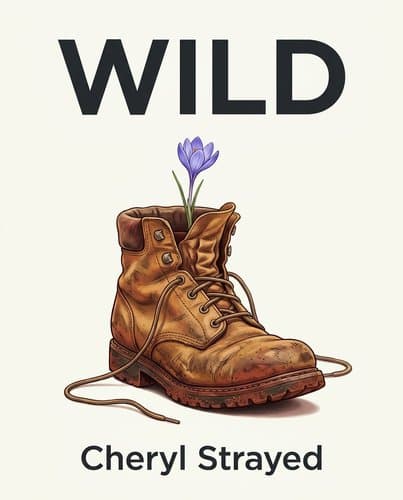
12262741_wild
by Cheryl Strayed
A woman destroys her life after her mother dies, then walks 1,100 miles alone through the Pacific Crest Trail to find out if grief can be outlasted on foot.
In Brief
A woman destroys her life after her mother dies, then walks 1,100 miles alone through the Pacific Crest Trail to find out if grief can be outlasted on foot. Strayed's memoir proves that the only way through suffering is exactly that—through it, not around it.
Key Ideas
Untreated Grief Finds Expression in Destruction
Grief that goes untreated doesn't disappear — it finds other forms. Strayed's heroin use, infidelity, and reckless self-destruction weren't separate problems from her grief; they were its expression. Naming the original wound is the prerequisite for addressing what grew from it.
Physical Hardship Interrupts Self-Destructive Mental Loops
Physical suffering that demands your full attention is one of the few things that can interrupt a self-destructive mental loop. The trail worked not because it was beautiful but because it was too hard to let your mind go anywhere else.
Acknowledging Resentment Enables Complete Grieving
You cannot grieve someone you also resent without first acknowledging the resentment. Strayed couldn't fully mourn her mother until she allowed herself to be furious at her — for dying, for her failures, for the love that was so consuming it left no room for normal complicated feelings.
Choosing Identity Is Just the Beginning
Choosing an identity and earning it are different acts. Strayed picked the name 'Strayed' from a dictionary at her lowest point as an act of will — then spent 1,100 miles discovering whether it was actually true. Declarations of who you intend to be are starting points, not endpoints.
Inhabit Your Life Before Seeking Redemption
The question 'What if I was never redeemed? What if I already was?' is not a philosophical paradox — it's a practical one. Waiting for redemption to arrive from outside keeps you from inhabiting the life you already have.
Who Should Read This
Readers who connect with first-person stories about Memoir and Resilience and want to see the world through someone else's eyes.
Wild
By Cheryl Strayed
12 min read
Why does it matter? Because grief doesn't stay grief — it becomes your life.
Most people assume a long walk is an escape. You put miles between yourself and the wreckage, and the wreckage recedes. Cheryl Strayed knew better, because she was the wreckage. By twenty-six she had watched her mother die in forty-nine days, dissolved her marriage through deliberate infidelity, and graduated from recreational heroin to the kind that leaves track marks. There was nothing left to protect. So she bought a guidebook she'd never read, strapped on a pack she couldn't lift, and walked over a thousand miles of the Pacific Crest Trail — not to find herself, but because everything else she'd tried had already failed. What follows is not an adventure story. It's an account of what happens when grief spreads so completely through a life that suffering stops being something to avoid and becomes the only honest way through.
She Didn't Choose the Trail — She Ran Out of Other Options
A doctor stands a pencil upright on the edge of a sink and taps it hard on the surface. That sound — the sharp knock of wood on porcelain — is how he explains what radiation will do to Bobbi Strayed's spine: one jolt, and her bones will crumble like a dry cracker. Bobbi's question in response is not about pain management or prognosis. She asks whether she'll still be able to ride her horse.
She dies 49 days after that first diagnosis in Duluth. Cheryl is 22 years old, and the woman who had been the gravitational center of her entire life — the one who sewed her clothes, mixed food coloring into sugar water and called it sarsaparilla, stretched her arms wide and still couldn't reach the edges of how much she loved her kids — is gone. What replaces her is an absence so total that Cheryl can't hold her marriage together, can't hold her family together, and eventually can't hold herself together. She cheats on her husband Paul, first tentatively and then without much calculation at all. She watches her siblings drift into their own grief and admits that without her mother, the family was always just four people connected by the thinnest rope. The woman she thought she could become — the writer in New York with the cool boots — evaporates.
In Portland, she meets a man named Joe and starts using heroin. First they smoke it, then snort it, then shoot it. She describes the drug as a place where the collapse of everything — her mother, her marriage, her family — becomes, if not okay, at least endurable. The mornings after are their own devastation, but the afternoons pull her back. Eventually Paul drives 1,700 miles straight through from Minneapolis and sits across from her at a kitchen table. What he says is quiet and ruinous: you seem like you aren't here.
The Pacific Crest Trail enters her life as an image on a guidebook cover — a boulder-strewn lake, blue sky — spotted while standing in a checkout line at an outdoor gear store. By then she is pregnant, alone in a Sioux Falls motel, crying so hard she can barely keep the car on the road. She decides to hike 1,100 miles through the California and Oregon wilderness not because she is strong but because everything else has failed to bring her back to herself.
The Pack Was So Heavy She Could Not Lift It Off the Floor
She sits on the floor of the motel room in Mojave and rocks herself forward until she lands on her hands and knees, pack strapped to her back, and then slowly scales the wall-mounted air conditioning unit with her fingers until she can push herself upright. By the time she's standing — hunching, really, her spine bent under a load that tops her waist when the pack rests flat on the ground — she's pulled the metal vent panel clean off the unit. She leans it against the wall and staggers into the middle of the room, her center of gravity lurching whichever direction she tilts.
She had packed everything she owned for survival over three months: a full-sized professional camera with separate zoom lens and flash, a foldable saw whose purpose she couldn't name, a candle lantern, Faulkner, Adrienne Rich. She'd visited the gear store in Minneapolis roughly a dozen times, absorbing the serious talk of employees who cared — genuinely cared — whether her sleeping bag zipper had a face muff that wouldn't obstruct her breathing. She'd felt expert by the end of it. Then, back in the motel room, she filled a 2.6-gallon water bladder for the first seventeen-mile dry stretch ahead, and the water alone weighed nearly 25 pounds.
The pack wouldn't budge when she first tried to lift it. Not an inch. She attempted a bear hug, a leg-braced dead lift, sheer will — none of it worked. The gap between what she'd imagined and what was true wasn't a plot point on the way to competence. It was the whole situation.
Forty minutes into her first steps on the trail, her body already burning, the pack pressing into her hips like a vise, a voice in her head began screaming a question she couldn't answer. She kept walking.
The Body Keeps the Score Whether You Want It To or Not
The trail doesn't give you space to think about your grief. That's not a side effect — it's the mechanism.
Three weeks in, Strayed's body has been transformed into something closer to damage than flesh. Her hips and shoulders are covered in blistered, scabbed-over wounds where the pack's straps have eaten through her skin in the same spots, day after day, until the tissue hardens into something resembling bark. When she fills a bathtub in a Sierra City boarding house, the water turns black within minutes from the blood and dirt washing off her body. Beneath all of it, she can see new ridges of muscle that weren't there before — her body quietly building what it needs while she's occupied with just getting through the day.
She had started the hike carrying a track mark on her ankle, still faintly bruised, from shooting heroin in Portland two days before she set foot on the trail. She covers it with her sock so she won't have to look at it. But here's what the trail does with that: it gives her something so immediately, overwhelmingly physical to contend with that the mental space those choices used to occupy simply gets filled with something else. Pain. Thirst. The arithmetic of miles. She had planned long meditations beside mountain lakes, tears of cathartic grief, careful excavation of every mistake she'd made since her mother died. Instead she counts to one hundred over and over just to get through another switchback. Her mind, which she had been using to destroy herself with extraordinary efficiency for years, becomes a machine that does exactly one thing: move the body forward.
That's the trail's particular genius. It doesn't heal her by giving her room to think. It heals her — provisionally, partially, but genuinely — by taking that room away.
By the end of her second week, she realizes she hasn't cried once. Not from grief, anyway.
Her feet are what hurt.
She Chose the Name 'Strayed' Before She Had Earned It
Think about signing a promissory note you can't yet cover. The signature is real. The debt is real. The money doesn't exist yet.
That's what Cheryl Strayed does in a Minneapolis apartment during the slow collapse of her marriage to Paul. She opens a dictionary, finds the word 'strayed,' and recognizes herself in its stacked definitions — to wander from the proper path, to be without a mother, to become wild. She copies the name down a full page of her journal, the way a teenager writes a crush's name, except the object of devotion is herself: who she intends to become. 'I was my own boy,' she writes — meaning there was no one else to be devoted to, no one coming to save her. She plants a root in the center of her rootlessness.
She had always quietly mocked the people in her circles who rechristened themselves Sequoia or Luna, treating identity like a costume. Now she's doing the same thing, trembling slightly every time she signs the name in a guest book, as if forging a check.
But the check is the whole point. She chose 'Strayed' not because she had already become someone worth the name, but because she needed to write something on that blank legal line in her divorce papers — the line that asked who she would be afterward.
What the trail then does is spend the next 1,100 miles asking whether she can make good on it. The name claimed wildness; her feet blister through every pair of socks. The name claimed motion; her pack is so heavy she has to scale a wall unit just to stand upright. Identity declared on a page turns out to be something else entirely — something you don't choose so much as suffer your way toward.
There Is No Such Thing as One Clean Shot
Christmas morning, seventeen below zero, and Cheryl is leading Lady toward a birch tree at the edge of the pasture. The horse still moves the way she always did — that long, high-stepping gait her mother used to watch with her breath caught in her throat. They tie the lead rope to the tree. Leif kneels in the snow with his rifle. They are six feet away. Her warm breath rises in clouds.
One shot, their grandfather had promised. Right between her eyes, right through the white star on her forehead, one clean shot.
Leif fires. Lady's leather halter snaps from the impact — and then she simply stands there, looking at them. Not falling. Not running. Just staring, her face punched through with holes that haven't even bled yet. Cheryl screams at Leif to shoot again. He fires three more rounds into Lady's skull. The horse still doesn't fall. When the blood finally comes it hits the snow so hot it hisses, pouring in tremendous surges from her nostrils. Lady goes to her front knees, sways, topples. Keeps fighting. Keeps trying to rise. Leif is out of bullets, screaming at them both to look away, and Cheryl is on her knees in the snow, wailing, while the horse takes minutes — maybe longer, she can't tell — to finally go still.
There is no such thing as one clean shot. Cheryl knows this the moment after Leif fires the first one. She had believed that love, careful enough, could produce clean endings. That you could grieve a mother properly if you showed up every day, held the pan while she retched, put on her socks when she couldn't manage them herself. That a mercy killing performed by people who loved the animal would be gentler than a stranger with a needle. None of it worked that way. The horse died in installments, in agony, in blood that steamed on the ice.
The wilderness doesn't clean anything up. It just gives the mess enough room to exist.
The Wildest Thing Was Not the Mountain — It Was Her Rage
August 18th. Her mother's fiftieth birthday, the one she would never reach. Cheryl is hiking through Oregon in 26-degree cold, water bottles frozen solid beside her in the tent.
What comes out of her that morning is not grief as she had known it. She wants to punch her dead mother in the mouth. The thought arrives whole and genuine, and she doesn't flinch from it — she walks faster, assembling an inventory of everything Bobbi got wrong: the pot-smoking in front of the kids, the wooden spoon she occasionally carried out her threats with, the suffocating optimism, all those declarations that they were rich in love, not poor in money, and most of all the failure to tell her daughter that Harvard existed as a real place she might aim for. The list is painstaking and specific and a little absurd, and Cheryl knows it's absurd, but she can't stop. She walks until her legs are driving and then she bends over in the dirt, her pack crushing down on her back, and wails — not crying, just making sound, the whole wreckage of it forcing its way out of her throat.
What she finally names, bent over that hiking pole, is the real problem: her mother's death had short-circuited the process every child is supposed to get. You pull away, resent her, say the hard things, watch her fumble, eventually understand she did her best, and then take her back as a full human being rather than a mother-shaped idol. Bobbi's death at 45 obliterated that sequence. It locked Cheryl permanently in the position of a child who could neither push off from her mother nor fully let go — just orbit the absence forever. You can't complete the argument if the other person leaves the room.
The trail makes room for the fury because the body's sheer exhaustion strips every polite layer away. What's left, hiking fast through the cold on a dead woman's birthday, is rage — at being loved too completely to escape, and then abandoned before the escape was possible. When Cheryl stops and touches a small crocus growing in the volcanic rock — the same flower she'd pressed into the soil over her mother's ashes — the anger drains out as fast as it arrived. But it had to surface first. Crater Lake spent centuries filling with rain only after the mountain blew itself hollow. Same principle.
The World Opens Its Arms — Except When It Doesn't
What does a solo woman actually encounter in months of wilderness travel — danger or kindness? The book's honest answer is both, and it refuses to tidy that into a lesson.
The kindness is relentless and specific. Three young thru-hikers who have been following her footprints and reading her trail register notes for hundreds of miles finally catch up to her in Oregon. They call themselves the Three Young Bucks, and they have hiked through the record snowpack everyone else bypassed — twenty miles a day, extraordinary machines. When they dub her Queen of the PCT, it's because strangers keep giving her things they never receive: a free cabin, a homemade dinner, a cold beer left cooling in a creek by two army captains who insist she's tougher than them. The world, it turns out, had been opening its arms to her at nearly every turn.
And then the sandy-haired bow hunter comes back.
He and his partner had already ruined her water purifier by pumping it into the pond mud, already made comments about her curves and her figure as though she weren't standing right there. She'd told them she was hiking on and instead quietly began pitching her tent. When he reappears alone, after dark, she understands immediately that he had stayed nearby while she changed clothes. 'I like your pants,' he says, watching her with a small smirk. Her mind assembles a precise inventory: the whistle clipped to her pack, the Swiss army knife in the wrong pocket, the arrows rising from his bag — and the realization that everything she had built over 1,100 miles could be erased by one bad evening. Nothing happens. His friend eventually hauls him away. But she packs her tent in the dark and runs.
Both things are true at once. The trail was generous and the trail was dangerous, and Strayed never flinches from holding those two facts in the same hand.
She Didn't Arrive Fixed. She Arrived Capable of Letting It Be Wild.
The trail doesn't end with transformation. It ends with the ability to stop insisting on one.
At the Bridge of the Gods, after eleven hundred miles of desert, snow, blisters, and six lost toenails — the last one peeled off by hand the night before — Strayed touches the concrete stanchion and simply stands there. Cars pass. She doesn't cry. What she feels is too small and too enormous to name yet, a secret she knows she carries but can't read. No epiphany announces itself. The wound doesn't seal. She walks to the drive-in, buys a chocolate-vanilla twist cone with the last two dollars she has in the world, and sits on a white bench eating it.
What the Feather in the Basement Means
Fifteen years after the trail, Cheryl goes to her basement and finds the raven feather Doug gave her still wedged in Monster's frame — broken, frayed, not preserved so much as simply surviving. Doug is dead by then. The children exist. None of it got cleaned up.
The trail didn't give her back what she lost. It gave her back herself — which turned out to be enough to carry all of it, and keep walking.
Notable Quotes
“It’s only an herb. Like tea.”
“Oh remember the Red River Valley and the cowboy who loved you so true …,’”
“I want to walk a bit farther, if you don’t mind,”
Frequently Asked Questions
- What is Wild about?
- Wild is Cheryl Strayed's memoir of hiking 1,100 miles of the Pacific Crest Trail alone following her mother's death and a period of self-destructive behavior. The memoir documents how physical hardship can interrupt destructive mental cycles and how confronting loss directly—rather than escaping it—becomes the path back to a stable sense of self. Strayed spiraled into heroin use, infidelity, and reckless choices that nearly consumed her life. Through the grueling journey, Strayed discovers that "Choosing an identity and earning it are different acts," as she had picked the name 'Strayed' from a dictionary during her lowest point as an act of will, then spent 1,100 miles discovering whether it was actually true.
- What are the key takeaways from Wild?
- Wild reveals how unprocessed grief manifests in self-destructive behavior and how physical suffering can interrupt mental cycles. "Grief that goes untreated doesn't disappear — it finds other forms." The memoir teaches that untreated grief manifests in heroin use, infidelity, and recklessness. Strayed couldn't fully mourn her mother until she allowed herself to feel fury at her. "You cannot grieve someone you also resent without first acknowledging the resentment." The trail succeeded not because of scenic beauty but because it demanded constant attention, breaking destructive patterns. Finally, the book questions whether redemption must come from outside: "What if I was never redeemed? What if I already was?" Identity declarations are starting points requiring earned experience.
- How does grief impact Cheryl Strayed's life before the PCT hike?
- Cheryl Strayed's grief following her mother's death triggers a spiral of self-destructive behavior that nearly destroys her life. Rather than processing her loss, she turns to heroin use, infidelity, and reckless choices that damage her marriage and relationships. The memoir reveals that "Grief that goes untreated doesn't disappear — it finds other forms," meaning her destructive behaviors weren't separate from her grief but were its direct expression. Additionally, Strayed carried complicated feelings toward her mother—love mixed with resentment about her mother's consuming intensity and failures. Before she could fully grieve, she needed to acknowledge the anger beneath her sadness. Only by naming this original wound could she begin addressing the self-destructive patterns that had grown from it.
- What does the Pacific Crest Trail represent in Wild?
- The Pacific Crest Trail functions as both a physical journey and a metaphorical path to healing in Strayed's memoir. The trek succeeds because its physical demands interrupt self-destructive mental cycles. "Physical suffering that demands your full attention is one of the few things that can interrupt a self-destructive mental loop. The trail worked not because it was beautiful but because it was too hard to let your mind go anywhere else." The 1,100-mile hike forces Strayed to confront her grief directly. Additionally, the trail becomes the space where she earns her chosen identity—she had selected the name 'Strayed' as an act of will, then discovered through the journey whether that declaration was true.
Related Book Summaries

Read the full summary of 12262741_wild on InShort