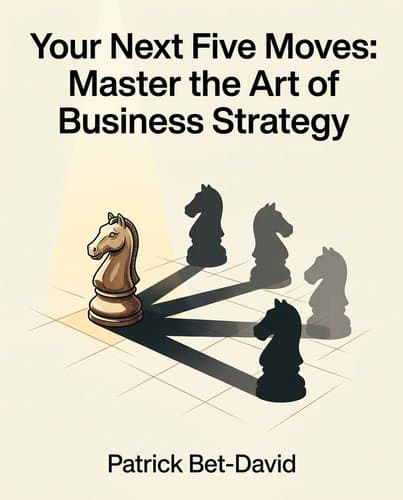
50542735_your-next-five-moves
by Patrick Bet-David
Chess masters don't react—they anticipate. Patrick Bet-David reveals the exact frameworks elite entrepreneurs use to decode their own blind spots, outmaneuver…
In Brief
Chess masters don't react—they anticipate. Patrick Bet-David reveals the exact frameworks elite entrepreneurs use to decode their own blind spots, outmaneuver competitors by turning personal disadvantages into market moats, and think five moves ahead while everyone else scrambles to survive the last one.
Key Ideas
Envy Reveals Your True Alignment
Run an envy diagnostic before committing to any major goal: if you can genuinely watch someone have what you lack and feel happy for them, you're aligned. If it eats at you, you're either lying to yourself about what you want or not doing the work to earn it. Envy is data, not a character flaw.
Your Weaknesses Are Your Moat
Map your competitive landscape for what your specific profile makes easy that rivals' profiles make hard. Your background, constraints, and apparent weaknesses may be the blue ocean your competitors literally cannot enter — Bet-David's advantage over a 57-year-old white male who couldn't cold-call or speak Spanish wasn't hustle; it was category selection.
Root Cause Lies Three Levels Deep
When a decision goes wrong, resist the urge to find a better solution faster. Keep asking 'why' until you hit bedrock. Most bad outcomes trace back to a variable two or three levels deeper than where you started looking — the apparel disaster wasn't bad luck, it was investing outside your competency in a charismatic founder without due diligence.
Payback Shrinks When Growth Curves Up
Before committing to any major investment, run the Investment Time Return formula using your projected growth rate, not your current state. The same project that looks like a 20-year payback today can become a 5-year payback when you account for where your business will be in three years.
Trust Levels Define Authority Boundaries
Assign everyone in your professional life to one of four trust levels — Stranger, Endorsed, Trusted, Running Mate — and never extend authority above their actual level. The most suspicious organization in the world was penetrated because greed overrode due diligence. Wariness isn't paranoia; it's calibration.
Principles Prove Themselves Through Sacrifice
Your stated principles mean nothing until they've cost you something in front of people who are watching. Fire the top producer over an ethics violation, turn down the side deal that would fund three hires, let revenue walk out the door — and do it where your team can see it. That's when culture becomes real.
Patient Service Compounds Relationship Value
The next time you meet someone you want a relationship with, don't ask for anything. Find out what they genuinely need and deliver it — including things that cost you real time. The power move is always the long game: Ritchie handed over a business card immediately and closed nothing; Bet-David washed dishes and drove four hours to a prison and eventually generated $30 million from one relationship.
Who Should Read This
Business operators, founders, and managers interested in Business Strategy and Leadership who want frameworks they can apply this week.
Your Next Five Moves: Master the Art of Business Strategy
By Patrick Bet-David
7 min read
Why does it matter? Because thinking one move ahead is the same as not thinking at all.
The assumption most people carry, quietly and comfortably, is that strategic thinking belongs to a certain kind of person. The right IQ. The right school. The network inherited from people who had networks. Then there's the man who built a fifteen-thousand-agent company and a channel with tens of millions of subscribers from a 1.8 GPA, an 880 SAT score, and no college degree. He enlisted at eighteen because he believed he had no other options. His argument isn't motivational. It's structural: the reason plans stall isn't effort or intelligence — it's that most people are solving symptoms instead of root causes, playing games that don't suit their actual wiring, and thinking one move ahead in a world that rewards the person who thinks five. This book shows you how to change that.
You Can't Plot Your Next Moves Until You Know Who's Actually Holding the Pieces
Shawn had burned through more than a dozen jobs before his thirtieth birthday, and the story was always the same: a new role, an early burst of energy, then a boss who couldn't see his value. When he called Bet-David to quit yet another position (insurance agent this time), they sat down to talk. Bet-David listened for a few minutes, then said: "This is going to sting. Every job you've ever left, the boss was at fault. Whose fault has it never been?"
Shawn pushed back, then went quiet, then started actually looking at it. Beneath the boss complaints was something older and more embarrassing: a rep he'd personally hired had started outearning him. He felt humiliated. Bet-David pressed past the job, past the office drama, to the real question — not what was wrong at work, but what kind of life Shawn actually wanted.
The answer surprised both of them. Not an empire. Not a leaderboard at the top of some national sales ranking. $150,000 a year, time to coach Little League, dinner at home, and the occasional morning to sleep in. He'd been running from job to job, blaming bosses for a gap that was really between himself and something he'd never been honest enough to say out loud.
"But isn't this thinking too small?" Shawn asked.
"You can't try to be me, and I can't try to be you," Bet-David said. "That's the worst thing you can do."
Shawn had been executing someone else's version of ambition. Once he stopped, the pattern stopped with him.
Shawn's story is where the book really begins. Not with strategy, but with the question underneath every failed plan: who do you actually want to be? The diagnostic he uses is uncomfortable: envy, read as a signal rather than a flaw. If you can watch someone have what you lack and feel genuinely happy for them, you're aligned. If it gnaws at you, one of two things is true: you want it and won't admit it, or you want it and won't do the work. Both are forms of lying to yourself, and no strategy survives that.
Who do you want to be? Not in the abstract — but specifically, with names and numbers and what you're actually willing to sacrifice. Until you can answer it honestly, you're not planning. You're just moving.
The Game You're In Matters More Than How Hard You Play It
Eric Drache spent thirty-six years as one of the world's best poker players, widely regarded as the seventh-best in the game. The running joke: he only played against the six people better than him. He was often broke. Winning depends on relative advantage, not absolute skill. Which game you choose matters as much as how well you play.
Bet-David entered insurance in 2007. He was twenty-nine, no college degree, an Iranian immigrant in an industry where the average competitor was a fifty-seven-year-old white male. On paper, the position looked terrible. What he did next was stop reading that profile as a threat and start reading it as a map.
That fifty-seven-year-old white male generally didn't speak Spanish. He wasn't on social media — and at a moment when Barack Obama was using it to dismantle an entire political establishment, that was a real gap. He'd built his business on cold calling. The Do Not Call Registry made that a federal crime in 2003. Insurance was Google's most expensive keyword at $54.91, nearly eight dollars more than "mortgage." The industry's tech-forward competitors thought life insurance could be sold through web forms, but Bet-David knew it had to be sold face-to-face. They were building something the product couldn't support.
The market had shifted underneath the incumbents. Women were increasingly the primary financial decision-makers in American households. The Latino population had crossed 45 million and was climbing. The legacy competitors weren't looking to reach either group. Bet-David went narrow where the industry had gone broad: one license instead of four or five, shorter training cycles, a social media presence nobody was building. What had looked like his disadvantages (immigrant, no degree, outside the old network) turned out to be entry points into markets the competition literally could not serve.
The game you're in should make your specific background an asset, not a liability.
The Problem You're Solving Is Almost Never the Real Problem
Bet-David argues this is how most business decisions get made. The issue you can see is almost never the one you should be solving. Surface-level processors grab the nearest explanation and start spending money on it. Expert processors keep asking why until the real variable surfaces.
The project he ran with his COO, Alice Terlecky, makes the case. He'd noticed that processing insurance applications was taking too long. After walking through every step of the intake process, they found automation software could cut five minutes per application. Cost: roughly a million dollars. Five minutes per policy times 30,000 policies a year is 2,500 hours. At $20 an hour in labor savings, that's $50,000 annually. A million dollars divided by $50,000 is a twenty-year payback. Dead on arrival.
But Bet-David kept asking. The analysis had treated 30,000 policies as a fixed number. It wasn't. His company was doubling. He ran the same numbers against his growth projections: 30,000 policies in year one, 60,000 in year two, eventually 240,000 by year five. The savings scaled with volume: $50,000, $100,000, $200,000, $300,000, $400,000. The payback window collapsed from twenty years to under five. The project ended up costing more than two million and ran long, but processing speed tripled and the long-term savings buried the cost.
Same project. Same math. Completely different decision — because someone kept asking what would happen if the denominator wasn't fixed.
That's Investment Time Return: the arithmetic isn't hard. What's hard is knowing which assumptions to feed it. Most people run the calculation on static inputs (current sales, current headcount) because those are the numbers on hand. The real variable tends to sit one level deeper. Growth rate. Future volume. A market that doesn't yet exist at its current scale. Keep interrogating until you find it.
The same principle holds across decisions: the variable causing the problem is almost never where you first looked. Keep asking why until the answer starts repeating itself. That repetition is bedrock. Once you're there, the problem is almost always more tractable than what you'd been working on.
Principles Are Only Real When They Cost You Something
The agent's wife was crying in the room. She told Bet-David they had children. She didn't know how they'd manage.
One year earlier, Bet-David had founded his company. The agent had come aboard and promptly earned more than $100,000 in his first three months — the kind of number that makes a first-year founder feel like he's finally cracked something. Then the reports started arriving: corners being cut, clients being misled, methods that sat somewhere between unethical and illegal.
Bet-David brought in Amour Noubarentz (a former branch office manager he'd known long enough to trust his judgment over any loyalty to the office) to investigate. He gave Amour free rein and promised to accept whatever he found. Three months later, Amour came back with documentation. The top producer had an FBI history. The conduct was possibly criminal.
"You have to terminate him," Amour said.
Bet-David did. The crying wife was still in the room when he made the call final. He took care of them as best he could on the way out, but the agent was gone. So was the revenue he carried with him.
Stated values are words on a wall until you sacrifice something real to defend them. Every person who watched Bet-David fire his highest earner — the guy pulling more in three months than most agents make in a year — walked away with evidence. Not a speech about integrity. Evidence. The company had principles, and the founder would push millions in revenue out the door to honor them.
Culture gets built in moments like this, not through retreats or mission statements, but through visible, costly choices. When you fire a mediocre performer, no one registers it. When you fire the person everyone knows is carrying the numbers, and you do it anyway, the remaining employees make a calculation: this place means what it says. The rules apply to everyone, including the people you can least afford to lose. That's when culture starts to outlive its founder. Bet-David's argument is that a business only becomes scalable when it no longer needs you in the room for things to hold together. That independence doesn't come from org charts or values posters. It starts the day you prove, with something you could barely afford to sacrifice, that the principles you've been repeating are actually true.
The Person Who Needs the Deal Least Always Wins It
The person with the most leverage in any negotiation is the one who could walk away and be fine. Everything else follows from that.
Most people treat this as a positioning problem — something to solve with bravado or bluffing. Bet-David's argument is more uncomfortable: real leverage can't be faked. It has to be built, slowly, through relationships so deep that asking for something later feels almost beside the point.
At twenty-two, a new insurance agent, Bet-David met a well-connected Middle Eastern man named Eli through mutual friends, a family connection, nothing more. When Eli invited him to a fiftieth birthday party at a large house in one of LA's expensive suburbs, Bet-David arrived in a Ford Focus and surveyed a parking lot full of nicer cars. He understood immediately that the room was full of potential clients and referrals. He spent the entire party not pitching. He talked, he listened, he helped wash the dishes.
Their friendship deepened over months, and Bet-David kept asking the same question: how can I help you? The answer surprised him. Eli's son had been imprisoned for nine years near San Luis Obispo — four hours away — and no one visited. The prison was rough, the drive was long, and most people in Eli's circle had quietly decided it wasn't worth the trip.
Bet-David said yes. He got fingerprinted, waited thirty days for clearance, drove north, and spent a full day with Eli's son. They became pen pals, handwritten letters, not email. He made the drive multiple times. No agenda. No ask.
When Eli finally turned to him and asked how he could help in return, Bet-David mentioned he was in financial services and looking for clients. Eli handed him a list of 600 names and told him to use his name on every call. One introduction led to another and another, six connections deep, ultimately generating $30 million in business. Eli never would have handed him that list if he'd spent the birthday party working the room.
The Move You Keep Postponing Is the Only One That Belongs Right Now
The grandmaster doesn't see further than everyone else. He sequences better. Section 3's math already showed this: those numbers only work in sequence. Run them out of order and you get nothing. You can list your next fifteen moves in an afternoon — it feels productive, looks strategic, and changes almost nothing if you're standing on step three while performing step twelve. That gap between where you actually are and where you're pretending to operate is where most ambitious people quietly stall.
Everything here points to the same uncomfortable pattern: power isn't grabbed. It's built — two and a half pounds per week, dishes washed at a party where everyone else was pitching, a four-hour prison drive that most people with better excuses skipped. The dramatic move is almost never the right move. It's just the one that feels like momentum.
The question is never where you want to be in five years. It's what step comes next — the one that's unglamorous enough that most people skip it. Two and a half pounds a week doesn't feel like a strategy. It is one.
Notable Quotes
“I f—in' bought it. Here we have a problem that we've allowed to be created.”
“I feel bad because I like the guy…. I don't even think it's intentional.”
“I've f—in' read more about coffee over the last three weeks than I've ever wanted to read or thought I would ever have to.”
Frequently Asked Questions
- What is "Your Next Five Moves" about?
- "Your Next Five Moves: Master the Art of Business Strategy" teaches entrepreneurs and leaders to think several moves ahead like chess grandmasters rather than reacting to immediate circumstances. Bet-David's 2020 book provides strategic frameworks for self-knowledge, competitive positioning, trust calibration, and long-term relationship building. Drawing from his own business experience, it helps readers make decisions with clarity and strategic intent by mastering five key areas that separate successful business leaders from those playing reactive chess with their organizations and careers.
- What does the envy diagnostic teach in the book?
- The envy diagnostic is a pre-commitment filter that reveals your true alignment with a goal. If you can genuinely watch someone have what you lack and feel happy for them, you're aligned. If the thought eats at you, you're either deceiving yourself about what you want or haven't done the work to earn it. "Envy is data, not a character flaw" — it signals misalignment or commitment gap. Run this diagnostic before pursuing any major goal to ensure psychological authenticity.
- How should you approach competitive positioning according to the book?
- Map your competitive landscape for what your specific profile makes easy that rivals make hard. "Your background, constraints, and apparent weaknesses may be the blue ocean your competitors literally cannot enter." For Bet-David, "his advantage over a 57-year-old white male who couldn't cold-call or speak Spanish wasn't hustle; it was category selection." Rather than outworking competitors in overlapping categories, identify the structural moat your unique background creates. Success lies in selecting a competitive arena where your profile provides an unfair advantage rivals cannot replicate.
- What does the book teach about trust assignment in organizations?
- Assign everyone in your professional life to one of four trust levels: Stranger, Endorsed, Trusted, or Running Mate — and never extend authority above their actual level. "The most suspicious organization in the world was penetrated because greed overrode due diligence. Wariness isn't paranoia; it's calibration." By categorizing people accurately and restricting power to their trust tier, you create structural safeguards against misalignment. This framework transforms trust from intuitive judgment into a measurable system, maintaining both security and operational efficiency.
Related Book Summaries
Read the full summary of 50542735_your-next-five-moves on InShort