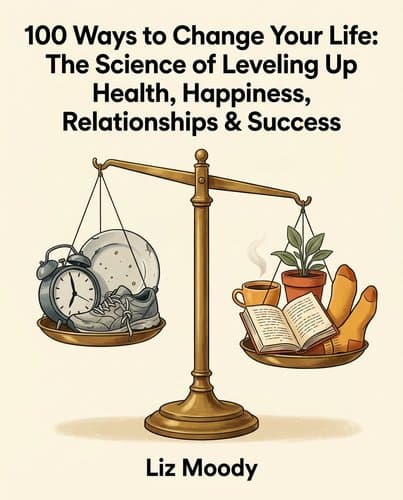
123018918_100-ways-to-change-your-life
by Liz Moody
Wellness culture lies when it tells you to suffer now and thrive later—instead, run 100 evidence-backed experiments on yourself, engineer your environment to…
In Brief
100 Ways to Change Your Life: The Science of Leveling Up Health, Happiness, Relationships & Success (2023) presents 100 evidence-backed strategies for improving health, happiness, relationships, and success — framed as personal experiments rather than rigid rules.
Key Ideas
Personal experiments validate habit choices
Run N-of-1 experiments on yourself: use the science as a starting point, then observe your actual response for two to four weeks before deciding if a practice belongs in your life.
Design systems to reduce willpower
Design your environment before you rely on willpower — temptation bundling, commitment devices, and fresh starts work because they're engineered, not because you summoned heroic discipline.
Net suffering reveals true habit success
Measure habits by net suffering, not by how much they're supposed to help: if a practice is generating chronic stress, isolation, or self-loathing, it has already failed on its own terms.
Gamify adding diverse plants weekly
Aim for 30 diverse plants per week by addition, not subtraction — gamify it with Plant Points, and know that one pasta dinner with garlic, mushrooms, zucchini, basil, and parsley gets you to ten plants before you've even thought about it.
Keep tiny promises, build self-trust
Build self-trust through tiny kept promises before reaching for self-love — the brain needs historical evidence before it will believe the words you say to yourself in the mirror.
Write three choices, restore agency
When you feel stuck, write down three choices — they don't need to be good choices, but naming them breaks the paralysis and restores the sense of agency that makes the next move possible.
Let the world reject you
Never pre-emptively reject yourself: let the world say no. Doing is a form of figuring out, and boldness regrets outlast the sting of failure by decades.
Stabilize five pillars before optimizing
Stabilize the five pillars first — social connection, sleep, movement, nutrition, and routine — before optimizing anything else. Everything else in this book is built on top of them.
Who Should Read This
People working on personal growth in Self-Improvement and Habit Formation, especially those tired of generic motivational advice.
100 Ways to Change Your Life: The Science of Leveling Up Health, Happiness, Relationships & Success
By Liz Moody
11 min read
Why does it matter? Because the way you're pursuing health is probably making you less healthy.
Most of us walk into the self-improvement project backwards. We assume the price of a better life is paid in suffering — earlier alarms, stricter diets, the slow accumulation of habits we quietly dread. We treat discipline like a virtue and discomfort like proof we're doing it right. But here's what the research actually shows: psychological suffering is just as physiologically damaging as physical stress, which means every wellness habit that makes you miserable is actively working against you. The problem isn't that you lack willpower. The problem is that you've been handed a framework that confuses the tool with the goal. Liz Moody, who spent years interviewing scientists and doctors for her podcast, argues that health isn't a destination you suffer toward. It's a set of experiments you run on yourself, in service of a life you actually want to live. That reframe changes which experiments you run, which questions you think to ask, and which habits you finally have permission to throw out.
Wellness That Makes You Miserable Isn't Wellness
Any health practice that makes your life worse has already failed. Skipping dinner with close friends because you can't vet the restaurant menu isn't discipline — it's a penalty you're paying for the privilege of calling yourself healthy. Liz Moody's core argument is that wellness is a tool for living better, and the moment it starts costing you joy, connection, or sanity, it has stopped being wellness at all. That's not a character flaw in you. It's a design flaw in how most of us were taught to think about health.
The fix isn't trying harder — it's experimenting smarter, specifically on yourself. Here's the thing nobody tells you about population-level health research: it describes averages, not you. Dr. Sara Gottfried, a Harvard-trained physician, makes this concrete. Studies of long-lived communities in Ikaria, Greece, show that locals drink wild foraged herbal teas — interesting data, but data about one island population in one environment. Rather than dismissing the finding or adopting it wholesale, Gottfried ordered a collection of those same organic teas, drank them each evening, and tracked what happened. Her blood pressure dropped five to ten points. One variable changed, one measurable result. That's an N-of-1 experiment: a clinical trial with a participant pool of exactly one. It turns broad epidemiological patterns into personal evidence — and it leaves room for the possibility that what worked on a Greek island also works in your kitchen, or doesn't, and that either answer is useful.
The Gap Between Knowing and Doing Is an Engineering Problem, Not a Character Flaw
Why do smart, motivated people fail to follow through on their own goals? The honest answer is that it's rarely a character problem — it's a design problem. The system is broken, and willpower was never going to fix it.
Positive visualization is actively working against you. NYU professor Dr. Gabriele Oettingen found that when people vividly imagine achieving a goal, the brain registers that imagined win as progress toward the real thing — and promptly reassigns the cognitive resources it had devoted to the task. You fantasize about running a half-marathon, feel a little glow of accomplishment, and then find yourself mysteriously less motivated to lace up your shoes. The brain isn't lazy; it's efficient. It thought the job was done. The WOOP framework exists to short-circuit exactly this. You identify the specific internal obstacle most likely to derail you, and you build a concrete plan to neutralize it. Move the alarm to the other side of the room. Switch the workout to lunch. The plan is the point — because when the moment comes, the decision is already made. You're not negotiating with yourself at 6 a.m.; you're just executing.
Temptation bundling works the same way — through mechanical design, not inspiration. Dr. Katy Milkman, a behavioral economist who studies how people change, figured this out as a graduate student who dreaded exercise but was obsessed with certain TV shows. She made a rule: the shows were only available on the gym elliptical. Suddenly her problem inverted — she was eager to work out because it was the only place she could find out what happened next. A later study formalized what she'd discovered intuitively: giving participants gym-only access to audiobooks led to a 51 percent increase in attendance. The key word is 'only.' The bundle collapses the moment the treat becomes available elsewhere, because the brain stops associating the pleasure with the chore.
None of this requires heroism. It requires noticing that you are, in fact, an engineering problem — and that engineering problems have solutions.
Your Body's Hidden Levers: Chronotype, Dopamine, and the Pleasure-Pain Teeter-Totter
Think of your brain's pleasure system as a teeter-totter, perfectly balanced at rest. Every dopamine hit — a scroll through Instagram, a square of chocolate, a drink — tips it toward pleasure. To restore balance, the brain tips an equal amount back toward pain. That's not metaphor. That's the actual mechanism, as Dr. Anna Lembke, who leads Stanford University's Addiction Medicine clinic, explains it. The person who can't put their phone down and feels irritable the moment it's gone isn't weak — they're caught in a biological feedback loop. Each spike demands a corresponding dip, and with repeated exposure, the pleasure response weakens while the pain response deepens. Eventually, the phone isn't delivering a high anymore. It's just preventing the crash.
Here's the counterintuitive part, the thing that reframes discomfort entirely: the way out runs through difficulty, not around it. When you deliberately subject yourself to mild but genuine stress — a cold shower, a cognitively demanding book, a hard workout — your brain interprets this as a signal that the body is under threat, and it responds by producing its own dopamine, serotonin, and norepinephrine. Unlike the sharp spike-and-crash of digital or chemical triggers, this internal release rises slowly and stays elevated for hours. A two-minute cold shower at the end of a regular one delivers the same slow-rising neurochemical payoff — the discomfort is the mechanism.
Your circadian biology works the same way — as a lever, not a fate. The idea that waking at five a.m. signals virtue is, in Moody's word, bullshit. Peak cognition tracks your chronotype, the biological clock encoded in your cells, and no amount of alarm-setting changes when your brain is actually ready to think. Research from Monash University found that indoor lighting in nearly half of homes was bright enough to suppress melatonin production by fifty percent — meaning millions of people are accidentally fighting their own sleep chemistry every night. Swapping to dim, orange-tinted bulbs in the evening and bright white ones in the morning nudges that clock without requiring any willpower at all.
The pattern across all of this is the same: your baseline isn't fixed. Think of the teeter-totter again — the same principle that governs your dopamine also governs your sleep. Tip the inputs deliberately, and the biology moves with you. It's not working against you. It's waiting to be used correctly.
The Smallest Effective Dose: Why Five Minutes Beats Zero Every Time
For three years, Dr. Rangan Chatterjee — a physician and BBC health presenter — has not missed a single morning workout. His secret isn't discipline. It's a French press. He weighs the grounds, pours the boiling water, sets a five-minute timer, and does kettlebell or bodyweight exercises right there in his kitchen, still in his pajamas. When the timer goes off, his coffee is ready. The workout is done. He's not building a new habit; he's borrowing time from one he already has.
The science actually sides with the pajama workout over the gym session. Researchers compared three groups — one sedentary, one doing an hour of morning exercise, one spreading twelve five-minute movement bouts across the day. Total active time for the latter two groups was identical. But the micro-bout group showed better blood sugar and insulin regulation than the one-hour group. Your metabolism cares less about the single heroic effort and more about how often you break up the sitting.
The same minimum-effective-dose principle holds for meditation. When psychologist Dr. Amishi Jha studied military personnel preparing for deployment, she started by asking for thirty minutes of daily practice. Almost no one complied. When she asked what people had actually done, the honest average was twelve minutes. So she stopped asking for thirty. Subsequent studies confirmed that twelve to fifteen minutes, three to five times a week, produced real, measurable improvements in attention. The thirty-minute standard wasn't science — it was an assumption. The assumption was costing people everything.
Chatterjee's French press timer works because attaching a new behavior to something you're already doing eliminates most of the friction of starting from scratch. Five minutes bolted onto coffee is nearly frictionless.
Your Gut Is Running More of Your Life Than You Think
The gut microbiome is running decisions you think you're making — and most people still treat it like a plumbing concern. The research shows something stranger: the trillions of microbes in your digestive tract are producing neurotransmitters, regulating inflammation, training your immune system, and shaping what you crave. When gastroenterologist Dr. Will Bulsiewicz describes the microbiome as a living ecosystem, he means it structurally. Specific microbes thrive on specific fiber from specific plants. A diverse diet feeds a diverse population, which reduces inflammation and improves metabolic health downstream.
The number that unlocks this is thirty — plants per week, not per day. That number is far more achievable than it sounds, and the way you hit it is by adding, never subtracting. Bulsiewicz demonstrates the math with a single pasta dinner. Start with whole wheat pasta and tomato sauce: two plants. Stir in garlic, onions, mushrooms, zucchini, and spinach. Tear some basil into the sauce. Scatter fresh parsley over the bowl when you sit down. You just went from two plants to ten without a new recipe, a specialty ingredient, or a single compromise. His suggestion for making it stick: hang a sheet of paper on the fridge, write down every plant the household eats, and treat it as a competition. Kids, he notes, love beating their parents.
The payoff compounds in ways that aren't just digestive. A Stanford University School of Medicine study found that adding fermented foods measurably improved gut microbiome health within ten weeks. Blood samples showed nineteen different inflammatory proteins dropping alongside reduced immune cell activation. That's not a gut story. That's a whole-body story.
A spoonful of kimchi on scrambled eggs, fermented hot sauce on tacos, a handful of seeds on a salad — the additions are small, and they stack. The body that starts eating more plants gradually starts wanting more plants. That bowl of pasta with ten plants in it starts to look like dinner, and then it starts to look obvious.
The Permission Slip You Didn't Know You Needed: N-of-1 Experiments
Gastroenterologist Dr. Will Bulsiewicz makes this concrete with a single scenario. You try a probiotic that has a peer-reviewed, randomized controlled trial behind it — real science, proper methodology — and after two months, you feel exactly the same. That's not failure. That's data. Your gut microbiome is a living ecosystem shaped by your specific history, your specific diet, your specific biology. A microbe that thrives in a study population of hundreds may simply not integrate into yours. The reverse is equally true: if you take a probiotic with no major studies behind it and your mood genuinely lifts, the absence of population-level proof is beside the point. You introduced something into your personal ecosystem and it worked. That's the whole game.
Bulsiewicz also sees the darker version of this play out in his clinic. Patients eliminate a food because it causes discomfort and feel better for two weeks — so they eliminate another, then another, until they're eating boiled chicken and potatoes and their gut handles even less than before. The gut, he says, is like a muscle. Avoiding the thing that challenges it doesn't protect it. It weakens it. The protocol failed to fit them, and nobody told them they were allowed to say so.
When something widely praised does nothing for you, you get to discard it without guilt. Science describes what works on average. You're trying to figure out what works in particular — for one specific body, yours, which no study has ever directly examined.
Never Be the One to Say No to Yourself
Picture Liz Moody sitting in her in-laws' house, too anxious to leave without triggering a panic attack, running a shoestring freelance writing career on the side, with exactly six months of recipe development under her belt. She had an idea for a cookbook built around healthy ice pops. By every conventional measure, she had no business pitching it. So instead of asking herself why any publisher would take her seriously, she typed 'what does a cookbook proposal look like' into Google, found some examples, and started cooking and photographing. That's the whole origin story of her first book deal.
She eventually made it to New York for meetings at the biggest publishing houses in the world, wearing the same outfit every single day — black silk pants, a white shirt, a gold necklace — because she couldn't afford a second 'professional author' costume. The meetings ended in a bidding war. Penguin Random House bought the book at auction. The career that followed — a dream job, a second book, a top-ranked podcast — traces back directly to the moment she refused to be the one to disqualify herself.
The self-screening feels like caution, but it's actually just a faster rejection with worse odds. When Moody asked Daniel Pink, who surveyed eighteen thousand people across a hundred and nine countries about their deepest regrets, what pattern kept appearing, it was what he calls boldness regret — the haunting 'if only I'd taken the chance.' The striking part isn't that people regret failed attempts. It's that when they take a risk and it doesn't pan out, they feel less regret than if they'd never tried. Failure gives you information and closure. Not trying gives you a question that ages badly.
Doing is a form of figuring out, not the reward you collect after you've already figured out. Moody didn't know how to write a cookbook proposal — she Googled it. That was enough to start. The world is well-equipped to say no to you. Don't do it first.
Self-Trust Is the Foundation Under Every Other Practice in This Book
Self-trust is the load-bearing wall under every good habit, every bold attempt, every moment of genuine confidence. Not self-love — self-trust. Jamie Varon, author of Radically Content, makes a distinction here that's almost uncomfortable in how clearly it lands: if you stand in front of a mirror and tell yourself you love yourself while consistently breaking every promise you've made to yourself, you're lying. Not in a cruel way — in a structural way. Words only carry weight when they're backed by evidence. The brain keeps receipts.
Here's the thing nobody tells you about self-love advice: it's got the sequence backward. You cannot think your way to believing yourself. You can only accumulate your way there. Every time you promise yourself an early morning and hit snooze four times, every time you vow to start the project and don't open the document, you're building a case against yourself, authored by yourself. Then you look in the mirror and say 'I believe in you' to someone with a track record that says otherwise. Of course it doesn't land.
The fix is almost insultingly small. Not a complete life overhaul — one kept promise, genuinely small enough that there's no reasonable excuse for breaking it. Walk around the block. Close the laptop at a set time. Five minutes of something you said you'd do. The size is the point. Lower the bar until keeping it is nearly certain, then keep it. Do that enough times and something shifts: the words you say to yourself start to feel true, because now they are. The confidence everyone thinks is a prerequisite is actually a byproduct. It shows up after the evidence does, not before. The biggest obstacle to the life you want is almost never someone else's no. It's the one you issue to yourself before anyone else gets the chance.
The Five Pillars That Everything Else Rests On
There's a version of Liz Moody standing in a London grocery store checkout line, basket full, completely unable to wait through the queue. She abandons everything — the food, the errand, the normalcy of it — and leaves. A few weeks later, her husband suggests watching a rugby match at the local pub. Casual plans, the kind of thing you say yes to without thinking. She can't go. And somewhere in there, she arrives at the thought that if every single day is going to feel this screamingly uncomfortable, life isn't worth it.
What she learned from that period — and from psychologist Dr. Julie Smith — is the insight that quietly undermines half the wellness industry. The fix wasn't a sophisticated technique. Not breathwork sequencing or an optimized supplement stack. It was the five pillars: social connection, sleep, movement, nutrition, and routine. Not as nice-to-haves, but as the ground floor everything else is built on.
Dr. Smith's framing is almost uncomfortably direct. Take any person — happy, resilient, psychologically robust — and start quietly dismantling those five things. Skip sleep to hit a deadline. Skip meals because you're busy. Let movement slide because you're stressed. Watch what happens. You don't have to be fragile to collapse under that. You just have to be human.
Moody's own recovery confirmed the routine beat specifically: the absence of structure made things worse, and what pulled her out was returning to a life with shape and edges. Routine wasn't a constraint. It was medicine.
The takeaway is disarmingly simple: before reaching for any advanced tool in this book — or any other — audit the foundation first. Write the five pillars on a sticky note. When something feels wrong, don't start with the complicated question. Start with the logistical one: which one slipped?
What the Risk Actually Costs You
Here's the thing nobody tells you about preparation: there's no version of it that ends with certainty. You can read every study, stack every habit, audit every pillar — and still not know whether the thing you want is actually waiting for you. But all of that work, every lever and system and experiment in this book, is ultimately in service of a single moment: the one where you move before you're ready. Daniel Pink's data keeps surfacing in the back of my mind — not the part about boldness, but the quieter finding underneath it. The failure gives you something to work with. The silence just compounds. So the question worth sitting with isn't 'what if this doesn't work?' It's more honest than that: what are you already losing by not finding out? Don't do their job for them.
Notable Quotes
“They’re the first things we let slide when we’re not doing so well,”
“How do we take this epidemiological data like Blue Zones and actually apply it to the individual?”
“I scroll to fall asleep. I can’t just lie there; I’ll never be able to turn off my brain.”
Frequently Asked Questions
- What is '100 Ways to Change Your Life' about?
- "100 Ways to Change Your Life: The Science of Leveling Up Health, Happiness, Relationships & Success" presents 100 evidence-backed strategies for improving your life across health, happiness, relationships, and success. Rather than prescriptive rules, author Liz Moody frames these as personal experiments you can test on yourself. The core philosophy is that small, intentional changes to your environment, habits, and mindset compound into lasting results. The book treats each strategy as a potential tool for your personal toolkit, encouraging you to observe how you actually respond to practices over two to four weeks before deciding what works for your unique life.
- What are the key takeaways from '100 Ways to Change Your Life'?
- Key insights include treating life improvements as N-of-1 experiments tailored to your response rather than universal truths. The book emphasizes designing your environment to support change over relying on willpower, and measuring habit success by whether they reduce suffering rather than external standards. According to Moody, you should "stabilize the five pillars first — social connection, sleep, movement, nutrition, and routine — before optimizing anything else." She also recommends building self-trust through small kept promises, embracing boldness by never pre-emptively rejecting yourself, and adopting a compassionate approach where practices that don't work simply don't belong in your life.
- How does Liz Moody suggest approaching habit change in this book?
- Moody recommends running "N-of-1 experiments on yourself: use the science as a starting point, then observe your actual response for two to four weeks before deciding if a practice belongs in your life." Rather than pursuing willpower-dependent changes, she advocates designing your environment with temptation bundling, commitment devices, and fresh starts. She also introduces a crucial reframing: measure habits by net suffering rather than intended benefit—if a practice generates chronic stress, isolation, or self-loathing, "it has already failed on its own terms." This approach personalizes change and removes guilt around practices that simply don't work for you.
- Is '100 Ways to Change Your Life' worth reading?
- This book is worth reading if you're tired of one-size-fits-all self-help advice and want evidence-based, practical strategies you can personalize. Moody's emphasis on experimentation and measuring success by personal suffering rather than external ideals offers a refreshing, compassionate approach. The book is particularly valuable if you struggle with perfectionism, motivation, or feeling stuck—she provides concrete tools like writing down three choices to break paralysis and practical tips like counting 30 diverse plants per week through addition rather than restriction. It's ideal for readers seeking sustainable change built on self-trust rather than willpower.
Related Book Summaries
Read the full summary of 123018918_100-ways-to-change-your-life on InShort