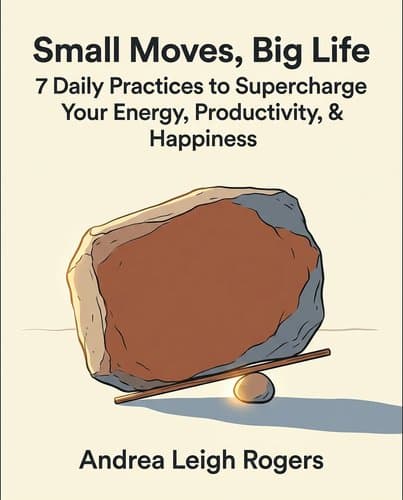
224004224_small-moves-big-life
by Andrea Leigh Rogers
Willpower isn't the problem—your system is. These 7 science-backed daily practices show you how to engineer your environment and identity so good habits become…
In Brief
Small Moves, Big Life: 7 Daily Practices to Supercharge Your Energy, Productivity, and Happiness (2025) argues that willpower is an unreliable foundation for lasting change, and that sustainable habits are built through environmental design, identity shifts, and strategically small actions.
Key Ideas
Choose One Keystone Habit for Cascades
Pick one keystone habit — not two, not three. Choose it because changing it will trigger a cascade in adjacent behaviors, not because it sounds impressive.
Start Impossibly Small for Early Wins
Shrink your starting habit until it almost feels pointless. Lacing up running shoes counts. Flossing one tooth counts. The brain needs a 'win' before it will cooperate.
If-Then Triggers Nearly Triple Success Rates
Plan your if-then trigger before the day starts: 'If [existing cue], then I [new habit].' The Christmas Eve essay study and the exercise data both show this nearly triples follow-through.
Real Rewards and Penalties Drive Compliance
Pair your habit with a reward you actually want — and withhold it on days you skip. The reward system only works if the penalty is real.
Expect 66 Days Not 21 Days
Expect 66 days on average, not 21. And know that missing one day doesn't reset the clock — Lally's research confirmed this explicitly.
Pre-Design Environment Before Low Motivation Hits
Design your environment the night before: pack the bag, thaw the meat, close the laptop. Reduce the decisions required at the moment of lowest motivation.
Measure Recovery Speed Not Guilt
When you fall off — and you will — measure your recovery by how long the next chain gets, not by how guilty you feel about breaking the last one.
Who Should Read This
Readers interested in Habit Formation and Self-Improvement, looking for practical insights they can apply to their own lives.
Small Moves, Big Life: 7 Daily Practices to Supercharge Your Energy, Productivity, and Happiness
By Andrea Leigh Rogers
11 min read
Why does it matter? Because the goal-setting advice you've been following is neurologically designed to make you fail.
Here's the hard truth about January 2nd: you already knew the resolution wasn't going to stick. Somewhere underneath the optimism, there was a quiet, familiar dread — because you've been here before. You're not lazy. You're not broken. You just keep using the wrong tool. Willpower is a battery that drains by noon, and every piece of standard self-improvement advice hands you a bigger battery instead of asking why you need one. What if the whole premise was wrong? What if lasting change isn't built through discipline at all, but through making the right behavior so small, so frictionless, so neurologically easy that your brain stops treating it as a threat? That's what the research actually shows — and what this book is unsparing about. The solution is almost offensively modest. Which, it turns out, is exactly the point.
You're Not Weak — You're Using the Wrong Tool
Most people who fail at their goals tell themselves the same story afterward: they weren't disciplined enough, they didn't want it badly enough, they just don't have what it takes. That story is wrong — and the data makes it hard to ignore. Researchers at the University of Scranton tracked New Year's resolutions and found that only 8% of people actually achieve them. Nearly one in four Americans has never successfully kept a single resolution. That's not a character epidemic. That's a systems problem.
Willpower is a finite resource — not a character trait but a battery that depletes with use. Ambitious, sweeping goals drain it fastest, because they demand constant conscious effort with no end in sight. The brain, faced with that sustained demand, eventually routes around it. Old behavior is easier — and, more to the point, automatic. A Duke University study found that more than 40% of what we do every day runs on unconscious habit, not deliberate choice. We're mostly on autopilot without realizing it.
The implication is uncomfortable but also genuinely freeing: the standard advice about self-improvement — set a big goal, summon your willpower, push through — is working against your own neurology. The fix isn't more discipline. It's a smaller door.
One Habit Can Quietly Rewire Everything Else
In 1987, Paul O'Neill stood before a room full of investors and stock analysts to introduce himself as the new CEO of Alcoa, one of the largest aluminum manufacturers in the world. The crowd expected the usual script: margins, growth projections, shareholder value. Instead, O'Neill announced that he intended to make Alcoa the safest company in America. Just worker safety. Some investors left that room and immediately called their brokers to sell. The man had clearly lost the plot.
Within a year, Alcoa's profits hit a record high. Within a decade, net income had risen by roughly 500%.
What happened? Focusing obsessively on one thing — safety — forced changes O'Neill never directly ordered. To track injuries, managers had to improve communication. To prevent accidents, line workers were empowered to flag inefficiencies. Those efficiency flags turned into cost savings. The whole organism reorganized itself around a single pressure point. O'Neill hadn't changed Alcoa's strategy. He had changed one habit, and the rest followed.
The practical implication is bigger than it sounds. If you're still thinking about habit change as a willpower problem — how do I find the discipline to do more things? — you're asking the wrong question. The better question is: which one habit, if I started it tomorrow, would make several other good behaviors more likely without me having to force them? That's the design move. Not accumulating effort, but finding that one small, well-chosen action that creates the conditions for others to follow on their own.
Forget 21 Days — Here's What the Research Actually Shows
The 21-day rule is everywhere — but tracing it back to its source is worth doing. The actual source turns out to be a plastic surgeon from the 1950s named Maxwell Maltz, who noticed that amputee patients needed roughly three weeks before they stopped feeling phantom sensations in missing limbs. He published the observation in 1960, and somewhere between his desk and the self-help shelf, one word fell out: 'minimum.' What Maltz wrote was that it takes a minimum of 21 days for an old mental image to dissolve. What people remembered was just the number.
A UCL psychologist named Phillippa Lally ran the study that actually measures this. In 2009, she tracked 96 volunteers over 12 weeks as they tried to build new habits, collecting daily reports on how automatic each behavior felt. The average time for a habit to reach genuine automaticity: 66 days. But the more interesting finding was the range — 18 days on the quick end, 254 on the slow end. That's not a narrow band around a tidy number. That's an acknowledgment that the timeline varies enormously depending on who you are and what you're trying to do. Some habits wire in fast. Some take the better part of a year.
Then there's the finding that should honestly be on a poster in every gym in January: missing one day didn't meaningfully slow the process. One skipped workout, one evening you didn't meditate — the data says it didn't restart the clock. That reframes what slipping up actually means. It's not evidence that you've failed. It's just a Tuesday.
Start So Small It Almost Feels Like Cheating
That's the logic behind what Stanford psychologist BJ Fogg calls 'Tiny Habits.' Fogg's insight is that the goal of a small action isn't the action itself — it's what the brain does afterward. Take the running shoes example. Your keystone habit is daily exercise. The small habit is simply lacing up your shoes. That's it. You're successful the moment they're tied, whether or not you make it out the door. Sounds too easy to matter, right? But here's what's actually happening: the brain just got a win. A small one, but real. And small wins are addicting in the best possible way — they cost almost no willpower to produce, which means there's willpower left over to do more.
Fogg noticed something else, though, that goes deeper than momentum. Watching yourself consistently succeed — even at trivial things — starts to shift how you see yourself. His framing: it's not just doing the actions; it's you watching yourself succeed. Floss one tooth, do two push-ups, sit down at the piano. Each completed action is a data point your brain files under 'person who does this.' Enough data points and the identity updates. You stop being someone who is trying to exercise and start being someone who exercises. That distinction matters more than it sounds — one is a performance you keep auditioning for, the other is just a description of you. The habit stops feeling like effort and starts feeling like evidence.
The micro-action was never the point. It was just the door — left intentionally small so you'd actually walk through it.
Your Brain Runs on Pain and Pleasure — Use That
Duke University professor Dan Ariely spent 18 months injecting himself with interferon three times a week to treat hepatitis C. Each injection brought on fever, vomiting, and dizziness — and yet Ariely achieved 100% compliance. His doctors told him he was the only patient in the practice who had managed it. Everyone else quit. What did he do differently? On injection days, he allowed himself to watch his favorite movies. On other days, he didn't. That was the entire system.
The brain is constantly running a negotiation between the discomfort of a new behavior and the pull of existing pleasures. Willpower can tip that negotiation briefly, but it burns out. What Ariely did was restructure the math — pairing a high-cost action with a high-value reward so reliably that injection day eventually carried its own anticipation. His brain stopped treating the needle as pure pain and started treating it as the price of admission to something good.
You can build the same structure around almost any habit, but two steps are harder than they sound. The first is immediate delivery: the reward has to come right after the behavior, not at the end of the week, not as a vague treat-yourself sometime soon. The second — and this is where most people quietly negotiate themselves into an exception — is withholding. If your reward for a morning workout is a coffee from your favorite café, you drive past without stopping on days you skipped. Every time. It sounds simple. It is genuinely difficult to do, especially when you're tired and the coffee shop is right there.
But that difficulty is the point. The system doesn't eliminate the discomfort of building a new habit — it gives your brain a reason to move toward the pain instead of away from it. Motivation stops being a personality trait you either have or don't, and starts being something you can engineer.
Stop Deciding in the Moment — Decide in Advance
Here's a claim worth sitting with: the most important decision in your habit chain isn't made in the moment — it was made hours or days earlier. When you rely on in-the-moment motivation to get yourself out the door or onto the mat, you're betting against your own tired, distracted, decision-fatigued brain. That bet loses more often than it wins.
NYU psychology professor Peter Gollwitzer studied a group of people trying to establish a regular exercise routine and found that 91% of those who assigned themselves a specific if-then trigger — if it's 6 p.m., then I put on my gym clothes — actually followed through. Among those who just resolved to exercise more? Thirty-nine percent. Same goal, same people, same days. The only difference was whether they'd pre-committed to a cue.
The mechanism isn't mysterious. When you build an if-then statement, you're not relying on a decision at all — you're running a script. Fatigue can kill motivation, but it can't override a script you've already written. The cue fires, the behavior follows, and your brain never has to agonize over whether tonight is the right night to run.
One caveat matters here: the trigger has to point toward something, not away from something. 'If I get bored, I won't snack' sounds reasonable, but what it actually does is plant the word 'snack' in your brain and wait. The version that works is a substitution: 'If I finish my coffee, I pour a glass of water.' Active, specific, positive. You've already decided. There's nothing left to negotiate when the moment arrives.
Positive Thinking Can Actually Work Against You
If-then planning helps you execute on a goal you've already committed to. This section addresses a different risk: committing to the wrong mental habit first — one that makes you feel like you've already won.
Gabriele Oettingen, a psychologist split between NYU and the University of Hamburg, ran a study in 2011 that should make every vision-board enthusiast a little uncomfortable. She split college students into two groups: one was asked to vividly imagine that the coming week would go beautifully; the other just jotted down whatever thoughts came to mind. The positive-visualization group reported feeling less energized than the control group — and went on to accomplish less that week. Not because optimism is useless, but because the brain is a bit too good at simulation. Spend enough time imagining yourself winning, and your nervous system files it under 'done.' The internal alarm that drives action never fires.
Oettingen calls the fix 'mental contrasting,' and it runs three steps: spend a moment genuinely picturing the goal, then immediately shift to imagining the specific obstacles that will show up — the alarm you'll sleep through, the soreness on day three, the friend who wants to order pizza — then map out concrete workarounds for each one. This isn't pessimism. It's inoculation. You're not rehearsing failure; you're giving your future self a script.
The results hold outside the lab. A follow-up study on diet and exercise found that participants who did this planning exercise — imagining barriers and pre-solving them — were exercising twice as long and eating considerably more vegetables four months later, compared to those who just visualized success.
The tool to add to your stack: after you've chosen your small habit, spend two minutes writing down what will try to stop you. Then answer it in advance.
Your Environment Is Doing More Habit Work Than You Are
Imagine trying to grow a lemon tree in a Minnesota backyard. You could read every gardening book ever written, visualize the fruit, water it faithfully — and it would still die. Not because you lacked commitment, but because the climate is wrong. A lemon tree needs warmth. That's not a motivation problem; that's a conditions problem.
Habit formation works the same way. The internal work — the goal-setting, the rewards, the if-then scripts — all of it runs inside a context you've either designed or ignored. An ignored environment has a way of eating habits alive.
Consider the morning runner who wakes up and has to locate an iPod in the kitchen, dig out shoes from the hallway closet, and remember which drawer has the shorts. By the time everything is assembled, the activation cost has been paid in full — often in the wrong direction. The moment of lowest motivation is the worst moment to make four small decisions. Pack the bag the night before, and the decision is already made. The friction disappears. The habit just runs.
Environmental design is moving the work earlier, when you have energy, so your future self encounters momentum instead of obstacles. Same idea applies to dinner: thaw the chicken the night before, set out the dry ingredients, so that arriving home exhausted doesn't open a negotiation about whether to cook or order in. The 'talk yourself out of it' window never appears, because you've already talked yourself into it.
Set up the environment first; let the habit follow.
The System Promises Simplicity, Then Hands You Nine Steps
Here's the honest irony: the book opens with a promise of five to ten minutes a day, and closes with a checklist that includes keystone habits, small habits, rewards, if-then scripts, realistic optimism, accountability partners, environmental design, a visual chain, and persistence. That's a lot of scaffolding for something that was supposed to be simple. The gap between the pitch and the practice is real, and worth naming.
But here's what makes it survivable: the Seinfeld calendar. Jerry Seinfeld, trying to force himself to write daily, hung a large wall calendar and drew a red X on every day he followed through. That was the whole system. The goal wasn't good writing or a finished set — it was just not breaking the chain. Once a streak of Xs builds up, the visual weight of that chain starts doing motivational work on its own. The blank space where an X should go feels wrong in a way that's hard to ignore. Seinfeld's insight is that you don't need to summon motivation from scratch each day; you just need to protect something you've already built.
And when you don't — when the chain breaks, because it will — the framework offers one more reframe. The book uses the image of a child learning to ride a bike: falling off isn't a verdict, it's a feature of the process. The goal after a fall isn't to mourn the broken chain. It's to build a longer one than before, which makes your previous record something to beat next time. You're not starting over. You're raising the bar.
The nine steps are more than advertised. But the Seinfeld calendar is simple enough to start tonight, and the bicycle logic is forgiving enough to survive the inevitable Tuesday when you don't. A visual you can maintain and a mindset that treats failure as data — that combination is what turns a complicated system into something you might actually use.
The Smallest Possible Version of Who You're Trying to Become
Here's the quiet truth underneath all nine steps: you're already running on autopilot. Rogers' real argument isn't about productivity hacks. It's about authorship. More than 40% of your day is already automatic, already habit, already shaping who you become. The only question is whether those habits belong to you — chosen, designed, pointed somewhere — or whether they just accumulated like sediment while you were busy trying to motivate yourself. You're going to live inside automatic behavior either way. You might as well write the script. Start with something embarrassingly small. And when you fall off the bike — not if — measure recovery by how long the next chain gets, not by how hard you hit the pavement.
Notable Quotes
“hidden in plain sight all around.”
“of our actions are unconscious habits.”
“You shift because of your own actions. But it’s not just doing actions: It’s YOU watching YOURSELF succeed, almost like you’re someone else observing and drawing conclusions. I have a sense that’s key. Seeing yourself perform new behaviors shifts your identity. And that creates ripple effects.”
Frequently Asked Questions
- What is Small Moves, Big Life about?
- Small Moves, Big Life argues that willpower is an unreliable foundation for lasting change. The book presents a concrete system for building sustainable habits through environmental design, identity shifts, and strategically small actions. Author Andrea Leigh Rogers teaches readers to use implementation intentions, keystone habits, and recovery strategies to make positive behavior the path of least resistance. Rather than relying on motivation or willpower, the book shows how strategic environmental changes and tiny behavioral adjustments can create automatic positive change. It challenges conventional wisdom about habit formation and willpower-dependent approaches to behavior change.
- What are the key takeaways from Small Moves, Big Life?
- The core takeaways include: Pick one keystone habit that will trigger a cascade in adjacent behaviors. Shrink your starting habit until it almost feels pointless — lacing up running shoes counts, flossing one tooth counts. Plan your if-then trigger before the day starts: 'If [existing cue], then I [new habit].' This nearly triples follow-through. Expect 66 days on average, not 21, and know that missing one day doesn't reset the clock. Design your environment the night before to reduce decisions. Finally, when you fall off, measure recovery by how long the next chain gets, not guilt.
- How does the environment design principle work in Small Moves, Big Life?
- Small Moves, Big Life emphasizes environment design as a replacement for willpower. The book recommends: 'Design your environment the night before: pack the bag, thaw the meat, close the laptop.' By pre-deciding and removing friction from the moment of lowest motivation, you make the desired behavior easier than the alternative. This approach leverages the principle that willpower is finite and unreliable, but a well-designed environment provides automatic cues for action. When you reduce decisions required in critical moments, you remove obstacles that cause habit abandonment. Environmental design is presented as more effective than motivation for sustained behavior change.
- How long does it actually take to build a habit according to Small Moves, Big Life?
- According to Small Moves, Big Life, 'Expect 66 days on average, not 21.' The book cites Lally's research confirming that 'missing one day doesn't reset the clock.' This directly contradicts the popular myth that habits form in 21 days. The practical implication is that a single missed day doesn't erase your progress — success depends on how quickly you resume the habit after a lapse. The author recommends measuring recovery 'by how long the next chain gets, not by how guilty you feel about breaking the last one.' This reframes habit failure as a learning opportunity rather than moral failure.
Related Book Summaries
Read the full summary of 224004224_small-moves-big-life on InShort