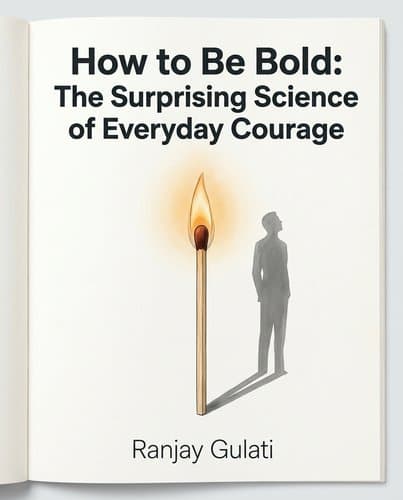
223830502_how-to-be-bold
by Ranjay Gulati
Courage isn't a personality trait you either have or lack—it's a learnable set of mental moves. This science-backed guide teaches you to systematically cap…
In Brief
Courage isn't a personality trait you either have or lack—it's a learnable set of mental moves. This science-backed guide teaches you to systematically cap downside risk, redirect fear rather than suppress it, and build the support structures that make bold action feel inevitable.
Key Ideas
Cap downside, start reversibly
Treat uncertainty like a logistics problem: systematically cap your downside, narrow your first action to something small and reversible, and build your capacity to improvise — don't wait for certainty that won't come.
Competence fuses identity with capability
Build competence before you need courage. Deliberate practice in lower-stakes situations doesn't just improve skill — it fuses your identity with capability, so that under pressure you fall back on 'who I am' rather than calculating whether you can.
Redirect fear toward your mission
When fear is blocking you, don't try to suppress it — redirect it. Use a pre-action ritual (even small talk), shift attention to your mission rather than the audience's reaction, or reframe the situation as what you stand to lose by not acting rather than what you risk by acting.
Build support squad before crisis
Construct your support squad before the crisis, not during it. You need people for four distinct roles: emotional processing, tangible resources, knowledge you don't have, and appraisal support — someone who confirms your reality when others are gaslighting you.
Tension between vision and reality
Use mental contrasting, not positive thinking: hold your vision of the desired future alongside an honest account of the real obstacles. The tension between them generates motivation that pure optimism cannot.
Identity fusion through shared purpose
To build collective courage, engineer identity fusion deliberately — through shared adversity, by making the group an extension of each person's individual identity, and by anchoring the team to a purpose larger than any individual's survival calculation.
Small practice precedes transformation
Start smaller than feels meaningful. Gandhi couldn't finish a joke at his own farewell dinner. The practice of courage begins with the next small move, not a breakthrough moment of transformation.
Who Should Read This
Business operators, founders, and managers interested in Self-Improvement and Confidence who want frameworks they can apply this week.
How to Be Bold: The Surprising Science of Everyday Courage
By Ranjay Gulati
13 min read
Why does it matter? Because waiting to feel brave before acting is the exact mistake that keeps you frozen.
Here's a private question worth sitting with: if something went badly wrong right now — not a thought experiment, but actually wrong — would you act, or would you freeze? Most people, if they're honest, suspect the answer is freeze. And here's what's strange: they're probably right, but not for the reason they think. It isn't weakness or cowardice encoded in their character. It's a mental operating system running exactly the program it was built to run — one calibrated for predators and physical threats, not the social and professional risks most of us actually face. The genuinely surprising finding, the one that changes everything, is that the operating system can be rewritten. Not through motivational pressure or sheer willpower, but through specific, documented, learnable shifts in how the mind interprets what's happening. Courage, it turns out, isn't a trait. It's a technique. And techniques can be taught.
The Biology Is Working Against You — And That's the Starting Point, Not the Verdict
Picture a teenage boy frozen in a doorway. In the living room just ahead of him, a thickset man in a badly fitting blazer has just peeled back his jacket to reveal a revolver at his hip. The man wants a signature on a land sale document. The boy's mother has refused, repeatedly. Now the gun is on the table as a different kind of argument.
The boy — a young Ranjay Gulati, who would later become a Harvard Business School professor — does not move. His brain is running calculations: how fast would the man react, could he wrestle the gun free without endangering his mother, would he be strong enough? Meanwhile his mother stands up, crosses the room, and slaps the man hard across the face. "You think you can scare me with a gun? Get out of my house right now." The man, stunned, gets up and leaves. They never see him again.
The biology here really is working against you. When the brain detects danger, the amygdala — the ancient part responsible for emotional regulation — fires off a survival response before your conscious mind has finished forming a thought. Fight, flight, or freeze. This reflex isn't a design flaw; it's a feature that natural selection spent millions of years perfecting. The anxious, risk-averse individuals among our ancestors were the ones who survived long enough to have children. You inherited that wiring. When you imagine yourself in a crisis and suspect you might freeze, you're probably right — not because of some personal deficiency, but because the circuitry running the show was built for exactly that outcome.
The implication cuts both ways. Yes, cowardice is the biological default. But that means courage was never a personality trait distributed unevenly at birth. It's always been an override — something learned, practiced, and deliberately constructed. Gulati's mother didn't lack fear. She had built ways of thinking about herself and her situation that made acting feel more possible than freezing. That's a skill. Which means it's teachable.
Courage Isn't the Absence of Fear — It's a Better Story About What the Risk Means
The courageous don't simply endure more fear than the rest of us — they build mental frameworks that change how threatening a situation registers in the first place. Courage isn't a higher pain tolerance. It's applied meaning-making.
Harriet Tubman is the cleanest demonstration of this anyone has found. Before her Underground Railroad missions, she engineered departures for Saturday nights, because plantation owners wouldn't notice missing workers until Monday morning — buying her group nearly two full days before pursuit began. She traveled in winter, calculating that cold weather would keep slave catchers indoors. She gave opium to infants to prevent cries that might alert strangers. None of this is fearlessness. It's the systematic compression of uncertainty into something the mind can categorize as manageable risk rather than open-ended chaos. And here's what matters: the same preparation that made her missions materially safer also changed what those missions felt like from the inside. The threat hadn't vanished, but it had a shape now. A shaped threat is psychologically different from a formless one — and that's the distinction Gulati keeps returning to. Risk is a danger you can quantify. Uncertainty is what fear actually feeds on: that vertiginous sense that events are happening to you rather than being navigated by you. Tubman's genius was turning the second thing into the first.
For those who can't bring faith to bear on what remains unknowable, Gulati points to obsessive preparation as a psychological act in its own right. Tightrope walker Philippe Petit spent eleven years gathering weather records and geological surveys before crossing the Grand Canyon on a wire — not primarily to make the walk safer, since no amount of data makes a 1,600-foot drop survivable, but to construct an internal narrative in which uncertainty had been hunted down until it felt essentially zero.
Your brain doesn't need a guarantee. It needs a coherent account of what's coming. Build that account deliberately, and the situation your biology encounters when the moment arrives is, quite literally, a different one.
Competence Is Confidence — and Confidence Is the Permission Slip for Action
What if you have courage backwards? The common assumption is that confidence arrives first — some internal permission slip that finally lets you act — and that without it, bold action is off the table. The research says the sequence runs the other way: competence comes first, confidence follows, and courage is the downstream product of that accumulation.
Albert Bandura's 1982 Stanford study makes this concrete. Ten people with severe snake phobias — some so frightened they couldn't enter a room containing a glass box with a corn snake inside — were walked through a series of graduated tasks, from approaching the box to eventually letting the snake move across their laps. No speeches about snakes being harmless. No encouragement to push through the fear. Just competence, built incrementally. As participants' perceived ability increased, their fear measurably decreased. Confidence wasn't a precondition for engaging with the snake. It was a consequence of having practiced doing so.
The gap between Chesley Sullenberger and Scot Peterson is the same principle at full scale. When both engines on Flight 1549 died ninety seconds after takeoff in January 2009, Sullenberger had no procedure to follow — pilots don't train for dual-engine shutdowns because they essentially never happen. What he had was decades of deliberate practice that had fused his identity to his competence. He could calculate the required descent rate, wing angle, and approach speed in real time, under mortal pressure, because he had internalized those variables through thousands of hours in cockpits. "My entire life up to that moment had been preparation," he said afterward. His confidence in that cockpit wasn't a feeling he'd arrived with. It was the accumulated residue of everything he'd already built.
Peterson, at Parkland in 2018, had none of that substrate. His active-shooter training was, by his own description, inadequate. He lacked the equipment — no rifle, no vest — to match the threat he was facing. When the moment arrived, his brain ran the same calculation Sullenberger's did and reached the opposite answer: I don't have what it takes. Gulati doesn't excuse what followed. But he's clear that Peterson's paralysis was the predictable output of the inputs — not a moral failure that arrived from nowhere, but the logical result of never having built the thing that makes action feel possible.
The lever this hands you is practical: stop waiting for confidence to appear, and start building the competence that produces it. The feeling is downstream. Go get the skill first.
The Narrative in Your Head Determines Whether Fear Stops You or Propels You
Think of a long road trip where you can see exactly where you're headed — the destination glowing on the map — but the route runs through construction zones, bad weather, and two mountain passes with no cell service. The visibility of the obstacles doesn't kill your motivation. It sharpens it. You pack accordingly. You leave earlier. The tension between where you want to be and what stands in the way turns out to be the engine.
That tension is what psychologists call mental contrasting — and it inverts the self-help orthodoxy most of us absorbed somewhere along the way. Visualizing success feels motivating in the moment, but research shows it actually bleeds urgency out of the situation. When your brain experiences the victory vividly enough, it begins treating the work as partly done. The tension collapses. What fuels genuine, sustained courage isn't a clear picture of the summit — it's holding that picture alongside an unflinching account of the climb.
Patrick Awuah understood this intuitively. A Microsoft manager in Seattle with a comfortable salary and a stable life, he walked away in the mid-1990s to found a university in Ghana, convinced that Africa's leadership crisis wasn't a technical problem but a moral one — a failure of ethical formation that only rigorous education could fix. The vision was grand. But what made his story powerful enough to pull in Berkeley MBAs, American teachers, skeptical government ministers, and village elders who sold him land below market value wasn't the optimism alone. It was that Awuah named the obstacles directly and then laid out concrete steps for getting through them. His pitch wasn't 'imagine how great this will be.' It was closer to: here is what's broken, here is exactly why it's hard to fix, and here is the specific path I intend to walk. When a former Microsoft colleague asked him about a backup plan, Awuah said simply: there isn't one. That certainty wasn't recklessness. It was the product of a narrative so precisely constructed around the gap between vision and reality that backing out felt less possible than pushing through.
The takeaway is practical: before your next significant act of courage, write down both sides. The future you're trying to build, and the full weight of what's in the way. The discomfort you feel reading the second list back is not a warning sign. That tension is the fuel.
You Don't Have to Be Brave Alone — Your Squad Changes What Feels Possible
In 2021, Frances Haugen downloaded tens of thousands of internal Facebook documents and prepared to hand them to journalists and Congress. She knew what was coming: a company with enormous legal resources, a reputation for aggressive retaliation, and a practiced ability to make dissenters doubt themselves. What most accounts of her whistleblowing miss is that she didn't walk into that alone.
Haugen built a deliberate support infrastructure before she went public. Her mother absorbed the emotional weight she couldn't carry solo — someone to call at midnight when the fear became too loud. A Wall Street Journal reporter gave her accountability and pacing, a schedule that made the whole endeavor feel like a structured project rather than a freefall. A legal scholar connected her to the right lawyers and communications people. And when Facebook responded to early pressure by insisting that Haugen had misread the data, that her concerns were overblown, that she was wrong about what she'd seen with her own eyes — it was her parents who steadied her. They confirmed what she already knew. The sky is blue. Trust yourself. That's not comfort — it's someone else vouching for your perception of reality when an institution is trying to dissolve it.
Gulati's argument is that support squads don't just reduce stress — they change what you're willing to risk in the first place. Each person in Haugen's network carried a different weight she couldn't carry alone: the emotional, the logistical, the legal, the epistemic. Together they expanded the ceiling of what felt survivable. She didn't become braver because she found extra courage somewhere inside herself. She became braver because the network around her redefined what 'alone with this' actually meant.
The lever here is both practical and surprisingly early: these bonds need to exist before the crisis arrives. A squad assembled in the middle of a dark moment is harder to build than one you've been tending all along. Figure out now who handles which weight.
In the Moment Everything Goes Wrong, Action Itself Is the Thinking
The earthquake and tsunami that hit Japan in March 2011 were catastrophic enough. What almost made them worse was what happened inside the control room at Fukushima Daini: instruments failed, lights went out, and nobody could tell whether four reactors were on the verge of meltdown. Site superintendent Naohiro Masuda walked to a whiteboard and did something that sounds almost anticlimactic — he listed what he didn't know. Then he sent forty volunteers into the flooded building to physically inspect the reactors and report back.
All the earlier preparation — the mental contrasting, the competence-building, the support squad — quietly depends on this insight, and sometimes collides with it. Preparation gives you a script. A real crisis shreds the script. What Masuda grasped, standing in the dark with useless instruments, was that waiting for clarity was a form of surrender. So he treated small imperfect actions as his pathway to understanding. When his first plan — restoring power through a specific source — proved too ambitious given actual conditions, he switched to an alternative. The information that justified the switch only became available because he had already moved. Within twenty-four hours, his crews had laid five and a half miles of cable through flooded corridors and restored cooling to all four reactors hours before a second meltdown would have become inevitable.
Sociologist Karl Weick gave this mode of operating a name: sensemaking — acting your way into understanding rather than waiting for understanding before you act. It sits in productive tension with everything this book has argued so far. Prepare thoroughly, yes. Build competence. Identify the obstacles honestly. And then recognize that when you finally step into the unknown, the map you've drawn will almost certainly be partially wrong. The defining skill becomes staying curious about what's actually in front of you rather than defending the picture you arrived with.
The calibration this demands is uncomfortable: be prepared enough that you can move, but loose enough that you can change direction the moment the ground shifts. That's not a formula. It's an ongoing negotiation — which is exactly what makes it courage rather than just execution.
Fear Is Contagious — But So Is Calm, If You Know How to Manufacture It
July 19, 1989. United Airlines Flight 232, somewhere over Iowa, has just lost its entire hydraulic system — the mechanism that controls every flight surface on the plane. Pilot Al Haynes and his copilot are steering a DC-10 with nothing but the throttles, adjusting engine thrust on each wing by hand, second by second, with no margin for error. A flight instructor named Dennis Fitch, who happened to be a passenger, knocks on the cockpit door and offers to take the throttles. Haynes says yes. A stranger settles into position and the two men, about to attempt something no pilot has ever survived, exchange the following words: 'My name's Al Haynes.' 'Hi Al, Denny Fitch.' 'How do you do, Denny?' 'We'll have a beer when this is all done.' 'I don't drink, but I'll sure as hell have one.'
That exchange is not small talk. It's what Stanford psychologist James Gross calls emotional regulation — the deliberate shaping of your fear response before it takes over completely. Haynes and Fitch didn't deny the danger. They reached for something recognizable and routine, the kind of banter you'd make on any ordinary flight, and in doing so injected just enough predictability into a situation of pure chaos that their nervous systems could keep functioning. Forty-four minutes later, the plane crash-landed in Sioux City. 185 people survived, including both men.
Gross's research identifies a few mental moves that do this work: ritual, which normalizes a threatening situation by anchoring it to something ordinary; attentional deployment, which narrows your focus to what you can actually influence; and reframing, which doesn't deny what's real but changes what it means. Aisha Chaudhary was a teenager given five years to live after a pulmonary fibrosis diagnosis. She became a motivational speaker. She didn't reframe the dying away. She reframed what the living was for — a choice for happiness rather than a sentence to be endured.
None of these moves eliminate fear. They redirect it, keeping you functional at the exact moment fear would otherwise take the wheel. And when you're in a leadership position, manufacturing that composure isn't emotional dishonesty. It's a service to everyone in the room watching to find out how afraid they should be.
When You Stop Calculating Your Own Risk, You've Reached the Most Powerful Form of Courage
What actually separates someone who calculates personal risk from someone who doesn't bother with the calculation at all?
Brandon Tsay, a soft-spoken coder in his mid-twenties, had privately answered this question about himself before January 2023. He'd heard about mass shootings and imagined his response honestly: he'd run. Then a gunman walked into the Lai Lai Ballroom — the dance studio his grandmother had founded, where he'd spent his childhood sleeping on couches and listening to customers' stories, where he'd put college on hold to keep the business alive after his mother died — and Tsay grabbed the weapon bare-handed. During the struggle, while the gunman beat him in the face, Tsay wasn't running the survival math. He was thinking about the people inside and whether he could face them afterward if he'd let them die. 'The ballroom has been part of my identity for my whole life,' he said later. That's not a metaphor. The studio was, in a functional psychological sense, him — his mother's memory, his family's immigrant story, the community he'd already sacrificed for. When your sense of self and the group's survival become genuinely the same thing — what psychologists call identity fusion — the personal risk calculation disappears entirely. Tsay's survival and the ballroom's survival had become one calculation. Which meant there was no calculation left.
Leaders can build this deliberately, though it takes more lead time than any other lever in this book. The Marine Corps' 54-hour Crucible — limited food, limited sleep, near-constant physical demand — isn't designed to make recruits tougher in isolation. It's designed so that afterward, as Marine General Robert Bowers puts it, 'your fear becomes: you don't want to let the team down.' Fear of personal harm gets replaced by fear of failing your tribe. Identity fusion, engineered through shared ordeal.
Here the argument surfaces its own discomfort. The same mechanism that made Tsay heroic — a self fused so completely with a group that personal risk stops registering — operates identically in radicalized actors willing to die for an extremist cause. The psychology is not inherently noble. It is extraordinarily powerful, and it goes where the values of the group go. Which means the longest lead time isn't in building the fusion. It's in being sure you've built the right clan to fuse with.
Brave Organizations Are Designed, Not Discovered
The evidence is a single statistic from the Taj Mahal Palace hotel in Mumbai on the night of November 26, 2008, when a coordinated terrorist attack killed more than 160 people across the city: not one of the hotel's hundreds of employees ran. Chefs formed human shields around guests escaping through a back entrance. Telephone operators stayed at their posts relaying evacuation instructions. General Manager Karambir Kang stood in the street directing rescues after learning his wife and children had died in the fire burning through the floors above him. These were not Navy SEALs. They were banquet managers and kitchen staff and front-desk clerks — people hired to make guests comfortable, now choosing to die for them.
What produced this wasn't a hiring filter for bravery, and it wasn't a speech. It was a specific design. The Taj puts new employees through eighteen months of onboarding built around a single premise: you are an ambassador for the guest, not a representative of the company. Employees are trained to make any decision necessary to serve a guest without waiting for manager approval. The organizational risk the Taj trains against isn't administrative error — it's failing to delight someone in your care. That framing, repeated across a year and a half until it fuses with how employees understand themselves, is what showed up in the ballrooms and kitchens when the grenades started falling. The decision to stay wasn't heroism overcoming instinct. It was identity, acting exactly as designed.
Everything covered in the earlier sections — the mental frameworks, the competence, the squad, the calm, the fused identity — works at the individual level. But organizations can engineer the conditions so that ordinary people encounter those levers already in place before the crisis arrives. The Taj didn't discover brave employees. It built a system in which ordinary employees defaulted to brave behavior. That's the final insight, and the most scalable one: courage stops being a rare personal achievement the moment you stop leaving it to chance.
The Gap Between One Sentence and an Empire
In the autumn of 1891, a young Mohandas Gandhi stood up at his own farewell dinner in London, opened his mouth to deliver a prepared joke, and sat back down having managed exactly one sentence. Mortified. Done. The room moved on without him. What followed that moment wasn't a transformation — it was an accumulation. A lawsuit in South Africa he couldn't avoid. A letter written when staying silent felt worse than speaking. A march refused, then reconsidered. Decade by decade, small move by small move, until the man who once couldn't finish a joke led 60,000 people to the sea and cracked an empire with a handful of salt. He never got a guarantee. Neither will you. But the gap between frozen and free has never been character — it's been repetition. The practice doesn't start at the big moment. It starts now, with whatever small move is sitting right in front of you.
Notable Quotes
“I’m here to get you to sign this.”
“I’ve already told your boss that I won’t sell. Why do you folks keep wasting my time? I won’t change my mind.”
“I’m here to get you to change your mind. I have brought a check with me. We just need to agree on the amount. I’m not leaving until that contract is signed.”
Frequently Asked Questions
- What is "How to Be Bold: The Surprising Science of Everyday Courage" about?
- "How to Be Bold" reframes courage as a learnable skill rather than an innate trait, drawing on psychology and behavioral science. Ranjay Gulati provides concrete techniques for managing fear, building competence under pressure, and acting despite uncertainty. The book offers readers a systematic toolkit for developing boldness in everyday situations through deliberate practice, proper support systems, mental redirection strategies, and realistic planning. Rather than waiting for innate bravery to emerge, Gulati demonstrates how courage is a skill that can be deliberately developed and strengthened through specific practices.
- What are the key strategies for managing fear in "How to Be Bold"?
- According to Gulati, "When fear is blocking you, don't try to suppress it — redirect it." The book recommends using a pre-action ritual (even small talk), shifting attention to your mission rather than the audience's reaction, or reframing the situation as what you stand to lose by not acting rather than what you risk by acting. This redirection approach is more effective than attempting to eliminate fear entirely, focusing instead on channeling fearful energy toward your goals and away from self-doubt.
- How should you approach uncertainty according to "How to Be Bold"?
- Gulati advises treating uncertainty like a logistics problem rather than waiting for perfect information. The approach includes three core steps: "systematically cap your downside, narrow your first action to something small and reversible, and build your capacity to improvise — don't wait for certainty that won't come." This framework rejects the paralyzing pursuit of certainty and instead focuses on limiting potential losses, taking manageable initial steps, and developing adaptability to handle unexpected challenges. The book emphasizes that sustainable courage often means acting decisively with incomplete information.
- What does "How to Be Bold" say about building support systems for courage?
- The book emphasizes constructing your support squad before facing a crisis rather than seeking help during it. According to Gulati, "You need people for four distinct roles: emotional processing, tangible resources, knowledge you don't have, and appraisal support — someone who confirms your reality when others are gaslighting you." These four support roles provide essential functions: emotional validation, practical assistance, specialized expertise, and objective reality-checking when doubts arise. The strategic timing and intentional composition of support networks significantly impacts your overall ability to act boldly when courage is most needed.
Related Book Summaries

Read the full summary of 223830502_how-to-be-bold on InShort