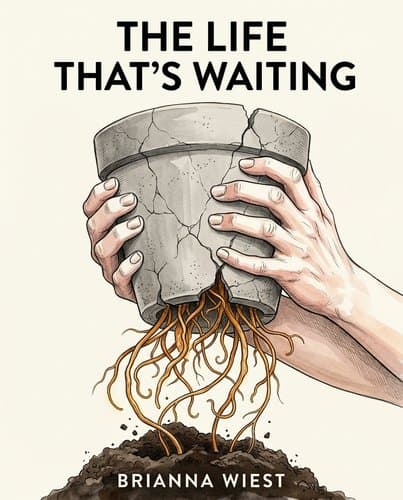
221111271_the-life-that-s-waiting
by Brianna Wiest
The life you're exhausting yourself to build may be the very thing blocking the one already waiting for you. Brianna Wiest reveals how releasing the wrong…
In Brief
The life you're exhausting yourself to build may be the very thing blocking the one already waiting for you. Brianna Wiest reveals how releasing the wrong things—careers, identities, relationships held together by sheer will—is the only move that actually moves you forward.
Key Ideas
Open hands release what's truly meant for you
When you can't stop thinking about 'letting go,' that's usually the moment to open your hands — things that are truly right for you don't require a closed fist to keep them.
Small gestures reshape identity through repeated practice
The habituation chain runs in both directions: you can deliberately use small, ordinary gestures to condition a new normal — identity shifts through what you allow yourself to get used to, not through grand declarations.
Only accept guidance from destinations you admire
Before accepting criticism, run the filter: would you want to switch places with this person? If not, their map of the territory doesn't apply to your destination.
Disorientation signals transformation and inner growth emerging
Feeling stuck is evidence of evolution, not stagnancy — you can't feel anchored unless part of you has already begun to sail. The disorientation is the alchemy.
Purpose lives in responsiveness to immediate calls
Purpose isn't a grand mission to decode but a responsiveness to immediate calls — the ones you can hear are the ones you're already equipped to answer.
Shrink the anxiety container, not individual worries
The anxiety container matters more than any individual anxiety — if you solve each worry without shrinking the container, the mind will always find new material to fill it.
Unfinished ventures hold more regret than mistakes
What you struggle most to forgive yourself for is usually what you never fully started, not what you finished. The regret is trying to instruct, not punish — there is still time.
Who Should Read This
People working on personal growth in Self-Improvement and Habit Formation, especially those tired of generic motivational advice.
The Life That's Waiting
By Brianna Wiest
11 min read
Why does it matter? Because the life you're exhausting yourself trying to hold together is blocking the one that's already waiting.
You've been holding something together for a long time now. A relationship, a career, a version of yourself — something that used to fit and quietly stopped. And here's what nobody tells you about that kind of effort: the grip itself becomes the obstacle. Brianna Wiest's The Life That's Waiting is built on a single destabilizing premise — that the life you're exhausting yourself trying to construct is actively blocking the one that's already forming beneath it. The human mind reliably mistakes the familiar for the correct. And so what you've been calling discipline might actually be avoidance. What feels like strength might be refusal. This book doesn't hand you a system. It hands you a mirror — and then asks whether the person staring back is who you are, or simply who you've had to be.
You're Not Failing at Life — You're Addicted to the Feeling of Fixing It
Here is a thing almost no one will say to you directly: you are not broken for being unable to simply enjoy your life. The problem isn't a deficit of gratitude or willpower. The problem is that your mind has been trained, over years, to treat a certain kind of struggle as home — and home, however uncomfortable, always pulls you back.
Wiest draws a sharp line between two things people tend to collapse into one: joyfulness and happiness. Joyfulness is the spike — the high you feel when something extraordinary lands, when a relationship ignites or a goal is finally reached. It's real, but it's weather. Happiness is something quieter and more architectural. It's the openness to move through a whole range of experiences without needing any of them to be the peak. The willingness to take what goes wrong as information rather than evidence of your fundamental inadequacy. A practice, in other words — not a reward you receive for having finally sorted yourself out.
But here's where the argument gets uncomfortable: if you have spent years cycling through collapse and recovery, or positioning yourself as the person everyone else brings their pain to, then the process of healing has likely become your identity. Being healed — actually arriving at a stable, ordinary life — is far more threatening than healing, because healing gives you a role, a story, a reason to keep moving. The stability on the other side of it? An open field with no map. The subconscious mind, which cares far more about the familiar than the ideal, will quietly steer you back toward the wreckage every time.
The container your anxiety was built inside doesn't disappear just because the old contents have been removed. The mind will find new material to fill it — a new worry, a new grievance, a new project of self-improvement that keeps the hum going. Not because you're self-destructive, but because the container itself was never dismantled.
The way out isn't to chase a better high. It's to stop treating happiness as a destination you haven't yet earned, and start recognizing it as the texture of a life you are actively building — which, in practice, looks less like a breakthrough and more like choosing to finish the thing you said you would finish, and not catastrophizing when it goes imperfectly.
Why Other People's Joy Makes You Feel Worse (And What That Actually Reveals)
Why does someone else's good news sometimes land like a small injury? You scroll past a former colleague's promotion, or hear that an old friend is buying a house, and somewhere beneath the congratulations you're capable of offering is a dull, uncomfortable ache. You probably chalk it up to a character flaw — a habit of comparison you need to discipline yourself out of, something gratitude journaling might fix. That framing misses the point entirely. The ache isn't a bad habit. It's a signal, and it's pointing somewhere specific.
Comparison is a symptom, not a cause. When someone else's life suddenly measures you and finds you wanting, it's because you've been borrowing your sense of self from an external ledger rather than generating it from inside. You scan the room — or the feed — to calibrate how you're doing, because your own lived experience hasn't felt like enough evidence on its own. And here's the part that stings: the comparison game only becomes painful when you end up on the losing side of a game you were previously winning. Before this moment, you were the one slightly further ahead, and that margin — however small — was quietly doing a lot of emotional work for you. The hierarchy felt real because you sat comfortably within it.
If comparison is crushing you right now, it's because it was sustaining you before. Which means the real problem was never the person who surpassed you. The real problem is that you've been using other people's lives as the measurement device for your own, and what finally broke through is the recognition — quiet, persistent, honest — that your life doesn't yet feel like enough to you. Not to anyone else. To you.
That's uncomfortable. It's also the only useful thing the ache was ever trying to say. The discipline you actually need isn't learning to suppress the comparison. It's building a life specific enough to your own desires and values that the comparison loses its grip — not because you've won, but because you've finally stopped competing.
The Hardest Things to Let Go Of Are Usually the Ones You Never Fully Had
Think about the last time you held a fist around something so tightly your hand cramped — not because it was precious, but because you were terrified it would drift away if you relaxed even slightly. That fear, that muscular vigilance, is the thing worth paying attention to. Because what you grip that hard is almost never something you fully possess. It's something you're working constantly to keep alive.
Wiest's diagnosis here is precise and a little uncomfortable: the things we hold onto most desperately are usually the ones we sense, at some level, cannot sustain themselves without our effort. We keep filtering them, warming them, narrating them into coherence. An honest relationship, a purpose that genuinely fits you, a version of your future that's actually yours — these don't require that kind of maintenance. They just are. The white-knuckle grip isn't love or loyalty. It's a subconscious admission that the thing can't stand on its own.
This reframes what feels like a personal failing — the inability to let go — into something more like a diagnostic tool. If you can't release it, it doesn't mean you loved too much. It means there's something still unextracted: a lesson the loss hasn't finished teaching you yet, or a projection of your own desires you haven't yet reclaimed. The pain lingers not because you're weak but because you're still mining it. Grief that won't move is usually grief that hasn't been fully read.
What opens up on the other side of releasing that grip is less about severing and more about seeing clearly. Wiest frames letting go as an observational act rather than a dramatic one — you stay still, you stop forcing it, and you allow whatever you've been holding to reveal what it actually is when you're no longer painting it with everything you hoped it would be. Some things, when you stop forcing them, quietly dissolve. Others come back sharper and more certain than before. Either way, you finally have real information to work with.
What You've Written Off as a Mistake Was Probably the Right Next Step
Imagine sitting with a photograph from five years ago — not the version of yourself you'd choose to show people, but the real one. The person who sent that hopeful email, signed that lease, said yes to that relationship with absolute certainty they'd found the thing they'd been circling. You remember how it felt: not reckless, but fated. And then you remember how it ended. And the story you've been telling yourself since is that the certainty itself was the betrayal — that the instinct you trusted so completely turned out to be broken. Wiest's argument is that you've been solving the wrong problem. The instinct wasn't broken. It was pointing you to the next step, not the last one.
She offers a framework that reorders everything: there are different versions of what's right for you at different phases of who you're becoming. The metric for whether something belongs in your life isn't whether it's permanent. It's whether you can grow alongside it. Whether you're becoming more of yourself inside it. And when that growth diverges — when the direction you're heading and the direction the relationship, the job, the plan is heading no longer align — that isn't failure. That's completion. The chapter ended. That's different from the chapter being wrong.
This is what the mistake narrative steals from you: the recognition that you were genuinely right at the time. The version of you who made that choice was experiencing love, or ambition, or belonging at exactly the level they were capable of then. Something in that situation was specifically required for who you were about to become. You may still be figuring out what. That's fine. The lesson doesn't need to be fully legible yet to be real.
What matters is that you grew out of it. And growing out of something is not the same as having walked into it wrong. A plant that has outgrown its pot didn't make a mistake by taking root there. It did exactly what it was supposed to do, and now it needs more room. The pot wasn't an error. It was the necessary condition for getting here.
The most useful question you can ask about an ended chapter isn't what went wrong. It's what became possible afterward — what version of yourself emerged from the loss that couldn't have existed without it. That version is standing right where you are. Which means the instinct, all those years ago, was pointing somewhere true.
Feeling Stuck Is Actually Proof You've Already Started to Change
Here is what's actually happening when you feel stuck: a part of you has already moved. You cannot feel anchored unless something in you has already begun trying to sail. The disorientation you're interpreting as stagnancy is evidence that a new self is forming underneath the old one — and the friction between them is what you're calling being stuck.
Wiest makes this observation with a precision that's almost startling: you would not be able to recognize the part of you that hasn't moved if there weren't already a part of you that had. The sensation isn't stagnancy. It's the specific discomfort of being between two versions of yourself — one that no longer fits and one that hasn't yet fully arrived. What feels like a wall is actually a threshold.
But here's where most people lose the thread. They wait for the threshold to feel less threatening before they step through it. They hold still, hoping the discomfort will clarify into a sign. And while they wait, they keep doing what they've always done — which is how the second insight closes the loop. You become what you let yourself get used to. What you tolerate becomes what you prefer, which becomes what you return to, which becomes who you are. Identity doesn't form in moments of dramatic decision. It calcifies slowly, through repetition, through what you allow yourself to practice being.
Which means the path forward isn't a grand gesture. It's something quieter and more mechanical: one micro-shift, consistently applied. When you'd normally withdraw, reach out instead. When you'd normally react, take one breath first. These acts aren't significant because they rearrange your circumstances — they matter because they introduce a new variable into the equation of who you are. Do something differently once, and you've shown yourself it's possible. Do it again, and you've started building a new normal. That new normal is the only thing that makes a different life feel livable rather than foreign.
Underneath all of this is a simpler question: not how to manufacture momentum from nothing, but how to recognize the movement that's already underway — and take one small, honest step in that direction.
You Don't Have to Find Your Purpose. You Have to Stop Hiding From It.
What if your purpose isn't something you haven't yet found — but something you keep finding and then dismissing as too small?
Wiest's answer reorders everything. Purpose doesn't arrive as a hero's mission, a calling card dropped at your door with your name written in destiny's handwriting. It moves through the world more like a series of quiet bells ringing constantly, everywhere, in every moment. Will someone love this person who is difficult to love? Will someone care for this place? Will someone make the thing that needs to be made? The bells don't address anyone in particular. They ring, and whoever can hear them is whoever is built to answer. The ones that reach you are the ones you're specifically equipped to respond to.
That's the shift. Purpose isn't a code to decipher. It's a responsiveness to develop.
But here's where most people stall. You can probably feel this: the pull to learn that skill that keeps returning to you — the instrument, the language, the thing you keep putting down because now isn't the right time. You hear it, file it as too small or too self-indulgent, and go back to scanning the horizon for something that feels more like a mission. What you miss is that the outer calls only open up once the inward ones have been answered first. The internal bells are ringing too. Will you disrupt the pattern you inherited? Will you trace the false belief underneath the emotion that just swept you off your feet? Will you bring yourself to stable ground? These are the first assignments, and most of us step over them entirely.
The practical consequence is quieter than it sounds. You don't need to architect a new self the world will finally approve of. You need to clear the aperture through which you're already seeing — because the quality of your attention is the actual tool, and a life organized around performing or proving corrodes it. When your life is an offering rather than an argument, you stop drowning out the bells with your own noise.
The whole operating system is just this: not forcing, not performing — listening, and then answering the thing you can actually hear right now.
The Things That Are Actually Meant for You Won't Require You to Break Yourself to Get There
Picture a table you've been building for years. Each new leg you add doesn't make the whole thing wobble more dangerously — it makes it harder to knock over. But somewhere along the way, most of us absorbed the opposite belief: that the more we build, the more we have to lose, and the more inevitable the collapse becomes. We move through good stretches braced, breath held, waiting for the weight of everything we've accumulated to finally tip the structure over.
Wiest's correction is structural. Growth doesn't increase your precariousness — it increases your stability. Every skill you develop, every honest relationship you sustain, every version of yourself you've grown into becomes another leg under the table. The collapse you keep anticipating isn't the inevitable companion to progress. It's only likely when what you've built was never sound to begin with — when it depended on pretense, or suppression, or a version of yourself you couldn't maintain. When something like that falls, it isn't punishment for daring to want more. It's information: that particular foundation couldn't carry you forward.
The harder corollary is this: anticipating disaster doesn't protect you from it. It just redirects your energy away from building. Every hour you spend scanning for the crack in the wall is an hour you didn't spend adding another leg. What actually shields you isn't vigilance — it's coherence. The more legs under the table, the less any single loss can take the whole thing down.
The Next Step Is Always Smaller Than You Think — and Closer Than You Fear
Imagine you have written the words
The Life That's Already Reaching for You
Wiest wrote this book from a mountain, trying to coax something into being through sheer attention. That image stays with you — not because it's romantic, but because it's honest. She was reaching toward something she could only half-feel, writing it into clarity before she had it. That's the same motion you make when you find yourself returning to this book, circling the thing you already know but haven't said yet.
The life that's waiting for you isn't passive. It has been assembling itself this entire time, one door quietly opening as you stood with your back against another. You don't have to decode the whole architecture before you're allowed to move. You don't have to have finished grieving, or finished figuring out, or finished becoming someone ready enough. You just have to stop using all your strength to hold together what is already, gently, persistently, trying to come apart. Open your hands. The next thing knows where you are.
Notable Quotes
“Bits and pieces, put together, to present a semblance of a whole.”
“Who would I like to be?”
Frequently Asked Questions
- What is 'The Life That's Waiting' about?
- "The Life That's Waiting" argues that the life you want is already available to you — blocked only by your insistence on holding together what no longer fits. The book draws on ideas around identity, purpose, anxiety, and self-forgiveness to offer a framework for recognizing when to release and how to shift who you are through small, consistent actions. It explores why feeling stuck is often a sign of growth already underway, challenging the notion that you must search elsewhere for your desired existence.
- What are the key takeaways from 'The Life That's Waiting'?
- The book offers several core insights: "When you can't stop thinking about 'letting go,' that's usually the moment to open your hands" — things that fit don't require force. Identity shifts through small, ordinary gestures and habituation rather than grand declarations. The framework includes filtering criticism by asking whether you'd switch places with the critic, recognizing that feeling stuck signals evolution, and understanding purpose as responsiveness to immediate calls rather than decoding a mission. Anxiety management requires shrinking the container itself, not just solving individual worries.
- How does 'The Life That's Waiting' define purpose?
- According to the book, purpose isn't a grand mission to decode but responsiveness to immediate calls — the ones you can hear are the ones you're already equipped to answer. This reframes how many people approach life direction, suggesting that searching for elaborate purpose may be less effective than responding to what's already calling to you. The framework moves away from pressure to discover hidden destiny and emphasizes presence and attunement to what needs your attention now.
- What does 'The Life That's Waiting' say about self-forgiveness?
- The book reveals that "What you struggle most to forgive yourself for is usually what you never fully started, not what you finished." This insight suggests regret isn't meant to punish but to instruct — pointing toward unfinished attempts rather than failed completions. The framework positions self-forgiveness as recognizing there's still time, making it less about absolving past wrongs and more about releasing resistance to continuing what remains incomplete.
Related Book Summaries
Read the full summary of 221111271_the-life-that-s-waiting on InShort