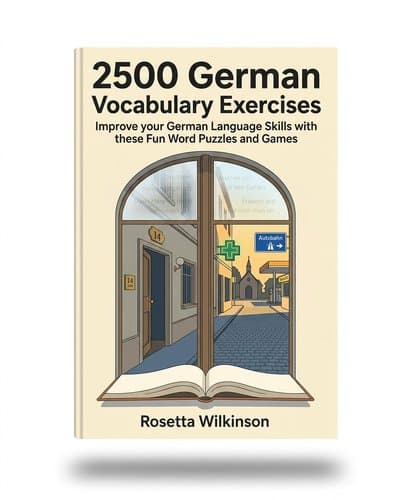
57960196_2500-german-vocabulary-exercises
by Rosetta Wilkinson
Master the tricky traps that trip up English speakers — like why "halb sechs" means 5:30, not 6:30 — through 2,500 scenario-driven exercises that give you…
In Brief
Master the tricky traps that trip up English speakers — like why "halb sechs" means 5:30, not 6:30 — through 2,500 scenario-driven exercises that give you ready-to-use German phrases for restaurants, emergencies, and everyday life before you've perfected the grammar.
Key Ideas
German Halbsechs points toward next hour
'Halbsechs' means 5:30, not 6:30. German 'half' points toward the next hour, not away from the last one. Check this before reading any German train or bus timetable — every printed schedule uses this convention.
German inverts decimal and thousands marks
German inverts the English roles of the period and comma: 15,000.75 in English is written 15.000,75 in German. The comma marks the decimal; the period marks thousands. A price tag reading '1.299,00' means 1,299 euros, not 1.29.
Always verify formal versus informal register
The book mixes formal address (Sie) and informal address (du) in the same chapters without marking the distinction. Do not use phrases verbatim with strangers until you have verified the register — several chapters switch between them in adjacent entries.
Prioritize emergency vocabulary for travel safety
For travel safety, Chapter 9 covers emergency vocabulary from medical crisis through crime through mass disaster. Read it before visiting German-speaking countries. The phrases cover both what to say and what you will hear in response.
Navigate by scenario not sequential order
Use this as a scenario-based reference, not a sequential course. Navigate by situation — restaurant, hotel, transport, emergency — rather than chapter order. The book's value is lookup speed in a real context, not structured progression.
Every exchange shown from both sides
The book consistently models both sides of exchanges: the question and the answer, the complaint and the response. This makes it more useful than single-perspective phrasebooks for understanding how a real conversation will unfold.
Who Should Read This
Readers interested in Skill Acquisition and Learning, looking for practical insights they can apply to their own lives.
2500 German Vocabulary Exercises: Improve your German Language Skills with these Fun Word Puzzles and Games
By Rosetta Wilkinson
9 min read
Why does it matter? Because you're about to buy a phrasebook with a workbook's name on the cover — and that gap changes everything about how you use it.
You open the book expecting puzzles. The title promised 2,500 of them — word games, exercises, something to solve. Page one: a German-English phrase list. Page two: another phrase list. The games never arrive. What does arrive, across seventeen chapters, turns out to be the more useful half: a dense, scenario-by-scenario phrasebook that drops you into a hotel lobby, a German emergency room, an Autobahn on-ramp, and a pharmacy counter, and hands you the exact sentences each situation demands. The title is a mismatch. The content is not. If you need German words now — for travel, for work, for the moment a stranger says something you have to answer — this book delivers them with unexpected range and cultural specificity a generic phrasebook would never include. Whether that trade is worth making depends entirely on what you were hoping to find.
The Puzzles in the Title Are the Only Puzzles You Will Find
The subtitle promises fun word puzzles and games. Open the book and you find bilingual phrase lists, chapter after chapter, format unchanged: German term, English translation, example sentence. That's what the book delivers from Chapter 1 to Chapter 17 without variation.
Chapter 1 makes the structure immediate. Article declension tables arrive first: German has four grammatical cases, and the definite article changes shape in each one. The masculine "the" alone takes four forms — "der" when it names (the man is here), "den" when it receives (I saw the man), "dem" when something goes toward it (I gave the doll to the man), "des" when it owns (I have the address of the man). Presented as a reference grid. From there, the chapter works through pronoun categories and cardinal numbers before reaching sixteen time expressions, each in the same format, each one more block of vocabulary to absorb, including a time-telling convention that reliably trips English speakers.
The chapter closes with vocabulary blocks for animals, nationalities, civil status, and careers, each with example sentences: a read-and-absorb format that repeats unchanged throughout the book.
By Chapter 17, the author has moved on from the subtitle entirely. The conclusion describes the book as covering "grammar rules and common terms" and closes with good wishes for the reader. No puzzle is mentioned. No game appears. The author's own summary of what they wrote matches the chapters accurately — and the title not at all.
The gap is worth naming because once you accept what the book actually is, a more useful question takes its place: whether a topic-organized bilingual reference, dense with vocabulary and example sentences, earns its time without the interactive mechanics it advertised. That question has an answer the cover doesn't prepare you for.
Half Six Means Five-Thirty: The Structural Traps This Book Shows Without Explaining
Start with the most common one. Say Marcus is travelling to Berlin. He has a train at seven-thirty. The hotel clerk tells him his taxi is booked for "halb acht." He knows "halb" means half. He sets a reminder for eight-thirty and misses his train.
The mistake is not vocabulary — it is direction. English "half past seven" is retrospective: thirty minutes from a completed hour. German "halb acht" is anticipatory: halfway toward an hour not yet reached. "Halb acht" is 7:30, not 8:30, because the landmark is the destination, not the departure. Every "halb" expression lands one hour earlier than an English speaker's first guess, reliably, every time.
Chapter 1 drills the pattern across sixteen worked examples without stating the rule once. "Es ist halbsechs" — half past five, 5:30. "Es ist halb acht Uhr morgens" — half past seven in the morning, 7:30. The English equivalent sits beside each entry. The forward-looking logic of "halb" is never named. You extract it from repetition. By the fourth or fifth example, the pattern is yours. No rule statement fixes it as firmly. When Marcus later sees "halb neun" on a meeting invite, he doesn't retrieve a principle about how German time works. He matches an example. That retrieval is faster.
The chapter handles the number notation difference the same way: state it once, show it once, move on. German periods and commas have swapped jobs. The thousands separator is a period; the decimal marker is a comma. English 15,000.75 is German 15.000,75. There is no English habit to lean on here. You either know this going in, or you misread every price, invoice, and bank figure you encounter. Not by a small margin: by a factor of a thousand in one direction and decimal precision in the other.
Both traps live below the level of vocabulary. Knowing the German word for "seven-thirty" does not save Marcus if he doesn't know how "halb" works. No chapter announces: here is a trap. The book never explains German to you. It shows you enough German, with enough variety and repetition, that the structural differences surface on their own.
The Book Accidentally Tells a Story About Ants
A guest checks in, takes the elevator to her floor, and finds ants in her room. Not a metaphor — the chapter actually delivers this scene, phrase by phrase, across a hotel-stay sequence that turns out to have a beginning, a complication, and a resolution nobody planned.
Chapter 7's 116 hotel phrases run through a complete stay: arrival, reservation confirmation, room selection, breakfast times, Wi-Fi password. Then, thirty-nine phrases deep into room service negotiations (the unavailable Porterhouse, the salmon substitute, the tray left outside the door), the sequence takes a turn. The guest reports that her room has many ants. The staff apologizes for the inconvenience. Someone promises to check immediately whether another room is available so she can transfer right away. The complaint is handled, resolved, and the stay continues.
Thirty-three phrases later, at checkout, the guest is asked for a rating. The answer: four stars. The reason: the stay would have been excellent, except for the ants.
The ant story is not the point. The structure underneath it is. No author assembled this as a narrative. Complaints cluster with complaints; checkout lines cluster with checkout lines. But because the topic is a hotel stay and the examples are specific rather than generic, the sequence accumulates into something a phrasebook is not supposed to be: a story with a protagonist, a problem, a resolution, and a coda. The ant complaint plants a detail in phrase 75. Phrase 108 retrieves it, thirty-three entries later, in a different section of the chapter. The book does not know it has done this.
Every exchange in the complaint sequence shows both sides. The guest reports the problem; the staff apologizes. The guest asks for a transfer; the staff promises to check availability and respond immediately. This models how a real complaint resolves: what you say, what comes back, what you say next. Memorize only the guest lines and you have half a script. The chapter gives you the full one, including the staff's phrasing at each step, so you can recognize when the exchange is going well and when it has stalled.
The hotel chapter is not the only one structured this way. Most phrasebook chapters give you vocabulary for one speaker. You get "Can I see the menu?" but not "May I take your order?" You get "I have a reservation" but not "For how many guests?" This chapter, and the food chapter before it, cover both voices throughout. The restaurant arc in Chapter 4 runs from reservation to tip, and at every turn the server's line follows the guest's. The waiter apologizes for a thirty-minute wait. The staff clarifies a billing error. Someone thanks the guest for the tip. These are phrases you need when someone speaks at you, not just when you initiate.
The ant story is the sharpest version of something the book does consistently: it models real situations with enough granularity that the exchange becomes navigable from any position in it — guest or staff, problem or resolution.
The China Cabinet Knows Something the Bush Does Not
Better safe than sorry gives you a principle. Vorsicht ist die Mutter der Porzelankiste gives you a breakable object. Same warning. Completely different world.
Chapter 15's proverb cluster makes that pattern visible across seventeen consecutive entries. "Beat around the bush" maps to Schlagen um den heißen Brei — beating around the hot porridge. "Save for a rainy day" becomes savings kept at home, sheltered until water eventually falls. English reaches for outdoors: bushes, birds, leaping, rain arriving from somewhere beyond your control. German reaches for the kitchen and the front room: porridge on the stove, crockery worth protecting, resources stored under the same roof as the person storing them. What you prepare against is outside. What you prepare with is inside. The contrast is consistent enough to notice, and once you notice it, it starts organizing everything else the book delivers.
The same specificity appears when the book leaves the front room for the road.
The signage chapter runs to 102 entries. Buried inside, between speed limit zones and pedestrian crossings, sits "Autobahn Kapelle" — a chapel built into a highway rest stop, listed beside the restaurant, the snack machine, and the restrooms. The book drops it without comment. No footnote, no cultural explanation. Just the German term, the English translation, and the next sign. That restraint is part of the point. The book gives you vocabulary. The cultural content arrives as byproduct.
A single entry. But it tells you something a phrase list isn't supposed to tell you: that the Autobahn network is large enough, and the journeys long enough, that Germany built places of worship into the infrastructure of driving. The rest stops in this system aren't quick fuel breaks. They carry petrol, food, sleep, and apparently a chapel. The Autobahn Kapelle exists because the highway was built with the assumption that people would be on it for real distances, crossing the country, needing more than a coffee and a tank of diesel. A vocabulary list of highway signs is supposed to give you words. This one gives you a picture of what kind of country the highway crosses. You learn the chapel the same way you learn rutschige Straße — slippery road — by encountering it in a list and moving on. The difference is that a slippery road is useful to know. The chapel is a window into a world where long-distance travel has its own architecture of need.
The book places these windows without announcing them. You walk through them on the way to the vocabulary.
From the Weather to Alien Encounters in Fifty Steps: What This Book Is and Is Not
The chapters do not connect to each other. That is not a flaw.
Chapter 10 teaches small talk in fifty phrases. It opens where you'd expect: phrase 1 observes that the weather is pleasant today. Phrases 3 through 5 offer three ways to ask the time, from casual to formally polite. By phrase 6, something shifts — you're asking a stranger what they'd be doing right now if they weren't at work. By phrase 19, you're asking about their television habits. By phrase 50, you're asking whether they've had an encounter with extraterrestrials.
Weather, hypothetical career reflections, entertainment preferences, alien sightings: that arc mirrors how real small talk moves. Strangers begin with the safest possible shared observation. They test slightly deeper water. They reach toward genuine personal strangeness once enough groundwork is laid. The chapter gives you fifty phrases in a social sequence. Internalize enough of them and you can carry a conversation from the first awkward pause to the kind of question that makes a stranger laugh. No grammar rule gets you there. A script for the whole interaction does.
A situational phrase reference organized around realistic arcs. Hotel stays with ants and a four-star checkout. Emergency vocabulary that escalates from feeling unwell to a building collapse to an international distress signal unchanged in either language column. Social introductions that run from first hello to "you look familiar." Each chapter maps a specific scenario, dense with vocabulary, structured by how situations actually unfold. No curriculum connects them. Open to the chapter you need; ignore everything else.
What remains is worth your time in one circumstance: you need words for a specific situation, now. Heading into a German hospital? Chapter 9. Navigating a hotel? Chapter 7. Stuck somewhere with time to kill and willing to ask a stranger about their supernatural experiences? Chapter 10, all fifty phrases. The book closes by telling you not to worry about the grammar. That applies to the book itself: stop expecting a curriculum, start treating it as a toolkit, and the mismatch disappears.
The Words Come First. The Grammar Can Follow.
The title lied to you. There are no puzzles, no games, no interactive mechanics of any kind. What is here instead: 2,500 phrases organized around seventeen scenarios you will actually encounter — hotel desks, pharmacies, traffic signs, emergency rooms, conversations that drift from weather to alien encounters. Both sides of every exchange, not just yours. Two structural traps get flagged early: halb goes toward the next hour, not away from the last one. The comma and period have swapped jobs. Know those two things before you arrive and the book has already paid for itself.
Hold it as a situational reference, not a course. Open to the chapter that matches where you are standing. The words will be there. That is less than the cover promised and more useful than you might expect.
Frequently Asked Questions
- What does 'Halbsechs' mean in German?
- 'Halbsechs' means 5:30, not 6:30. German 'half' points toward the next hour, not away from the last one. Check this before reading any German train or bus timetable — every printed schedule uses this convention. This distinction from English time references is critical for travelers, as misunderstanding could result in missed trains or appointments. Wilkinson's book emphasizes this trap because it's among the most common mistakes learners make when navigating German transportation systems. Understanding this convention early prevents costly travel mishaps.
- How are German and English numbers and prices formatted differently?
- German inverts the English roles of the period and comma: 15,000.75 in English is written 15.000,75 in German. The comma marks the decimal; the period marks thousands. A price tag reading '1.299,00' means 1,299 euros, not 1.29. This distinction is critical for avoiding major financial mistakes when shopping in German-speaking countries. Misinterpreting a price—thinking something costs 1.29 euros when it actually costs 1,299 euros—creates serious confusion. Wilkinson's book highlights this trap because it's one of the most common errors learners encounter in real-world transactions.
- Is '2500 German Vocabulary Exercises' designed as a sequential course?
- No, it's designed as a scenario-based reference tool. Use this as a scenario-based reference, not a sequential course. Navigate by situation—restaurant, hotel, transport, emergency—rather than chapter order. The book's value is lookup speed in a real context, not structured progression. This approach makes it ideal for travelers who need immediate vocabulary solutions in specific situations rather than systematic progression through all chapters. You can jump directly to the section matching your current need, whether at a restaurant, hotel, or during travel. This flexibility distinguishes it from traditional textbooks.
- Does the book cover emergency German vocabulary for travel safety?
- Yes, Chapter 9 provides comprehensive emergency coverage. For travel safety, Chapter 9 covers emergency vocabulary from medical crisis through crime through mass disaster. Read it before visiting German-speaking countries. The phrases cover both what to say and what you will hear in response. This dual-perspective approach is invaluable for travelers preparing for unexpected situations. The book models both sides of exchanges—your questions and expected responses—helping learners understand how real emergency conversations unfold. This makes it more useful than single-perspective phrasebooks for handling genuine emergencies.
Related Book Summaries

Read the full summary of 57960196_2500-german-vocabulary-exercises on InShort