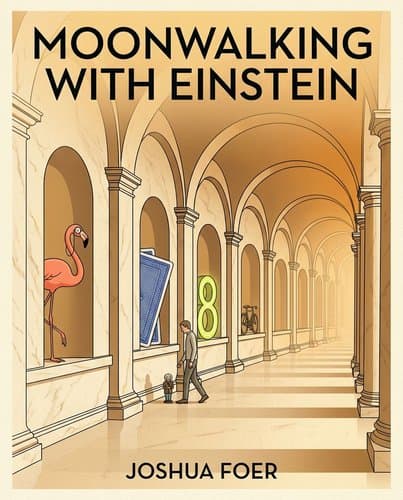
6346975_moonwalking-with-einstein
by Joshua Foer
Memory isn't a fixed talent—it's a trainable craft ancient orators mastered and modern life forgot. Follow a journalist's unlikely year competing in memory…
In Brief
Memory isn't a fixed talent—it's a trainable craft ancient orators mastered and modern life forgot. Follow a journalist's unlikely year competing in memory championships to rediscover why the images you build in your mind outlast anything you store in your phone.
Key Ideas
Spatial Images Encode Memory Durably
Build a memory palace by mentally walking through a familiar space — your childhood home, a regular commute — and placing vivid, outrageous images at specific locations to represent what you want to remember. The more absurd and sensory the image, the more durable the encoding. The technique works because your brain evolved for spatial navigation, not for abstract lists.
Background Knowledge Compounds Learning Capacity
New information only sticks when it connects to something you already know. This means broad background knowledge compounds: the more you know about a subject, the faster you can learn more about it. Reading widely isn't a luxury — it's infrastructure for future memory.
Deliberate Practice Drives Skill Growth
To improve past the 'OK plateau' in any skill, you must deliberately practice at the edges of your ability. Set targets slightly beyond your current ceiling, allow yourself to fail, and build in immediate feedback. Accumulating hours at a comfortable level is not practice — it is habit maintenance.
Novel Experiences Slow Perceived Time
Memory is the substrate of subjective time: days without novel experience compress psychologically, which is why life seems to accelerate as it grows more routine. Deliberately encoding unusual experiences — converting them into images worth filing — is one mechanism for slowing down perceived time.
Memory Training Deepens Attentional Habits
The goal of memory training is not to compete in championships. Training memory is training attention — the habit of noticing what is actually in front of you, closely enough to make it stick. That habit changes how you move through the world regardless of whether you ever memorize a deck of cards.
Who Should Read This
Science-curious readers interested in Skill Acquisition and Learning who want to go beyond the headlines.
Moonwalking with Einstein
By Joshua Foer
10 min read
Why does it matter? Because your "bad memory" is a software problem, not a hardware one — and the fix is 2,500 years old.
Most of us have quietly made peace with a bad memory. You forget names at parties, lose the car in parking garages, finish books and retain almost nothing. You've decided this is just who you are — some people have it, you don't, nothing to be done. Then Joshua Foer walks into a memory championship and discovers something that should embarrass all of us: every person in that room who can memorize hundreds of digits in minutes insists they have a completely average brain. Not false modesty. They're running ancient, learnable software that somehow fell out of the Western curriculum around the time Gutenberg showed up. This book follows Foer's absurd year training to compete among them — and the question underneath all of it: when we handed our memories off to smartphones and search engines, what exactly did we hand over with them?
The Competitors Who Memorize 252 Digits in a Row All Claim to Have Average Memories — and They're Right
In a conference room on the nineteenth floor of a Con Edison building in Manhattan, a 24-year-old Englishman named Ed Cooke finishes reciting 252 random digits — forward, without hesitation — and sets his notes down. He's wearing a loosened tie and flip-flops printed with the Union Jack. He walks with a cane because of chronic juvenile arthritis. To any observer, he looks like someone operating neurological hardware the rest of us weren't issued.
Then someone asks when he first realized he was a savant.
He laughs. "Photographic memory is a detestable myth. My memory is quite average. All of us here have average memories."
That looks like false modesty after memorizing 252 random digits. It isn't.
A neuroscientist named Eleanor Maguire put ten World Memory Championship finalists in brain scanners alongside a control group. Their brains looked the same. Their cognitive test scores came back identical. The competitors had no structural advantages, no enlarged memory regions, nothing that set their brains apart from anyone waiting outside. What differed was which circuits they activated during memorization.
When the athletes memorized new material, they lit up regions associated with spatial navigation and visual memory — the same circuits every person uses to navigate a familiar building. They hadn't built specialized memory architecture through years of training. They had learned to route information through architecture they already had.
The technique predates the Roman Empire, attributed to a Greek poet named Simonides: the memory palace. Convert abstract information into vivid images, then place those images at specific locations along a familiar mental route. When you need to retrieve them, you walk the route. The images are there. You don't inherit this ability — you learn it the way you learn to drive, starting badly and improving through repetition.
This is the inversion the book turns on. The assumption most of us carry is that extraordinary memory belongs to a type of person — that the competitors at the World Memory Championship are doing something the rest of us fundamentally cannot. The brain scans say otherwise. The hardware is standard issue. What separates Cooke from the rest of us isn't his brain. It's a technique anyone can learn, on architecture that comes standard.
The Reason You Remember a Face but Forget a Name Is Also Exactly Why Memory Palaces Work
To understand what that infrastructure is actually made of, start with a failure everyone recognizes. Why can you look at someone across a room and know immediately that you've met — but draw a complete blank on their name? The answer is the same thing that makes memory palaces work.
A researcher shows two different people the same photograph and gives each a single fact. The first is told the man is a baker. The second is told his surname is Baker. A few days later, the researcher shows the photo again. The person who learned the profession remembers it. The person who learned the name usually doesn't. Same face. Same word. Different outcome every time.
The reason: "Baker" as a surname attaches only to a face, a single fragile thread. "Baker" as a profession pulls in everything you've ever associated with baking: flour, white hats, the smell of warm bread on a morning walk. When you try to retrieve the profession, a dozen paths lead back to it. When the single thread holding the surname snaps, there's nowhere else to go.
Memory is a web of associations. New information holds when it can attach to something already there; it vanishes when it can't. The richer the connections, the more retrieval paths you have. The surname "Baker" has one. The profession has many.
Tip-of-the-tongue moments are the same thing in miniature: that maddening sensation of knowing you know something without being able to produce it. You're accessing the part of the neural network that holds a memory without reaching the node that contains the word itself.
Now consider where those associative webs come from.
The human brain evolved over roughly 1.8 million years of hunting and gathering, not sitting in lectures or memorizing login credentials. What memory was built for was navigating terrain, recognizing which plants were edible, and finding the route home. Spatial information and vivid visual scenes are the formats it runs on. Wander through an unfamiliar house for five minutes and you leave having absorbed hundreds of spatial details without trying: you weren't fighting your biology. You were using it.
Memory palaces work for the same reason the profession "baker" sticks when the surname doesn't. They take abstract information (a list, a sequence of digits, a deck of cards) and force it into a format that comes pre-loaded with associations. Each item becomes a vivid image dropped at a specific location along a familiar mental route. The brain doesn't process this as isolated data. It treats it as something that happened somewhere, attached to everything else that lives in that space. When you retrace the route, the images are waiting.
The technique matches the architecture. That's why it works.
Memory Training Didn't Disappear Because It Failed — It Disappeared Because Books Made It Seem Unnecessary
Think of GPS navigation. Nobody decided to stop memorizing routes. Street maps just gradually stopped feeling urgent once phones could do it — and by the time anyone noticed, nobody under thirty could navigate across town without the blue line. Memory training followed the same path, over a much longer stretch of time.
The clearest evidence of where that path began is ancient Greek text itself. Before roughly the ninth century, written words ran together with no spaces, no punctuation, all capitals: GODISNOWHERE. Scholars call this scriptio continua, and it meant you could not simply pick up a text and read it. Parsing an unbroken string of letters into words required knowing the words in advance. The Greek term for "to read," ánagignósko, literally meant "to know again." Reading was an act of recollection, not retrieval. The scroll wasn't the thing you consulted; it was the thing that helped you reconstruct what was already inside you.
In that world, memory training wasn't self-improvement. It was literacy.
What changed wasn't any single invention but a long accumulation of them: punctuation, spaces between words, the codex (pages bound at the spine, which let you skip around rather than unrolling everything to find one line), and eventually the index. When five hundred Parisian monks spent years compiling the first Bible concordance in the thirteenth century, a reader could find a specific passage without having memorized the whole text. The index gave books the same associative, random-access quality that internal memory already had. And slowly, the need to internalize texts dissolved.
Within a century of Gutenberg, Europe had fourteen times as many books. The shift was irreversible. Where people had once read a few texts intensively — returning to them repeatedly until the words were genuinely theirs — they could now read broadly, shallowly, and forget almost everything they encountered. Foer admits he can recall almost nothing of One Hundred Years of Solitude. That isn't a personal failure. It's the natural result of reading in a world built for looking things up rather than holding them in.
Memory training didn't lose to a better competitor. It retired because the problem it solved was quietly solved for it, one invention at a time.
EP Scores 103 on an IQ Test and Has Never Heard of JFK: What Total Memory Loss Reveals About the Self
EP sits across a dining room table from a researcher, and for the first twenty minutes he's clearly annoyed. She asks him what continent Brazil is on. The boiling point of water. The number of weeks in a year. He answers every one correctly, shooting sidelong glances that say: do these people think I'm an idiot?
Then she asks about the last president. He goes quiet for a moment. "I'm afraid it's slipped my mind." When prompted with the name Bill Clinton, his face brightens — "Of course I know Clinton! An old friend of mine, a scientist, a good guy. I worked with him." He catches her expression and pulls back: "Unless there's another Clinton you're thinking of?"
There is. EP's IQ tests at 103. His short-term memory is completely undamaged. He can tell you the boiling point of water and immediately fail to place the most famous name in recent American political history. The last president he can recall on his own is Franklin Roosevelt. He has never heard of John F. Kennedy. He believes gas costs a quarter a gallon. He is 84 years old and estimates his age at somewhere around 59.
In 1992, herpes simplex encephalitis hollowed out both hippocampal regions of his brain. Without that structure, experience cannot harden into long-term memory. He sees, but doesn't record. His reasoning, language, and personality are fully intact — but the tape stopped rolling over three decades ago.
You might read this as cognitive tragedy: a man who can't remember what he had for breakfast. But EP's wife Beverly points to something much worse. "There's nothing wrong with him in his mind," she says, watching him from across the room. "But underneath, he must know. He just must." She lives with him and can no longer access his basic emotions. His daughter says he is happy all the time — no stress, no worry. She calls it a kind of accidental sainthood. A blessing she would never wish on him. The result is a life his own family cannot reach.
Memory, it turns out, is not a utility for storing names and appointments. It is how a person exists in time: the link between who you were yesterday and who you are today, a story that can be offered to another person. Without it, EP feels things moment to moment but cannot compare today's feelings to yesterday's, cannot tell a coherent story about himself, cannot sustain a conversation that outlasts his attention span. A meaningful relationship cannot exist only in the present tense.
The memory palaces and the Baker/baker trick from earlier chapters looked like clever workarounds for a practical inconvenience. EP shows what they are actually defending.
The Fastest Way to Stop Improving at Something Is to Keep Practicing the Same Way
EP's hippocampus was gone. Foer's question was different: whether someone with a working brain could be trained to use it better, and what that required.
Practice makes you better only if the practice keeps failing you.
The clearest proof comes from an unexpected place: diagnostic radiology. You'd assume a radiologist with twenty years of reading mammograms would catch more cancer than one fresh out of residency. Studies have found the opposite. The longer mammographers practice, the less accurate their diagnoses tend to become. The reason isn't burnout. It's the feedback loop. When a mammographer reads a scan, she won't know if she was right for weeks or months, sometimes never, by which point the specific case is long forgotten. Without a closing loop, there's no mechanism to learn from mistakes. She reads thousands of scans and gets worse, not from doing less work but from doing the same work in the same way, repeatedly.
Surgeons follow the opposite trajectory and for the opposite reason. A surgery's outcome lands quickly — the patient recovers or they don't, and the surgeon sees it. This immediate feedback pulls the surgeon back out of autopilot and forces ongoing conscious engagement with technique. Same hospital, same training pipeline, completely opposite trajectories. The variable isn't talent or dedication. It's whether the feedback loop closes.
Psychologists have a name for this pattern: the OK plateau. As a skill becomes habitual, the brain's conscious-reasoning regions go quiet and the task runs on automation; you can watch it happen in a scanner. Most people call this "as good as I can get." It's actually a choice, made without noticing. The way past it is to engineer deliberate failures: set targets slightly above what you can currently do, make errors on purpose, and let each mistake tell you something rather than convince you you're done.
Foer won the U.S. Memory Championship. His digit span doubled from nine to eighteen over a year of training. Then, a few nights after the World Memory Championship, he went to dinner with friends, took the subway home, and only remembered at his front door that he'd driven a car to the restaurant. Not just where he'd parked it — the car itself. The techniques worked on exactly the kind of structured material they were built for: sequences that could be converted to images and dropped along a mental route. Daily life mostly arrives in a different format.
What training actually gave him, he says, was something harder to measure: the habit of attention. You can only remember what you first decide to notice. Improving your memory turns out to mean improving your willingness to be present — which has nothing to do with memory palaces, and everything to do with them.
What the Memory Palace Was Always Really For
You can only remember what you first decide to notice.
The memory palace persists not because it is the most efficient filing system ever devised, but because you cannot build one without first deciding that something is worth placing inside it. That decision — to look closely enough at experience to convert it into an image worth keeping — is rarer than it sounds. Most of what passes in front of you today will be gone by tonight, not because your hippocampus is broken but because you never quite arrived in the first place.
Someone like EP cannot compound yesterday into wisdom. You can. The question is whether you choose to — which turns out to be a question about attention, not about memory at all.
Notable Quotes
“Oh, I'm not a savant,”
“Photographic memory is a detestable myth,”
“Doesn't exist. In fact, my memory is quite average. All of us here have average memories.”
Frequently Asked Questions
- What is the memory palace technique and how does it work?
- The memory palace is an ancient mnemonic technique for remembering information. You mentally walk through a familiar space—your childhood home or regular commute—and place vivid, outrageous images at specific locations to represent what you want to remember. The more absurd and sensory the image, the more durable the encoding. This works because your brain evolved for spatial navigation rather than abstract lists, making spatial memory far more reliable than rote memorization.
- What are the key takeaways from Moonwalking with Einstein?
- "Memory is a learnable skill, not a fixed trait." The book teaches that "new information only sticks when it connects to something you already know," meaning broad background knowledge provides infrastructure for future learning. To improve any skill, you must deliberately practice at the edges of your ability, set targets beyond your current ceiling, and allow failure. Finally, the real goal is training attention—"noticing what is actually in front of you"—which changes how you experience your entire life.
- Why does deliberate practice matter more than accumulated hours?
- To improve past what Joshua Foer calls the "OK plateau" in any skill, you must deliberately practice at the edges of your ability. Setting targets slightly beyond your current ceiling, allowing failure, and building in immediate feedback separates real progress from habit maintenance. Simply accumulating hours at a comfortable level doesn't build skill—it just reinforces existing patterns. This distinction explains why professional experts aren't those with the most practice hours, but those practicing with intentional difficulty.
- How does memory training affect your experience of time?
- "Memory is the substrate of subjective time." Days without novel experience compress psychologically, which is why "life seems to accelerate as it grows more routine." By deliberately encoding unusual experiences—"converting them into images worth filing"—you can slow your subjective experience of time. This mechanism reveals that memory training isn't just about recall; it's about deepening attention and presence, making daily life feel richer and slower regardless of competitive achievements.
Related Book Summaries
Read the full summary of 6346975_moonwalking-with-einstein on InShort